BIOCHEMISTRY in Questions and Answers - Alimov A.M. - 2016
SECTION 6. CARBOHYDRATE METABOLISM
Question 1. What are CARBOHYDRATES?
Answer: Carbohydrates are polyhydroxy aldehydes and polyhydroxy ketones. They range from low-molecular-weight compounds containing only a few carbon atoms to substances with molecular weights reaching several million.
Question 2. What are Monosaccharides?
Answer. Carbohydrates that cannot be hydrolyzed into simpler forms, meaning they contain only a single polyhydroxy aldehyde or polyhydroxy ketone structural unit. For example,
Class="center">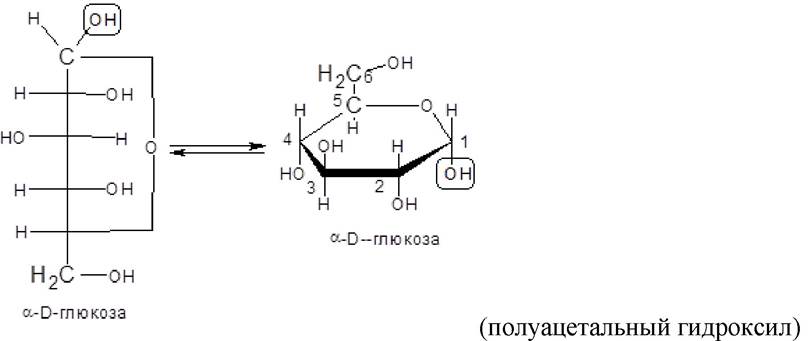
Question 3. What are Oligosaccharides?
Answer: Upon Hydrolysis, oligosaccharides yield 2 to 10 monosaccharide molecules linked by covalent bonds. Examples include maltose, lactose, and sucrose.
Question 4. What are Polysaccharides?
Answer: Polysaccharides are long chains formed by hundreds or thousands of monosaccharide units. Examples include starch, Glycogen, and Cellulose.
Question 5. What is meant by aldoses?
Answer: If the carbonyl group is located at the end of the carbon chain, the monosaccharide is an aldose.
Question 6. What is meant by ketoses?
Answer: If the carbonyl group is located at any other position, the monosaccharide is a ketone and is termed a ketose.
Question 7. Which monosaccharide residues make up a maltose molecule?
Answer: Maltose consists of two residues of α-D-glucose and β-D-galactose linked by an α (1 —> 4)-glycosidic bond.
Question 8. Which monosaccharide residues make up a lactose molecule?
Answer: Lactose consists of molecules of α-D-glucose and β-D-galactose linked by a β (1 —> 4)-glycosidic bond.
Question 9. Which monosaccharide residues make up a sucrose molecule?
Answer: Sucrose consists of molecules of β-D-fructose and α-D-glucose linked by an α1 —> β2-glycosidic bond.
Question 10. How is the starch molecule structured?
Answer: A starch molecule consists of an unbranched helical Structure of amylose (10-30%) and amylopectin (70-90%), which is formed by branched chains.
Question 11. What types of bonds link the a-D-glucose residues together in amylopectin?
Answer: α (1 —> 4)- and α (1 —> 6)-glycosidic bonds.
Question 12. What is the difference between amylase and cellulose?
Answer. In starch, α-D-glucose residues are linked by α (1 —> 4)-glycosidic bonds, whereas in cellulose, β-D-glucose residues are connected by β (1 —> 4)-glycosidic bonds.
Question 13. Why is cellulose not utilized in the Human and Animal body?
Answer: Only monosaccharides are absorbed in the Small Intestine. The gastrointestinal tract of humans and animals lacks the enzyme required to cleave the β (1 —> 4)-glycosidic bond in cellulose; therefore, cellulose cannot be utilized by the Organism.
Question 14. What are dextrins?
Answer: Products of the partial Hydrolysis of Starch.
Question 15. What is glycogen?
Answer: Glycogen is an animal homopolysaccharide composed of α-D-glucose residues linked by α (1 —> 4)- and α (1 —> 6)-glycosidic bonds. It is more branched compared to starch, with branch points occurring approximately every 8–10 glucose residues.
Question 16. What glycosaminoglycans (mucopolysaccharides) exist?
Answer: Hyaluronic acid, heparin, chondroitin sulfates, and dermatan sulfates.
Question 17. What is the Biological Role of hyaluronic acid?
Answer: Hyaluronic acid binds Water, fills the extracellular space, and acts as a cushioning and lubricating agent.
Question 18. What are the repeating disaccharide units of hyaluronic acid composed of?
Answer. β-D-glucuronic acid and N-acetyl-D-glucosamine residues.
Question 19. What is heparin?
Answer: A heteropolysaccharide found in the vascular endothelium that acts as an anticoagulant.
Question 20. Which Enzymes are responsible for carbohydrate Digestion?
Answer. Carbohydrate digestion is carried out by amylase, cellulase, maltase, sucrase, lactase, and cellobiase.
Question 21. What is the Biological Role of Carbohydrates in humans and animals?
Ответ: In humans and animals, carbohydrates serve as a source of chemical energy, perform structural and protective Functions, act as a basis for The Biosynthesis of Biopolymers (such as Nucleic Acids and complex Proteins), are components of high-energy compounds, and form part of plant Cell structures.
Question 22. Which polysaccharides are found in human and animal Tissues?
Answer: Human and animal tissues contain glycogen, mucopolysaccharides, hyaluronic acid, and heparin.
Question 23. What are the PATHWAYS OF GLUCOSE utilization within The Cell?
Answer: 1. Aerobic degradation
2. Glycolysis
3. Glycogen synthesis
5. Synthesis of non-Essential Amino Acids
6. Lipid synthesis
Question 24. What is called Glycogenolysis?
Answer. Glycogenolysis is the anaerobic oxidation of glucose starting from glycogen and ending with The formation of lactic acid
Question 25. What is glycolysis?
Answer: Glycolysis is a multi-step biochemical process of glucose breakdown under anaerobic conditions into two molecules of lactic acid (lactate), comprising twelve main stages
Question 26. What is glycolytic oxidoreductase system?
Answer: This is a set of two redox reactions of glycolysis that ensure the regeneration of NAD+ in the Cytosol under anaerobic conditions and the synthesis of ATP via substrate-level phosphorylation
Question 27. Which enzymes are key in glycolysis?
Answer: Hexokinase, Phosphofructokinase, Pyruvate kinase
Question 28. Where does glycolysis take place and what is its significance?
Answer: Glycolysis takes place in the cytosol of Cells in many tissues and serves as an energy source for heavily working Muscle during the initial period
Question 29. How many ATP molecules are formed in glycolysis under anaerobic conditions? Describe the overall reaction of glycolysis.
Answer: 2 ATP molecules.
С6Н12О6 + 2 АДФ + 2 Н3РО4 —> 2 С3Н6О3 + 2 АТФ + 2 Н2О
Question 30. What function does the malate-aspartate shuttle mechanism perform?
Answer: It facilitates the regeneration of NAD+ in the cytosol under aerobic conditions and supplies reducing equivalents to the Respiratory Chain
Question 31. Where does The oxidative decarboxylation of pyruvic acid take place and what is produced?
Answer: In the mitochondrial matrix, decarboxylation of pyruvate occurs, accompanied by its oxidation and the Formation of Acetyl-CoA
Question 32. Which enzymes are included in the pyruvate dehydrogenase complex?
Answer: 1. Pyruvate dehydrogenase
2. Dihydrolipoyl transacetylase
3. Dihydrolipoyl dehydrogenase
Question 33. Which Coenzymes are involved in the Oxidative Decarboxylation of pyruvic acid?
Answer: 1. Thiamine diphosphate (vitamin B1)
2. Lipoic Acid
3. Coenzyme A (pantothenic acid)
4. FAD (vitamin B2)
5. NAD+ (Vitamin PP)
Question 34. In which Cells and Tissues is lactate (lactic acid) produced?
Answer. In erythrocytes and Skeletal Muscle under hypoxic conditions
Question 35. What is the Biological Significance of The pentose phosphate pathway?
Answer: 1. Generation of NADPH for the synthesis of Fatty acids and Steroids
2. Provision of ribose-5-phosphate for nucleotide synthesis
3. Interconversion of monosaccharides with different numbers of carbon atoms
Question 36. In which tissues are the Reactions of the pentose phosphate pathway most active?
Answer: In the erythrocyte cytosol, adrenal cortex, Liver, Gonads, adipose tissue, and Thyroid Gland
Question 37. What are the two Phases of the pentose phosphate pathway?
Answer. 1. The oxidative phase, which results in the formation of ribulose-5-phosphate
2. The non-oxidative phase, in which 6 molecules of ribulose-5-phosphate are converted back into 5 molecules of glucose-6-phosphate
Question 38. Deficiency of which enzyme is accompanied by erythrocyte hemolysis?
Answer: Glucose-6-phosphate dehydrogenase
Question 39. Which enzymes are involved in glycogen synthesis?
Answer: Hexokinase, phosphoglucomutase, glucose-1-phosphate uridylyltransferase, glycogen synthase, branching enzyme
Question 40. Which enzymes are involved in intracellular glycogen degradation?
Answer: Glycogen phosphorylase, phosphoglycolipase, lysosomal amylases
Question 41. Which glycogen store serves as the source of Blood glucose?
Answer: Liver and Kidney glycogen
Question 42. Which enzymes are key in Glycogen METABOLISM?
Answer: Glycogen phosphorylase and glycogen synthase
Question 43. How is glycogen phosphorylase activated?
Answer. By phosphorylation and the binding of adenosine monophosphate to the allosteric site of the dephosphorylated enzyme
Question 44. How is glycogen synthase activated?
Answer. By dephosphorylation and the binding of glucose-6-phosphate to the allosteric site of the phosphorylated enzyme
Question 45. What is Gluconeogenesis?
Answer: Gluconeogenesis is The process of glucose synthesis from non-carbohydrate precursors
Substrates for gluconeogenesis include: glucogenic amino acids, lactate, and glycerol
Question 46. In which Organs does gluconeogenesis occur most intensively?
Answer: In The Liver and Kidneys, which contain the complete set of required enzymes
Question 47. Which reactions drive gluconeogenesis?
Answer: Reversible reactions of glycolysis
Question 48. Which enzymes catalyze the irreversible reactions of glycolysis?
Answer: 1. Hexokinase
2. Phosphofructokinase
3. Pyruvate kinase
Question 49. Which enzymes bypass the irreversible reactions of glycolysis?
Answer: Pyruvate carboxylase, phosphoenolpyruvate carboxykinase, fructose-1,6-bisphosphatase, glucose-6-phosphatase
Question 50. Which enzymes are involved in The conversion of galactose to glucose?
Answer: Galactokinase, galactose-1-phosphate uridylyltransferase
Question 51. What is galactosemia?
Answer: A condition characterized by elevated concentrations of galactose in the blood and tissues due to a hereditary deficiency, primarily of galactose-1-phosphate uridylyltransferase
Question 52. What is fructosuria?
Answer. Fructosuria is the presence of fructose in the urine due to the Congenital absence of fructokinase or fructose-1-phosphate aldolase, which are involved in Fructose Metabolism
Question 53. What causes diabetic cataract?
Answer: Accumulation of sorbitol and fructose in the lens of the eye
Question 54. What method is used to determine blood serum glucose?
Answer: The glucose oxidase method, which is based on The oxidation of glucose to gluconic acid
Question 55. What is the normal Blood Glucose Level in humans, cattle, and pigs?
Answer: 3.3-5.5 mmol/L, 2.50-3.88, and 4.70-5.20, respectively.
Question 56. Under what conditions does blood glucose concentration decrease?
Answer: 1. Insulin overdose during the Treatment of Diabetes Mellitus
2. Hypothyroidism
3. Addison's disease
Question 57. Under what conditions does blood glucose levels increase?
Answer: 1. Diabetes mellitus
2. Thyrotoxicosis
3. Increased release of adrenaline into the blood
Answer: Glucagon, adrenaline, thyroxine, glucocorticoids
Question 59. Which hormone lowers blood glucose levels?
Answer. Insulin
Question 60. Why can insulin not be taken per os?
Answer: Insulin is a low-molecular-weight protein that is hydrolyzed into amino acids in the gastrointestinal tract, thereby losing its activity
Question 61. What are the symptoms of diabetes mellitus?
Answer: Diabetes mellitus is a condition characterized by:
1. Hyperglycemia – elevated blood glucose levels
2. Glucosuria – presence of glucose in the urine
3. Polyphagia – excessive food intake
4. Polyuria – increased urine output
5. Polydipsia – excessive thirst and consumption of large amounts of water
6. Ketonemia – elevated ketone body levels in the blood
7. Ketonuria – the presence of Ketone Bodies in the urine
8. Metabolic acidosis
Question 62. What is diabetes insipidus?
Answer: It is a disorder associated with vasopressin deficiency, in which a patient produces up to 30 liters of urine per day while blood glucose levels remain within the normal range
Question 63. How does the urine composition of starving individuals differ from that of patients with diabetes mellitus?
Answer: Patients with diabetes mellitus have glucose and ketone bodies in their urine, whereas fasting individuals have only ketone bodies
Question 64. WHAT IS A decreased blood glucose level called?
Answer. Hypoglycemia.
Question 65. What is the condition characterized by elevated blood glucose levels called?
Answer: Hyperglycemia.
Question 66. When is hypoglycemia observed?
Answer: In liver diseases, excessive insulin concentrations, pancreatic disorders, decreased glucose synthesis, etc.
Question 67. Which carbohydrate-digesting enzymes are secreted by the Pancreas?
Answer: Amylase
Question 68. Which carbohydrate-digesting enzymes are secreted by the mucosal Cells of the small intestine?
Answer: Sucrase, lactase, maltase, isomaltase
Question 69. What is the physiological significance of glycolysis?
Answer: Glycolysis meets the energy demands of skeletal Muscles at the onset of intense exercise, becomes activated in The Heart muscle during Circulatory Disorders and Hypoxia, and serves as the primary energy source for erythrocyte metabolism
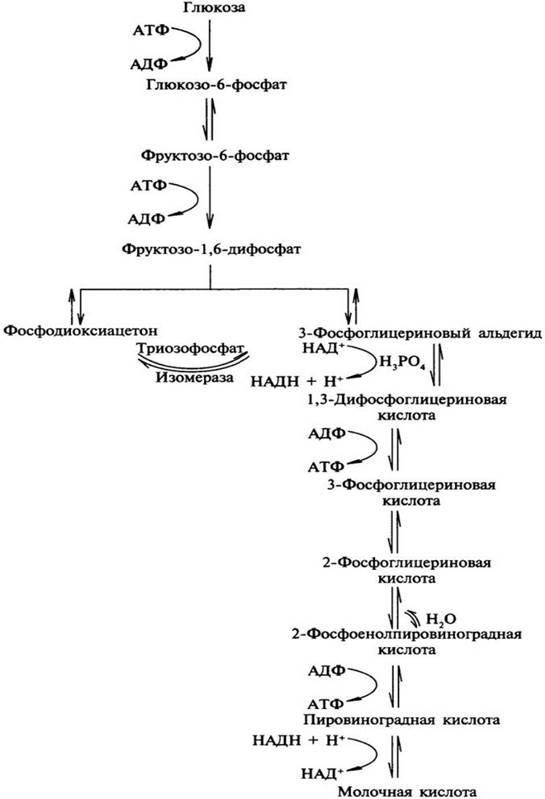
Question 70. Describe the general pathway of Glucose Catabolism
Answer:
Last update: 06/08/2026
Editorial and Educational Adaptation: This material has been compiled based on the primary/original source text. The project team performed an editorial review, corrected technical inaccuracies, structured sections, and adapted the content for an educational format.
What was processed:
- elimination of formatting defects (OCR errors, structural breaks, corrupted characters);
- editorial organization of content;
- standardization of terminology in accordance with academic sources;
- verification of factual statements against the original source text.
All mentions of the author, publication year, and origin of the primary text have been preserved in accordance with the source.