BOTANY: Lecture Course for Bachelor Students Majoring in Agronomy - 2016
LECTURE 3. Plant Cell Metabolic Products
The Vacuolar System. Cytology/cytology/67.html">Development and Structure. Role in cellular activity. Cell sap and its chemical composition: Organic compounds, Inorganic Compounds. Physiologically active substances. Enzymes. Phytohormones. Vitamins. Antibiotics. Phytoncides. Metabolic and storage products. CARBOHYDRATES. Lipids. Fatty oils. Cutin. Suberin. Waxes. Phospholipids. Structural and storage Proteins. Amino Acids. Polypeptides. Toxic substances. Cell wall. Origin, physical properties, chemical composition, and Functions. Significance of the cell wall.
Vacuoles (from Lat. vacuus - empty) are cavities in the Cytoplasm filled with a liquid content known as cell sap. During growth, small vacuoles fuse and increase in size, eventually occupying most of The Cell volume (up to 90%). The vacuole is bounded by the tonoplast, which is the internal cytoplasmic membrane.
The number and size of vacuoles in a cell change as it ages. Young Cells contain many small vacuoles called provacuoles. They appear as microvesicles pinching off from The Endoplasmic reticulum. As cell sap accumulates, provacuoles increase in size and fuse with one another. In Aging cells, vacuoles merge into a single central vacuole that pushes the protoplast to the periphery of the cell. Water enters the vacuole through the tonoplast via osmosis, driven by the higher concentration of solutes in the cell sap. Substances are transported into the vacuole via Active Transport or in membrane vesicles, which are most often derivatives of the Golgi apparatus.
Functions of vacuoles:
- by maintaining the cell in a turgid state, they provide structural support together with The cell wall;
- they contain hydrolytic enzymes that break down complex compounds;
- vacuoles accumulate and store specific substances.
Among these are nutrient reserves. For instance, the vacuoles in bean and pea seeds contain large amounts of proteins. When the seeds germinate, these proteins are broken down by enzymes, and the Amino acids are transported across the tonoplast into the cytoplasm. Vacuoles can also store pigments, such as anthocyanins, notably in petals to attract pollinators. These Organelles may also contain unpalatable or toxic substances, such as Alkaloids or Glycosides, which deter animals and protect plants from being eaten.
The chemical composition can vary: water containing various dissolved or colloidal substances (salts, sugars, organic acids, soluble compounds, proteins, lipids, Phenolic Compounds (anthocyanin and anthochlor), Tannins, alkaloids). The concentration of the cell sap ranges from 0.4 to 0.6 M; among the minerals, Na+, K+, Mg2+, Cl-, SO42-, and PO43- ions predominate. When concentration increases due to dehydration (e.g., seed maturation), substances crystallize.
Water enters the vacuole across the tonoplast via osmosis, driven by the high concentration of the cell sap solution. Substances are transported into the vacuole via active transport or via Golgi membrane vesicles.
Cell sap pigments color the fluid in bright shades of red, violet, blue, or yellow. The most common compounds are glycoside-type pigments, namely anthocyanins and anthochlors.
Anthocyanins determine the violet and red colors of fruits such as cherries, plums, and strawberries, as well as ROOT crops like beets and radishes. Anthocyanins change color depending on the pH of the cell sap: in an alkaline reaction, they turn blue or light blue; in a neutral environment, violet; and in an acidic environment, pink. The cell sap can also change color reflecting the physiological state of the plants: corollas in the Boraginaceae family are pink or red before pollination, and turn blue or light blue after pollination.
Their presence enhances Light absorption efficiency by utilizing PARTS OF THE spectrum that METABOLISM/14.html">Chloroplasts do not absorb, and raises tissue Temperature, which protects the plant from the Adverse effects of low temperatures.
Anthochlors are yellow pigments (found in the flowers of lotus corniculatus, toadflax, and dahlias) that serve to attract pollinators and aid in seed dispersal.
Functions:
1. Supportive - they maintain the cell in a turgid state, functioning together with the cell wall to provide structural support.
2. Storage - they accumulate substances (nutrient reserves in seed cells that attract animals for pollination and dispersal through consumption, or toxic alkaloids and glycosides that deter animals and protect the plant from being eaten).
3. Breakdown of polymers and complex substances into monomers or simpler components due to the hydrolytic enzymes they contain.
Inclusions are structurally defined solid substances or liquids that can accumulate in the cytoplasmic matrix, organelles, vacuoles, or cell wall in an amorphous or crystalline state. These include nutrient reserves, minerals, and organic compounds (resins, tannins, Gums, rubber, alkaloids). Reserve substances include proteins, lipids, and carbohydrates.
Carbohydrates. Starch (С6Н12О6) is synthesized in chloroplasts during Photosynthesis (primary starch) and is stored in Plastids as long as carbohydrate residues remain in the cell. It undergoes enzymatic conversion into glucose, which is transported from the leaf to nourish tissue Organs or for storage. Storage starch is formed in leucoplasts as starch grains. A single plastid may contain one or several starch grains that remain separate (simple starch grains) or form a compound starch grain. A starch grain forms around a central hilum by the deposition of successive layers. Uniform layer deposition forms concentric starch grains (such as in wheat grains), while uneven deposition forms eccentric starch grains (in potato tubers).
They are most abundant in seeds, tubers, rhizomes, bulbs, and the parenchyma of secondary vascular bundles.
Proteins occur as amorphous or crystalline deposits. Amorphous protein forms shapeless masses. Crystalline protein exhibits The properties of both crystals and colloids, and is therefore called a crystalloid (such as gluten in wheat grains associated with starch). The endosperm contains aleurone grains, which form during seed maturation. During this process, cell vacuoles dry out, lose water, and protein substances crystallize along with mineral salts. A mature aleurone grain consists of a protein membrane, a protein body (crystalloid), and small crystalline inclusions of mineral salts containing phosphorus, known as globoids (forming complex aleurone grains). Upon seed germination, proteins and globoids dissolve in water.
In simple aleurone grains, the protein appears as an amorphous mass (in legumes and corn). Storage proteins are found in The Nucleus, plastids, Mitochondria, and the ER.
Fats and fat-like substances. The term "fats" is used for esters of Fatty acids and glycerol, as well as similar substances grouped together as lipids. Fatty oils are considered liquid fats. Substances similar to fats include waxes, suberin, and cutin (found in cell walls and epidermis, serving a protective function), as well as phosphatides and stearins.
They are located in seeds, spores, embryos, and meristematic cells. They can exist in a liquid state (droplets of various sizes within the cytoplasm) or a solid state, and originate in the cytoplasm or leucoplasts.
Essential Oils are volatile aromatic substances (found in all Tissues of conifers, in the petals and fruit peels of citrus plants like oranges, in the bark and leaves of the cinnamon tree, and in nutmeg seeds).
Mineral salts in the form of nitric acid salts (nitrates) are found in stinging nettle, redroot pigweed, shepherd's purse, sunflower, potato, and bean; phosphoric acid salts (phosphates) in petioles and leaves of horse sorrel, rhubarb, and garlic; and Hydrochloric acid salts (chlorides) in plants of arid habitats, etc.
Organic acids occur in the form of salts or in a free state (oxalic, tartaric, malic, and citric acids). They are found in fruits (lemons, currants, apples, grapes). Their concentration changes during ripening, and they play a significant role in Human Nutrition.
Crystals. Mineral Substances are deposited as calcium salts (mono- and trihydrate salts forming crystal sand, octahedrons, rhombohedrons) or silicon oxides. They can form druses and spherites, as well as elongated styloids grouped into bundles known as raphides.
They are found in the vacuoles or cytoplasm of ordinary cells or specialized cells (idioblasts).
Physiologically active substances are produced by the cytoplasm and other cell organelles. Having lost their direct connection with the protoplast, they retain their activity even if the cell is destroyed.
I. Enzymes (enzymes, E) are cellular catalysts of biochemical reactions that accelerate The rate of biochemical reactions by hundreds and thousands of times. Discovered in 1819 by the Russian scientist K. Kirchhoff, there are currently about 2,000 known enzymes. The structural basis of an enzyme consists of proteins combined with a non-protein moiety (vitamins, metals, etc.). All biochemical processes occur sequentially, with each specific reaction catalyzed by its corresponding enzyme.
Classification of Enzymes:
1. Hydrolases catalyze the Cleavage of complex organic compounds into simpler ones with the participation of water (proteases catalyze the breakdown and synthesis of proteins, lipases of fats, and Phosphatases of phosphoric acid esters).
2. Lyases catalyze non-hydrolytic cleavage reactions resulting in The formation of double bonds.
3. Oxidoreductases are oxidation-reduction enzymes involved in Respiration and Fermentation reactions (oxidoreductases, dehydrogenases).
4. Transferases catalyze The transfer of molecules and atomic groups from one compound to another (such as phosphoric acid residues, Monosaccharides, and amino acids).
5. Isomerases catalyze The conversion of organic compounds into their isomers through intramolecular rearrangement of atoms.
6. Ligases catalyze the synthesis of complex organic compounds from simpler ones. The action of enzymes is utilized in numerous technological processes across various industries, including winemaking and ensilage.
II. Vitamins are physiologically active substances with diverse physiological effects. They act as Coenzymes, without which the interaction between an enzyme and its substrate cannot occur. Synthesized exclusively by plants, there are about 40 known vitamins, which are divided into water-soluble (accumulating in cell sap) and fat-soluble (accumulating in the cytoplasm).
III. Phytohormones are organic compounds—Hormones produced by the protoplast of plant cells. They regulate cell growth, development, and reproduction. Their action is indirect, mediated through changes in metabolism. Produced in SHOOT apices, they are transported to other parts of the plant to regulate physiological processes.
Classification:
Auxins (bind to cytoplasmic proteins, causing longitudinal cell elongation by softening the cell wall);
Cytokinins stimulate Cell Division and accelerate seed germination;
Gibberellins stimulate Plant Growth and accelerate seed germination.
Phytohormones also include growth inhibitors (which suppress the action of growth-promoting substances).
IV. Phytoncides are a complex of organic compounds possessing bactericidal, antifungal, and protistocidal properties.
Function: They regulate the microbial flora of the air and maintain the Stability of the biological environment. They are used to produce antibiotics applied in medical practice and agriculture. They act against the pathogens of dysentery, cholera, tuberculosis, gas gangrene, typhoid fever, and the Influenza virus.
The cell wall is a metabolic product of the cytoplasm. Its functions include protecting the cell contents from damage, providing a specific shape, participating in the uptake and Transport of substances, Transpiration, and excreting substances from the cell.
Typically, the cell wall is colorless, transparent, and readily permeable to sunlight; it facilitates the Movement of water containing dissolved low-molecular-weight substances.
When the cell protoplast dies, the cell walls often remain intact, allowing the cells to continue performing various functions.
It consists of the middle lamella, primary wall, and secondary wall. The cell wall features pits, perforations, and plasmodesmata.
The middle lamella is an amorphous intercellular layer located between the primary walls of adjacent cells. It is the first layer formed during cell division and consists of pectic Polysaccharides, which can be extracted with water upon prolonged boiling.
The primary wall is deposited from the inside of the cell onto the middle lamella. It is capable of growth and thickening. Its main constituent is Cellulose (C6H12O6)n, the chains of which lie parallel to one another and group together in clusters of several dozen to form a three-dimensional lattice—micelles, each comprising about 100 cellulose molecules. Micelles group into microfibrils, and the latter into fibrils, which are visible under a Light Microscope. These polymolecular fibers, or microfibrils, are embedded in a polysaccharide matrix whose primary component is pectin. Microfibrils are both elastic and highly tensile.
The secondary wall consists of additional layers deposited on the inner side of the primary wall (facing the cytoplasm). It is composed of cellulose microfibrils embedded in a polysaccharide matrix made of hemicellulose and a small amount of pectin.
Cell wall growth. The primary wall has a thickness of 0.1–0.5 µm. The formation and growth of the primary wall are associated with The activity of organelles (Golgi apparatus) and the Plasmalemma. Cell growth is accompanied by an increase in volume, during which surface growth occurs through the intercalation (intussusception) of new cellulose micelles into the cell wall between older ones, facilitating its stretching.
When cell growth ceases, the cell wall may thicken through the sequential deposition of new cellulose micelles
towards the cell lumen, resulting in a reduction of the lumen size—a process known as apposition.
Cell wall modifications. In addition to pectic substances and hemicelluloses, other substances may be deposited in the matrix. Up to 30% of the matrix component can consist of the polyphenol Lignin; its deposition leads to increased wall hardness, loss of elasticity, and reduced water permeability, a process known as lignification.
The cells of aerial organs may contain significant amounts of mineral substances (such as silica or calcium oxalate) that impart hardness and brittleness to the wall (characteristic of horsetails, sedges, and grasses)—a process known as mineralization.
The walls of cells in superficial organs may contain cutin and wax, which perform a protective function and form a surface film—a process known as cutinization.
Upon the deposition of suberin, a lipid-like substance consisting of a mixture of polymeric saturated and unsaturated fatty acid esters, the cell walls become impermeable to water and gases. Consequently, the protoplast gradually dies, and this secondary modification is termed suberization (corking).
Mucilaginification—the cell wall becomes coated with a mucilage composed of cellulose and pectin.
A pit is an unthickened region of the cell wall that appears as a depression. Strands of cytoplasm called plasmodesmata pass through these pits to connect neighboring cells. Pits arise due to uneven thickening of the primary wall (forming primary pit fields), which is characteristic of meristematic cell walls.
Class="center">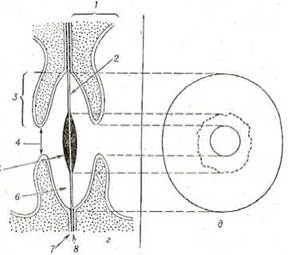
Secondary cell wall pit fields may form over primary pit fields or in areas where no pit fields previously existed. A pit in one cell corresponds to a pit in an adjacent cell, forming a pit pair. The closing membrane is common to both pits and consists of two primary walls and an intercellular substance layer.
Maceration is The process of cell Separation resulting from The breakdown of intercellular substance. It can occur naturally (in overripe fruits such as watermelons and pears, or in leaf petioles prior to leaf fall), where the pectic substances of the middle lamella become soluble and are subsequently washed away by water; artificial maceration is employed in the industrial extraction of fibers from fiber crops (such as flax and hemp).
Last update: 07/08/2026
Editorial and Educational Adaptation: This material has been compiled based on the primary/original source text. The project team performed an editorial review, corrected technical inaccuracies, structured sections, and adapted the content for an educational format.
What was processed:
- elimination of formatting defects (OCR errors, structural breaks, corrupted characters);
- editorial organization of content;
- standardization of terminology in accordance with academic sources;
- verification of factual statements against the original source text.
All mentions of the author, publication year, and origin of the primary text have been preserved in accordance with the source.