PLANT ADAPTATION TO ANTHROPOGENIC FACTORS - 2017
3. ENVIRONMENTAL POLLUTION BY INDUSTRIAL CHEMICAL WASTE
3.4. Physiological and Biochemical Responses of Plants to Air Pollution
Industrial and transport emissions entering the soil and atmosphere penetrate plants, disrupting PHYSIOLOGICAL AND BIOCHEMICAL processes. Ultimately, this manifests as reduced growth, loss of ornamental value, and diminished reproductive function.
One of the most frequent pollutants in industrial emissions is sulfur dioxide (SO2). According to numerous researchers (Ilkun, Nikolayevsky, et al.), the toxic mechanism of SO2 involves the disruption of multiple Enzymes due to cytoplasmic acidification, Changes in the ion balance, accumulation of ballast toxic substances, destruction of photosynthetic structures, and the onset of autocatalytic chain reactions involving free-radical and photodynamic oxidation.
The photosynthetic apparatus of plants exhibits high sensitivity to SO2, which can impair both the light and dark Stages of Photosynthesis by affecting the state of chlorophyll, enzyme activity, the Electron Transport Chain, or the lamellar Structure of grana. Net photosynthesis and potential photosynthetic activity decline in leaves damaged by sulfur dioxide. According to Japanese researchers, SO2 inactivates the primary electron donor or the reaction center of The electron transport chain itself. Sulfur dioxide disrupts the proton gradient associated with ATP formation and inhibits electron transport. Sulfite and sulfate act as uncouplers of electron transport. Exposure to SO2 has been shown to cause a significant decrease in ribulose bisphosphate carboxylase and chlorophyllase activity, as well as reduced photosynthetic intensity and chlorophyll content.
One of the earliest signs of cellular Damage caused by SO2 is the Swelling and deformation of chloroplast thylakoids, whereas the Golgi apparatus, Endoplasmic reticulum, and Cell/35.html">Mitochondria remain intact. Ultrastructural abnormalities in METABOLISM/14.html">Chloroplasts caused by sulfur dioxide have been observed in plants even in the absence of visible leaf injury. Finnish researchers studying areas polluted with atmospheric SO2 found disruptions in The plant cell surface structure and alterations in cuticular Waxes. Notably, damage to chloroplast membranes serves as the primary symptom of pollutant action at the ultrastructural level, accompanied by thylakoid swelling and stroma granulation. Mitochondria are damaged at later Stages of the pollution response. Initial cytoplasmic changes include an increase in endoplasmic reticulum elements, vacuolization, the appearance of granules and lipid droplets, and a decrease in polysome numbers.
Low doses of sulfur dioxide can stimulate respiratory gas exchange. Complete and irreversible inhibition of Respiration occurs under The Influence of 15-20 ppm SO2. Increases and decreases in respiration intensity result from disrupted activity in A number of oxidative enzymes, an imbalance in the accumulation of intermediate products from The pentose phosphate and glycolytic oxidation pathways, or, ultimately, the depletion of the respiratory substrate.
Sulfur dioxide disrupts Amino acid metabolism and their derivatives, alters The ratio of SS and SH groups, induces profound disturbances in the cellular Water regime, increases fatty acid ester levels, reduces organic acids and biologically active growth substances, and impairs the cation-anion balance and cytoplasmic buffering capacity. The degree of damage to leaves and other plant Organs by acidic gases is determined by the ratio between The rate of toxicant uptake into internal Tissues and the efficiency of their neutralization and metabolization without disrupting cellular systems.
Studies on the combined effects of SO2, NO2, and O3 in various combinations on the carbon dioxide and water gas exchange of forest vegetation have shown that fumigation with sulfur dioxide alone reduced Transpiration and photosynthesis in Allium ursinum. The SO2+NO2 combination did not alter these parameters in this plant and Melica uniflora, but led to their decrease in Oxalis acetosella and Viola reichenbachiana. Treatment with SO2+NO2+O3 reduced Gas Exchange in all studied species. Reaction Variability was higher at low PAR values.
Environmental pollution by fluorides causes a significant decrease in leaf pigment content, inhibition of photosynthesis, disruption of oxidative enzyme activity and the water regime, and shifts in pH and redox potential. Elevated atmospheric hydrogen fluoride concentrations near chemical plants lead to increased frequencies of Chromosomal aberrations, chromosome breaks, and enhanced mutation rates in cereal crops, alongside altered Hydrolysis.
It should be noted that Glycolysis (the Embden-Meyerhof pathway) is the central pathway of Glucose Catabolism—a series of enzymatic reactions in which the six-carbon glucose molecule (C6H12O6) is split into two three-carbon molecules of pyruvic or lactic acid. Glycolysis is a catabolic pathway for glucose that does not directly involve oxygen; however, due to oxidation-reduction reactions within the pathway, two ATP molecules are generated through glycolytic glucose Cleavage. E. A. Vainshtein and S. V. Soldatenkov demonstrated that fluorides, when infiltrated from aqueous solutions into excised bean leaves, inhibit glycolysis by inactivating enolase while enhancing the Pentose Phosphate Pathway of sugar oxidation. Conversely, Lushchinets and co-workers observed fluoride-induced activation of glycolysis and inhibition of glucose transport in wheat leaves. These same authors established that fluorides enhance the pentose phosphate pathway of sugar oxidation in plants grown in gibberellic acid solution. Under the influence of fluorine, apparent photosynthesis intensity decreases by 29.2% in wheat seedlings, 24.4% in barley, and 35.5% in maize. A reduction in photosynthesis is also observed under the influence of nitrogen compounds.
Environmental pollution significantly affects plant Protein metabolism. Depending on the active substances involved, various disruptions in Amino Acid and Protein Synthesis may occur, along with accelerated degradation processes. These disruptions impair numerous enzyme systems, leading to shifts in many metabolic processes within plants. Notably, enzyme systems are the most labile and sensitive to pollution, whereas reserve and structural Proteins remain more stable.
Sulfur compounds play a crucial role in protein metabolism. As an essential element, sulfur exists in plants in both organic and inorganic forms. Compared to other organs, leaves are the richest in sulfur. The content of organically bound sulfur ranges from 0.06% in needles to 0.7% in the leaves of certain brassicaceous plants. Neutralized within Organic compounds, sulfur is part of sulfhydryl, disulfide, and sulfo groups, or heterocyclic rings. The SH-form of sulfur is vital for the Synthesis of the Essential Amino Acids Cysteine and Methionine. The activity of many enzymes also depends on the presence of highly reactive SH groups, as seen in coenzyme A, for example.
At the same time, sulfur dioxide acts as a potent assimilation poison. The driving force behind the absorption of SO2 by plants is the diffusion of SO2 molecules, primarily through Stomata. The rate of SO2 uptake is a function of the concentration gradient from the leaf surface inward and the resistance to the SO2 flux (aerodynamic, cuticular, stomatal, and mesoplastic). The primary end product of dissolved SO2 is sulfate.
Two metabolic pathways for intracellular sulfite are known, depending on whether the incoming sulfate is oxidized or not. The first pathway involves The oxidation of SO32- to SO42-, which takes place in chloroplasts and mitochondria. It is believed that The conversion of SO32- ⇔ SO42- in chloroplasts occurs within the electron transport chain and is accompanied by the reduction of NADP+. The oxidized sulfite enters normal sulfur metabolism, being reduced to S2- within the photosynthetic system of chloroplasts—a process requiring 180 kcal/mol. Sulfate assimilation is preceded by its activation via ATP phosphorylation. This reaction can be considered a specific "gateway" through which the relatively inert sulfur oxide enters the metabolic cycle. In most organisms, sulfate activation occurs in two stages:
Class="center">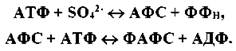
The reaction forming the precursor of "active sulfate"—adenosine-5'-phosphosulfate (APS)—is catalyzed by the transferase-cycle enzyme ATP sulfurylase, while The formation of "active sulfate"—3'-phosphoadenosine-5'-phosphosulfate (PAPS)—is catalyzed by the phosphokinase-type enzyme APS kinase. Several studies postulate the existence of a second metabolic pathway for the reduction of S4- to S2-, bypassing the oxidation stage. In this case, sulfite binds to a low-molecular-weight carrier protein, HS-Car-SH. The reaction is catalyzed by sulfotransferase. The formation of SH groups in the carrier molecule occurs during electron transport: the rate of phototransport determines the rate of sulfur incorporation into the sulfur-containing compound. The rate-limiting step in sulfate reduction is APS synthesis, whereas sulfite reduction is limited solely by the number of SH groups.
An increased sulfur content in the environment and tissues up to a certain threshold stimulates phosphorylation and sulfate reduction reactions, increases the incorporation rate of Sulfur-Containing Amino Acids into proteins, and raises the levels of methionine-rich Proteins and Enzymes catalyzing subsidiary reactions in sulfur metabolism. During this period, The Cell's potential capacity to balance all responsive reactions to excess sulfate is maximally mobilized, which manifests as enhanced oxidative degradation of S-Amino Acids and feedback regulation of their synthesis. With a further increase in sulfur content, the regulatory capacities for biosynthetic reactions and the detoxification of metabolites and sulfoxides accumulating in Cells become sharply limited, leading to an irreversible disruption of sulfur metabolism and interconnected metabolic cycles.
The Nature of SO2's effect on proteins is quite diverse: the pollutant can bind to the reactive sulfhydryl groups of enzymes; cleave Disulfide Bonds, thereby affecting The quaternary structure of molecules; compete with substrates for the enzyme's Active Site; disrupt Allosteric Regulation; promote the appearance of new isoforms; form complexes with Isoenzymes or substrates, leading to altered enzymatic activity; and modify enzyme activity by disrupting complex systems.
Fluorine is a toxic element for plants. Its toxicity can be caused by disruptions in Protein Biosynthesis. Research has demonstrated that sodium fluoride inhibits the initial binding of aminoacyl-tRNA to Ribosomes. It was found that the inhibition of valine incorporation into proteins from ribosome preparations pretreated with sodium fluoride occurs faster than in normal ribosome preparations. This proved that fluorine primarily inhibits the initiation phase rather than Polypeptide chain elongation. Further experiments showed that sodium fluoride disrupts the non-enzymatic binding of 14C-phenylalanyl-tRNA to the poly-U-ribosome complex. Enzymatic binding of tRNA to this complex depends on guanosine triphosphate and is likewise suppressed by sodium fluoride.
Nitrogen is a component of amino acids and, consequently, of proteins. Therefore, the IMPACT OF ENVIRONMENTAL pollution by nitrogen compounds is dual in nature. Up to certain concentrations, the synthesis of Amino Acids and Proteins can be stimulated by these compounds, whereas high concentrations are toxic and suppress synthetic processes. For instance, it has been shown that elevated ammonia concentrations in gas mixtures lead to a significant increase in free amino acid content in resistant species. In sensitive species, this indicator either increases insignificantly or decreases. Evidently, this plant response serves as one of the mechanisms of ammonia detoxification. An Analysis of Protein spot signals in gels using a computerized image analyzer showed that in Rhododendron mucronatum plants fumigated with 4 · 10-6 NO2 for 8 hours, 2 out of 1,200 protein spots with a pI of 5.6 and a Molecular Weight of 25–26 kDa exhibited a 5-fold increase in intensity in response to fumigation. They were found to contain 22 amino acid residues, whose sequence shows 57–68% Homology with the N-terminal sequences of germin-like proteins from white mustard (Sinapis alba) and auxin-binding proteins from peach.
Symptoms of PAN and ozone damage include leaf translucency and the appearance of a bronze or silvery coloration, which typically develops in patches or isolated spots. Among plants, petunias, beans, tomatoes, and tobacco are the most sensitive. In grasses, affected tissue initially appears colorless and subsequently begins to turn yellow. Conifer needles are also sensitive to PAN action.
Thus, air pollution negatively affects virtually all physiological and biochemical processes in plant organisms. At the same time, resistant species are characterized by a more stable course of these processes and enhanced adaptive capacity.
Depending on the concentrations, chemical nature, and duration of pollutant exposure, physiological and biochemical disruptions in plants can be more or less profound. In this regard, researchers distinguish invisible, chronic, and visible or acute damage. Invisible damage is caused by short-term exposure to low toxicant concentrations, and upon removal of the pollutant, plants fully restore their physiological and biochemical status. Chronic damage manifests at the physiological and biochemical level under prolonged exposure to low toxicant concentrations. These injuries are irreversible, and upon accumulation of a critical pollutant content, they transition into visible damage. Acute damage can also arise As a result of short-term exposure to very high pollutant concentrations (salvo or accidental emissions). Symptoms of acute (visible) damage depend on the acting pollutants and manifest as necrotic spots of various colors (Fig. 10).
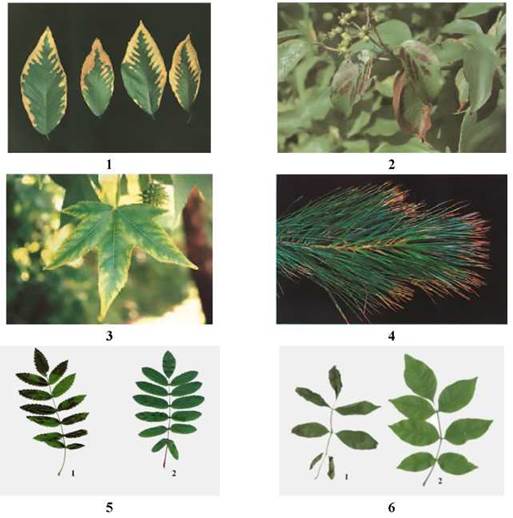
Fig. 10 - Acute plant injuries caused by acid gases: 1, 2 - sulfur dioxide; 3, 4 - hydrogen fluoride; 5, 6 - complex air pollution (HF+SO2+H2SO4+NH3) (1-4 - after http://www.aces.edu; 5-6 - after Prysedskyi)
The arsenal of defense mechanisms ensuring plant resistance lacks specialized adaptations that would guarantee successful growth under these conditions. Thrust into a growing environment drastically altered by human activity and lacking specific protective adjustments against its destructive factors, plants inevitably follow a pre-adoptive pathway to achieve resistance and relative growth success. The pre-adaptation concept of Plant resistance to anthropogenic factors is based on the proven ability of certain plant structures to perform new protective Functions without compromising their original ones.
Pre-adaptation refers to an adaptive trait or traits, possessing a Structural and functional basis, that provides resistance to a specific extreme factor (e.g., the leaf epidermis and cuticle, which prevent overheating, excessive gas exchange, and transpiration) while simultaneously being able to perform a protective function under the influence of a technogenic factor (such as high concentrations of gaseous pollutants). It is particularly noteworthy that once the technogenic factor ceases to act, this structural and functional complex fully resumes its original function.
Leaf fall in trees and shrubs, which originally evolved as an adaptation to annual climatic periodicity, can be regarded as a form of pre-adaptation. At the same time, deciduous species exhibit high resistance to SO2 because the annual shedding of leaves prevents a lethal buildup of sulfides and sulfates in the mesophyll cells. Under these conditions, coniferous plant species suffer more severe damage and die rapidly.
Xeromorphy and succulence, along with their entire complex of morphological and physiological adaptations for efficient water consumption and conservation, play a pre-adaptive role in providing resistance to atmospheric pollutants. Protective coverings, tightly packed tissue layers, and reduced rates of gas and water exchange ensure high Gas resistance in thick-leaved plants (Crassulaceae), cacti (Cactaceae), as well as various herbaceous and woody species of arid zones.
The significant role of pre-adaptation is highlighted by Ernst Mayr's view that an Organism is pre-adapted if it is equipped to transition into a new biotope. It must be especially emphasized that pre-adaptation is by no means a pre-existing adaptation created in advance.
It should be noted that natural and technogenic ecological factors should not be contrasted with one another. Plants respond to various stimuli through changes in growth rates, biomass accumulation, lifespan, reproductive features, and population density. Comparing the effects of different factors on a plant organism shows, for instance, that nitrogen deficiency as a nutritional element and atmospheric pollution from industrial emissions containing SO2 and heavy metals produce a similar effect in plants—leaf chlorosis. Such facts provide grounds to speak of the ecological equivalence of natural and technogenic factors. The key to understanding this ecological equivalence lies in the similar end result—the final physiological state of the plant organism. However, this comparison often overlooks the underlying physiological mechanisms that ensure plant resistance and characterize the specific nature of damage and alterations in the plant's structural and functional Organization.
Last update: 07/08/2026
Editorial and Educational Adaptation: This material has been compiled based on the primary/original source text. The project team performed an editorial review, corrected technical inaccuracies, structured sections, and adapted the content for an educational format.
What was processed:
- elimination of formatting defects (OCR errors, structural breaks, corrupted characters);
- editorial organization of content;
- standardization of terminology in accordance with academic sources;
- verification of factual statements against the original source text.
All mentions of the author, publication year, and origin of the primary text have been preserved in accordance with the source.