Principles of Biochemistry, Volume 3 - A. Lehninger 1985
Molecular Mechanisms of Genetic Information Transfer
Protein Synthesis and Its Regulation
Polypeptide chain elongation is a repeating process
The addition of each amino acid residue to the growing polypeptide chain occurs in three distinct steps. This cycle repeats for every residue that needs to be added. Elongation requires: 1) the initiation complex described above; 2) the incoming aminoacyl-tRNA corresponding to the next mRNA triplet; 3) three soluble cytosolic Proteins known as elongation factors EF-Tu, EF-Ts, and EF-G; and 4) GTP. These elongation factors are often referred to simply as Tu, Ts, and G.
In the first step of the elongation cycle (Fig. 29-15), the incoming aminoacyl-tRNA first binds to a complex composed of elongation factor Tu and a GTP molecule. The resulting aminoacyl-tRNA-Tu-GTP ternary complex then associates with the 70S initiation complex. Simultaneously, GTP is hydrolyzed and the Tu-GDP complex leaves the 70S ribosome; the Tu-GDP complex is subsequently recycled back to Tu-GTP with the help of GTP and the Ts factor.
Next, a new aminoacyl-tRNA binds to the ribosomal A site. This occurs through antiparallel complementary interactions between the anticodon of the incoming aminoacyl-tRNA and the corresponding mRNA codon (we will examine the structures of various codons and anticodons later). However, codon-anticodon interaction alone is not sufficient to ensure the binding of the correct aminoacyl-tRNA. The precise match between the latter and the mRNA codon is verified through an additional specific contact within the A site, formed between another region of the tRNA molecule and the rRNA. The next elongation step proceeds only if both contacts are correct.
Class="center">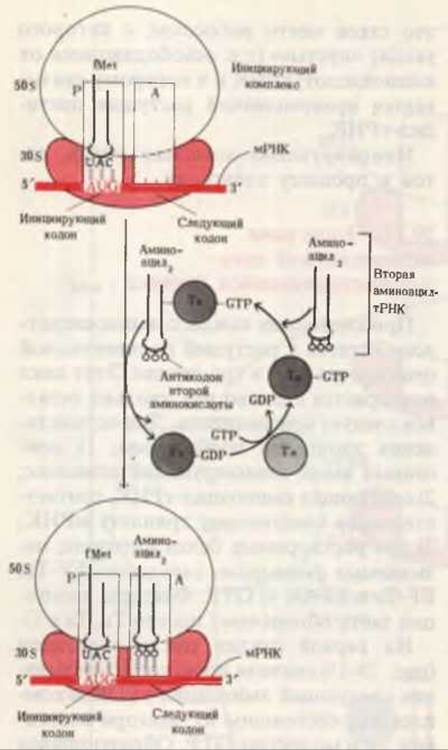
Fig. 29-15. The first step of elongation: binding of the second aminoacyl-tRNA, which enters the ribosome as a complex with elongation factor Tu containing bound GTP. The attachment of the second aminoacyl-tRNA is accompanied by the Hydrolysis of the bound GTP. The resulting bound GDP is converted back into GTP via a reaction catalyzed by elongation factor Ts. The NUCLEOTIDES of the next amino acid anticodon are indicated by circles.
In the second step of the elongation cycle, a new peptide bond is formed between the Amino Acids whose tRNAs occupy the A and P sites of the ribosome. This process is driven by The transfer of the initiating N-formylmethionine residue from its tRNA to the amino group of the newly arrived amino acid in the A site. This transfer is catalyzed by peptidyl transferase, a specialized protein component of the 50S subunit (Fig. 29-16). As a result of this reaction, a dipeptidyl-tRNA is formed in the A site, while a "empty," uncharged initiating tRNAfMet remains in the P site.
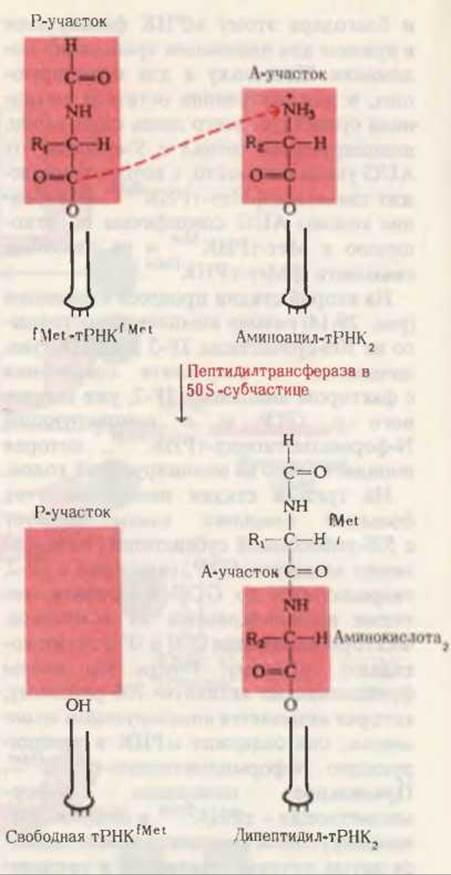
Fig. 29-16. Formation of the first peptide bond. The N-formylmethionyl group is transferred to the amino group of the second aminoacyl-tRNA, resulting in the presence of dipeptidyl-tRNA in the A site.
In the third step of the elongation cycle, the ribosome moves along the mRNA toward its 3' end by a distance of one codon (i.e., three nucleotides). Because the dipeptidyl-tRNA remains attached to the second mRNA codon, the movement of the ribosome shifts the dipeptidyl-tRNA from the A site to the P site. Consequently, the preceding, now free tRNA is released from the P site and returns to the Cytosol. The third mRNA codon now occupies the A site, while the second codon resides in the P site. The movement of the ribosome along the mRNA is known as translocation; this step requires elongation factor G (also called translocase) and the hydrolysis of another GTP molecule (Fig. 29-17). At this stage, a conformational change of the entire ribosome likely takes place, facilitating its progression along the mRNA toward the next codon in the 3' direction of the template. The translocation process is driven by the energy derived from GTP hydrolysis.

Fig. 29-17. The translocation step. The ribosome moves forward by one codon toward the 3' end of the mRNA, powered by The energy released from the hydrolysis of GTP bound to elongation factor G. Dipeptidyl-tRNA2 shifts to the ribosomal P site, vacating the A site for the next aminoacyl-tRNA3.
Now the ribosome, carrying the attached dipeptidyl-tRNA and mRNA, is ready for the next elongation cycle—that is, the addition of the third amino acid residue, which proceeds in exactly the same manner as the addition of the second residue. The addition of each amino acid consumes two GTP molecules, which are hydrolyzed to GDP and Pi. As the ribosome moves codon by codon along the mRNA toward its 3' end, amino acid residues are successively added to the growing polypeptide chain, which remains tethered throughout to the tRNA corresponding to the most recently incorporated amino acid.
Last update: 06/08/2026
Editorial and Educational Adaptation: This material has been compiled based on the primary/original source text. The project team performed an editorial review, corrected technical inaccuracies, structured sections, and adapted the content for an educational format.
What was processed:
- elimination of formatting defects (OCR errors, structural breaks, corrupted characters);
- editorial organization of content;
- standardization of terminology in accordance with academic sources;
- verification of factual statements against the original source text.
All mentions of the author, publication year, and origin of the primary text have been preserved in accordance with the source.