Human Biochemistry, Volume 2 - Murray R. 1993
Structure, Function, and Replication of Information Macromolecules
Regulation of Gene Expression
Regulation of Gene Expression in Eukaryotes
In Eukaryotic Cells, the nuclear membrane physically separates the processes of METABOLISM/31.html">Transcription and Translation because Ribosomes are confined to the Cytoplasm. Consequently, EUKARYOTIC Gene Expression involves considerably more stages than in prokaryotes, particularly regarding RNA Processing. Accordingly, eukaryotes possess a variety of regulatory checkpoints that are entirely absent in prokaryotic systems. For instance, Eukaryotic RNA Processing includes capping the 5' end of the primary transcript, adding a polyadenylate tail to the 3' end, and excising introns. Accumulating evidence indicates that eukaryotic gene expression is regulated at the levels of transcription, nuclear RNA processing, and mRNA stability. Furthermore, gene Amplification and rearrangement have been shown to influence eukaryotic gene expression.
Class="center">
Fig. 41.12. Primary structures of the leader Peptides of the Phe-, His-, Leu-, Thr-, and Ilv (isoleucine, leucine, valine) operons of E. coli or S. typhimurium, deduced from nucleotide sequences. Amino Acids regulating the given Operon are shown in bold and underlined (Reproduced with permission from Yanofsky C. Attenuation in control of expression of bacterial operons. Nature 1981, 289, 751)
Thanks to advances in Introduction/32.html">Genetic Engineering, significant progress has been achieved in recent years in understanding eukaryotic gene expression. However, because most eukaryotes contain substantially more Genetic information than prokaryotes, and the scope for manipulating eukaryotic genes is much more limited, the molecular aspects of eukaryotic gene regulation are far less understood. This section of the chapter briefly outlines several types of eukaryotic gene regulation.
Gene Amplification During Development
During the Cytology/cytology/16.html">Early stages of multicellular development, a critical need arose for a dramatic increase in the Abundance of specific molecules, such as Ribosomal RNAs or mRNAs encoding Proteins that form specialized structures like eggshells. One mechanism to intensify the synthesis of such molecules is to increase the copy number of the corresponding genes. For example, repetitive DNA sequences include hundreds of copies of rRNA and tRNA genes. The multicopy nature of these genes is initially established in the genomic material of Gametes and is thus transmitted from generation to generation. In some organisms, such as the fruit fly (Drosophila), the amplification of specific genes, such as chorion protein genes, occurs during oogenesis. In this case, the increase in gene copy number is likely achieved through multiple rounds of DNA Synthesis initiation within the same Replication bubble, thereby generating multiple Transcription initiation sites for the corresponding genes (Figs. 38.16 and 41.13).

Fig. 41.13. Scheme of the amplification process for the s36 and s38 chorion protein genes. (Reproduced with permission from Chisholm R. Gene amplification during development. Trends Biochem. Sci. 1982, 7, 161.)
In recent years, it has become possible to induce the amplification of specific genomic regions in cultured mammalian cells. In some cases, sequential exposure to increasing concentrations of a selective agent leads to a several-thousand-fold amplification of a specific gene. For instance, Cancer patients treated with methotrexate (an anticancer drug) developed tumor Cell resistance to the medication. This drug resistance is driven by the amplification of the Dihydrofolate Reductase gene, which is itself the direct target of the therapeutic action of methotrexate. Spontaneous gene amplification occurring in vivo, i.e., in the absence of exogenous selective agents, can become fixed in The Genome under appropriate Selection pressure.
Immunoglobulin Gene Rearrangement
One of the most fascinating and complex questions confronting biologists in recent decades concerned the genetic and Molecular Basis of antibody diversity (see Chapter 55). Moreover, advances in immunology revealed that Cells of the human immune system, as they differentiate, produce Antibodies with identical Specificity but diverse effector Functions. Over the past few years, studies from A number of laboratories have contributed significantly to understanding the GENETIC BASIS OF antibody diversity and the REGULATION OF IMMUNOGLOBULIN gene expression during development and cellular differentiation.
As described in Chapter 39, nucleotide sequences encoding a particular protein molecule in the mammalian genome are often partitioned into separate, unlinked segments. The fragmented localization of PARTS OF THE same gene was first demonstrated using DNA segments encoding the Variable and constant domains of immunoglobulin (antibody) light chains. IMMUNOGLOBULINS, as detailed in Chapter 55, consist of two distinct polypeptide chains: light (L) and heavy (H) (Fig. 55.3). Both L and H chains possess variable (V) regions at their N-termini and constant (C) regions at their C-termini. The variable regions are responsible for recognizing Antigens (foreign molecules), whereas the constant regions mediate effector functions that determine the ultimate fate of the antigen-antibody complex.
The molecular Structure of immunoglobulins is governed by three unlinked gene families. Two of these encode the λ and κ light chains, and one encodes the immunoglobulin heavy chains.
Each light chain is determined by three distinct segments: variable (VL), joining (JL), and constant (CL). The mammalian haploid genome contains approximately 500 different VL segments, 5–6 JL segments, and presumably 10 or 20 CL segments. During lymphoid B-Cell Differentiation, a VL segment is translocated from a distal region of the chromosome to a position adjacent to the JL and CL segments. This chromosomal DNA rearrangement allows all three segments to be transcribed as a single primary precursor RNA transcript, which, following processing, yields a mature light-chain mRNA molecule for a specific immunoglobulin. The shuffling of various VL, JL, and CL segments within the genome enables the Organism's immune system to generate an extraordinarily diverse library of antigen-specific immunoglobulin molecules. Such rearrangements during light-chain gene formation are referred to as V–J joining.
The heavy chain is encoded by four segments: VH, D (from diversity), JH, and CH. The variable region of the heavy chain is formed by the joining of the VH, JH, and D segments. The resulting VH–D–JH DNA region is subsequently joined to one of eight CH genes. These CH genes (Cμ, Cδ, Cγ3, Cγ1, Cγ2b, Cα2a, Cα, and Cε) determine the classes and subclasses—such as IgM, IgG, IgA, etc.—of immunoglobulin molecules (see Chapter 55). An example of the rearrangements and processing leading to The formation of the Cγ2b heavy chain is shown in Fig. 41.14.
As a result of differentiation, B cells secreting antibodies against a specific antigen acquire The ability to secrete antibodies of various classes that share the same antigen specificity but exhibit different biological functions. Different immunoglobulin classes are built from identical light chains and heavy-chain VH regions, but contain different heavy-chain CH regions. Consequently, a single B cell and its clonal progeny can undergo "class switching" of the immunoglobulins they produce. Class switching is triggered by a different type of DNA rearrangement that occurs during immune system differentiation. It should be emphasized that the joining of V and J segments for light-chain expression and the joining of V–D–J segments for the heavy chain precede, both developmentally and chronologically, the DNA rearrangements responsible for class switching of synthesized immunoglobulins.

Fig. 41.14. Recombinational events leading to the formation of a functional γ2b immunoglobulin heavy chain gene. A. Germline DNA prior to rearrangements. In germline cells, part of the variable (V) region of the molecule is encoded by a cluster of at least 50 genes, each possessing its own short leader sequence (L). The D-gene cluster encodes most of the third hypervariable region. Located at a distance are four J segments that complete the coding V region. At a distance of approximately 8,000 bp from the J segments lies the CH gene—the first in the cluster of C-region genes. The genes within the C region are interrupted by non-coding sequences. The exons of this region structurally correspond to the domains and hinge region of the respective Amino Acid Sequence. B. During the first rearrangement, one segment from each cluster (V, D, J) is united into a single structure, forming a functional transcriptional unit for the μ chain. The transcript is a copy of the gene shown in the figure. Upon intron removal, a μ mRNA is formed containing a continuous coding sequence. C. During the second rearrangement, corresponding to the heavy-chain class-switch stage, the Cμ, Cγ3, and Cγ1 segments are deleted, and the V–D–J segment, along with part of the J–CH intron, is relocated to the Cγ2b gene. Following transcription, introns are excised and a γ2b mRNA is formed containing a continuous coding sequence. (Reproduced, with permission, from Molgaard N.V. Assembly of immunoglobulin heavy chain genes. Nature 1980, 286, 659.)
Class Switching
During the ontogeny of immunoglobulin-secreting B cells and their clonal progeny, including terminally differentiated plasma cells, The sequence of immunoglobulin Synthesis and Secretion begins with IgM, then switches to the synthesis of IgA or IgG, and so forth. In germline cells, the JH segments lie immediately adjacent to the CH genes; thus, following the VH–D–JH rearrangement, direct Transcription of the μ-chain mRNA precursor can occur without requiring any further rearrangements. However, during subsequent differentiation, to switch from IgM to IgA synthesis, the V–D–J region must undergo rearrangement to join the Cα gene. Only then does it become possible to synthesize the α-chain mRNA precursor containing the exact same antigen-specific variable region.
The linear order of the eight closely linked CH genes is as follows: Cμ, Cα, Cγ3, Cγ1, Cγ2b, Cγ2a, Cα, and Cε. The temporal order of class switching mirrors the physical arrangement of the CH genes from left to right. In most cases studied to date, rearrangements associated with immunoglobulin class switching appear to represent deletions of the CH genes situated between the V–D–J region and the 5' end of the incoming CH gene.
An example of the recombinational events or rearrangements leading to the formation of a complete Cγ2b gene is shown in Fig. 41.14. First, rearrangements involving the Formation of the V–D–J region occur, followed by the rearrangement or deletion of the appropriate CH genes. The sequences of the gene's C regions correspond to domains located within the "hinge" region (Chapter 55). Intervening sequences, or introns, are excised from the primary transcript via splicing, The Mechanism of which is discussed in Chapter 39.
The combinatorial diversity of individual segment pairings described above clearly vastly increases the volume of information encoded within the genome. This mechanism not only ensures a multitude of structural variants for variable regions, but also allows useful rearrangements to be fixed when the function of a cell Lineage changes during cellular differentiation.
The seemingly complex process of DNA rearrangement during cellular development and differentiation can be governed by a relatively simple form of regulation based on the timely Induction and Repression of specific cross-linking proteins that recognize highly conserved sequences flanking the corresponding coding regions.
Transcriptional Control
Chapter 39 defines a promoter as the specific region of a gene sequence to which RNA polymerase must bind to initiate transcription at the corresponding site. Promoter sequences precisely dictate where RNA polymerase will start transcription. Determining when (or how frequently) such transcription should occur is a far more complex and considerably less understood problem. As shown in Chapter 39, two distinct DNA fragments complexed with specific binding proteins determine these exact "where" and "when" parameters. In the limiting case where transcription is at a zero level, the "where" and "when" questions lose much of their meaning, as transcription does not initiate at all. Therefore, a "where" signal is a potential signal that becomes meaningless if the "when" signal evaluates to "not now." As demonstrated in Chapter 38, nuclear Chromatin contains both relatively extensive transcriptionally inactive regions (either constitutively or facultatively) and regions of potentially active chromatin. Furthermore, as noted in Chapter 38, the methylation of DNA deoxycytidine residues can lead to significant chromatin alterations that hinder its transcription. For example, in mouse Liver cells, only unmethylated ribosomal genes are expressed. A body of evidence indicates that the methylation of animal virus DNA strips it of transcriptional activity. However, none of this warrants the sweeping generalization that all methylated DNA is transcriptionally inactive, that all inactive chromatin is methylated, or that transcriptionally active DNA is invariably unmethylated.
The Role of Enhancers
In addition to major structural changes in chromatin that influence transcriptional activity, DNA molecules contain specific booster signals—enhancers—that help boost transcription efficiency. For instance, in the simian virus SV40, the early gene promoter is preceded (at a distance of about 200 Base Pairs) by two identical 72-base-pair tandem repeats capable of significantly enhancing GENE EXPRESSION IN vivo. These so-called enhancer elements differ from promoters in two fundamental ways. First, they can influence gene transcription even when located thousands of base pairs away from the promoters; second, their enhancing effect is orientation-independent. Enhancers act in a non-specific manner, boosting transcription from any accessible promoter. Thus, introducing an SV40 enhancer element into a plasmid carrying a cloned ß-globin gene can result in a 200-fold amplification of that gene's transcription. The enhancer element appears not to encode any specific effector that directly targets the promoter, since its action manifests exclusively toward promoters situated on the same DNA molecule as the enhancer itself (the cis-effect). Proteins that bind to enhancers have already been isolated. Studying their functions will likely shed light on the MECHANISM OF ACTION of these regulatory elements. Enhancers confer hypersensitivity to nuclease Digestion upon the DNA regions where they reside (see Chapter 38).
Many genes have already been identified that possess enhancers positioned in A wide variety of arrangements relative to their coding regions. Beyond merely amplifying transcription, certain enhancer elements exhibit tissue specificity. For example, an enhancer located between the J and C regions of immunoglobulin genes boosts the expression of these genes predominantly in lymphoid cells. Enhancer elements of pancreatic enzyme genes can selectively enhance the expression of linked foreign genes in mouse pancreatic cells (introduced via microinjection into single-cell embryos as part of genetic engineering constructs). Thus, tissue-specific gene expression can be mediated by the action of enhancers or enhancer-like elements.
Other Regulatory Elements
By ligating specific DNA regions carrying putative regulatory sequences to various reporter genes (The Gene Fusion or chimeric gene construction method discussed in Chapter 36), one can determine which particular DNA segments near a structural gene influence its expression. In many cases, sequences situated 5' to the transcription start site have been shown to exert a profound effect on the frequency of transcription initiation. Consider metallothionein as an example: a Cysteine-rich, heavy-metal-binding protein found in most mammalian Organs. When an organism or cultured cell line is exposed to Metal Ions such as zinc or cadmium, transcription of the metallothionein gene is upregulated, leading to a corresponding increase in the level of metallothionein protein capable of sequestering potentially toxic ions. Using genetic engineering techniques, it has become possible to isolate a DNA region several hundred base pairs long located near the transcription initiation site of the metallothionein gene. Another structural gene, such as the thymidine kinase gene, can be attached to this metallothionein regulatory element. The resulting chimeric construct can be introduced into cultured cells, resulting in a small fraction of the cells integrating the foreign DNA into their genome. When cells transformed in this manner are treated with heavy metal ions, thymidine kinase is induced via the metallothionein promoter. By employing progressively shorter segments of the DNA under study, researchers can pinpoint the Location OF THE target regulatory element. A similar experiment was recently conducted in mice. The metallothionein promoter was attached to the structural genes for thymidine kinase or Growth Hormone. These engineered constructs were microinjected into the male pronucleus of a single-cell embryo, which was subsequently implanted into a surrogate mouse Uterus for gestation. Offspring derived this way responded to the presence of zinc in their drinking Water by upregulating the expression of thymidine kinase or growth hormone. In the latter case, Transgenic Animals grew to twice the size of normal control subjects.
Glucocorticoids are a class of Steroid Hormones that regulate gene expression (see Chapter 44). Upon entering a mammalian cell, glucocorticoid molecules bind to a steroid-specific receptor, which undergoes Conformational Changes in the cytoplasm and translocates to The Nucleus. The glucocorticoid-receptor complex interacts with a specific DNA receptor-binding site within the 5' regulatory region of steroid-dependent genes—such as the mouse mammary tumor virus gene—located several hundred base pairs away from the transcription initiation site. The binding of this complex to the receptor site apparently promotes more efficient utilization of the promoter by RNA polymerase, thereby enhancing the expression of steroid-dependent genes. The DNA region that binds the hormone-receptor complex can also be cloned and joined to another structural gene. Following the integration of such chimeric constructs into the genome of cultured mammalian cells, the reporter structural genes become subject to control by the glucocorticoid levels in the medium, effectively turning them into steroid-inducible genes. By progressively shortening the ends of the cloned fragment via nuclease digestion and introducing Mutations, one can identify the DNA regions directly involved in binding the hormone-receptor complex. It appears that the binding of the hormone-receptor complex to a specific DNA segment converts it into an active enhancer element. In the near future, we will likely unravel the molecular mechanism governing the precise Regulation of Eukaryotic gene expression, using steroid-dependent genes as a prime example.
RNA Processing as a Regulatory Mechanism of Expression
Beyond regulating gene expression by modulating promoter utilization efficiency, eukaryotic cells possess an additional control mechanism based on alternative RNA processing. There are two general types of RNA processing control: the first involves deciding which primary transcripts undergo processing at all, and the second involves differential processing. Regarding the first mechanism, it is clear that primary transcripts containing introns must undergo splicing to remove introns before they can reach the cytoplasm as mature, expressed mRNAs. The nucleus contains a far broader array of primary transcripts than corresponding mRNAs in the cytoplasm. Consequently, a decision must be made at some level regarding which transcripts are processed and which are not. As for selecting which primary transcripts are processed, the mechanism remains unknown, nor is there direct evidence that this selection shifts during development or in response to environmental cues.
Direct evidence of differential processing of primary transcripts has emerged from studies on The regulation of immunoglobulin synthesis.
Differential RNA Processing
As noted earlier, the first immunoglobulin synthesized during B-cell differentiation is IgM. However, at the earliest stages of B-cell development, secreted IgM does not span The Cell membrane entirely. The C-terminal region of the μ chain, much like Membrane Proteins, remains embedded in the membrane (see Chapter 42). The μ chain of normally secreted IgM is designated as μs, whereas the μ chain of membrane-bound IgM is termed μm. The Amino acid sequences of the μs and μm chains from a single B cell or cell line are identical up to the Cμ4 domain of the C-terminal region (see Fig. 55.3). Following the Cμ4 domain, the μs chain features a hydrophilic 20-residue segment, whereas the C-terminus of the μm chain contains a hydrophobic 38-residue segment ending with the sequence -Lys-Val-Lys. This hydrophobic segment, up to the first charged Lys residue, can anchor into The Lipid Bilayer of the cell membrane. Clearly, the μs and μm chains must be transcribed from distinct mRNA molecules.
Such distinct mRNA molecules have been isolated, and their nucleotide sequences were successfully determined from the sequences of their corresponding cDNA copies. It was found that the μm mRNA consists of 2,700 bases, while the μs mRNA consists of 2,400 bases. Analysis of The nucleotide sequence of the cloned genomic region encoding the μ mRNA molecules revealed that both types of μ mRNA are generated from a common precursor transcript via alternative RNA processing in the nucleus. Figure 41.15 illustrates two Alternative Splicing pathways for generating the μs and μm mRNA molecules transcribed from a single μ gene.
The common mRNA precursor contains two potential polyadenylation sites (see Chapter 39): one between exons Cμ4 and M, and another 3' to exon M. Depending on which of the two potential polyadenylation sites undergoes endonuclease Cleavage during preparation for polyadenylation, one of the Two Types of heavy-chain μ mRNAs (μm or μs) with distinct 3' ends is produced. It is likely that the choice of polyadenylation site dictates one of the two alternative exon-splicing pathways for the primary transcript.
mRNA Stability
The stability of Messenger RNA molecules in the cytoplasm is a factor whose modulation can exert both positive and negative effects on the expression level of a given gene. Stabilizing an mRNA at a fixed transcription rate leads to its accumulation, and vice versa. Little is known about the mechanisms involved in the mRNA degradation system, yet several well-documented instances of this control process can be cited. Estradiol extends the half-life of vitellogenin mRNA from a few hours to over 200 hours. Furthermore, estrogens are known to stimulate the transcription of this gene by 4- to 6-fold. Combined, these effects result in a substantial accumulation of vitellogenin mRNA. The half-life of the mRNA encoding the major milk protein, casein, is also markedly prolonged upon incubating mammary gland cells with the hormone prolactin.
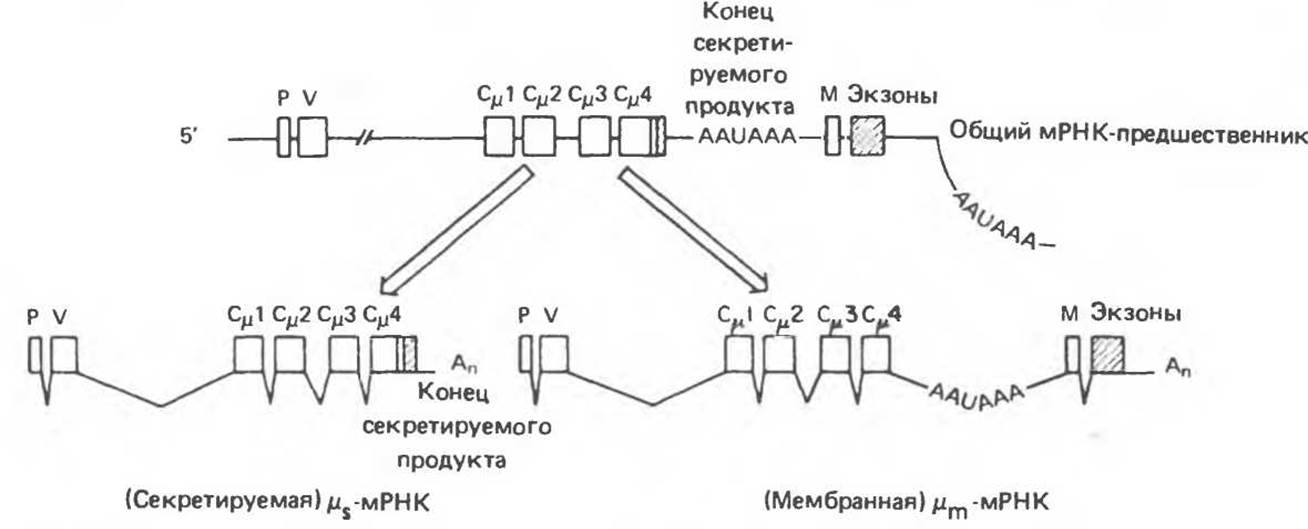
Fig. 41.15. Putative alternative splicing pathway for μs and μm mRNAs. The 5' ends of both molecules contain the Cμ4 sequence. Open boxes represent exons. 3' Untranslated sequences are shaded. P = signal peptide exon; V = rearranged VH exon. Dashed lines indicate the splicing pathway. An = alternative polyadenylation sites (AAUAA) within transcripts. (Reproduced, with permission, from Early et al. Two mRNAs can be produced from single immunoglobulin μ-gene by alternative RNA processing pathways. Cell 1980, 20, 313.)
Table 41.2. Frequencies of occurrence of various control types (reprinted with permission from Darnell J. E. Variety in the level of gene control in eukaryotic cells. Nature 1982, 297, 359 Copyright 1982 by Macmillan Journals Ltd).
|
Proven or well-established Examples |
Possible |
|
|
Nucleus Transcription: Initiation |
Multiple (>100) |
|
|
Termination Premature readout arrest (attenuation) |
1 |
+ |
|
RNA processing Polyadenylation Alternative splicing |
∼3 1 |
|
|
Cytoplasm mRNA stability |
~5 specific and many general |
|
|
mRNA Translation efficiency |
~10 specific and many general |
It is anticipated that the number of examples will grow for those control modalities currently represented by only one or a few instances. At present, it is pointless to even speculate on the true frequencies with which Different types of gene expression control are utilized.
Differential mRNA Translation
Certain organisms or cultured cell lines are known to be capable of differential translation of mature mRNAs whose translation efficiencies cannot be clearly distinguished in vitro. This implies the existence of specific factors capable of recognizing particular mature mRNA molecules and selectively altering their translation rates relative to other mRNAs.
Table 41.2 compares the frequencies of various control types in eukaryotic gene expression.
Compere S. J., Palmiter R. D. DNA Methylation controls the in- ducibility of the mouse metallothioncin-I gene in lymphoid cells, Cell, 1981, 25, 233.
Darnell J. E. Variety in the level of gene control in eukaryotic cells, Nature, 1982, 297, 365.
Jacob F., Monod J. Genetic regulatory mechanisms in Protein Synthesis, J. Mol. Biol., 1961, 3, 318.
McKnight S., Tjian R. Transcriptional selectivity of viral genes in mammalian cells, Cell, 1986, 46, 795.
Ptashne M., Johnson A.D., Pabo C.O. A genetic switch in a bacterial virus. Sci. Am. (Nov.), 1982, 247, 128.
Shimizu A., Honjo T. Immunoglobulin class switching, Cell, 1984, 36, 801.
Swift G. H. et at. Tissue-specific expression of the rat pancreatic Elastase I gene in Transgenic Mice. Cell, 1984, 38, 639.
Wu R., Bald C. R., Narang S. A. Lactose operator-repressor interaction, Curr. Top. Cell. Regul., 1978, 13, 137.
Yamamoto K. Steroid receptor regulated transcription of specific gene and gene networks. Annu. Rev. Genet., 1985, 19, 209.
Yanofsky C. Attenuation in the control of expression of bacterial operons, Nature, 1981, 289, 751.
Last update: 06/08/2026
Editorial and Educational Adaptation: This material has been compiled based on the primary/original source text. The project team performed an editorial review, corrected technical inaccuracies, structured sections, and adapted the content for an educational format.
What was processed:
- elimination of formatting defects (OCR errors, structural breaks, corrupted characters);
- editorial organization of content;
- standardization of terminology in accordance with academic sources;
- verification of factual statements against the original source text.
All mentions of the author, publication year, and origin of the primary text have been preserved in accordance with the source.