Fundamentals of Molecular Biology - V.I. Rezyapkin 2009
RNA, RNA Processing
RNA Processing
Various types of RNA undergo Processing, including mRNA, rRNA, tRNA, and others. Post-transcriptional RNA modifications are most prominent in eukaryotes. In prokaryotes, RNA processing is essential for The formation of mature rRNA and tRNA molecules.
Splicing
Many eukaryotic genes consist of exons—coding sequences—and introns—non-coding sequences. During the METABOLISM/31.html">Transcription of such genes, an RNA molecule containing both exons and introns is synthesized. The resulting primary transcript undergoes processing, during which introns are excised, and exons are joined together to form mature RNA (Fig. 5.12). This process is known as splicing.
Class="center">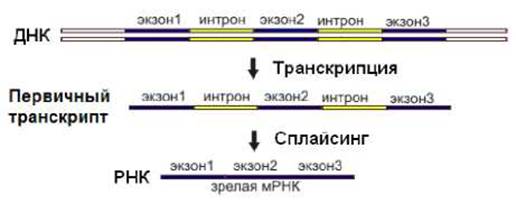
Fig. 5.12. Splicing.
Precursors of various eukaryotic RNAs, such as mRNA, tRNA, and rRNA, undergo splicing.
In eukaryotes, introns within mRNA precursors (pre-mRNA) are excised within spliceosomes—complexes consisting of snRNA and Proteins. Introns have canonical sequences at their boundaries: GU at the 5'-end and AG at the 3'-end. They also contain sequences required for their removal: an acceptor site, a donor site, and a branch site (Fig. 5.13). The snRNAs, in accordance with the base-pairing rules, and proteins interact with these sites to ensure intron removal.

Fig. 5.13. Intron Structure
The process of intron removal involves the following steps (Fig. 5.14):
a) Cleavage of the RNA molecule at the intron-exon boundary at the 5'-end of the intron;
b) formation of an ester bond between the phosphate group of the first nucleotide of the intron (G) and the ribose hydroxyl group (at the 2' carbon atom) of the adenosine located within the branch site, resulting in a lariat-like structure;
c) removal and subsequent degradation of the intron;
d) rejoining of the exons via phosphodiester bond formation.

Fig. 5.14. Mechanism of intron removal
It should also be noted that primary transcripts in Cell/35.html">Mitochondria and Chloroplasts, as well as Yeast tRNA precursors, lack the canonical GU-AG sequences at the intron-exon boundaries.
Certain polynucleotide sequences of RNA may act as an intron in some cases and as an exon in others. Consequently, RNA splicing can occur via alternative pathways (Fig. 5.15). The mature RNAs produced through alternative splicing will differ in their Primary Structure, sharing both identical regions and unique polynucleotide sequence fragments.

Fig. 5.15. Alternative splicing
Alternative splicing enables the generation of diverse proteins from the same primary transcript. For example, in thyroid Cells, transcription of a specific Gene followed by splicing yields an mRNA that serves as a template for synthesizing Calcitonin, a hormone responsible for Calcium Homeostasis. In contrast, in Brain cells, alternative splicing of the primary transcript from the same gene produces an mRNA encoding a protein involved in taste perception.
In alternative splicing, exons are typically arranged in the same orientation as they were in the gene.
Trans-splicing is a form of splicing in which exons from different RNA molecules are joined together (Fig. 5.16).
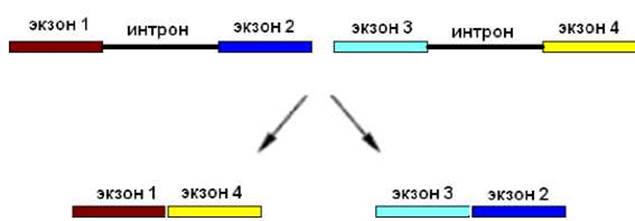
Fig. 5.16. Trans-splicing
Autosplicing (self-splicing) is the splicing of a primary RNA transcript that occurs without the involvement of any Enzymes, meaning the RNA itself acts as a catalyst for the process. For instance, in the Ciliate Tetrahymena thermophila, a 35S rRNA precursor (pre-rRNA) 6,400 NUCLEOTIDES in length is formed. Without the participation of proteins, a 414-nucleotide intron is excised from this pre-rRNA, and the two exons are ligated to form 26S rRNA. For splicing to occur, a guanine-containing nucleotide (GTP, GDP, GMP, or free guanosine) must be present. The phosphate group at the 5'-end of the intron is transferred to the 3'-hydroxyl group of this guanine nucleotide. Subsequently, the 3'-hydroxyl group generated at the end of the first exon is used to join the 5'-end of the second exon via a phosphodiester bond. The excision of the intron is accompanied by its circularization and the deletion of a small fragment containing the guanine nucleotide originally used to initiate the splicing process (Fig. 5.17).
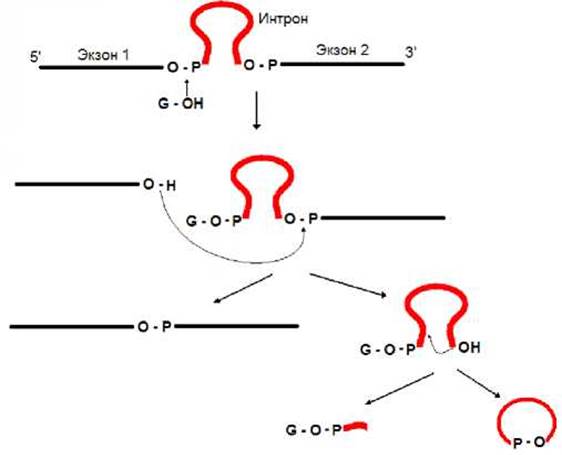
Fig. 5.17. rRNA autosplicing in Tetrahymena thermophila
Introns analogous to those of Tetrahymena thermophila are found in the pre-rRNA of mitochondria, chloroplasts, and Fungi.
Last update: 12/08/2026
Editorial and Educational Adaptation: This material has been compiled based on the primary/original source text. The project team performed an editorial review, corrected technical inaccuracies, structured sections, and adapted the content for an educational format.
What was processed:
- elimination of formatting defects (OCR errors, structural breaks, corrupted characters);
- editorial organization of content;
- standardization of terminology in accordance with academic sources;
- verification of factual statements against the original source text.
All mentions of the author, publication year, and origin of the primary text have been preserved in accordance with the source.