Fundamentals of Molecular Biology. Part 2: Molecular Genetic Mechanisms - A. N. Ogurtsov 2011
DNA Transcription
Alternative Splicing
The presence of introns in eukaryotic genes allows for the synthesis of various (yet related) Proteins from a single Gene via alternative splicing. In higher eukaryotes, alternative splicing is a crucial mechanism for synthesizing distinct protein forms, known as isoforms, across different Cell types.
Let us examine alternative splicing using Fibronectin as an example—a multidomain extracellular adhesive protein found in mammals (Figure 18).
Class="center">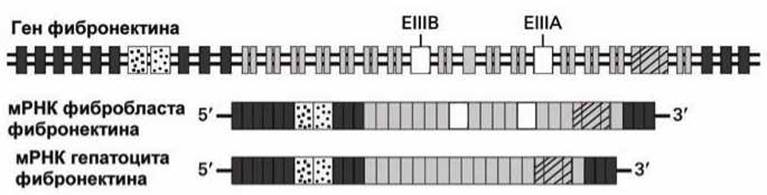
Figure 18 - Alternative splicing of fibronectin in fibroblasts and hepatocytes. Introns in the fibronectin gene (not to scale) are represented by double black lines.
In fibroblasts, an mRNA is transcribed that includes the EIIIA and EIIIB exons; these exons encode Amino acid sequences for domains that bind to specific proteins on The Plasma Membrane of fibroblasts. Consequently, this fibronectin isoform "anchors" the fibroblast to the Extracellular matrix.
As a result of alternative splicing of the primary fibronectin transcript in hepatocytes (the principal Cells of the Liver), an mRNA lacking the EIIIA and EIIIB exons is produced. Therefore, the fibronectin secreted into the Blood by hepatocytes does not bind to cells, allowing them to circulate freely.
Over 20 fibronectin isoforms have been identified, their synthesis encoded by various mRNAs generated through alternative splicing from a single primary transcript of the fibronectin gene.
Recent sequencing of numerous mRNAs derived from various human Tissues, along with comparisons to genomic DNA, has revealed that approximately 60% of human genes are expressed via alternative mRNA splicing. Alternative splicing exponentially increases the repertoire of proteins encoded within the genomes of higher Multicellular Organisms.
Introduction/24.html">DNA METABOLISM/31.html">Transcription is carried out by RNA polymerase, which adds one ribonucleotide at a time to the growing 3' end of the RNA chain. The sequence of nucleic acid bases in the DNA template strand determines the order in which ribonucleotides are polymerized to form the RNA strand.
During Transcription initiation, RNA polymerase binds to a specific DNA region known as the promoter, locally melts (unwinds) the DNA double helix to expose the unpaired template strand, and polymerizes the first few NUCLEOTIDES.
During elongation, RNA polymerase moves along the DNA, sequentially unwinding the DNA helix and adding ribonucleotides to the growing RNA chain.
When RNA polymerase reaches a terminator, it halts transcription, leading to the release of the completed RNA molecule and the dissociation of RNA polymerase from the template DNA.
In prokaryotic DNA, multiple protein-coding genes are organized into a functional DNA unit called an Operon, which is transcribed from a single shared promoter into a single RNA molecule that directs the synthesis of several functionally related proteins. Translation of bacterial RNA can begin even before Transcription of the RNA is complete.
In eukaryotic DNA, each protein-coding gene is transcribed from its own promoter. The primary transcript frequently contains non-coding regions (introns) interspersed between coding regions (exons).
To form a functionally mature RNA, eukaryotic primary transcripts must undergo Processing. During processing, the ends of the primary transcript undergo 5' capping and 3' polyadenylation. Transcripts from genes containing introns undergo splicing, which removes the introns and joins the exons.
Individual domains of multidomain proteins in higher eukaryotes are often encoded by individual exons or a small group of exons. Different isoforms of such proteins are frequently expressed in a cell-type-specific manner as a result of alternative splicing.
1. Provide a definition of a gene.
2. What process is referred to as DNA transcription?
3. What reaction is catalyzed by RNA polymerase?
4. Why does RNA polymerization during transcription proceed in the 5'→3' direction?
5. What is The Role of the enzyme pyrophosphatase in nucleotide polymerization?
6. What is defined as the transcription start site?
7. List and characterize the Stages of Transcription.
8. WHAT IS A promoter?
9. What stage of transcription is called abortive initiation, and why?
10. What is the transcription bubble (region), and how many Base Pairs does it span?
11. How many base pairs are contained within the RNA-DNA hybrid region inside the transcription bubble?
12. What is a transcription terminator?
13. What are the Similarities and differences in the Organization of Prokaryotic and eukaryotic genes?
14. What is an operon?
15. How do prokaryotic and eukaryotic genes differ?
16. What are the similarities and differences between introns and exons?
17. What are the similarities and differences between pre-mRNA and mRNA?
18. Can transcription and translation occur simultaneously in prokaryotes, and why?
19. Can transcription and translation occur simultaneously in eukaryotes, and why?
20. What cellular process is referred to as RNA Processing?
21. Does RNA processing occur in prokaryotes? Explain your answer.
22. List the MAIN TYPES OF RNA processing.
23. What does mRNA capping involve?
24. What does mRNA polyadenylation involve?
25. What does mRNA splicing involve?
26. What is alternative splicing?
27. How does alternative splicing allow for the diversification of Protein Synthesis within The Cell?
Last update: 12/08/2026
Editorial and Educational Adaptation: This material has been compiled based on the primary/original source text. The project team performed an editorial review, corrected technical inaccuracies, structured sections, and adapted the content for an educational format.
What was processed:
- elimination of formatting defects (OCR errors, structural breaks, corrupted characters);
- editorial organization of content;
- standardization of terminology in accordance with academic sources;
- verification of factual statements against the original source text.
All mentions of the author, publication year, and origin of the primary text have been preserved in accordance with the source.