Biochemistry, Vol. 1 - A. Lehninger 1985
Appendix
Answers
Chapter 2
1. a) 625 Cells: b) 1 x 10⁵ Cell/35.html">Mitochondria: c) 2 x 10⁵ molecules.
2. a) 1.1 x 10⁴ molecules; b) 1 x 10⁻⁴ M.
3. a) 1 x 10-12 g (1 picogram); b) 5.9%: c) 4.6%.
4. a) 1.3 mm; the DNA length exceeds The Cell size by 650 times, which is why DNA must be tightly compacted, b) 3156 Proteins.
5. a) Metabolic rate is limited by diffusion, which in turn depends on surface area, b) For the bacterium—12 x 106 m-1, or 12 µm-1; for the amoeba—4 x 10⁴ m-1, or 0.04 µm-1: the ratio is 300. c) The surface-area-to-volume ratio in humans is 19 m-1; the ratio between these values for the bacterium and a human is (1.2 x 10⁶)/1. The answer will differ for other body sizes.
6. a) 7850; b) 3.14 x 10⁻¹⁰ m2; c) 2.72 x 10⁻⁹ m2; d) A 765% improvement in the surface-area-to-volume ratio.
Chapter 3
1. Vitamins derived from these two sources are identical, and the body cannot distinguish between them.2.
Class="center">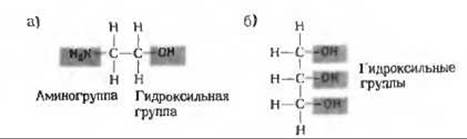
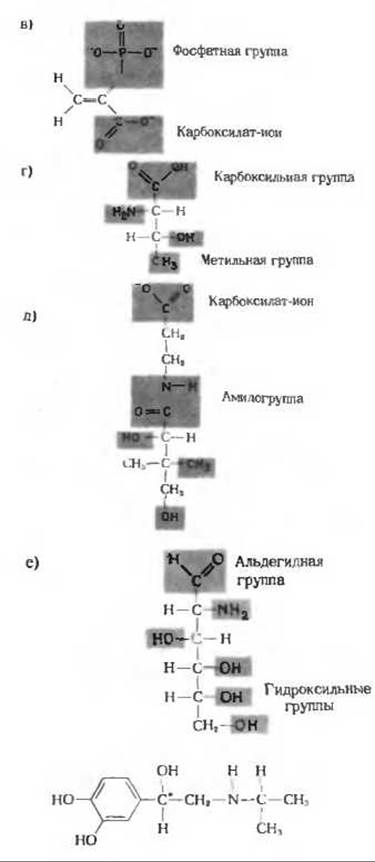
These two enantiomers interact differently with a chiral biological "receptor" (i.e., a protein).
4. Dexedrine is a single enantiomer, whereas benzedrine is a racemic mixture.
5. a) 3 phosphoric acid molecules, a-D-ribose, adenine.
b) Choline, phosphoric acid, glycerol, oleic acid, palmitic acid. c) Tyrosine, 2 Glycine molecules, phenylalanine, Methionine.
6. a) СН2О; С3Н6О3.
b)
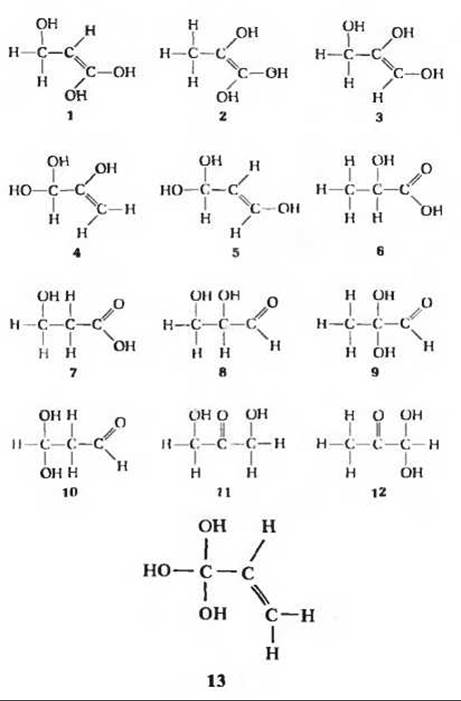
c) This indicates that X contains a chiral center; all except 6, 7, 8, and 12 are unstable and thus do not occur naturally.
d) This indicates that X contains an acidic functional group; Structure 8 can be excluded; structure 6 is consistent with all obtained data. e) Structure 6; we cannot distinguish between the two possible enantiomers.
Chapter 4
1. 9.6 molal, or approximately 9.6 M.
2. 3.35 mL.
3. 1.1.
4. 7.5 x 10⁻⁶ moles.
5. For the equilibrium reaction HA⇄H++A-, the corresponding Henderson-Hasselbalch equation is as follows: pK' = pH++log[A-]/[HA]. If the acid (HA) is half-dissociated, then [HA] = [A-]. Then [A-]/[HA] = 1, log 1 = 0, and pK' = pH.
6. a) At a pH of about 9.3; 
c) 10-2 L; d) pH — pK' = - 2.
7. a) 0.1 M HCl; b) 0.1 M NaCl; c) 0.1 M NaOH.
8. The correct answer is d).
10. 5.80 g of NaH2PO4 ∙ H2O and 8.23 g of Na2HPO4.
11. a) Blood pH is regulated by the CO2-bicarbonate buffer system According to the following overall reaction:
CO2 + H2O ⇄ H+ + HCO-3.
With inadequate ventilation of the Lungs, the concentration of CO2 in them and in arterial blood increases, shifting the equilibrium to the right and increasing the concentration of hydrogen ions; i.e., blood pH decreases. b) During forced breathing (hyperventilation), the concentration of CO2 in the lungs and arterial blood decreases. This shifts the equilibrium to the left, consuming hydrogen ions As a result. Thus, their concentration decreases, and the pH rises compared to the normal value of 7.4. c) Lactic acid is a moderately strong acid (pK' 3.86) that dissociates completely under physiological conditions:
CH3CHOHCOOH ⇄ CH3CHOHCOO-+ H+.
Consequently, the pH of blood and Muscle tissue decreases. Forced breathing is beneficial because it removes hydrogen ions [see item (b)], thereby increasing the blood and tissue pH in anticipation of future acid accumulation.
Chapter 5
1. +17.9 deg ∙ ml/(dm ∙ g); specific rotation does not indicate whether citrulline is a D- or L-amino acid.
2. Determine the absolute configuration of the a-carbon atom and compare it with D- and L-glyceraldehyde.
3. 1) Glycine (b); 2) Alanine (e); 3) valine (e); 4) Serine (a); 5) Proline (h); 6) phenylalanine (d); 7) Tryptophan (d); 8) tyrosine (k); 9) aspartic acid (i); 10) glutamic acid (i); 11) methionine (g); 12) Cysteine (l); 13) Histidine (g); 14) Arginine (m); 15) Lysine (c); 16) asparagine (n).
4. a) I, b) II, c) IV, d) II, e) IV, f) II and IV, g) III, h) III, i) II, j) V, k) III, l) IV, m) V, n) II, o) III, p) IV, q) V, r) I, s) III, t) V, u) V.
5. b) One ten-millionth.

7. 0.879 L of 0.1 M glycine and 0.121 L of 0.1 M glycine hydrochloride.
8. a) Toward the anode: Glu; b) toward the cathode: Lys, Arg, and His; c) remained at the origin: Gly and Ala.
9. a) Asp; b) Met; c) Glu; d) Gly; e) Ser.
10. a) 27; b) 6.
11. a) 2; b) 4; c)
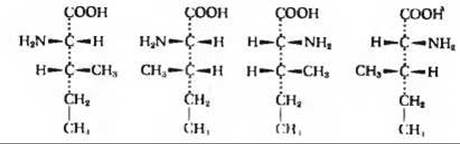
г) 2S, 3R, 2S, 3S, 2R, 3R and 2R, 3S, respectively.
12. a)
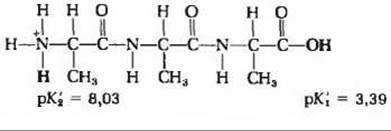
b) The ionization of the first proton in both Ala and the Ala-oligopeptide leads to The formation of a zwitterionic species. This equilibrium is shifted to the right because favorable conditions are created for an interaction between the carboxylate anion and the protonated amino group. Since the protonated amino group is closer to the carboxylate anion in Ala than in the Ala-oligopeptide, the equilibrium in the first case is shifted to a greater extent, as indicated by the lower pK1 value. c) The ionization of the second proton in both Ala and the Ala-oligopeptide disrupts the conditions that favored the interaction between the charged groups. Because these groups are closer to each other in Ala than in the Ala-oligopeptide, it is more difficult to remove the second proton in Ala, and consequently, the pK'2 for Ala is higher than the pK'2 for the Ala-oligopeptide.
Chapter 6
1. 3500 molecules.
2. a) 32100 g/mol; b) 2.
3. 1200; 12200 g/mol.
4. +2; +1; 0; —2; pI = 7.8.
5. —COO-; Asp and Glu.
6. Lys, His, Arg; electrostatic attraction between the negatively charged phosphorus residues in DNA and the positively charged basic residues in Histones.
7. a) (Glu)20; б) (Lys—Ala)3; в) (Asn—Ser—His)5; г) (Asn—Ser—His)5.
8.
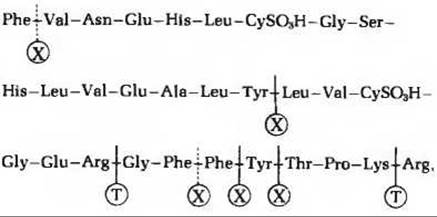
Dashed lines indicate poorly cleaved bonds; T - Trypsin, Ch - Chymotrypsin.
9. Tyr—Gly—Gly—Phe—Leu.
10. a) 1 - to the anode; 2 - to the cathode; 3 - to the cathode; 4 - to the anode; b) pH 7-9.
11. a) The addition of high salt concentrations removes the Hydration shell from protein molecules, resulting in decreased Protein solubility. b) Choose a concentration of (NH4)2SO4 at which protein A precipitates while protein B remains in solution. Collect the precipitated protein A by centrifugation.
12. Wash the Column with a large excess of free Ligand to displace the ligand bound to the polymer.

Chapter 7
1. a) Short bonds are strong bonds of higher order, i.e., double or triple bonds rather than single bonds. The C—N bond occupies an intermediate position between a single and a double bond. b) The peptide bond is represented by two Resonance structures. c) Rotation around the peptide bond is restricted at physiological temperatures.
2. The main structural units of wool fiber Polypeptides are consecutive turns of the α-Helix with a pitch of 0.54 nm. Upon stretching and steaming the fibers, the polypeptide chain extends, and the distance between R-groups in the β-conformation increases to 0.70 nm.
3. About 40 peptide bonds per second.
4. The repulsion of the negatively charged carboxyl groups of Polyglutamic acid at pH 7 causes the unwinding of the polypeptide chain. The repulsion of the positively charged amino groups of polylysine at pH 7 leads to the same result.
5. Disulfide bridges between cystine residues form cross-links between protein chains, thereby increasing the rigidity and mechanical strength of the protein.
6. Wool shrinks as the polypeptide chain transitions from an extended conformation (the pleated-sheet ß-Structure) to an a-helical conformation.
7. Cystine residues prevent the complete unfolding of the protein.
8. a)
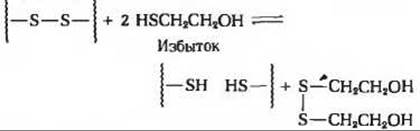
б) Due to air oxidation of cysteine to cystine.
9. In the sheets, Gly is aligned opposite Gly, and Ala/Ser opposite Ala/Ser.
10. 30 Amino Acids; 89%.
11. The finding that 14C-hydroxyproline is not incorporated into Collagen argues against the first hypothesis and Supports the second.
12. The bacterium's ability to invade tissue is due to its secretion of the enzyme collagenase, which degrades the host's Connective Tissue barrier. The Bacteria themselves contain no collagen.
Chapter 8
1. At positions 7 and 19; at positions 13 and 24.
2. Exterior: Asp, Gln, Lys; interior: Leu, Val; Ser can be located anywhere.
3. In most cases, the functional three-dimensional folding of a polypeptide chain—that is, the native Protein Structure—represents its most stable conformation. Consequently, although proteins are synthesized as linear polymers, they spontaneously adopt the correct three-dimensional conformation. Evidence for this concept can be found in Anfinsen's classic work on Ribonuclease (see Fig. 8-8).
4. a) Only the combinations found in the native structure yield functional activity, b) The native structure is determined by the Introduction/19.html">Primary Structure of the protein. c) The native structure of Insulin is not its most stable conformation.
5. a) By comparing the molar amounts of valine contained in the protein with its derivative, one can determine the number of NH2-termini and, consequently, the number of polypeptide chains. b) 4.
6. a) 16400 g/mol; b) this means that there are four iron atoms in Hemoglobin.
7. a) 3.2 x 10⁻¹¹ g; b) 300 million; c) 90 µm3; d) 0.55; e) packing volume of 94 µm3; f) because the above calculation shows that hemoglobin molecules are in contact with one another and fill the entire erythrocyte, any change in the interactions between neighboring molecules must alter the cell shape. In Sickle-Cell Anemia, hemoglobin inside the cell is arranged not in a cubic lattice, but in long parallel filaments. As a result, the erythrocyte also becomes elongated along the axis of these filaments.
8. a) 7.8 x 10⁻⁴ g O2 per kg of tissue; b) 1.3 x 10⁻² g O2 per kg of tissue; 17/1; c) 7.8%.
9. a) Hemoglobin F. b) This ensures The transfer of oxygen from maternal blood to fetal blood. c) DPG decreases the affinity of hemoglobin for oxygen. The fact that the saturation curve of hemoglobin A is shifted to a greater extent by DPG binding than that of hemoglobin F indicates that hemoglobin A binds DPG more tightly than hemoglobin F.
10. a) It cleaves peptide bonds on the carboxyl side of Lys and Arg residues. b) Hb Philadelphia. c) by Electrophoresis of the intact a-chain.
11. By means of electrophoresis at pH 7.
Chapter 9
1. The enzyme responsible for converting sugar into starch is inactivated by heat.
2. 2.4 x 10⁻⁶ M.
3. 9.5 x 10⁸ years.
4. a) 15.5 nm; 18.8 nm. b) Upon Formation of the three-dimensional conformation of the enzyme, these amino acids turn out to be in close proximity to each other; c) The protein acts as a "scaffold" maintaining the catalytic groups in the correct orientation.
5. Determine the value of KM; measure the initial velocity (The rate of NADH disappearance, recorded spectrophotometrically) at several specific enzyme concentrations; plot The change in initial velocity as the Enzyme Concentration increases.
6. Vmax ~ 140 μmol/L·min; KM ~ 1 x 10⁵ M.
7. Apparently, they isolated the same form of the enzyme. The value of Vmax depends on the enzyme concentration. To resolve the contradiction, they should determine the turnover number for each of the enzyme preparations.
8. a) 1.7 x 10⁻³ M; b) 0.33, 0.67, 0.91.
9. KM = 2.2 mM; = 0.51 mg·min.
10. 2.0 x 10⁷ min-1.
11. 29,000; we should assume that each enzyme molecule contains only a single titratable sulfhydryl group.
12. The enzyme-substrate complex is more stable than the enzyme and substrate taken separately.
13. Measure the total acid phosphatase activity in the presence and absence of tartrate ion.
14. The fact that acetazolamide lowers the Vmax of the enzyme without altering its KM indicates that this inhibitor acts in a noncompetitive manner.
15. Ethanol competes with methanol for the Active Site of Alcohol dehydrogenase.
16. Glu-35 is protonated; Asp-52 is deprotonated.
Chapter 10
1. a) Nicotinic acid is required for The Biosynthesis of Trp and, at the same time, can itself be synthesized from Trp. b) Corn is poor in tryptophan.
2. Thiamine deficiency.
3. The rate of lactic acid formation depends on The amount of riboflavin in the culture medium.
<4. Pyridoxine is converted into Pyridoxal phosphate, which serves as a prosthetic group playing a central role in Transamination reactions.
5. a) Bacterial contamination. b) Avidin binds free biotin and inhibits bacterial growth. c) It protects the developing embryo from the destructive action of bacteria during the incubation period.
6. Upon the addition of thymidine to the nutrient medium, bacteria can bypass the requirement for tetrahydrofolate, the synthesis of which requires Folic acid.
7. Vitamin B12 deficiency in the bacterial flora.
8. The high solubility of B-group vitamins leads to their rapid excretion from the body.
9. In adults, vitamin A is stored in the Liver.
10. Vitamin D3; Kidney damage prevents the complete hydroxylation of vitamin D3 and the formation of its biologically active form.
11. a) It can act as an inhibitor in vitamin K-dependent enzymatic reactions. b) They experience severe hemorrhaging caused by an apparent vitamin K deficiency. c) The vitamin K antagonist decreases the concentration of blood-clotting factors.
12. Vitamin B12 deficiency.
13. a) Phytic acid binds zinc and prevents its Absorption in the Small Intestine. b) Yeast breaks down phytic acid.
Chapter 11

b) Mutarotation occurs in a freshly prepared solution of a-D-galactose, leading to the formation of an equilibrium mixture of a- and ß-D-galactose. Mutarotation of pure a- or ß-D-galactose yields a mixture of both forms with the same composition: c) 72% ß-form and 28% a-form.
2. a) Measure the change in optical rotation as a function of time. b) The direction of the optical Rotation of the mixture is opposite to that of the sucrose solution. c) 0.63 parts of sucrose are hydrolyzed; final COMPOSITION OF THE mixture: glucose and fructose — 0.77 parts, sucrose — 0.23 parts.
3. Prepare the center of the chocolate from a paste containing sucrose and Water; add a small amount of invertase; coat with chocolate immediately.
4. a)
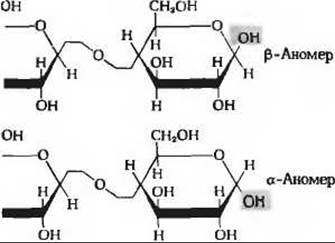
b) Hydrolysis of both lactose anomers yields a mixture consisting of a- and ß-D-glucose and a- and ß-D-galactose.
5. Sucrose is a nonreducing sugar.
6. 7840 residues/s.
7. Natural Cellulose consists of glucose monomers linked together by ß(1→4)-glycosidic bonds. Due to the ß-bonds, the glucose residues form an extended polymer chain (see Fig. 11-16). Intermolecular Hydrogen Bonds form between several parallel chains, resulting in long, rigid, insoluble fibers. Glycogen is also composed of glucose residues, but they are linked by a(1→4)-bonds. Such a-bonds between glucose residues cause the chain to bend and prevent the formation of long strands. In addition, glycogen is highly branched (Fig. 11-15). These structural properties ensure a high degree of glycogen hydration because many hydroxyl groups are exposed to water. Therefore, glycogen can be extracted in a dispersed form with hot water. The Physical Properties of these two polymers are well suited to their biological Functions. Cellulose serves as a structural material in plants, which is consistent with its ability to aggregate into insoluble fibers. Glycogen acts as a storage fuel in animals. Highly hydrated and accessible glycogen granules are rapidly hydrolyzed by Glycogen phosphorylase to glucose-1-phosphate. This enzyme acts only on nonreducing ends, so the high degree of polymer branching ensures a multitude of sites accessible to glycogen phosphorylase.
8. 10.8 s.
9. a) Residues located at branch points yield 2,3-dimethylglucose, whereas other residues in the polymer yield 2,3,6-trimethylglucose.
b) 3.74%.
10. D-glucopyranosyl-(1→1)-D-glucopyranoside.
Chapter 12
1. The number of cis double bonds. Each cis double bond introduces a kink into the hydrocarbon chain, making it harder to pack tightly in a crystal lattice.
2. Unsaturated fats (such as butter) are readily oxidized by molecular oxygen.
3. Phosphatidylcholine emulsifies fat.
4. a) Sodium salts of palmitic and stearic acids, as well as glycerol; b) under mild hydrolysis conditions — sodium salts of palmitic and oleic acids and glycerol-3-phosphorylcholine; c) under harsh hydrolysis conditions — sodium salts of palmitic, oleic, and phosphoric acids, as well as glycerol and choline.
5. a) 0; b) 0; c) -1.
6. Wax protects against water loss.
7. 63.
8. Hydrophobic groups: a) two Fatty acids; b, c, d) one Fatty acid and the sphingosine hydrocarbon chain; e) hydrocarbon backbone.
Hydrophilic groups: a) phosphoethanolamine; b) phosphocholine; c) D-galactose; d) several sugar molecules; e) alcohol group (—OH).
9. a) Lipids that form bimolecular layers are amphipathic molecules, meaning they contain both hydrophilic and hydrophobic regions. To minimize contact between the hydrophobic region and water, lipids form two-dimensional sheets in which the hydrophilic heads face the aqueous phase, while the hydrophobic tails are sequestered on the inside. Furthermore, to prevent the hydrophobic edges of such sheets from interacting with water, lipid bilayers close upon themselves. For the same reasons, any hole that forms in the sheet seals spontaneously because the membrane is semifluid.
б) These lipid properties have profound biological implications: lipid sheets form closed membrane surfaces, which leads to the formation of cells and intracellular compartments (“rooms”) — Organelles.
10. They have to traverse the nonpolar environment that makes up the interior of the membrane.
11. Sodium dodecyl sulfate and sodium cholate solubilize the hydrophobic regions of membranes, acting as soaps or detergents (Fig. 12-2).
12. a) Sugars are hydrophilic compounds. b) Glycoproteins cannot flip and end up on the outer surface of the membrane.
13. a) Integral Membrane Proteins must reside in a fluid environment to adopt their functional conformation. b) An elevated level of Unsaturated fatty acids lowers the phase transition Temperature of the membrane.
Last update: 06/08/2026
Editorial and Educational Adaptation: This material has been compiled based on the primary/original source text. The project team performed an editorial review, corrected technical inaccuracies, structured sections, and adapted the content for an educational format.
What was processed:
- elimination of formatting defects (OCR errors, structural breaks, corrupted characters);
- editorial organization of content;
- standardization of terminology in accordance with academic sources;
- verification of factual statements against the original source text.
All mentions of the author, publication year, and origin of the primary text have been preserved in accordance with the source.