Protein Chemistry - Part 1 - General Protein Chemistry - Ashmarin I. P. 1968
Protein electrochemistry. Protein-water interactions
Protein solubility
The solubility of various Proteins varies within a wide range. For example, Scleroproteins are insoluble in Water, dilute salt solutions, and most other Solvents. Other proteins—prolamins—are soluble only in 60–80% alcohol. A third group of proteins is soluble in water or dilute salt solutions at moderate pH and Temperature values. Differences in protein solubility have served as the basis for several protein classifications. However, many proteins were subsequently discovered that possess intermediate solubility and cannot be assigned to any of the previously established classes. Therefore, in subsequent classifications, solubility was considered merely as one of the CHARACTERISTICS OF THE classified proteins.
Protein solubility and Hydration capacity do not depend on one another. For instance, Collagen binds more water than serum albumin, but unlike the latter, it is insoluble in water. To understand this apparent discrepancy, one must recall that protein solubility depends on The ratio of polar to nonpolar groups within the molecule, their spatial arrangement, and the resulting dipole moment. A large number of polar groups should increase both the affinity of proteins for water and their solubility. However, ionic groups can also exert the opposite effect by combining with groups of opposite sign to form intra- and intermolecular salt-like bonds. The formation of such intermolecular bonds invariably leads to dehydration and promotes the appearance of large insoluble aggregates.
In water, electrostatic interaction forces decrease due to the high dielectric constant, and an interaction arises between polar groups and water molecules that enhances solubility. If the interaction between the protein and the solvent is stronger than the interaction between protein molecules, dissolution occurs (albumins, pseudoglobulins). Conversely, if the attractive forces between protein molecules are stronger, the protein does not dissolve in water (euglobulins). Therefore, many proteins are insoluble in water and weak salt solutions despite containing a large number of anionic and cationic groups.
Protein solubility depends on the concentration of neutral salts in the solution, its pH, and temperature. Salts exert a dual effect on solubility. In small amounts, they significantly increase solubility, bringing poorly soluble or completely insoluble proteins into solution (euglobulins). At low salt concentrations, the increase in the logarithm of solubility S is directly proportional to the Ionic strength of the solution, which is due to the interaction of their ions with charged protein groups, as well as an increase in the number of such groups. Presumably, each ionic group is surrounded by an atmosphere of salt ions of the opposite sign. At sufficiently high salt concentrations, most proteins precipitate from aqueous solutions. In this case, the solubility of many proteins decreases with increasing salt concentration logarithmically, in accordance with the following equation:
Class="center">
where β = lgS0 (S0 is the solubility in pure solvent), μ is the ionic strength of the solution, and KS is the salting-out constant. The salting-out constant can be determined from the slope of the linear portion of the salting-out curve (Fig. 49), and its values depend on both The Nature of the salt used and the Nature of the protein.
It is evident from formula (79) that at high salt concentrations, protein solubility decreases in proportion not only to the concentration but also to the valency of the salt. However, a strict proportionality does not exist, since doubling the valency of the salt decreases protein solubility by more than a factor of two. The precipitating action of high salt concentrations is evidently due to competition between salt and protein molecules for solvent molecules. It is also possible that bonds are formed between the polar groups of the protein and the salt ions, as it is known that in the precipitation of negatively charged proteins, the positively charged salt ion plays the main role, and vice versa.
Since protein solubility depends on the number and ratio of polar groups in the molecule, it will also vary depending on the ambient pH. In the absence of salt, protein solubility is lowest at the isoinic pH, where the net charge of the protein is zero, and increases as the pH is either lowered or raised. As mentioned earlier, protein precipitation at the isoinic point likely occurs due to The Emergence of salt-like bonds between the anionic and cationic groups of neighboring macromolecules. In the presence of small amounts of salts, protein solubility increases slightly both at the isoinic point and when the pH deviates in either direction from it. At the same time, the pH value corresponding to the solubility minimum decreases slightly, because The addition of salt also alters the isoinic point of the protein (see § 2). Nevertheless, the general rule remains unchanged even in this case: protein solubility is minimal at the isoelectric point.
As for the Effect of temperature on protein solubility, no such general rule applies. For instance, the Solubility of proteins such as seed globulins, Muscle phosphorylase, and Pepsin increases with rising temperature. Furthermore, this increase in solubility depends on the surrounding medium. For some proteins, solubility increases with temperature if they are in a dilute salt solution, whereas others require concentrated salt solutions or water-alcohol mixtures. At the same time, protein solubility often drops sharply with rising temperature, and this decrease can be observed in both aqueous and salt solutions. Examples of such proteins include muscle aldolase, Insulin sulfate, and Various Forms of Hemoglobin. Interestingly, temperature exerts a dual effect on the solubility of the latter protein. Thus, raising the temperature from 0 to 25° leads to a decrease in the solubility of oxyhemoglobin, methemoglobin, and carboxyhemoglobin. However, upon further heating to 40°, solubility begins to increase again.
Finally, protein solubility can be significantly affected by their ability to form complexes with various anions and cations present in the solution. Such polyions may include other proteins and Nucleic Acids. The formation of such complexes greatly complicates The Study of solubility, although it sometimes facilitates the isolation of individual proteins from their mixtures. Such complexes arise when the protein and the second component possess opposite charges in the pH range lying between their isoelectric points. Since electrostatic interaction is the primary type of bond here, increasing the ionic strength of the solution to high values (up to 2 M) leads to the dissociation of these complexes. Examples include protamine insulinate and deoxynucleoproteins formed by DNA and basic Nuclear Proteins—Histones.
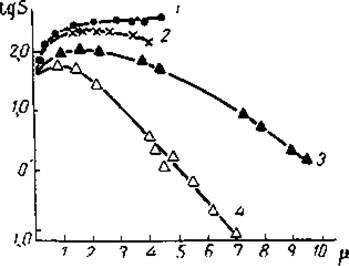
Fig. 49. Effect of various electrolytes on the solubility of carboxyhemoglobin (from Neurath and Bailey, 1956): 1 - NaCl, 2 - KCl, 3 - MgSO3, 4 - (NH4)2SO4; T = 25°
Summing up the above, we can conclude that protein solubility is a complex phenomenon for which only certain regularities have been studied in detail—namely, the dependence of solubility on solution pH and salt concentration.
Last update: 06/08/2026
Editorial and Educational Adaptation: This material has been compiled based on the primary/original source text. The project team performed an editorial review, corrected technical inaccuracies, structured sections, and adapted the content for an educational format.
What was processed:
- elimination of formatting defects (OCR errors, structural breaks, corrupted characters);
- editorial organization of content;
- standardization of terminology in accordance with academic sources;
- verification of factual statements against the original source text.
All mentions of the author, publication year, and origin of the primary text have been preserved in accordance with the source.