MODERN BOTANY - P. RAVEN - 1990
SECTION IX. ECOLOGY
CHAPTER 31. COMMUNITY AND ECOSYSTEM DYNAMICS
Ecology is the scientific Study of the interactions of organisms with one another and with their physical environment. It attempts to explain why particular plants and animals occur only in certain regions, why There are many organisms of one kind and few of another, what changes their interactions may cause in a given area, and how ecosystems function, particularly with respect to the formation and utilization of Organic compounds and the cycling of elements.
Some basic Structure/97.html">Definitions will be useful for our subsequent Discussion. A community consists of all the plants, animals, and other organisms living in a particular area. An ecosystem includes not only these living organisms (biotic factors) but also the nonliving (physical) elements of the environment with which they interact. Biomes are large-scale territorial complexes of communities characterized by distinct vegetation and climate, such as deserts or steppes. Major biomes are described in Chapter 32.
Interactions Among Organisms
No Organism in a community—whether in a forest, grassland, pond, or coral reef—exists in isolation from its surroundings. It interacts either with other living creatures or with environmental factors. This chapter will discuss three MAIN TYPES OF organismal interactions: mutualism, competition, and the relationships between plants and herbivores (phytophages).
Mutualism
Mutualism is a biological interaction that promotes the growth and survival of both partner species; that is, it is a form of Symbiosis. In nature, neither of these species can live without the other. A classic example of such symbiosis—Lichens—was already discussed in Chapter 13. Another example is the relationship between legumes and nitrogen-fixing Bacteria in their ROOT nodules (see Chapter 26). Mutualism also includes certain close relationships between pollinators and pollinated plants, as discussed in Chapter 29, such as the moth Tegeticula yucasella and the yucca.
One of the most interesting and ecologically important Examples of mutualism is the interaction between Fungi and vascular plants. As noted in Chapters 13 and 26, the roots of most of these plants form complex structures with fungi, known as mycorrhizae. Without them, normal plant growth would be impossible. Mycorrhizae apparently played a decisive role in the colonization of land by plants.
The more we learn about mycorrhizal associations, the clearer their importance to vascular plants becomes. In many species, non-mycorrhizal individuals are rare in nature, even though their growth might be possible without fungi under carefully controlled environmental conditions. Most vascular plants are "double" organisms in the same sense that lichens are, although this duality is generally imperceptible in their above-ground parts. In the words of soil scientist S. Wilde of the University of Wisconsin, "a tree extracted from the soil is only a part of the whole plant, surgically separated from its... absorbing and digestive organ." In most plants, mycorrhizal fungi play a vital role in the uptake of phosphorus and other essential nutrients.
The fungi that form mycorrhizae with the majority of plants belong to the Zygomycetes. As discussed in detail in Chapter 13, this type is called endomycorrhizae; it is characteristic of most grasses, shrubs, and trees. Certain groups of conifers and dicots—mostly trees—form mycorrhizae with Basidiomycetes as well as some Ascomycetes. In this case, we speak of ectomycorrhizae. Sometimes this relationship is highly specific: a single fungal species interacts only with a specific species of vascular plant or a group of related species. For example, the basidiomycete Boletus elegans is known to associate exclusively with larch (Larix) among conifers. Other fungi, such as Cenococcum geophilum, form mycorrhizae with over a dozen genera of forest trees. Ectomycorrhizae are particularly characteristic of relatively species-poor tree communities living in the high latitudes of the Northern Hemisphere or in alpine regions.
The most complex examples of mutualism are found in the tropics, where organismal diversity is much higher than in temperate regions. For instance, acacias (trees and shrubs of the genus Acacia) are widely distributed throughout the tropics and subtropics. The interactions between certain species of acacias on the plains of Mexico and Central America and the ants inhabiting their thorns provide a remarkable example of complex plant-animal interactions. These relationships are particularly evident in ants of the genus Pseudomyrmex (Fig. 31-2).
Class="center">Fig. 31-2. Ants and acacias. A. The base of a petiole of a compound leaf showing nectaries. B. Beltian bodies at the tips of leaflets of A. collinsii. C. Worker ants (Pseudomyrmex ferrugineus) attacking the tendrils of a liana entangled with A. cornicigera. Receiving all their nourishment from the acacia, the ants in turn eliminate all plants coming into contact with the tree and kill most other insects that attempt to feed upon it. D. An individual specimen of A. cornicigera towering above dense secondary vegetation on a tropical plain in Mexico. If ants had not colonized this plant, it would likely have perished at the seedling stage, shaded out by other plants or eaten by insects.


In these acacias, a pair of swollen thorns more than 2 cm long is located at the base of each leaf, nectaries are situated on the petioles, and small nutritive Organs called Beltian bodies are found at the tips of the leaflets. The ants live inside the hollow thorns, feeding on sugars from the nectaries and on the lipid- and protein-rich Beltian bodies. Acacias grow extremely rapidly and are particularly characteristic of disturbed areas where competition among fast-growing colonizing plants is often intense.
Thomas Belt was the first to describe the relationship between Pseudomyrmex and these trees in his book The Naturalist in Nicaragua, published in 1874. Following his observations, a long debate ensued as to whether the presence of ants genuinely benefits the acacias. This question was definitively settled in 1964 by D. H. Janzen, then a student at the University of California, Berkeley, and now a professor at the University of Pennsylvania. He discovered that worker ants swarming over the plant surface attack animals of any size that Touch it in any way, thereby simultaneously defending the acacia against herbivores while securing shelter and food for themselves and their brood. Furthermore, if the branches of another plant brush against the ant-occupied acacia, the ants strip their bark. As a result, these branches die off, securing access to light for the acacia surrounded by rapidly growing tropical vegetation.
When Janzen removed the ants (by poisoning them or breaking off colonized PARTS OF THE plant) or observed the rare acacias lacking these insects, he found that tree growth was severely retarded and the plants typically died within a few months due to insect damage or shading by other species. Conversely, acacias with ants grew very rapidly, soon reaching 6 m or more in height and shading out shorter plants. These ants nest exclusively on specific tree species and depend entirely on their nectaries and Beltian bodies as food sources. Thus, the ant-acacia system is as much a dual biological complex as, say, a lichen. Neither element can survive without the other in the community where this phenomenon evolved.
There are many Other types of mutualistic relationships linking organisms. For example, forest trees (as well as grasses) often have their roots naturally grafted together. As a result, nutrients are transferred from one plant to another in complex and completely unexpected ways, and the survival of a given species in a specific locality literally depends on the presence of another with which it forms such a connection. Tree stumps may live indefinitely, despite lacking photosynthetic organs, because they are root-grafted to other individuals and can receive nutrients from them. Certain diseases, such as oak wilt in the Midwest and eastern United States, can also be transmitted via these root grafts.
Competition
Unlike animals, plants obtain energy in only one way—through Photosynthesis. Consequently, competition among them is manifested primarily as a "struggle for light," and individuals typically growing in the shade of others have evolved various mechanisms enabling them to photosynthesize under low light intensities. Although competition for Water and nutrients also plays an important role, competition for light is much more intense among plants. Differences in height, leaf arrangement, and crown shape are the main factors allowing specific types of plants to adapt to diverse habitats within the same community, whether a shortgrass meadow or a tall-canopy forest. In animals, competition is more specific. In plants, the types of competition discussed here may occur even between species that happen to find themselves growing side by side. In most cases, seedlings are much more sensitive to competition than mature individuals of the same species.
Under experimental conditions, when two species coexist for a sufficiently long time in a homogeneous environment, one of them is invariably eliminated. Based on such observations and theoretical calculations, the view has emerged that in nature two species cannot coexist indefinitely in the same habitat while utilizing the same resources in the exact same way. This is a simplified expression of what Garrett Hardin termed the competitive exclusion principle. If two species grow together while consuming the same indispensable resources available in limited quantities, individuals of one or both species will be smaller or less numerous than if the species were growing separately. When the environment is sufficiently complex (as it invariably is in nature), different organisms can utilize it in different ways, essentially partitioning the habitats. Under these conditions, they can coexist indefinitely.
For example, in a bog, sphagnum mosses often form continuous carpets composed of several co-occurring species. How do they manage to coexist? A more careful analysis reveals semi-aquatic species growing along the bottoms of the wettest depressions, mosses occupying drier sites along the slopes of hummocks (in The formation of which they participate), and species tolerating only the driest conditions at the summits of hummocks, where they are eventually replaced by one or more species of flowering plants. Consequently, although all these mosses coexist in the sense of being present in the same bog, they actually occupy different microecotopes and constantly succeed one another in response to microenvironmental changes.
If the population densities of coexisting species are kept at a low level, they may not eliminate each other. This can be observed in England, where a severe epidemic of the viral disease myxomatosis catastrophically reduced the rabbit population in the twentieth century. Formerly, chalk grasslands were literally "mowed" by these mammals, allowing many dicotyledonous species to grow in such habitats. Following the decline in the rabbit population, the grass cover became taller and denser, and many previously abundant forb species became rare (Fig. 31-3). A similar effect is frequently observed when comparing grazed and ungrazed pastures, as well as in areas affected by natural disasters such as hurricanes. For this same reason, greater species diversity can be expected along the intertidal zone of seashores (where disturbances are constant) than in more stable habitats.
Fig. 31-3. Lullington Heath National Nature Reserve in East Sussex, England. Chalk grasslands before (A) and after (B) the death of rabbits due to myxomatosis. The first photograph was taken in 1954, the second in 1978. To restore herbaceous plant diversity, a sheep and horse grazing program was introduced across most of this 62-hectare reserve.

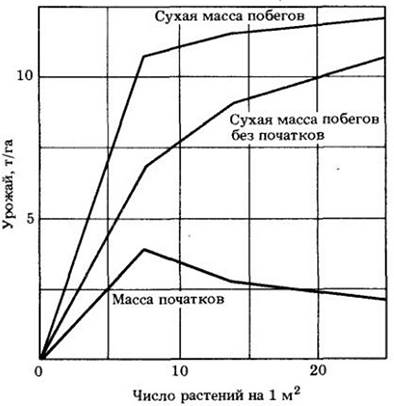
Most competitive situations are highly complex and involve both intra- and interspecific interactions. There are various ways to express the relative competitiveness of two species growing together. For example, Fig. 31-4 illustrates the dependence of crop dry weight per hectare on planting density in corn (Zea mays). As density increases, this yield (including shoots and ears) increases. However, when there are more than 7 plants per 1 m2, the mass of shoots without ears increases faster than the total plant mass due to a marked decrease in ear mass.
Fig. 31-4. Effect of plant density on the yield of corn (Zea mays), measured in three different ways. If the goal is to obtain the maximum dry mass of ears, the optimal number of plants per 1 m2 should be between 7 and 8.
Clonal propagation, which is important for many plants, sometimes makes it difficult to determine the boundaries of genetically identical individuals in nature. This, in turn, can hinder the assessment of their competitive relationships. Genetically identical individuals may be widely distributed across distant yet environmentally similar ecotopes within a complexly organized environment. This is typical not only of rhizomatous perennials (e.g., many grasses and sedges), but also of dandelions and other species whose seeds are formed asexually and contain embryos genetically identical to the parent plants, as well as plants like white clover (Trifolium repens), in which daughter individuals simply detach from the parent specimen.
In some types of competition, one or both competing organisms produce chemical substances that inhibit the growth of individuals either of their own species—thereby increasing the distance between them—or of another species. For example, the fungus Penicillium chrysogenum, growing on an organic substrate such as seeds, produces significant amounts of penicillin. This antibiotic suppresses the growth of bacteria directly competing with the fungus for nutrients. However, the bacterium Bacillus cereus, which produces penicillinase Enzymes that break down penicillin, often outcompetes this fungus.
Similar interactions among plants are often referred to as allelopathy. For example, a sort of dead zone typically lies between shrub and grassland communities along the California coast (Fig. 31-5). It is precisely here that rabbits, rodents, and birds—which find refuge in the bushes—forage most actively. If wire mesh prevents animals from entering this area, annual grasses flourish in this otherwise empty space (Fig. 31-6). In addition, certain shrubs, such as sage (Salvia leucophylla), produce volatile Terpenes that prevent the survival of seedlings of many species in their immediate vicinity. Consequently, seedlings cannot establish themselves in the "dead zone" even if a barrier keeps herbivores out, yet they often grow at the boundary between it and the undisturbed grassland, where the concentration of toxins produced by the sage is already low and the grass cover is not yet too dense.
Fig. 31-5. The shrubby sage Salvia leucophylla produces terpenes that evaporate, disperse through the air, and ultimately enter the soil, thereby suppressing the growth of other plants. The aerial photograph clearly shows a fringe of bare ground around the thickets of this species. Directly around the bushes lies the "dead zone," followed by a zone with a small number of low-growing annuals.

Fig. 31-6. When mammals (such as mice) are excluded from the "dead zone," annuals thrive right at the edge of the bushes in an area where they are normally absent. These results, presented by B. Bartholomew of the California Academy of Sciences, indicate that the existence of the dead zone may be entirely due to the action of herbivores, regardless of whether the plants produce toxins or not.

Plant-Herbivore Interactions
Vast areas of Australia were once covered by thorny thickets of the prickly pear cactus (Opuntia), introduced there from Latin America. As a result, fertile lands could not be used for grazing, and the economy of vast regions in the interior of the country suffered greatly. Today, Opuntia has been almost completely eradicated by the cactus moth (Cactoblastis cactorum), an insect discovered in South America and deliberately introduced into Australia. The larvae of this species feed on cacti. Once abundant in Australia, the cactus moth is now so rare that it is difficult to find even when specially inspecting the few remaining Opuntia thickets; nevertheless, there is no doubt that it continues to control the population size of this plant in Australia (Fig. 31-7).
Fig. 31-7. A. Dense thickets of prickly pear (Opuntia inermis) in a mixed shrub woodland in Queensland, Australia, October 1926. B. The same forest in October 1929, after the cacti were destroyed by the specially introduced South American cactus moth. First appearing in May 1925, the larvae of this insect destroyed cacti across more than 120 million hectares of pastureland.

Overall, both the short-term and long-term impacts of herbivores on plants are profound. As discussed in Chapter 29, these interactions have driven the evolutionary development of a wide range of defensive chemical compounds in plants, commonly referred to as "secondary plant metabolites." The ability of plants to produce toxins and accumulate them in their Tissues gives them a tremendous competitive advantage. Indeed, such chemicals appear to be a crucial factor controlling herbivorous insect populations in nature. This advantage is analogous to that provided by spines or tough, leathery leaves, and scientists working on improving crop resistance to herbivores are intensely studying these compounds. Given their role in terrestrial ecosystems, it is hardly surprising that substances with similar Functions have recently been found in many marine Algae, where they have been shown to protect the algae from being grazed by marine herbivores.
Plant-herbivore and plant-parasite interactions can be highly complex. For example, peas (Pisum sativum) are well protected against fungal parasites by pisatin, a substance they produce. However, many strains of the important parasitic ascomycete Fusarium contain monooxygenase enzymes that convert pisatin into a less toxic substance, thereby allowing them to infect this crop. Humans also use Monooxygenases to inactivate certain potentially hazardous substances. Thus, the "chemical warfare" between plants and herbivorous animals is ongoing.
Defensive compounds produced by plants are often unpalatable, but some repel herbivores through other mechanisms. Chromenes, for instance, can interfere with the insect juvenile hormone (necessary for a normal life cycle), acting essentially as true insecticides. The Mexican plant sneezeweed (Helenium spp.) produces helenalin, which acts as a strong insect repellent. Pyrethrins, first discovered in the daisy family (Pyrethrum), are a prime example of natural insecticides that are commercially extracted from Chrysanthemum, a genus closely related to pyrethrum. Even the waxy leaf surface, which is difficult to digest, can serve as an effective barrier against insects and fungi.
When plants are attacked by fungi or bacteria, they often defend themselves by producing Antibiotics called phytoalexins. The synthesis of these lipid-like substances can be triggered by simple leaf wounding. They appear to be produced in response to specific carbohydrate molecules called elicitors, which are components of fungal and bacterial Cell walls. Released from these walls by Enzymes of the infected plant, these molecules diffuse through its Cells like Hormones, ultimately binding to specific receptors on the Plasma Membranes and triggering metabolic changes that lead to phytoalexin synthesis. In principle, uninfected crops could be sprayed with elicitors, thereby protecting them against fungal or bacterial infection. Such a method would be analogous to human vaccination.
However, one difficulty is that the plant's energetic costs for synthesizing large quantities of phytoalexins may reduce final crop yields even more severely than parasites would. Nevertheless, understanding The Mechanism of phytoalexin production by plants is vital for crop protection, and some synthetic elicitors have already been developed and are currently being tested. Altering the GENETIC BASIS OF resistance, which is now possible through Introduction/32.html">Genetic Engineering techniques (see Chapter 30), opens up new avenues for enhancing herbivore resistance without increasing the organism's energetic costs.
Instead of phytoalexins, some plants produce Tannins and other Phenolic Compounds, which likely play a similar role in nature. When the gypsy moth (Lymantria dispar) defoliates oaks (Quercus spp.), the new leaves that subsequently emerge on the trees have a much higher concentration of tannins and other phenolic compounds. These leaves are much tougher and contain less water than the ones they replaced. These differences are significant enough that the new nutritional conditions stunt larval growth and thereby slow the growth of the moth population. Tannins probably hinder Digestion in insects by binding with plant Proteins and rendering them indigestible. Similar responses can be observed in other plants. For example, when snowshoe hares heavily browse certain trees and shrubs, such as paper birch (Betula papyrifera), the plants produce new shoots with significantly higher resin and phenolic content than before damage occurred.
Similar data were obtained by D. Rhodes of the University of Washington for willows and alders. Furthermore, Rhodes discovered that these trees appear to produce a volatile substance when attacked by gypsy moth caterpillars or when a significant portion of their leaf area is experimentally removed. This substance is presumably transmitted through the air from tree to tree, causing an undamaged tree—one that has had no direct contact with the damaged tree—to react as if it had been attacked by insects. In both cases, the plants produced elevated levels of phenolic compounds and tannins, which reduced their palatability to herbivores within 36 hours of the onset of damage (Fig. 31-8). However, despite ongoing research, this volatile substance has not yet been identified.
Fig. 31-8. Relative growth rate of larvae of the lackey moth feeding on the leaves of ten Salix sitchensis willow trees experimentally infested with colonies of these caterpillars on May 28, 1981, the leaves of ten nearby trees of the same species, and the leaves of twenty distant trees. Bottom: number of caterpillars recorded on the trees. The "palatability" of nearby trees (estimated by their ability to support caterpillar growth) dropped noticeably over time, whereas that of distant trees remained unchanged throughout the experiment.

The fact that plants can defend themselves by producing toxins must be taken into account in agriculture. For example, wild species of the gourd family (Cucurbitaceae) produce bitter terpenes in their fruits and leaves that deter most herbivores. In cultivated varieties, these substances are no longer produced because breeding has focused on improving fruit flavor, making the plants edible to pests. To protect them, special measures must be taken, such as spraying crops with insecticides. Cultivated watermelons (Citrullus vulgaris) are attacked by a much larger number of insects than their wild counterparts, and to preserve the harvest, these herbivores must be neutralized.
The process of pollination is a specific form of relationship between phytophages and plants, in which a certain part of the latter (most notably nectar) is consumed by the pollinating animal. In many aspects, this relationship takes the form of mutualism, as both partners benefit from it. Over the course of evolution, mechanisms for attracting phytophages developed, which, as described in Chapter 29, led to the immense diversity of angiosperm flowers. Under this form of Selection, both plants and animals adapted increasingly well to one another, giving rise to ever more specialized pollination systems.
Secondary plant metabolites ingested by phytophages may, in turn, play a significant role in their interactions with other animals. By accumulating such toxins in their tissues, certain insects become unpalatable to predators (Fig. 31-9). A number of sex attractants are obtained by insects from the plants they feed on; they concentrate these substances and subsequently use them to attract mates of the opposite sex.
Fig. 31-9. A. The monarch butterfly (Danaus plexippus) acquires cardiac Glycosides from plants of the milkweed family (Asclepiadaceae), upon which its caterpillars live and feed (B). As a result, the butterfly is unpalatable to birds and other vertebrates. It "warns" predators of this through the striking orange-and-black pattern of the adults, as well as the clearly visible white, yellow, and black stripes on the caterpillars. Even the pale-yellow, conspicuous eggs of the monarch contain sufficient cardiac glycosides to deter predators.

Ants inhabiting acacia thorns, which were mentioned earlier in our discussion of mutualism, play roughly the same role in the lives of these plants as secondary metabolites do—they protect the trees from phytophages. Interestingly, Acacia species that are typically not colonized by ants contain bitter compounds, whereas "ant-acacias" do not produce them. Thus, chemical compounds and insects perform essentially the same function.
Overall, the relationships among organisms within a community are exceedingly complex. Plants that occur together influence each other in endlessly diverse ways, only a few of which we are beginning to understand. It is unlikely that the survival of a species depends on The Fate of an individual organism; rather, its success in a particular habitat is determined by a group of interconnected individuals and the TYPES OF RELATIONSHIPS existing among them.
Nutrient Cycling
From the standpoint of nutrient (biogen) supply, an ecosystem is more or less self-sustaining. One of the most important reasons for this autonomy is the constant cycling of chemical elements between organisms and their environment. The pathways of certain elements essential to life, known as biogeochemical cycles, were discussed in Chapter 26. Ideally, nothing is lost, and the total pool of nutrients is continually replenished and remains available to organisms. The rate of flow from the abiotic environment to organisms and back, the available quantity in the physical environment, and the chemical form in which an element resides vary considerably from one element to another.
nutrient cycling in a forest ecosystem.
Studies of deciduous forest ecosystems have shown that plants within this community serve as the primary reservoirs of biogens. Research was conducted at the Hubbard Brook Experimental Forest (White Mountain National Forest, New Hampshire). Initially, a method was developed to determine the "mineral budget"—that is, the input and loss of an element—in various sectors of the community. By analyzing the nutrient content of rain and snow, the first parameter could be estimated, while constructing concrete dams to collect runoff water from selected plots allowed for the measurement of the second (Fig. 31-10). The site was exceptionally well-suited for such an experiment: the underlying bedrock lay immediately beneath the soil surface, resulting in very little leaching (soil water percolated to only a shallow depth).
Fig. 31-10. A weir in the Hubbard Brook Experimental Forest (New Hampshire). Water draining from each of the six study ecosystems was collected in catchments (such as the one shown in the photograph) as it flowed from the area, and its chemical composition was analyzed. The trees and shrubs in the watershed above this dam were subsequently felled. Experiments demonstrated that such deforestation significantly increases ecosystem nutrient losses.

The researchers found that an intact forest is extremely efficient at retaining mineral elements. For instance, the annual net loss of calcium from this ecosystem was 9.2 kg/ha, or merely 0.3%. The ecosystem accumulated nitrogen at a rate of 2 kg/ha per year. The net input of potassium was similar, though somewhat lower.
In the Hubbard Brook forest, the biological regulation of nutrient cycling was tested in the following manner. During the winter of 1965/66, all trees, understory vegetation, and shrubs within a 15.6-hectare watershed were cut down, leaving the organic matter in place without disturbing the soil. The following spring, the area was treated with herbicides to suppress plant growth. For a four-month period, from June to September 1966, surface runoff from this plot was four times higher than in previous years. Net calcium losses were 20 times greater, and potassium losses 21 times greater, than those observed in the undisturbed forest. The most dramatic changes occurred in The Nitrogen Cycle. The tissues of dead plants and animals continued to decompose into ammonia (or ammonium ions), which nitrifying bacteria converted into nitrates—the form in which this element is typically assimilated by plants. However, in the absence of vegetation, nitrates were not retained in the soil. Net nitrogen losses averaged 120 kg/ha per year from 1966 to 1968. A secondary consequence was algal "blooms" in the streams draining the area; contaminated by nitrates, the concentrations in these waters exceeded the safe drinking water standards established by the U.S. Public Health Service.
Nitrogen is not always lost from disturbed forest ecosystems as rapidly as it was at Hubbard Brook. The actual rate of this process depends on the specific dynamics of the nitrogen cycle within the particular community prior to disturbance. For example, if the microbial demand for the nitrogen released following deforestation is high, nutrient losses may not be nearly as severe as in the case examined here.
TROPHIC LEVELS
In addition to abiotic (nonliving) components, every ecosystem comprises two biotic (living) components—autotrophs and heterotrophs. Autotrophs are primarily photosynthetic organisms capable of utilizing solar energy to synthesize their own organic compounds. Because heterotrophs cannot do this, they must rely on organic molecules produced by autotrophs. Heterotrophs make up several feeding, or trophic, levels. These include, first, primary consumers (herbivores), which feed directly on autotrophs. Second are secondary consumers (carnivores and parasites), which consume other animals. Finally, decomposers (reducers), including fungi, bacteria, and various small animals, break down organic matter into inorganic substances. All of these levels are present in most ecosystems.
Organisms across all trophic levels form what is known as a food chain (Fig. 31-11). The relationships among organisms within food chains regulate the flow of energy through the ecosystem. The length and complexity of such chains vary widely. Typically, each organism has multiple food sources and is itself consumed by several other organisms. In most cases, it is more accurate to speak of a food web (Fig. 31-12). The complexity of trophic interactions exerts a profound influence on The properties of the ecosystem as a whole.
Fig. 31-11. A food chain. An ornate box turtle (Terrapene carolina triunguis) feeds on a snail, which in turn feeds on fungi that decompose organic matter in the soil.

Fig. 31-12. Food web of the Atlantic herring (Clupea harengus) in the North Atlantic, illustrating the complexity of trophic interactions.

In an ecosystem, this flow typically originates with solar radiation captured during photosynthesis and used to synthesize carbohydrate molecules. Energy does not cycle within ecosystems; rather, it is transferred from autotrophs (typically photosynthetic organisms such as plants, algae, and certain bacteria) to consumers (animals and heterotrophic protists), and subsequently to decomposers. At each stage, the greater part of this energy is dissipated as heat, eventually returning to outer space in the form of infrared radiation.
An enormous amount of biomass is produced on the planet annually. This term refers to organic matter as a whole, including the woody parts of trees, stored nutrient reserves, bones, etc. Currently, global biomass production is estimated at 200 billion metric tons per year. Despite this massive figure, the efficiency with which photosynthetic organisms convert solar energy into organic matter is relatively low. Plants typically utilize less than 1% of the light radiation falling upon them (see Chapter 5). However, certain exceptionally productive plant communities and aquatic systems can convert up to 3% of the incident solar radiation into chemical energy each year.
When organic matter synthesized by plants is consumed by herbivores, energy is released. Most of it is lost as heat, but a portion of the ingested organic matter is converted into animal tissue. Typically, only 2 to 10% of the plant's assimilable energy is added to the herbivore's biomass—the rest is lost to Respiration. Similar consumption-to-loss relationships are found at each subsequent trophic level. Thus, if plants absorb an average of 1,500 cal of solar energy per 1 m2 of land surface daily, only about 15 cal is converted into plant matter. Of this amount, about 1.5 cal forms the bodies of herbivores and approximately 0.15 cal forms the bodies of carnivores that feed on herbivores.
L. Slobodkin of Cornell University, studying Cayuga Lake, calculated that out of every 1,000 cal of solar energy utilized by algae, about 150 cal is transferred to small aquatic animals and 30 cal to smelt (a small fish). If you eat this smelt, you can obtain 6 cal of the original 1,000 assimilated by the algae. However, if a trout eats the smelt and we then eat the trout, we get only 1.2 cal out of those 1,000. Obviously, we would obtain more energy by eating the smelt rather than the trout, but trout is a delicacy, whereas smelt is less appealing to humans as food. During times of famine, people should switch entirely to a plant-based diet, thereby avoiding the tenfold loss of energy resulting from feeding plants to animals. To maximize The Use of solar radiation captured by plants, we must become herbivores.
Food chains are usually limited to three or four links; The amount of food remaining at the end of a longer chain is so small that it can sustain very few organisms. Body size also influences The structure of food chains. For example, animals at a given link must generally be large enough to prey upon animals of the preceding trophic level. However, most of the biomass in an ecosystem is utilized by decomposers, particularly fungi and bacteria, which ensure the recycling of nutrients.
As follows from the relationships just discussed, the total biomass typically decreases sharply with the transition to the next trophic level of the ecosystem, giving rise to the so-called "pyramid of biomass" (Fig. 31-13). These relationships sometimes fail to hold if there is rapid turnover of primary producer populations, such as algae in a lake. In such cases, the turnover rate becomes critical, and the total biomass of that level at any given moment may be relatively low. When measured in terms of energy, it turns out that energy decreases just as rapidly with increasing trophic level as biomass does—that is, a "pyramid of energy" exists, with a much smaller total sum in the bodies of all predators present in a given community than in all plants, for example. As a rule, there are always far more individuals at lower trophic levels than at higher ones, meaning we can also speak of a "pyramid of numbers." It also follows that if all organisms in an ecosystem are divided into size classes, small animals will be far more numerous than large ones.
Fig. 31-13. Pyramids of biomass (A), energy (B), and numbers in various communities. A relatively small amount of mass and Energy is transferred to each higher level.

The practical aspect of studying energy flows in ecosystems is tied to humanity's efforts to create renewable Energy Sources from plants (so-called biological energy conversion). It has been estimated that the vast amount of waste generated annually after harvesting or logging could provide energy equivalent to 1% of the gasoline or 4% of the electricity consumed in the U.S. annually. However, this potential is limited by the energy costs of gathering the material. Planting fast-growing trees and other plants could provide a major renewable energy source in the future and become one of the most efficient ways to harness solar energy.
Community and Ecosystem Development
Succession
Some plant communities remain stable for many years, while others change rapidly. In the latter case, predictable shifts occur in their composition, known as succession. A forest clearing is rapidly colonized by surrounding trees; similarly, a meadow eventually gives way to a forest. Analogous phenomena are observed in natural open habitats—in lakes, on rocky slopes, and so on. The process of succession is continuous and occurs across the entire planet.
The rate of succession in all temporarily vacant areas varies. Some lakes, for example, gradually fill with the remains of aquatic plants; species emerging from the water form soil, and the body of water turns into a meadow where moisture-loving shrubs may appear and, finally, a forest typical of that natural zone can develop (Fig. 31-14). Rocks weather and break down under the action of freezing, thawing, and other physical factors; this process is sometimes accelerated by lichens that secrete specific chemicals that directly etch the rock. Soil accumulates around the bases of the lichens, after which they give way to mosses and flowering plants (Fig. 31-15). The roots of flowering plants widen cracks in the rock, breaking it down further. Eventually, perhaps after hundreds of years, this fragmentation produces soil that is colonized by forest or other vegetation characteristic of the area. In the Cytology/cytology/16.html">Early stages of succession, plants that form symbioses with nitrogen fixers often predominate. Other examples are shown in Fig. 31-16.
Fig. 31-14. A. Submerged vegetation along the edge of a lake. B. Plants with floating leaves, such as the water lily (Nymphaea odorata), spreading across The surface of the body of water and gradually crowding out bottom-dwelling species. C. Water hyacinth (Eichhornia odorata) plays a similar role in warmer regions. D. Marsh grasses, sedges, and cattails (Typha spp.) at the site of an overgrown lake complete the succession.

Fig. 31-15. Early stage of succession on a rocky slope. Lichens begin to break down the rock, while ferns and bryophytes accumulate soil in small crevices.

Fig. 31-16. A. Young balsam fir trees (Abies balsamea) growing beneath trembling aspen (Populus tremuloides) and replacing them in northern Minnesota; a stage of forest succession leading to a climax community of white spruce (Picea glauca) and balsam fir. B. A red maple seedling (Acer rubrum) rising above the pine needles of an eastern white pine (Pinus strobus). Mature pines of this species let in so little light that their own seedlings fail to survive beneath them, and only the understory of shade-tolerant species, such as maples and oaks capable of establishing themselves there, persists. On the other hand, succession is inhibited by the suppression of soil nitrogen-fixing bacteria due to chemical substances leached from fallen pine needles.

Every ecosystem goes through various stages of succession until a "mature" or so-called climax community arises. Although The Nature of this final state depends on climate, climax communities are often much more stable than those they replaced. The organisms within them form highly complex networks of interactions.
Some aspects of succession are of paramount importance to humans. For example, when European settlers first arrived in large numbers in California, they encountered majestic sugar pine (Pinus lambertiana) forests along most of the Sierra Nevada range. Later, despite conservationists' efforts to turn some of these forests into national parks, many pine communities were replaced by other species, notably white fir (Abies concolor) and incense cedar (Calocedrus decurrens). Why did this happen?
The fact is that the sugar pine was an element of a specific stage of forest succession in that area, and this stage was maintained by periodic fires. Following the arrival of Europeans, the scale and frequency of fires decreased significantly. Without periodic low-intensity thinning fires that "swept" through the pine stands, thickets of shrubs and small trees grew so dense that the light-requiring pines were unable to regenerate. Only a system of prescribed Burns can preserve the remaining sugar pine forests in their original state (Fig. 31-17, B).
Fig. 31-17. A. Following a forest fire, secondary succession begins—that is, the recovery of vegetation from the nearest fire-unaffected areas. Some plants resprout from their bases, while others dis
perse large quantities of seeds over the burn area. In one group of pines, cones do not open and release their seeds until acted upon by fire (see also Fig. 19-7). B. Sugar pine in the southern Sierra Nevada of California. Following the cessation (due to human efforts) of forest fires, this species is being replaced by other trees, such as incense cedar (Calocedrus decurrens) (the massive tree on the right in the photograph).

Recolonization
When humans transform the landscape, changes occur in community structure. On abandoned fields, bare sand dunes, and the streets of deserted towns in the American West, succession proceeds toward ecosystems that more or less resemble those found in adjacent, less disturbed areas (Fig. 31-18). Given enough time, the successional process can gradually lead to the restoration of native vegetation. For example, it is estimated that in the northern deciduous forests of North America and Eurasia, 60 to 80 years are required to restore the plant biomass and nutrients removed by tree harvesting. In other communities, this process may proceed faster or slower. In any case, its success requires significant time and a seed source for recolonization. In many regions, especially in the tropics, these conditions are lacking due to the severe impact exerted on vegetation by rapidly growing populations and general poverty (see Chapter 30).
Fig. 31-18. A. Loblolly pine (Pinus taeda) forest in an experimental plot at the Tall Timbers Research Station near Tallahassee, Florida. The last controlled burn in this area was conducted on March 23, 1967. B. In the absence of fire, succession proceeds rapidly here. The photograph was taken at the same Location in 1982.

Following natural disasters, recolonization leads to similar changes. For example, in August 1883, a massive volcanic eruption destroyed half of Krakatoa Island in the Sunda Strait (40 km from Java), while its remaining half was covered with a layer of pumice and ash more than 31 m thick. Neighboring islands were also buried, causing the complete destruction of their flora and fauna. However, recolonization of Krakatoa began shortly thereafter, and the expected number of species (based on initial avifaunal diversity)—about 30 species of land and freshwater birds—recovered within approximately 30 years. Plant colonization also proceeded rapidly: by 1934, more than 270 plant species had been recorded on the island.
In Washington State (USA), during the violent eruption of Mount St. Helens on May 18, 1980, a massive avalanche of volcanic material from the summit and northern slope of the mountain rushed into the North Toutle River valley. Within 15 minutes, more than 61,000 ha of forest and recreational areas were devastated by a lateral blast that blew down timber across 21,000 ha and killed standing trees and other vegetation across another 9,700 ha. In addition, the nine-hour eruption blanketed the entire area with a half-meter layer of ash, pumice, and rocks hurled by the blast (Fig. 31-19).
Fig. 31-19. The latest eruption of Mount St. Helens in Washington State occurred on May 18, 1980. A. Productive forests of Douglas-fir (Pseudotsuga menziesii), western hemlock (Tsuga heterophylla), and the firs Abies amabilis and A. procera blown down by the lateral blast. B. A thick layer of volcanic material was deposited across an area of over 60 km2. C. In the summer of 1980, numerous perennial grasses, particularly fireweed (Epilobium angustifolium), sprouted through the ash. This photograph was taken one year after the eruption. D. Douglas-fir and many other plants with wind-dispersed seeds recolonized areas covered by volcanic deposits so deep that the underlying vegetation was killed. This photograph was taken in 1984.

Life began to return to the eruption-affected slopes almost immediately, but plants were able to pierce the thick layer of volcanic deposits only by the following spring. Most of these deposits were soon eroded, allowing wind-dispersed seeds and fruits to reach the area. This influx was particularly crucial for regions covered with avalanche debris and hardened volcanic lava mixed with ash so heavily that the buried vegetation perished. Many small animals survived both underground and in lakes and streams; vertebrates soon returned to these lands as well. Over the past 35 centuries, the intervals between eruptions of this volcano have ranged from 100 to 150 years; consequently, the Nature of the damage and the recovery processes observed by scientists after 1980 are typical of natural phenomena that periodically affect living systems in volcanic regions.
The events following the eruption of Mount St. Helens serve as a striking example of succession, but we must remember that it is typical of all communities and occurs worldwide. It is one of the key factors maintaining biological diversity on our planet.
An ecosystem is the highest level of biological complexity and integration. It is a solar-powered, self-sustaining complex in which the regulated cycling of essential nutrients takes place. Within ecosystems, communities of organisms interact with their physical environment.
Some of the interspecific interactions within communities can be grouped into three main categories: mutualism, competition, and plant-herbivore interactions. Mutualism benefits both interacting populations. Examples include the formation of lichens, The Development of nitrogen-fixing bacteria in root nodules of legumes, mycorrhizal associations between fungi and vascular plant roots, and the close coadaptation of certain flowering PLANTS AND THEIR pollinators.
Competitive interactions are established for most co-occurring plants. One of the most important forms is competition for light. Plants also produce chemical defense compounds that inhibit the growth of neighboring species. Such allelochemic interactions play a major role in shaping the future structure of communities.
Herbivores regulate plant population growth by consuming their photosynthetic, storage, or reproductive organs. Plants counteract these injuries by evolving spines, tough leaves, or, most importantly, chemical defenses. When an insect develops resistance to plant toxins, it not only gains a new and often largely untapped food source but may also utilize these plant-produced compounds to protect itself from its own enemies. Pollination interactions represent a special case of plant-herbivore relationships, where attracting the visitor is more important than deterring it. Some plant-herbivore interactions are largely mutualistic, such as the obligate associations between thorn acacias and their inhabiting ants in eastern Mexico.
An ecosystem consists of abiotic components and Two Types of living organisms: autotrophs and heterotrophs. Among heterotrophs, a distinction is made between primary consumers (herbivores), secondary consumers (carnivores and parasites), and, finally, decomposers. Organisms at these trophic levels are linked into food chains or webs.
As energy flows through ecosystems, roughly 0.1 to 1% of incident solar energy is converted by green plants into chemical bond energy. When plants are consumed by animals, about 2 to 10% of that energy is transferred to the next trophic level; further energy transfers along the food chain proceed with similar efficiency. The amount of energy remaining after several such steps is so small that food chains rarely comprise more than three or four links.
Successions occur in areas devastated by artificial or natural causes or upon the appearance of new substrates, such as cooled volcanic lava, rock outcrops, or sandy and gravelly river islands. During succession, PLANT AND ANIMAL species gradually replace one another; some are characteristic only of its early stages, while others are restricted to later stages. The amount of organic matter accumulated by organisms during succession increases, species diversity within the ecosystem rises significantly, and interspecific relationships become increasingly complex. Peak production is observed fairly early, whereas respiration rates increase rapidly during later stages. Ultimately, succession leads to a climax community that can perpetuate itself indefinitely barring major environmental disruptions.
Appendix 1. Pesticides and Ecosystems
In the United States alone, approximately 0.5 billion tons of pesticides are produced annually for crop protection. It has been estimated that of this huge quantity, only about 1% actually affects pest organisms, while the rest either penetrates the soil, water, and other organisms within the same ecosystem or is transported to neighboring ecosystems, which can severely impair their functioning. For instance, the extinction of certain species is entirely possible, sometimes leading to the disruption of ecosystem functioning as a whole or indirectly to the disappearance of other species. Populations of vital decomposers, such as earthworms or other soil organisms, can be so depleted by pesticides that the ecosystem as such ceases to function. The severity of such an impact depends on the toxicity of the chemicals and their persistence in the environment.
One of the Problems associated with certain chemical pollutants is their tendency to biomagnify as they move up food chains, reaching maximum concentrations at the highest trophic levels—in the bodies of top predators. For example, organochlorine pesticides, particularly DDT (currently banned by law in the USA and other developed countries), accumulated in the tissues of birds of prey, causing abnormal thinning of their eggshells. Such eggs frequently cracked long before hatching, significantly reducing species fecundity. Furthermore, many populations of insects, bacteria, and fungi have developed resistance to the pesticides intended to control them. It is estimated that out of 2,000 major pest insect species, about a quarter already include populations insensitive to one or more insecticides. Similarly, a number of weed species have evolved resistance to herbicides (see Chapter 30).
Other impacts are less direct. For instance, beneficial predators that naturally maintain low pest populations may be killed by pesticide poisoning, triggering population outbreaks of the very species those chemicals were meant to control. As with most anthropogenic interventions, the overall result of pesticide application is a reduction in The Diversity of the ecosystems affected. Despite these complications, high-yield agriculture currently depends heavily on the use of such chemicals.
However, because their effects are often dramatic, scientists are actively seeking alternative Methods of pest management. These include breeding pest-resistant crop varieties (utilizing genetic engineering techniques described in the previous chapter), developing less toxic and less persistent pesticides than those currently in use, integrated pest management programs incorporating predators and pest pathogens, and rational pesticide application protocols.
Appendix 2. Defense Systems of Solanaceous Plants
Many plants of The Nightshade family (Solanaceae), which includes crops of major economic importance such as potatoes (Solanum), tomatoes (Lycopersicon), and tobacco (Nicotiana), have evolved glandular trichomes as a primary defense against insect pests, secreting sticky and in some cases toxic fluids. Cultivated potatoes (Solanum tuberosum) lack such hairs, but some of their wild relatives (e.g., Solanum berthaultii) are densely covered with them on their leaves and stems. Becoming entrapped in the sticky secretions, insects are effectively caught and gradually die of exhaustion. This defense mechanism is effective against many species, including major potato pests such as aphids, flea beetles, and leafhoppers. Efforts are currently underway in several countries to introduce these trichomes into high-yielding cultivated potato varieties, which readily hybridize with S. berthaultii.
Glandular trichomes are only one element of the solanaceous defense arsenal. The leaves of plants in this family are rich in Alkaloids such as nicotine, atropine, and hyoscyamine, which are toxic to many herbivores and account for the hallucinogenic properties of jimsonweed (Datura stramonium) and other nightshades. Steroidal glycosides found in their leaves also deter many herbivores from feeding while simultaneously stimulating feeding in insects specialized on this plant family. As mentioned in the previous chapter, certain Solanum species are currently being investigated as a potential source of steroid molecules for The production of contraceptives. In addition, as demonstrated by C. Nelson of Washington State University, tomatoes and potatoes subjected to severe localized wounding synthesize two distinct, highly concentrated proteinase inhibitors within four hours—two enzymes that disrupt herbivore digestion. Inhibitor concentrations remain unchanged for another 5 hours before dropping sharply.
A scanning electron micrograph (A) shows a glandular trichome on a leaf of Solanum berthaultii. The sticky substance is released when its four-lobed HEAD ruptures upon contact with an insect. Other micrographs obtained using the same Microscope (B, C, D) show (at increasing magnifications) an aphid (Myzus persicae) trapped on the stem of S. berthaultii by the sticky exudate from this trichome.

Last update: 07/08/2026
Editorial and Educational Adaptation: This material has been compiled based on the primary/original source text. The project team performed an editorial review, corrected technical inaccuracies, structured sections, and adapted the content for an educational format.
What was processed:
- elimination of formatting defects (OCR errors, structural breaks, corrupted characters);
- editorial organization of content;
- standardization of terminology in accordance with academic sources;
- verification of factual statements against the original source text.
All mentions of the author, publication year, and origin of the primary text have been preserved in accordance with the source.