Principles of Biochemistry, Volume 2 - A. Lehninger 1985
Bioenergetics and Metabolism
Glycolysis: The Central Pathway of Glucose Catabolism
Chapter Summary
Glycolysis, in which a D-glucose molecule is broken down into two Pyruvate molecules, serves as a central metabolic pathway for most organisms, used to generate chemical energy in the form of ATP. Under anaerobic conditions, pyruvate is reduced to lactate in most animal and plant Tissues, whereas in Yeast Cells it is converted to ethanol and CO2 during Alcoholic Fermentation. The overall equation for anaerobic glycolysis in Muscles and for Lactic acid fermentation, carried out by certain microorganisms, is written as follows:
Class="center">
The process of alcoholic fermentation is described by the overall equation

In aerobic cells, pyruvate is not reduced to lactate (or to ethanol and CO2); instead, it is oxidized to acetyl-CoA and CO2. Thus, in many organisms, glycolysis constitutes an essential preliminary stage of aerobic Glucose Catabolism.
The conversion of glucose to pyruvate is catalyzed by a sequential set of ten Enzymes. This transformation consists of two phases. In The first phase, comprising five enzymatic reactions, D-glucose is phosphorylated at the expense of ATP and ultimately cleaved into two molecules of D-glyceraldehyde 3-phosphate. In the second phase, glyceraldehyde 3-phosphate is oxidized by NAD+ and accepts inorganic phosphate to yield 3-phosphoglyceroyl phosphate. The high-energy phosphate group of 3-phosphoglyceroyl phosphate is then transferred to ADP, yielding ATP and 3-phosphoglycerate, which subsequently undergoes isomerization to form 2-phosphoglycerate. Enolase-catalyzed dehydration of 2-phosphoglycerate produces phosphoenolpyruvate, which then transfers its phosphate group to ADP, yielding free pyruvate. The first phase of glycolysis consumes two molecules of ATP, whereas the second phase produces four molecules of ATP from ADP, resulting in a net yield of two ATP molecules per cleaved glucose molecule. In animal tissues lacking oxygen, the NADH generated during The oxidation of glyceraldehyde 3-phosphate is reoxidized to NAD+ by reducing pyruvate to lactate, a reaction catalyzed by Lactate dehydrogenase.
The glucose residues that make up Glycogen and starch are converted to glucose-6-phosphate through the action of Glycogen phosphorylase or starch phosphorylase and phosphoglucomutase. Other hexoses—specifically fructose, mannose, and galactose—are also phosphorylated and thus enter glycolysis as intermediates. The entry of glucose into The Glycolytic Pathway, mediated by hexokinase, is regulated by glucose-6-phosphate, which acts as a negative modulator. Glycogen phosphorylase, which catalyzes the conversion of glycogen glucose units to glucose-1-phosphate, is a regulatory enzyme existing in two forms: a more active form (phosphorylase a) and a less active form (phosphorylase b); phosphorylase b is stimulated by AMP. Phosphofructokinase Functions as the principal regulatory enzyme in the glycolytic sequence; it is inhibited by ATP and citrate and stimulated by AMP. The pyruvate kinase reaction serves as a second regulatory locus of glycolysis. The reactions of alcoholic fermentation are identical to those of glycolysis up to The formation of pyruvate; however, in alcoholic fermentation, pyruvate is not reduced to lactate, but rather undergoes decarboxylation to form acetaldehyde, which is subsequently reduced to ethanol by NADH in a reaction catalyzed by Alcohol dehydrogenase.
Books
Atkinson D. E. Cellular METABOLISM/26.html">Energy Metabolism and Its Regulation, Academic, New York, 1977. An insightful Treatment of cellular energetics and the Regulation of glycolysis.
Dickens F., Randle P. J., Whelan W. J. Carbohydrate Metabolism and Its Disorders, 2 vols., Academic, New York, 1968. A comprehensive collection of review articles.
Fruton J. S. Molecules and Life, Wiley, New York, 1972. Contains a detailed historical account of research on glycolysis. Hochachka P. Living without Oxygen, Harvard University Press, Cambridge, Mass., 1980. Comparative biochemistry and physiology of anaerobic glycolysis across various organisms.
Kalckar H. M. (ed.). Biological Phosphorylations: Development of concepts, Prentice-Hall, Englewood Cliffs, N.J., 1969. Features classic papers on glycolysis.
Lehninger A. L. Biochemistry, 2d ed., Worth, New York, 1975. (Russian Translation: Lenindzher A. Biokhimiya. - M.: Mir, 1976.) Chapter 16 provides detailed information on glycolysis.
Newsholme E. A., Start C. Regulation in Metabolism, Wiley, New York, 1973. Chapters 3 and 6 cover The regulation of glycolysis.
Articles
Coulson R. A. Anaerobic Glycolysis: The Smith and Wesson of the Heterotherms, Perspec. Biol. Med., 22, 465-479 (1979). A highly engaging Analysis of the comparative role of anaerobic glycolysis in large animals, based on experimental observations in alligators and other species.
Ottaway J. H., Mowbray J. The Role of Compartmentation in the Control of Glycolysis, Curr. Topics Cell Regulation, 12, 108-195 (1977).
1. Equation for the first phase of glycolysis. Write the material balance equations for The sequence of reactions through which D-glucose is cleaved into two molecules of D-glyceraldehyde 3-phosphate (the first phase of glycolysis). Specify the Standard Free energy change for each equation. Also, write the overall equation for the first phase of glycolysis and state the corresponding overall standard free energy change.
2. Second phase of glycolysis in Skeletal Muscle. In active skeletal muscle under anaerobic conditions, glyceraldehyde 3-phosphate is converted to lactate (the second phase of glycolysis). Write the material balance equations for the reaction sequence in this process, indicating the standard free energy change for each reaction. Also, write the overall equation for the second phase of glycolysis and state the overall standard free energy change for this phase.
3. Fructose Metabolism in spermatozoa. The fructose concentration in human and bovine seminal plasma is approximately 12 mM. In spermatozoa, ATP required for flagellar motility is generated via the anaerobic breakdown of fructose. The principal catabolic pathway from fructose to lactate in these cells bypasses the phosphofructokinased-catalyzed step of glycolysis, utilizing instead an enzyme that cleaves fructose 1-phosphate into two three-carbon units (Fig. 15-8). Write the equations for the corresponding sequence of chemical transformations. Also, write the overall equation for the anaerobic catabolism of fructose (its conversion to lactate) in spermatozoa.
4. Carbon atom pathway in fermentation. A pulse-chase isotope experiment is performed on a yeast extract under strictly anaerobic conditions to ensure alcoholic fermentation. A small amount of radiolabeled substrate (pulse) is incubated with the yeast extract for a sufficient time for each intermediate in the metabolic pathway to incorporate the label. The label is then "chased" through the entire pathway by adding an excess of unlabeled substrate. This is done to prevent labeled products from participating in reverse reactions or being diverted into alternative metabolic pathways.
a) At which position will the label appear in the fermentation product, ethanol, if the substrate is glucose labeled with 14C at position 1? Why?
b) At which position must the label be located in the starting glucose molecule for all of the 14C radioactivity to appear as 14CO2 released during alcoholic fermentation? Explain your answer.
Problem 4

5. Relationship between the kinetic Properties of Enzymes and their physiological functions. The concentration of glucose in mammalian cells is low compared to its concentration in Blood Plasma. This is because glucose uptake into cells is regulated, and glucose is rapidly phosphorylated via a reaction with ATP

In the mammalian body, this reaction is catalyzed by two different enzymes that differ markedly in their properties. Skeletal muscle contains only one of them: hexokinase. This enzyme is inhibited by glucose-6-phosphate and has a KM value of 0.1 mM. In the Liver, In addition to hexokinase, glucokinase is also present and predominates. Glucokinase has a much higher KM value (10.0 mM) and is not inhibited by glucose-6-phosphate. What is The Significance of the difference in KM values between muscle hexokinase and liver glucokinase? How should the differences in The properties of these two enzymes (the KM value and The ability to be inhibited by glucose-6-phosphate) affect their physiological roles in muscle versus liver?
6. The role of lactate dehydrogenase. During strenuous exercise, Muscle tissue consumes much more ATP than at rest. In white skeletal muscles, such as the leg muscles of a rabbit or the wing muscles of a turkey, almost all of this ATP is generated through anaerobic glycolysis. As shown in Fig. 15-5, ATP is produced in the Second Stage of glycolysis via two enzymatic Reactions Catalyzed by phosphoglycerate kinase and pyruvate kinase. Imagine that skeletal muscle lacked lactate dehydrogenase. Would the muscle still be able to perform strenuous work—i.e., rapidly generate ATP via glycolysis? Provide a reasoned argument for your answer. Keep in mind that the lactate dehydrogenase reaction does not require ATP. A clear understanding of the answer to this question is crucial for grasping the glycolytic cycle as a whole.
7. Arsenate poisoning. Structurally and chemically, arsenate resembles phosphate (Pi); consequently, many enzymes that require phosphate can also utilize arsenate. However, organic derivatives of arsenic acid are much less stable than the corresponding phosphoric acid derivatives. For example, acyl arsenates readily decompose without catalysts:

In contrast, Acyl phosphates—such as 3-phosphoglyceroyl phosphate—are more stable and undergo intracellular transformations only in the presence of appropriate enzymes.
a) How would the replacement of phosphate by arsenate affect the overall reaction catalyzed by glyceraldehyde-3-phosphate dehydrogenase?
b) What are the consequences of replacing phosphate with arsenate? Arsenate is extremely toxic to most organisms. How can this be explained?
8. Phosphate requirement in alcoholic fermentation. In 1905, Harden and Young published a series of classic studies on alcoholic fermentation. By investigating the fermentation of D-glucose to ethanol and CO2 by brewer's yeast extracts, the researchers established the following: 1) Inorganic phosphate is essential for fermentation; once the phosphate supply is exhausted, fermentation ceases even before all the glucose is consumed. 2) Under these conditions, fermentation leads to the accumulation of ethanol, CO2, and hexose diphosphate. 3) If phosphate is replaced by arsenate, hexose diphosphate does not accumulate, but fermentation continues until all the glucose is converted into ethanol and CO2.
a) Why does fermentation stop when the phosphate supply is depleted?
b) Why do ethanol and CO2 accumulate? Is the conversion of pyruvate into ethanol and CO2 necessary? Why? State which hexose diphosphate accumulates, and explain why it does so.
c) Why does substituting arsenate for phosphate prevent the accumulation of hexose diphosphate while still allowing fermentation to go to completion—i.e., the full conversion of glucose into ethanol and CO2 (see section 7)?
9. Glycerol metabolism. Glycerol, generated during The breakdown of fats, is converted via two enzymatic reactions into the glycolytic intermediate dihydroxyacetone phosphate. Propose a plausible sequence of reactions for glycerol metabolism. Which well-known enzymatic reactions are your hypotheses based on? Write the overall equation for the conversion of glycerol into pyruvate based on your proposed pathway.

10. Measuring intracellular metabolite concentrations. Measuring the concentrations of metabolic intermediates in living cells presents significant experimental challenges. Because cellular enzymes catalyze rapidly proceeding metabolic conversions, a common issue with any experimental intervention in cellular life is that measured values reflect steady-state or equilibrium metabolite concentrations rather than true physiological ones. Therefore, any experimental technique is reliable only if it can instantly arrest all enzymatic reactions in intact tissue, thereby preventing further transformations of metabolic intermediates. This goal can be achieved by rapidly pressing the tissue between large aluminum plates cooled in liquid nitrogen (-190 °C)—a technique known as "freeze-clamping." Following freezing, which instantly halts enzyme activity, the tissue is pulverized, and the enzymes are inactivated by precipitation with perchloric acid. The precipitate is removed by centrifugation, and the clear supernatant is analyzed for metabolite content using specific enzymatic assays. The true intracellular concentration of a given metabolite is calculated taking into account the total Water content of the tissue and measurements of the extracellular space volume. Table 1 lists the apparent intracellular concentrations of substrates and products for the phosphorylation of fructose-6-phosphate catalyzed by phosphofructokinase in isolated rat Heart tissue. a) Based on the data in Table 1, calculate the mass-action ratio Q for the phosphofructokinase reaction under physiological conditions

Table 11)
|
Metabolite |
Apparent concentration, mM (μmol/mL of intracellular H2O) |
|
Fructose-6-phosphate |
0.087 |
|
Fructose-1,6-diphosphate |
0.022 |
|
ATP |
11.52 |
|
ADP |
1.32 |
1) From Williamson, J. Biol. Chem., 240, 2308, 1965.
b) The ∆G0' value for the phosphofructokinase reaction is — 3.4 kcal/mol. Using this value, calculate the Equilibrium Constant for this reaction.
c) Compare The values of Q and K'eq. Is this physiological reaction at equilibrium? What does this experiment reveal about the role of phosphofructokinase as a regulatory enzyme?
11. Regulation of phosphofructokinase. The graph shown in the figure illustrates the relationship between ATP concentration and The activity of phosphofructokinase, which is an allosteric enzyme. At a given concentration of fructose-6-phosphate, the activity of phosphofructokinase initially increases with rising ATP concentration, but eventually reaches a turning point where further increases in ATP concentration lead to Enzyme Inhibition.
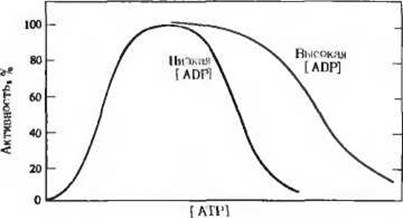
a) Explain how ATP can function as both a substrate and an inhibitor of phosphofructokinase. How is the activity of this enzyme regulated by ATP?
b) How is glycolysis regulated depending on the intracellular ATP level?
c) The inhibitory effect of ATP on phosphofructokinase is less pronounced at high ADP concentrations. How can this observation be explained?
12. Enzymatic activity and physiological function. Skeletal muscle glycogen phosphorylase exhibits a significantly higher Vmaх value than the same enzyme from liver tissue.
a) What physiological function does glycogen phosphorylase perform in skeletal muscle versus liver tissue?
b) Why must the Vmаx value for the muscle enzyme be greater than that for the liver enzyme?
c) [Missing in source, keeping numbering if implied, but translating text] 13. Enzyme deficiencies in carbohydrate metabolism. Four clinical cases are described below. For each case, identify the defective enzyme and provide appropriate recommendations by selecting them from the provided list. Explain the reasoning behind your decision. Answer the questions given in the description of each of the four cases.
Case 1. A patient is intolerant to milk. Immediately upon drinking it, he experiences vomiting and diarrhea. A lactose tolerance test was performed. (In this test, the subject receives a specific amount of lactose, after which blood plasma glucose and galactose concentrations are measured at regular intervals. Normally, the levels of these sugars rise to a maximum in about an hour and then decline.) In this patient, blood glucose and galactose concentrations did not increase during the test, remaining constant instead. Explain why the blood concentrations of glucose and galactose initially rise and subsequently fall in healthy individuals. Why do such changes fail to occur in this patient? Case 2. In a mentally retarded patient, milk induces vomiting and diarrhea. Blood glucose concentration is low, while the concentration of reducing sugars is significantly above normal. Galactose is detected in the urine. What accounts for the high concentration of reducing sugars in the blood? Why is galactose detected in the urine?
Case 3. A patient suffers from muscle cramps during strenuous physical exertion, but otherwise feels healthy. Muscle biopsy revealed that the glycogen concentration in this patient's muscles is much higher than normal. Why does glycogen accumulate?
Case 4. A patient is lethargic and apathetic. The liver is enlarged; a liver biopsy reveals a large excess of glycogen. Blood glucose concentration is below normal. What is the cause of the decreased blood glucose concentration in this patient?
|
Enzymes with impaired activity |
Recommendations |
|
a) Muscle phosphofructokinase |
1. Jogging 5 km/day |
|
б) Phosphomannose isomerase |
2. Low-fat diet |
|
в) Galactose-1-phosphate uridylyltransferase |
3. Low-lactose diet |
|
г) Liver phosphorylase |
4. Strenuous physical labor prohibited |
|
д) Triokinase |
|
|
е) Intestinal mucosal lactase |
5. High doses of niacin |
|
ж) Intestinal mucosal maltase |
6. Frequent and regular meals |
14. Severity of clinical symptoms caused by enzyme deficiencies. The clinical manifestations of two forms of galactosemia—one caused by galactokinase deficiency and the other by galactose-1-phosphate uridylyltransferase deficiency—differ drastically in severity. In both conditions, milk induces gastrointestinal disturbances in patients; however, galactose-1-phosphate uridylyltransferase deficiency is also accompanied by impaired Functions of the liver, Kidneys, Spleen, and Brain, eventually leading to death. What products accumulate in the blood and tissues in each of these two enzyme deficiencies? Evaluate the relative toxicity of these products based on the data provided above.
Last update: 06/08/2026
Editorial and Educational Adaptation: This material has been compiled based on the primary/original source text. The project team performed an editorial review, corrected technical inaccuracies, structured sections, and adapted the content for an educational format.
What was processed:
- elimination of formatting defects (OCR errors, structural breaks, corrupted characters);
- editorial organization of content;
- standardization of terminology in accordance with academic sources;
- verification of factual statements against the original source text.
All mentions of the author, publication year, and origin of the primary text have been preserved in accordance with the source.