Vertebrate Zoology: A Study Guide - T. A. Dauda 2014
Metazoa
Chordates
Subphylum Vertebrates (Craniata)
The subphylum Vertebrates encompasses the absolute majority of chordate species that occupy a higher level of Organization than acraniates. Unlike sedentary and passively feeding acraniates, the ancestors of vertebrates transitioned to active food foraging and the locomotion associated with it. This drove the evolution of vital Organ Systems: the strengthening of the musculature and Axial Skeleton, The Emergence of the Skull, the refinement of The Nervous system, the complexification of Sense Organs, the enhancement of Blood Circulation, The formation of The Heart, etc. (Fig. 5).
Class="center">
Fig. 5 Diagram of the anatomy of a vertebrate animal:
1 — notochord; 2 — Spinal Cord; 3 — Brain; 4 — gill slits; 5 — heart; 6 — lung; 7 — pronephros; 8 — mesonephros; 9 — metanephros; 10 — gonad; 11 — Stomach; 12 — intestine; 13 — Pancreas; 14 — Liver; 15 — Spleen; 16 — Urinary Bladder; 17 — cloaca.
The integument of modern vertebrates is represented by Skin consisting of two layers: the outer epidermis and the inner cutis, or dermis. Various glands are embedded within the skin, while its surface gives rise to diverse epidermal derivatives such as scales, scutes, feathers, and Hair.
The musculature lies beneath the skin. In aquatic vertebrates, it consists of longitudinal bands divided by thin septa into a series of segments, whereas in terrestrial forms, it differentiates into numerous independent Muscles.
The vertebrate skeleton is subdivided into the axial skeleton, the visceral skeleton, and the Skeleton of the limbs with their girdles. The axial skeleton includes THE Vertebral Column and the neurocranium.
The vertebral column consists of vertebrae bearing neural arches and forming the spinal canal, which houses the spinal cord. The neurocranium is formed by a series of bones. It develops in connection with the expansion of the brain and sense organs to serve as their protective Structure. The visceral skeleton is the skeleton of the anterior digestive tract. In most forms, it is represented by the jaw apparatus, which is formed by specialized bones.
Vertebrate limbs are either unpaired or paired. Unpaired limbs—the dorsal, caudal, and anal fins of aquatic inhabitants—consist of cartilaginous or bony rays not connected to other PARTS OF THE skeleton. Paired limbs comprise the limb girdles and the free limbs. The limb girdles lie inside the animal's body and consist of three pairs of bones connected to the vertebral column. The Pectoral Girdle of terrestrial inhabitants is formed by the scapulae, clavicles, and coracoids, while the Pelvic Girdle is formed by the ilia, pubic bones, and ischia. In fish, The structure of the limb girdles is simpler; they consist of several cartilaginous or bony elements lying freely within the musculature, to which the fin skeletons attach. The skeleton of the free limbs in other vertebrates is represented either by fins or pentadactyl limbs. Fins consist of several rows of cartilages or small bones that move freely relative to the girdle as a single lever. The anterior pentadactyl limb is formed by the humerus, two forearm bones (ulna and radius), a series of carpal, metacarpal, and phalangeal bones. The posterior pentadactyl limb includes the Femur, two leg bones (Tibia and Fibula), tarsal, metatarsal, and phalangeal bones.
The Digestive System is fundamentally represented by a tube that is typically subdivided into the Oral Cavity (Mouth), Pharynx, Esophagus, stomach, and intestine, terminating in the anus. Digestive glands, specifically The Liver and pancreas, are also present.
Respiratory organs are of two types: gills and Lungs. Gills are lamellar or lobe-like outgrowths of the pharynx densely permeated by a network of Blood Vessels. Lungs, like gills, develop from paired outgrowths of the ventral wall of the pharynx, pierced by a vascular network. In some vertebrates, cutaneous Respiration plays a significant role.
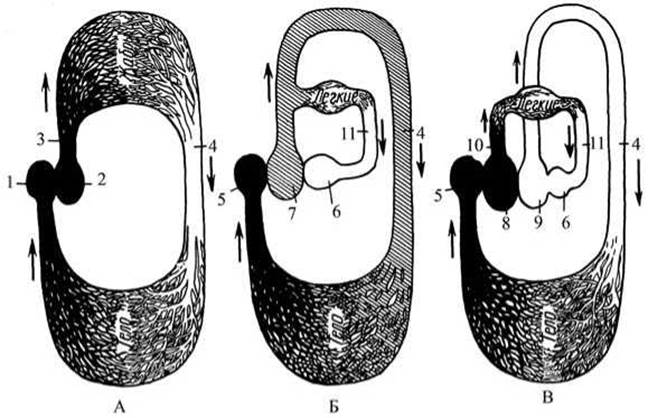
Fig. 6 Circulatory system diagrams in various vertebrate animals:
A — fish; B — amphibian; C — mammal (black — venous blood, grey — mixed blood, white — arterial blood); 1 — atrium; 2 — ventricle of the heart; 3 — ventral aorta; 4 — dorsal aorta; 5 — right atrium; 6 — left atrium; 7 — common ventricle; 8 — right ventricle; 9 — left ventricle; 10 — pulmonary artery; 11 — pulmonary vein.
The vertebrate circulatory system is closed. It includes the heart, which propels the blood; arterial vessels, which carry blood to the organs; venous vessels, which return blood to the heart; and capillaries, which connect the terminal branches of Arteries and Veins (Fig. 6). The heart is a thick-walled muscular sac subdivided into several compartments, or chambers. The primary ones are the atrium and the ventricle.
The nervous system is subdivided into the Central Nervous System, represented by the BRAIN AND SPINAL cord; the Peripheral Nervous System, consisting of nerves emerging from the brain and spinal cord; and the Autonomic nervous system, formed by ganglia lying near the Vertebral Column and connected by longitudinal cords.
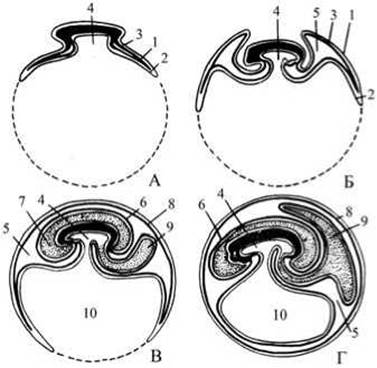
Fig. 7 Embryonic membranes of amniotes:
A-D — stages of embryonic development; 1 — ectoderm; 2 — entoderm; 3 — mesoderm; 4 — gut cavity; 5 — extraembryonic coelom; 6 — amnion; 7 — amniotic cavity; 8 — serosa; 9 — allantois; 10 — yolk sac.
The brain consists of five regions: the Telencephalon (Forebrain), divided into the right and left hemispheres; the Diencephalon (interbrain); the mesencephalon (Midbrain); the myelencephalon (Medulla Oblongata); and the Cerebellum. The cerebellum serves as the center for motor coordination.
The sense organs of vertebrates—such as Vision, Hearing, Touch, and Olfaction—are developed to varying degrees across different classes. Typically, several of these reach a high level of perfection in Structure and function.
The excretory organs of vertebrates are represented by paired Kidneys. Their structure varies among different classes: anamniotes possess mesonephric kidneys, whereas amniotes possess metanephric kidneys.
Vertebrates are predominantly gonochoric (separate-sex) animals. Only a few species of lower vertebrates are hermaphroditic.
Vertebrate Gonads are generally paired. Initially, they lacked efferent ducts, and Germ Cells were released through ruptures in the walls of the reproductive organs into the body cavity, from which they were expelled outward via specialized pores. Subsequently, reproductive tracts evolved that became associated to varying degrees with the ducts of the excretory system.
Depending on their reproductive features, structure, and embryonic development, vertebrates are divided into two natural groups: anamniotes and amniotes (Fig. 7). Anamniotes include fish and amphibians. Fertilization in these animals is external, the larva necessarily develops in Water and lacks extraembryonic membranes. Amniotes include reptiles, birds, and mammals. Egg fertilization in these animals is internal and occurs within the female reproductive tract. An extraembryonic membrane, the amnion, forms around the developing embryo. Amniotic Fluid is located between the amnion and the embryo. The posterior section of the embryonic gut forms a thin-walled, sac-like outgrowth called the allantois.
It performs two Functions: respiration and the storage of embryonic waste products. On the outside, the embryo is further surrounded by a third extraembryonic membrane, the serosa.
The high level of organization in vertebrates has enabled more complex behavior, colonization of all major environmental mediums, and widespread global distribution.
The subphylum Vertebrata comprises several superclasses and classes:
Division Agnatha (Jawless vertebrates)
Class Cyclostomata (Round-mouthed Fishes)
Division Gnathostomata (Jawed vertebrates)
Superclass Pisces (Fishes)
Class Chondrichthyes (Cartilaginous fishes)
Class Osteichthyes (Bony fishes)
Superclass Tetrapoda (Four-limbed or terrestrial vertebrates)
Class Amphibia (Amphibians)
Class Reptilia (Reptiles)
Class Aves (Birds)
Class Mammalia (Mammals)
QUESTIONS FOR SELF-assessment and review:
1. What is The Significance of the transition to active food foraging for animals?
2. What structural and organizational features characterize the subphylum Vertebrata?
3. Which ecological environments have been colonized by vertebrates?
Last update: 13/08/2026
Editorial and Educational Adaptation: This material has been compiled based on the primary/original source text. The project team performed an editorial review, corrected technical inaccuracies, structured sections, and adapted the content for an educational format.
What was processed:
- elimination of formatting defects (OCR errors, structural breaks, corrupted characters);
- editorial organization of content;
- standardization of terminology in accordance with academic sources;
- verification of factual statements against the original source text.
All mentions of the author, publication year, and origin of the primary text have been preserved in accordance with the source.