Vertebrate Zoology - V. M. Konstantinov 2011
Chordates
Jawless Vertebrates
Class Cyclostomata — Order Lampreys
Parasitism is less pronounced in lampreys than in hagfishes. Lampreys frequently attach themselves to fish, feeding on their Blood and flesh. In addition, some species occasionally consume fish roe, and Algae have also been found in lampreys' intestines. Like hagfishes, lampreys have an eel-like body covered with smooth, naked Skin. Their eyes are relatively well-developed. Alongside a pair of lateral eyes, There is a rudimentary pineal (or parietal) eye used to perceive light stimuli. There is a single olfactory capsule. The Organ of Hearing is an internal ear featuring two semicircular canals. There are 7 pairs of gill openings, all opening independently to the exterior. The Pharynx is divided into two sections: an upper section functioning as the Esophagus, and a lower, blind pouch into which the internal gill openings lead. The Mouth is equipped with a suctorial disc and a rasping Tongue bearing horny Teeth. Both an axial and a visceral Skeleton are present.
Unlike hagfishes, lampreys undergo development with metamorphosis: the egg hatches into a larva known as an ammocoetes (or pride). It differs significantly from the adult lamprey. Its mouth is shaped like a funnel with an overhanging upper lip. The pharynx is not divided into a respiratory region and an esophagus; instead, its ventral side features a glandular-ciliated groove that is fully homologous to the endostyle of amphioxus: much like the endostyle, it traps food particles suspended in the Water and directs them into the esophagus. The larva spends a considerable amount of time burrowed into the bottom sediment, leading a lifestyle reminiscent of amphioxus. The entire metamorphosis period in lampreys typically takes several (2 — 5) years. All lampreys reproduce in fresh water, while their habitats include seas, lakes, rivers, and streams.
The order comprises a single family, Petromyzonidae (lampreys), containing 7 genera and 24 species with an almost cosmopolitan distribution.
Class="center">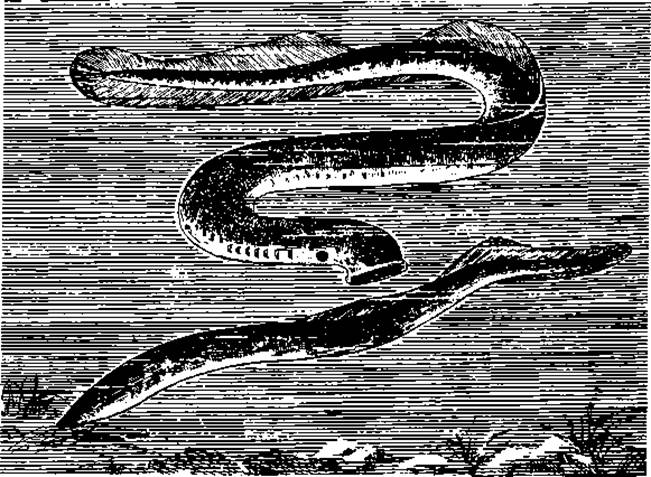
Fig. 27. Sea lamprey (top) and river lamprey (bottom)
The sea lamprey (Petromyzon marinus, Fig. 27) reaches a length of 50 — 100 cm. It is distributed across the Atlantic Ocean, near both the European and American coasts, inhabiting various depths, sometimes down to 500 m. It primarily feeds on fish and occasionally on benthic invertebrates.
It ascends rivers to spawn, without traveling very far upstream.
It does not form spawning schools. The eggs are deposited in nests excavated in the bottom sediment. Reproduction occurs in spring. Its commercial fisheries value is minor.
The Caspian lamprey (Caspiomyzon wagneri) and the river lamprey (Lampetra fluviatilis) are also typically anadromous.
The river lamprey (with a body length of up to 40 cm) inhabits the seas of Europe, northern Asia, and North America. It spawns in rivers. It enters the Neva River in schools from May to June and spawns in late June. Lampreys ascending for spawning cease feeding, and their digestive tracts atrophy. In addition to the spring run, there is another major spawning run in autumn. These lampreys overwinter in the rivers and spawn the following summer. The river lamprey has commercial value, albeit lower than that of the Caspian lamprey.
The brook lamprey (Lampetra planeri), with a body length of up to 16 cm, is distributed across the rivers of Europe and never enters the sea. In our region, it inhabits the rivers and streams of European Russia.
It spawns in May and dies after spawning. It has no commercial fisheries value.
Last update: 13/08/2026
Editorial and Educational Adaptation: This material has been compiled based on the primary/original source text. The project team performed an editorial review, corrected technical inaccuracies, structured sections, and adapted the content for an educational format.
What was processed:
- elimination of formatting defects (OCR errors, structural breaks, corrupted characters);
- editorial organization of content;
- standardization of terminology in accordance with academic sources;
- verification of factual statements against the original source text.
All mentions of the author, publication year, and origin of the primary text have been preserved in accordance with the source.