Vertebrate Zoology: Study Guide - T. A. Dauda 2014
Metazoa
Class Mammalia
Subclass Theria
Infraclass Marsupials (Metatheria). Marsupials comprise around 240 species of mammals characterized by a very poorly developed Placenta or its complete absence (Fig. 61). Consequently, the gestation period is short (lasting only 30 days in the giant kangaroo), and the young are born underdeveloped. For instance, while an adult kangaroo can reach up to 2 m in length, a newborn is only about 3 cm long. Females of most marsupial species carry and nurture their offspring in an abdominal pouch. The only exceptions lacking a pouch are the South American opossums and the Australian numbat (banded anteater); however, in both cases, the newborns firmly attach themselves to the mother. This occurs as follows: the newborn crawls to one of the teats and takes it into its Mouth. The teat then swells significantly, filling the infant's Oral Cavity. At the same time, its respiratory and digestive tracts become temporarily isolated from each other. As a result, the milk—injected into the mouth by the contraction of a specialized Muscle—does not enter the respiratory tract.
The size of marsupials varies considerably: from 5 cm (marsupial mice) to 2 m or more (some kangaroos). They are predominantly distributed in Australia and its surrounding islands, with approximately 1/4 of all species found in the Americas.
Class="center">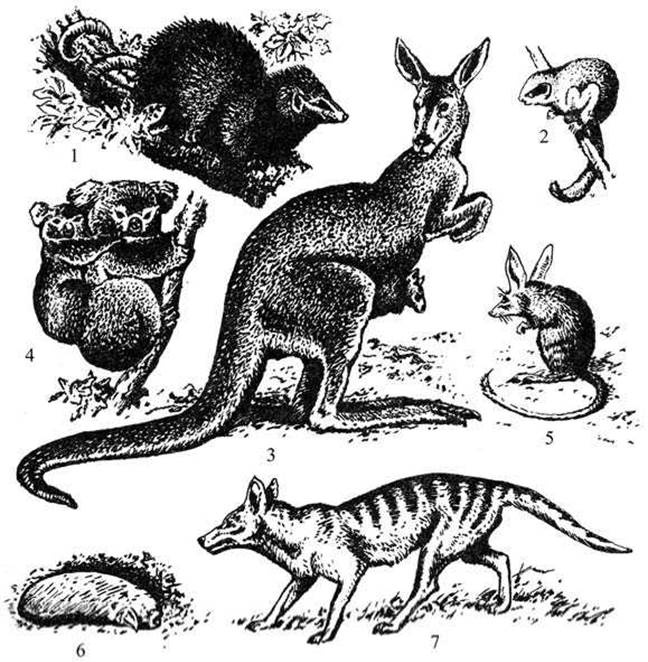
Fig. 61 Marsupial mammals:
1 — opossum; 2 — marsupial glider (sugar glider); 3 — giant kangaroo with a joey in the pouch; 4 — koala with a young on its back; 5 — quoll (marsupial cat/marten); 6 — marsupial mole; 7 — thylacine (marsupial wolf).
Among marsupials, kangaroos are the best known, inhabiting Australia with roughly 50 species. All these animals have underdeveloped forelimbs and exceptionally strong hind limbs. They maintain a more or less upright posture, balancing on their two hind legs and a powerful tail; they move by bounding and leaping on their hind legs. Giant kangaroos can execute leaps up to 8 m in length, and occasionally even 13.5 m, reaching speeds of 40–50 km/h.
Kangaroo sizes vary; the smallest—rat kangaroos (not to be confused with marsupial rats)—are only a few dozen centimeters long, whereas the largest forms exceed 2 m in height. All species are herbivorous. Some inhabit plains, others live in mountainous regions, and a few even lead an arboreal lifestyle.
Less famous, yet widely distributed across various habitats in Australia and nearby islands, are carnivorous marsupials, including marsupial mice, rats, quolls, and thylacines. Marsupial mice and rats occupy diverse ecological niches ranging from arid deserts to human settlements. The mice feed primarily on invertebrates, though they frequently prey on house mice and rats as well. Marsupial rats are voracious and bloodthirsty predators that hunt house mice and rats, and may occasionally raid farms and chicken coops. Quolls resemble both cats and martens, which is why some are also referred to as marsupial martens. They spend a significant amount of time in trees, capturing prey through sudden pouncing leaps. Their primary diet consists of fish, birds, small vertebrates (most often rodents), but they do not pass up insects either. The largest carnivorous marsupial is the Tasmanian wolf (thylacine). Today, this animal survives only in the remote, uninhabited regions of Tasmania, having been exterminated in mainland Australia. Until relatively recently, however, this predator was widespread across the mainland, where it preyed on chickens, ducks, and sheep.
Numbats (banded anteaters) inhabit the forests of Australia. Their body length reaches up to 24 cm, with a similarly long, bushy tail. Lacking a pouch, their tiny, hairless young cling tightly to the teats and remain attached for 8–9 months. Numbats dwell in tree hollows, which they rarely venture far from, and feed mainly on termites. They locate termite mounds using their highly developed SENSE OF SMELL. Australian marsupial moles inhabit sandy soils; they do not maintain permanent burrows because the earth rapidly caves in behind them as they burrow through. However, the nest used for rearing offspring is constructed deep underground. In other anatomical and behavioral aspects, this marsupial resembles placental moles. The forests of Australia host numerous arboreal species, including marsupial gliders, pygmy possums, koalas, and various other possums. Some possums possess a specialized membrane along the sides of their bodies that enables them to glide through the air over distances of up to 80–90 m.
Certain marsupials, particularly kangaroos, have long been utilized for fur. At present, the populations of fur-bearing marsupials have declined sharply.
Last update: 13/08/2026
Editorial and Educational Adaptation: This material has been compiled based on the primary/original source text. The project team performed an editorial review, corrected technical inaccuracies, structured sections, and adapted the content for an educational format.
What was processed:
- elimination of formatting defects (OCR errors, structural breaks, corrupted characters);
- editorial organization of content;
- standardization of terminology in accordance with academic sources;
- verification of factual statements against the original source text.
All mentions of the author, publication year, and origin of the primary text have been preserved in accordance with the source.