BOTANY, VOLUME 1: CELL BIOLOGY. ANATOMY. MORPHOLOGY — 2007
4. MORPHOLOGY AND ANATOMY OF CORMOSTATS (LEAFY PLANTS)
In the preceding chapters, Cells were examined as the elementary units of life and the Building Blocks of Tissues. In a multicellular Organism, each Cell is likewise an elementary unit of the living, yet not an individual organism. The MORPHOLOGICAL Structure OF a multicellular organism differs from its cellular structure just as the architecture of a building differs from the arrangement of bricks and other construction components. One can study Morphology without having any conception of cells whatsoever (which was done for a long time). The complex External structure of an organism can also be conceptualized without differentiating its body into individual cells (see Box 4.1; Figs. 4.1, 11.73 B, 11.91, and also Section 2.2.3.6). However, the rarity of large unicellular entities and the vast diversity of Multicellular Organisms clearly demonstrate that multicellularity provides a far better foundation for the evolution of larger organisms than the enlargement and complexification of a single-Cell Structure. The formation of multicellular organisms involves not only an increase in mass and aggregation, but also the orderly differentiation of initially identical cells. The differentiation and functional specialization of genetically identical cells within an organism (somatic cells, from the Greek soma — body) are based on the differential activation of genes (see 2.2.3; 7.2.2.3); every newly formed cell receives signals containing information regarding the direction of its subsequent differentiation. A multicellular organism arises as a harmonious ensemble of all its constituent cells and intercellular signals (see 7.4). Consequently, the biological unit is no longer an individual cell, but rather a supra-cellular functional "union" of the multicellular vegetative body, the so-called blastema (from the Greek blastema — structure; sprout, SHOOT). It is precisely this systemic integrity that distinguishes a multicellular organism, or blastema, from a mere aggregation of cells (a cenobium, see Section 5.1).
Somatic cells are elements of this whole and perform a limited number of Functions. They can manifest themselves as elementary organisms only when isolated from the blastema. Disruptions of Intercellular Communication in a multicellular system lead to abnormal patterns of growth and differentiation, such as tumor formation.
4.1. Morphology and Anatomy
The retina of each human eye is connected to the Brain by approximately one million Nerve Cells, and the transmission capacity of the human Optic nerve reaches 100 million bits per second. However, it is not merely a well-developed visual organ, but also the capacity of neural centers to process information, that leads from mere contemplation to perception and The ability to discriminate. In this regard, comprehending The structure of objects is the starting point of any investigation in nature, biological studies in particular.
Class="center">Fig. 4.1. Complex structural formations in siphonous Algae: outgrowths on giant cells of Dasycladaceae (cf. Fig. 11.92) (SEM micrograph by S. Berger)
A—umbrella-shaped whorl of branches of *Acetabularia polyphysoides*, B—whorls of branchlets of *Chlorocladus australasicus*

Macromorphology of large and therefore easily observable cormophytes was long the sole basis of systematics and Taxonomy. Yet the visible only seems understandable, and comprehending the problem requires the effort of reason. In this connection, let us recall A. Schopenhauer: "The task is not so much to see what no one has yet seen, but to think what nobody has yet thought, concerning that which everybody sees." Here is the dictum of another classic, J.W. Goethe, one of the founders of comparative morphology, who discovered the intermaxillary bone in humans (1784): "What is the hardest of all? That which seems to you the easiest: to see with your eyes what lies before your eyes" (*Metamorphosis of Plants*, 1790).
At present, the investigation of causal interactions in The Development of multicellular organisms (see Chapter 7) is progressing at an extremely rapid pace thanks to advances in molecular biology. Previously, only a very limited understanding of morphogenesis was possible because the signaling substances and receptors involved appeared only briefly and at extremely low concentrations. More accessible was The Study of the relationships between structures/functions and the adaptations of organisms to their environment and special living conditions. The forms of organisms can be understood within a teleonomic framework based on their biological significance and purposiveness.
This principle was introduced into botany more than 100 years ago in two epoch-making, albeit initially much-debated works: *The Mechanical Principle in the Water/140.html">Anatomical Structure of Monocotyledons* by S. Schwendener (1874) and *Physiological Plant Anatomy* by G. Haberlandt (1884). Since then, plant tissues have been defined not only by their structure, but also by their functions (see Chapter 3). Elucidating the Functional Significance of organismal structural features had previously been a leading theme in scientific observation (see C.C. Sprengel’s *The Secret of Nature Revealed in the Structure and Fertilization of Flowers*, 1793). However, it was only C. Darwin’s evolutionary theory that provided a scientific foundation for this line of research. Of course, The Role of THE PRINCIPLE OF economic utility in interpreting organismal structure has often been exaggerated. Errors frequently arose from the misconception that natural Selection preserves exclusively what is useful and that the living world must therefore be structured in a supremely rational and purposeful manner. In reality, selection permits the short-term survival of the non-purposive as well — and this represents a quite different understanding. Opposing selection as a restrictive principle of evolution are the entropic processes of random hereditary changes (Mutations, recombinations, Horizontal Gene Transfer) and symbiogenesis. They have given rise to the immense species diversity and the physiological, ecological, and morphological variety of the living world.
The typological approach is a specifically morphological method. Types are identified by comparing different forms. Even for large systematic groups (genera, families, etc.), despite all the Variability and Diversity of the forms they comprise, it is possible to determine constant and fundamental features of Organization that constitute the type of the corresponding taxonomic unit.
J.W. Goethe already used METABOLISM/2.html">THE CONCEPT OF the "prototype" in this same sense, which was later replaced by the Concept of the "Bauplan" (structural plan). However, the latter is too anthropomorphic, easily leading to misunderstandings. According to W. Troll, a classic of typological morphology from the previous century, the type of any group of organisms "can be discerned, but not demonstrated." A type represents a mental construct, an abstraction based on identifying the common, i.e., the similar, across various organisms. Typological morphology is independent of causal and finalist reasoning. It forms the basis for constructing "natural" systems in biology. The very possibility of distinguishing morphological types is an expression of hierarchical phyletic development ("phylogenetic trees"). C. Darwin’s remark that morphology always poses the question of type is highly revealing.
To describe all currently living and fossilized organisms, systematize them, and name them correctly, an extensive terminology has been developed. For example, the explanations for Fig. 4.2 provide an Introduction to the terms used in describing leaf blades and their margins. Plant identification keys contain concise summaries of such "applied morphology."
Fig. 4.2. Some forms of leaf margins and leaf blades
Leaf margin: A—entire (maize; here, as in almost all monocots, the entire margin is combined with parallel venation, where the leaf's vascular bundles run parallel to its margin, 2.8×); B—entire in the herbaceous dicot perennial Japanese knotweed (*Reynoutria japonica*) with reticulate leaf venation (parallel venation is not a prerequisite for an entire margin, 2.8×); C—crenate (horseradish, *Armoracia rusticana*, 2.8×); D—dentate (sweet chestnut, *Castanea sativa*, natural size); E—serrate (stinging nettle, *Urtica dioica*, 1.7×); F—doubly serrate (*Kerria*, 1.5×); G—runcinate (dandelion, *Taraxacum officinale*, 0.7×). Leaf shape: H—lobed leaf (pedunculate oak, *Quercus robur*, natural size); I—pinnately compound (rowan, *Sorbus aucuparia*, natural size); K—palmatilobed leaf (field maple, *Acer campestre*, 0.75×); L—palmatically compound leaf (creeping cinquefoil, *Potentilla reptans*, 0.75×)

The term "anatomy" (from the Greek *anatempnein* — to cut up, dissect) has a somewhat different meaning in botany than it does in medicine and zoology. To reveal Organs hidden within the bodies of humans and animals, bodies must be literally dissected—a Procedure entirely unnecessary for observing the superficially positioned organs of most plants. Accordingly, plant anatomy is understood as the microscopic study of tissue arrangement within the primary organs. Plant anatomy and macromorphology (organography) are closely interconnected and are therefore discussed together in this chapter.
4.1.1. Homology and Analogy
Resemblance does not always imply identical morphogenesis or evolutionary relationship. Alongside similarities stemming from belonging to the same structural type and thus from genealogical relationships (homology), there are similarities resulting from the performance of identical functions (analogy). Homology signifies the equivalence of primordia, the expression of similar Genetic information, whereas analogy, by contrast, denotes the execution of identical functions.
For example, adaptations for aerial flight have arisen multiple times independently in both the PLANT AND ANIMAL kingdoms. All of them are based not on a simple ability to glide, but rather on the application of aerodynamic laws and the formation of wings. Therefore, all wings (of insects, flying fish, birds, bats, etc.), the wing-like outgrowths of maple fruits or seeds of *Zanonia* species (see Fig. 11.194, D), as well as aircraft wings and propeller blades of other flying objects, are fundamentally similar without being homologous to one another. The streamlined shape of fast-swimming creatures (and watercraft) likewise serves a single purpose: to reduce environmental resistance. Such a shape is characteristic of certain hawkmoths, Gametes, or even giant whales (whose analogous external resemblance to fish has earned them the misleading German vernacular name *Blauwal* / "whale-fish"). In everyday speech, spines and thorns are often confused (see Fig. 4.7), though their similarity is due to identical functions (see Section 3.2.2.1).
Thus, just as identical demands can bring about similarities in different organs, conversely, homologous structures can become dissimilar due to the performance of different functions or adaptation to varying environmental conditions. An illustration of this is the diverse appearance of identical organs within the same organism, such as the morphological variability of leaves on different parts of plants (Figs. 4.5, 4.6; see Sections 4.3.2, 4.3.3). One may also mention the atypical functioning/structure of organs. For instance, in some plants, lateral shoots with limited growth take over the function of leaves (phylloclades, from the Greek *phyllon* — leaf, *klados* — branch; Fig. 4.3). They resemble leaves, i.e., they are leaf analogs, but in reality they represent shortened shoots (and are homologous to shoots). The shoot nature of phylloclades is evident from the fact that, unlike true leaves, they arise in the axils of scale-like or spine-transformed leaves and can bear flowers. In other plants, aerial roots can assume the role of leaves (Fig. 4.4). In this case, they bear no resemblance to roots at all, but are flattened and green like leaves due to the presence of Chloroplasts in their cells. Such transformations of organs driven by the performance of special functions are referred to in plant morphology as metamorphoses (from the Greek — transformations; in zoology, this term has an entirely different meaning).
Fig. 4.3. Phylloclades — flattened shoots functioning as "leaves" (photo by W. Barthlott).
Branch of butcher's broom (*Ruscus aculeatus*) with leaf-like, flower-bearing lateral shoots arising from the axils of scale leaves (natural size; cf. Fig. 4.34)
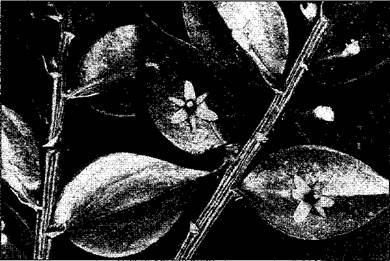
Fig. 4.4. Taeniophyllum zollingeri — an epiphytic orchid growing on trees, featuring green, ribbon-like aerial roots (w) that serve as assimilating organs (0.5×) (after K. Goebel)

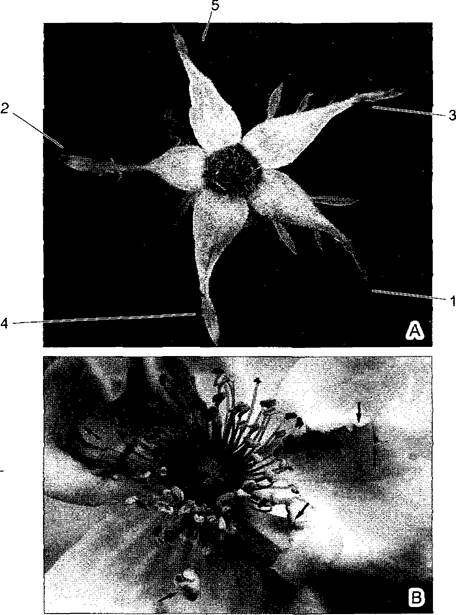
It is particularly important to clearly distinguish between homology and analogy when studying evolutionary relationships among organisms (see Section 11.1.3). Evolutionary, or phyletic (from Greek phylon — stock), relationship is manifested exclusively in homologous similarities, i.e., in belonging to the same morphological type. Various criteria of homology exist, including molecular, karyological, morphological, and physiological criteria. Among morphological criteria, the most fundamental is the positional criterion: an organ is homologous to another if it occupies the same spatial position within comparable structures. As mentioned previously, cladodes are located in the axils of bracts, which is "typical" for lateral shoots (see Fig. 4.3). Another morphological criterion is the criterion of transitional forms, which links sharply differing forms. For instance, intermediate forms exist between cataphylls (reduced lower leaves), stem leaves, hypsophylls (bracts), between perianth segments and stamens (see Figs. 4.6, 11.170), and finally between leaves and leaf spines; all these dissimilar structures are fundamentally leaves. In phylogenetics, fossil intermediate forms between representatives of different systematic groups that have lost their similarity in the course of evolution hold equal significance. Finally, to prove the homology of organs, it is especially important to study the Cytology/cytology/16.html">Early stages of their development in ontogeny (the individual development of organisms). Most fully developed organs perform specific functions and consequently possess specific features, whereas the similarity of their primordia still allows their homology to be recognized.
Fig. 4.5. Leaf series of Helleborus foetidus (0.25×) (after D. von Denffer): A — cotyledon; B, C — juvenile leaves; D — leaf of the first year of development; E — pedately dissected leaf of the second year; F — transitional leaf; G–I — upper leaves of the third year of development; K — floral envelope leaf

Fig. 4.6. Transitional forms between various leaf organs in the dog rose (Rosa canina): A — outer sepals 1 and 2 still retain pinnateness (resembling ordinary leaves), while inner sepals 4 and 5 are entire; sepal 3 is pinnate only on one side, specifically the one facing sepal 2 (natural size); B — intermediate forms between petals and stamens. Arrows indicate anthers at the margins of petals (1.3×)
Divergent evolution in general, which increases the differences between forms, can lead to similarities in individual traits As a result of adaptation to identical conditions. Zoologist W. Hennig, within the framework of phylogenetically consistent systematics (cladistics), reformed the terminology concerning The concepts of "analogy/homology." This cladistic terminology has since become widely accepted. Analogy, i.e., the similarity of organs of different origin, was designated by the scientist as
homoplasy. Within it, one must distinguish between convergence and parallelism. According to Hennig, convergence denotes a similar shape of non-homologous organs. Examples include spines (Fig. 4.7; see Fig. 4.36) and tendrils (see Fig. 4.69), i.e., organs corresponding to leaves or metamorphosed shoots. Parallelism, by contrast, is understood as phyletically independent, similar transformation of homologous structures in different taxonomic groups, such as The Emergence of stem succulents in various families.
Fig. 4.7. Transformation of leaves into spines: A, B — barberry (Berberis vulgaris): A — progressive transformation of ordinary leaves into leaf spines in the lower part of a branch (0.6×); B — a shortened shoot develops from the axils of leaves completely converted into spines; in its first year it produces serrate leaves, and In the second year flowers (0.9×); C — in most cacti (Notocactus rutilans is shown as an example), leaves, which are also located on shortened axillary shoots (areoles), are converted into lignified spines. The function of leaves is performed by the green, succulent stem (1.9×)

4.1.2. The Shoot (Cormus) and Thallus
All pteridophytes and gymnosperms share a common morphotype consisting of three principal organs — stem, leaf, and ROOT. This type of plant organization is termed cormose (from Greek kormos — trunk, shoot). The relative arrangement of axial organs in cormophytes (shoot-bearing plants) is always invariant: leaves are invariably borne on stems and never occur on roots. Roots produce endogenous lateral roots, whereas shoots produce entirely different, exogenous, lateral shoots (branching); however, adventitious roots may arise on a shoot, and adventitious shoots on a root. It should be noted that a flower is not a primary organ; it is merely a shortened shoot bearing sporophylls and serving for plant reproduction.
Not homologous to the cormus are the vegetative bodies of multicellular algae as well as liverworts1. Their bodies are called thalli (from Greek thallos — young shoot, foliage). An Overview of their morphological organization is provided in Chapter 5. This chapter is devoted to the MORPHOLOGY AND ANATOMY of cormophytes as the most well-known, thoroughly studied, species-rich, scientifically significant, and evolutionarily youngest and most advanced group of plants.
1 The majority of liverwort species exhibit a shoot-based organization. — Note by the Editor.
Functionally, all Living organisms are highly ordered entities. This Abstract functional order is usually overtly manifested in the structural arrangement; examples of this are given below. The regular repetition of identical or similar structural elements is termed Symmetry (from Greek symmetria — commensurability).
There are three main forms of symmetry:
• Metamerism — translational symmetry — the repetition of similar elements along an axis at equal intervals and in the same orientation; homonomous metamerism (Fig. A).
Fig. A. Examples of metamerism in plants.
A — pinnate leaf of Potentilla anserina (natural size); B — portion of a first-order pinna of the frond of the male fern Dryopteris filix-mas (lower side with sori; bundles of matured sporangia are concealed beneath pale, Kidney-shaped indusia) (2.5×); C — longitudinal rows of areoles (shortened shoots with leaf spines) of the cactus Cereus pasacana (0.2×); D — cover scales of a spruce cone (1.5×). Other examples of metamerism are represented by horsetails (see Figs. 11.141, E, K).

Special forms arise in the case of non-straight axes (curves, spirals) and polar axes along which elements, for instance, progressively diminish in size (heteronomous metamerism). A straight or curved axis of metamerism can become polar (a vector) if the elements along it are asymmetrically oriented in the same way. This occurs in many Biopolymers. Due to axial polarity, the direction of synthesis is typically established (5' → 3' in Nucleic Acids, N-terminus → C-terminus in Polypeptides; elongation from the plus-end in microtubules or Actin microfilaments). The number of symmetry elements in homonomous metamerism is unlimited. In certain cases, extremely high numbers are actually attained, such as NUCLEOTIDES in DNA molecules.
• Radial symmetry — rotational symmetry — the repetition of similar, identically oriented elements at equal angles around a symmetry axis (Fig. B). The number of symmetry elements is limited, and the symmetry axis can be characterized by this number.
Fig. B. Examples of radial symmetry
A—arrangement of flower heads in the globe thistle Echinops sphaerocephalus (0.8×). Many other examples of spherical symmetry are found in fruits and seeds. B—Primula, garden variety (explaining the 6-merous nature of this flower; wild forms have 5-merous flowers) (1.2×). C—5th-order rotational symmetry of an oleander flower (0.8×)

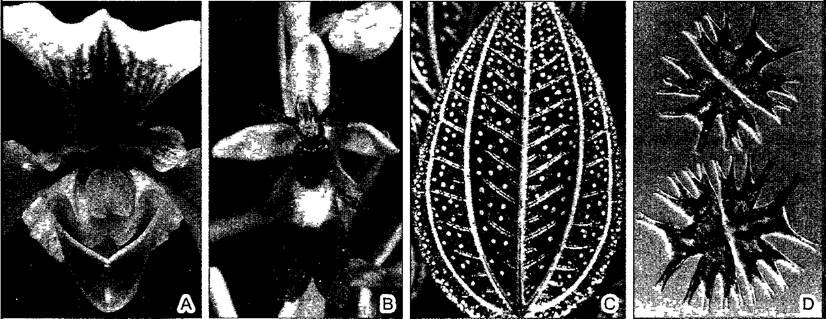
• Bilateral symmetry refers to mirror symmetry (Fig. C) as a reflection across a plane of symmetry, the median: There are two elements of symmetry—the structure and its reflection. This type of symmetry predominates in the animal kingdom and is present in our own bodies. However, countless examples of bilateral symmetry are also found in plants: most leaves and so-called zygomorphic flowers. Radial symmetry transitions into bilateral symmetry through specific transformations perpendicular to the axis of symmetry. Accordingly, mirror symmetry occurs in organisms predominantly when two shape-determining vectors intersect (in animals: gravity/direction of movement; in plants: gravity/direction of growth—therefore primarily in organs extending laterally from the vertical axis). Bilateral symmetry is almost always associated with dorsoventrality, i.e., differences between the upper and lower sides (Lat. dorsum = back; venter = belly, abdomen).
Fig. C. Bilateral symmetry (B—photos by K. and N. Rasbach; C—photo by W. Barthlott): A, B—orchid flowers, like those of many other plants, are zygomorphic. Examples shown include the flowers of the lady's slipper orchid (Paphiopedilum—A, 0.5×) and the bee orchid (Ophrys insectifera—B, 2×); the flowers of Ophrys are mistaken for females by specific male insects, which, during mating attempts, transfer pollinia from one flower to another (cf. Fig. 11.227) and thereby effect pollination. These flowers are not only bilaterally symmetrical but also dorsoventral (exhibiting top/bottom or front/back differentiation). The vast majority of typical leaves are also bilateral and dorsoventral: C—leaf of the tropical Bertoutia houtteana from Melastomataceae; D—some unicellular organisms are also mirror-symmetrical, for example, the desmid alga Micrasterias radiata (190×)
Complex symmetry occurs when two or all three MAIN TYPES OF symmetry are combined, meaning that variations of different symmetry types overlap within a single structure (Fig. D). A simple example of this symmetry is whorled phyllotaxis: individual whorls are radially symmetrical, but alongside this, the longitudinal metamerism of the shoot is evident, with the leaves of adjacent whorls alternating (see 4.2.2). In such cases, symmetry particularly clearly demonstrates the integration of elements into a system.
Fig. D. Examples of complex symmetry
A—flower of the bogbean-like grass of Parnassus (Parnassia palustris); the corolla is 5-merous, as are the glandular-tipped staminodes (stamens transformed into nectaries, which are false here because the nectar contains no sugar) and the regular stamens, whereas the pistil is 4-merous (1.3×). B—flower of the passionflower Passiflora caerulea with numerous thread-like, radially symmetrically arranged receptacle outgrowths, 5 identically radially arranged stamens, and 3 carpels; 3 dark stigmas delimit two larger and one smaller angle such that the arrangement of the stigmas becomes bilaterally symmetrical (0.6×). C—branch portion with Phytolacca fruits; zygomorphic carpels are aggregated into a radially symmetrical structure, with the flower gynoecium. Flowers and fruits alike are borne on horizontal stalks, which in turn diverge helically from the vertical main axis (metamerism) (1.3×)

Temporal metamerism—regular rhythms—can be represented graphically on a plane by treating time as an axis, which makes its symmetry very clear. Countless examples of rhythmic processes can be found in living beings: alongside movements (flagellar beating, fin and wing strokes, walking and running), There are also endogenous rhythms (see 7.7.2.3) and periodically recurring morphogenesis, such as that of a shoot, which is spatially expressed in its metamerism. In the molecular realm, this corresponds to rhythmically repeating synthesis reactions during macromolecular formation.
Regular patterns arise when identical, similarly oriented elements are closely packed. Circles or spheres of the same size form a hexagonal pattern when packed densely (Fig. 4.17): each element is surrounded by six others, and there are three distinct directions intersecting at angles of 60° or 120°, respectively. However, in most biological patterns, the individual elements are not entirely identical. For instance, they vary in size, are not oriented in an absolutely uniform manner, and the distances between them are not equal but vary within certain limits (Figs. E, F). Nevertheless, they are clearly distinct from chaotic patterns, in which no regularities can be discerned in the orientation and arrangement of the elements.
Fig. E. Statistical and regular patterns
A—in "health" dark rye bread, baked wheat grains form a random pattern with irregular distances between the (light-colored) grains (0.5×). B—grains on a corn cob show a clearly regular arrangement given their nearly uniform size and density; the distribution of dark grains—the result of Mendelian segregation 3:1—creates a random pattern due to the contingencies of Meiosis (0.5×). C, D—in these examples of high but imperfect regularity, the distances between neighboring pattern elements are similar but not identical. C—Stomata on the upper surface of a floating leaf of the water lily Nymphaea alba (70×). D—underside of the fruiting body of a polypore fungus (Polyporus, 1.3×)

Fig. F. Patterns on individual cells: Surface structures of pollen grains (cf. also Figs. 1.176 and 11.214) (specimens and SEM micrographs by T. Esche)
A—Stachys recta, B—Phlox (garden variety), C—Centaurium erythraea, D—Silene nutans, E—Thymus pulegioides, F—Aster linosyris

The imperfect symmetry of biological patterns is due to the fact that rigid order would preclude any manifestations of life: symmetry breaking is a prerequisite for all developmental processes, Biosynthesis, and movement. Crucial symmetry breaks also occur repeatedly in the evolution of organisms. Significantly, crystalloid virus particles within host cells are required to facilitate viral Replication.
Of particular importance in biology is complementary symmetry (antisymmetry): two dissimilar yet harmonizing structural elements combine to fulfill a single function. Familiar technological examples include a lock and key or a socket and plug; in the animal world, joints and copulatory organs. Antisymmetric molecular structures frequently mediate recognition or replication processes: enzyme/substrate, receptor/Ligand, translocator/transported substance, antigen/antibody, etc. The complementary bases of the polynucleotide chains in the DNA double helix are antisymmetric, as are the codon and anticodon during Translation. The self-assembly of supramolecular biostructures—such as The quaternary structure of Proteins or Viral Particles—is entirely based on the complementary symmetry of molecules and their subunits.
In antisymmetric structures, the architecture of one element is complementary to that of the other. Consequently, direct similarity between elements is excluded. In complex functional systems, this goes so far that all their elements are distinct while remaining complementarily symmetrical. In such cases, the functional connection often emerges solely from the specific spatial arrangement rather than the Morphology of the elements. The more elements a functional system comprises, the more diverse its actions and the lower its overall degree of morphological symmetry. This is associated, for example, with the low symmetry of multicellular structures. Ameboid cells represent an extreme example. However, asymmetrical organisms are significantly rarer than symmetrical ones, which presumably have been favored by selection. This is readily understandable: symmetry implies (also) repetition; developing and operating a symmetrical system requires substantially less information than an asymmetrical one.
Last update: 07/08/2026
Editorial and Educational Adaptation: This material has been compiled based on the primary/original source text. The project team performed an editorial review, corrected technical inaccuracies, structured sections, and adapted the content for an educational format.
What was processed:
- elimination of formatting defects (OCR errors, structural breaks, corrupted characters);
- editorial organization of content;
- standardization of terminology in accordance with academic sources;
- verification of factual statements against the original source text.
All mentions of the author, publication year, and origin of the primary text have been preserved in accordance with the source.