BOTANY WITH BASICS OF HYDROBOTANY (AQUATIC PLANTS OF UKRAINE) - B.Ye. Yakubenko - 2011
VIII. BASICS OF PLANT MORPHOLOGY AND ANATOMY
Morphology and Anatomy of the Stem and Shoot
Higher plants are differentiated into ROOT, stem, and leaf. Over millennia, the stem has evolved to perform two main Functions: 1) increasing the Nutrition surface area through branching and an increasing number of leaves; 2) transporting Water and mineral salts via the ascending current, and plastic substances via the descending current.
The stem is an above-ground axial organ characterized by radial Symmetry, positive heliotropism, and indeterminate apical growth. It can serve as a storage site for nutrients and act as an organ for vegetative propagation. A key feature of the stem is its ability to produce leaves and buds.
The stem is the axis of the SHOOT, performing two primary functions: mechanical and conductive. It provides The connection between roots and leaves. In the aerial environment, where mineral nutrients are highly dispersed, the need arose to increase the assimilation surface area. This was achieved through the emergence and branching of the stem, as well as an increase in leaf count. Plants compensated for water scarcity by expanding their root system surface area and developing adaptations to reduce water evaporation (cuticles, various epidermal appendages). The stem successfully integrated these vital spheres of aerial and underground nutrition. In perennial plants, the stem can also store nutrients.
The shape of the stem (in cross-section) varies and is often an important diagnostic feature in plant identification. Most stems are cylindrical, but some plants have flat stems (Opuntia), triangular stems (sedges), or quadrangular stems (Lamiaceae). Hollow stems are characteristic of grasses.
A shoot is a stem bearing leaves, buds, nodes, and internodes (Fig. 61). Emerging as a necessity for terrestrial life, the stem increases the sphere of aerial nutrition and accumulates the plastic organic substances required for terrestrial survival through branching and The formation of
metameric Organs. This is facilitated by the co-Development of the stem and Leaf as a single organ—the shoot—which ensures an increased photosynthetic surface area and the accumulation of organic matter for metabolic processes. All of this demonstrates the close interconnection between the stem and the leaf.
A node is defined as the region of the stem that bears leaves.
Class="center">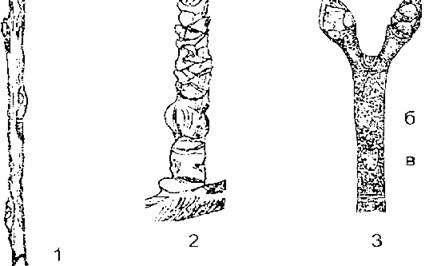
Fig. 61. Types of shoots based on internode length:
1 - elongated, 2 - shortened, 3 - normal: a - apical bud, b - internode, c - stem leaf traces between two adjacent ones
The region between nodes is called an internode. The angle between the stem and the petiole forms the leaf axil, which contains the axillary buds. Often, a shoot is understood as an annual unbranched stem with leaves developing from the buds or the promeristem of the embryo.
A bud is an integral part of the shoot, representing its miniature, undeveloped primordial form. Dissecting the protective and embryonic leaves reveals the Internal Structure of the bud. At the center of the bud lies the embryonic stem, whose apex forms the growing cone, composed of meristematic Tissues—the tunica and the corpus. Lateral primary protuberances form at its base, giving rise to primordial leaves that curl inside the bud. Secondary protuberances develop within the axils of the primary meristematic ones, giving rise to axillary buds. Externally, they are covered with protective corky bud scales. These scales fit tightly together, making the buds impermeable to water, fungal spores, and Bacteria. This impermeability is enhanced by the resinous impregnation of the scales, The Development of the cuticular layer, and the cork. Consequently, winter buds reduce Transpiration by 75–95% and protect plant primordia from Temperature fluctuations.
Buds can be vegetative, giving rise to vegetative shoots, or reproductive (generative), also known as flower buds, which develop into flowers and inflorescences. If the buds produce a stem with leaves, buds, and flowers, they are classified as mixed buds.
Depending on their position, buds are classified as apical or lateral (axillary). Apical buds ensure the lengthwise growth of the stem and branches through Cell Division in the growing cone. Lateral buds can be vegetative, floral, or mixed in origin. Based on their arrangement, buds can be solitary, serial (stacked one above the other), and collateral (positioned side by side). Buds may also be active (or winter) buds, which awaken after overwintering, or dormant buds, which remain in a resting state for extended periods. The latter awaken following the death of the apical bud and an active influx of Auxins to their Location. When branches are pruned or frost-damaged, dormant buds sprout and produce new shoots. On perennial trees, they form water sprouts, or epicormic shoots (aspen, poplar, apple, pear, plum).
In perennial plants, adventitious buds are endogenously formed in the superficial main tissues, protective (exogenous) tissues, or deep meristematic tissues (cambium, pericycle). These buds produce basal growth around the stumps of felled oak, linden, and birch trees. Adventitious buds also generate root suckers in raspberries, cherries, acacia, and many stubborn agricultural weeds (thistle, bindweed, knapweed), significantly complicating weed control efforts.
Shoot development from a bud. In spring, with rising air temperatures and a substantial influx of water and mineral salts, buds begin to open. First, they swell and increase in size, the protective bud scales open, and green leaves appear at the apex. Under these conditions, the Cells of the growing cone divide intensively, increasing in number and causing the stem to elongate. Concurrently, Primary and secondary primordial meristematic protuberances appear, transforming into new primordial leaves and axillary buds. Shortened nodes grow to reach their normal size, while leaves attain their proper shape and dimensions.
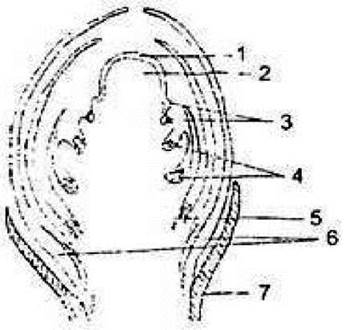
Fig. 62. Structure of a bud:
1 - tunica, 2 - corpus, 3 - primary leaf protuberances, 4 - axillary buds, 5 - formed buds,
6 - primordial leaves, 7 - bud scales
Because the cells of the apical bud constantly grow much more vigorously than the growing cones of lateral buds and shoots, the main stem is formed As a result. It stands out among the mass of branches in terms of growth rate and vigor (Fig. 62).
In certain plant groups (such as grasses and sedges), apical shoot growth is supplemented by intercalary growth. This allows grass stems to grow rapidly. Bamboo can achieve a daily growth rate of up to 50 cm. Among local fast-growing tree species are poplar, willow, and spruce; the latter can grow over 1 m per growing season, whereas slow-growing species add only 2–5 cm. In many plants (such as swamp pine, oak, and apple), shoot growth continues from April–May to June–July. The growth of a vegetative shoot concludes with an apical bud, a flower, or an inflorescence. Occasionally, after a period of dormancy, shoot growth resumes, giving rise to so-called St. John's shoots or Lammas shoots (in oak, maple, and raspberry).
An annual shoot represents a plant's growth increment over a single growing season. In perennial herbaceous plants, these shoots form the above-ground phytomass. Every year, annual shoots die off, and new ones grow from renewal buds the following spring. In woody plants, new shoots develop on older ones. Shoots that form the tree trunk persist throughout its entire life.
Depending on internode length, shoots are classified as shortened (apple, pear), normal (hazel, plum, walnut), and elongated (tree of heaven, apricot, willow).
Shortened shoots have extremely abbreviated internodes that are difficult to distinguish, and when leaves are arranged alternately, they appear to form rings. Flowers and subsequently fruits develop on shortened shoots, which is why they are referred to as fruiting spurs (brachyblasts). The needles of pine and larch are also borne on shortened shoots.
Normal shoots with typical or medium-length internodes occur in many agricultural and wild plants (sunflower, potato, pea). Elongated shoots feature excessively long internodes devoid of leaves and flowers. They are characteristic of lianas and the tree of heaven. Water sprouts also produce elongated shoots.
Last update: 07/08/2026
Editorial and Educational Adaptation: This material has been compiled based on the primary/original source text. The project team performed an editorial review, corrected technical inaccuracies, structured sections, and adapted the content for an educational format.
What was processed:
- elimination of formatting defects (OCR errors, structural breaks, corrupted characters);
- editorial organization of content;
- standardization of terminology in accordance with academic sources;
- verification of factual statements against the original source text.
All mentions of the author, publication year, and origin of the primary text have been preserved in accordance with the source.