BOTANY WITH BASICS OF HYDROBOTANY (AQUATIC PLANTS OF UKRAINE) - B.Ye. Yakubenko - 2011
VIII. FUNDAMENTALS OF PLANT MORPHOLOGY AND ANATOMY
Morphology and Anatomy of the Root
Secondary Anatomical Structure of the Root
In gymnosperms and dicotyledons, In addition to the Primary Structure above the absorption zone, a Secondary structure eventually develops. It is characteristic of ROOT regions that perform only mechanical and conducting Functions. With The change in function, the Water/140.html">Anatomical Structure of the root changes as well. The formation of the secondary structure occurs in several stages. These changes begin in the central cylinder, where secondary lateral Meristems—the cambium and phellogen—appear. Initially, areas of cambium appear between the xylem and phloem, formed from living parenchymal Cells of the phloem (fascicular cambium). The parenchyma cells begin to divide and form arcs whose ends abut against the pericycle. The segments of the pericycle enclosed between the ends of the cambial arcs complete the Formation of the cambium ring (interfascicular cambium). Thus, the cambium is of parenchymal-pericyclic origin. The cambial ring begins to divide actively. The fascicular cambium deposits secondary phloem outward, which pushes the primary phloem to the periphery, and secondary xylem inward (Fig. 60). Due to the more intensive division of the fascicular cambium, its ring, which initially had a wavy outline, straightens out and takes the form of a ring. At the same time, the interfascicular cambium forms the parenchyma of the medullary rays, which separate the regions of secondary xylem and phloem. Toward the periphery, the cambium lays down secondary phloem, which consists of sieve tubes, companion cells, cambiform cells, and phloem parenchyma. As the secondary xylem and phloem grow, the primary xylem is pushed toward the center, and the primary phloem is pushed by the secondary phloem toward the periphery. In plants with a fascicular type of structure, open collateral vascular bundles are formed.
Class="center">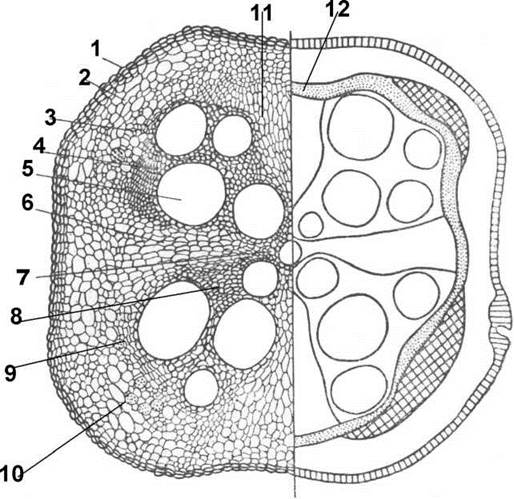
Fig. 60. Introduction/11.html">Secondary structure of the root of cultivated pumpkin: 1 - periderm, 2 - secondary cortex parenchyma, 3 - secondary phloem, 4 - region of fascicular cambium, 5 - vessels of secondary xylem, 6, 12 - regions of interfascicular cambium, 7 - vessels of primary xylem, 8 - xylem parenchyma, 9 - sieve tubes, 10 - remnant of primary phloem, 11 - parenchyma of medullary rays
Secondary changes occur not only in the central cylinder but also in the peripheral region. The pericycle cells that did not participate in the formation of the fascicular cambium and the living cells of the endodermis divide and transform into phellogen cells. The phellogen, in turn, produces cork cells outwardly and phelloderm cells inwardly. The cork, phellogen, and phelloderm taken together are called the periderm. The periderm isolates the primary cortex from the central cylinder; a process of shedding or "molting" of the root takes place, which is intensified by the significant thickening of the central cylinder due to the proliferation of secondary phloem and xylem elements. After the shedding of the primary cortex, a secondary cortex arises in its place, and a secondary structure is formed with developed secondary xylem and phloem, cortical parenchyma, medullary rays, fascicular and interfascicular cambium, and suberized periderm cells. Only the primary xylem in the center and the primary phloem pushed to the periphery by the secondary phloem remain from the primary structure.
The roots of carrots and radishes have certain specific features. They exhibit a typical secondary structure, but due to nutrient storage, they undergo extraordinary thickening.
In carrots, the root thickens due to the excessive proliferation of the parenchyma and secondary phloem. The secondary xylem is poorly developed.
The root crop of the radish is characterized by the excessive proliferation of the secondary xylem, especially the xylem parenchyma. The cambium is located beyond the xylem, forming secondary phloem toward the periphery. The secondary phloem is poorly developed. Beyond it lie the region of primary phloem, cortical parenchyma, and periderm.
The Tertiary Structure of the root is characteristic of the common beet. During ontogeny, the primary root structure develops first. The primary structure is short-lived, and with the appearance of the first true leaves, secondary changes occur that form the secondary anatomical structure. Tertiary changes in The structure of the beet root manifest primarily in the formation of an additional 8–12 cambial rings, which are initiated in the ground parenchyma of the secondary cortex, where nutrients are stored. Each cambial ring corresponds to The Development of two true leaves.
Last update: 07/08/2026
Editorial and Educational Adaptation: This material has been compiled based on the primary/original source text. The project team performed an editorial review, corrected technical inaccuracies, structured sections, and adapted the content for an educational format.
What was processed:
- elimination of formatting defects (OCR errors, structural breaks, corrupted characters);
- editorial organization of content;
- standardization of terminology in accordance with academic sources;
- verification of factual statements against the original source text.
All mentions of the author, publication year, and origin of the primary text have been preserved in accordance with the source.