Molecular Biology: Protein Structure and Functions - Stepanov V.M. 2005
Quaternary Protein Structure
Functional Significance of Quaternary Protein Structure
A detailed Analysis of the functional role of quaternary Structure can only be given using specific Proteins as Examples, which goes beyond The Scope of this chapter. Therefore, we will focus only on a few fundamental principles. It has often been argued that building large protein molecules from relatively short peptide chains that form a quaternary structure helps reduce the risk of Translation errors. Indeed, even a single error in The Biosynthesis of a sufficiently long polypeptide chain consisting, for example, of 1,000 amino acid residues can destabilize its structure and render the entire Protein Synthesis meaningless. If a protein of the same size were built, say, from four subunits of 250 amino acid residues each, the same error would result in the loss of only a single subunit.
These considerations are likely incorrect because, as has recently become clear, many proteins are synthesized as very large precursors (consisting of several thousand amino acid residues) known as polyproteins, which are subsequently cleaved into functional globules. Consequently, translation errors do not impose serious restrictions on the size of the peptide chain, making it difficult to imagine that quaternary structure evolved as a defense mechanism against them.
It can be hypothesized that quaternary structure is capable of performing one or more of the following Functions.
1. Integration of multiple interrelated functions into a single structure. This feature of quaternary structure underlies spatial Organization and the combination of several functionally active sites within a single structure, each located on a separate subunit—such is RNA polymerase, for example. Sometimes, very large multienzyme complexes are organized on similar principles, albeit in a much more complex manner.
2. Architectural function. Quaternary structure allows spatial formations of highly complex configurations to be assembled from relatively small globular subunits, providing specific functional capabilities for the protein.
For instance, in ferritin (an animal protein), the molecule is composed of 24 subunits surrounding a large internal cavity. This cavity is designed to store iron oxide, accommodating up to 3,500 FeO.OH groups (Fig. 7.3). Another example of this function is the formation, by two subunits of the small protein uteroglobin, of a cavity measuring 15x7x8 Å, which serves to bind the steroid hormone progesterone. The subunits of the E. coli Tryptophan synthase enzyme catalyze the following reactions:
✵ the α-reaction is provided by the α-subunit: indole-3-glycerol phosphate → indole + D-glyceraldehyde-3-phosphate;
✵ the β-reaction is provided by the dimer of β-subunits: L-Serine + indole → L-tryptophan + H2O.
Class="center">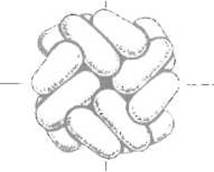
Fig. 7.3. Quaternary Structure of ferritin. Ferritin is a heteropolymeric protein composed of 24 structurally similar light and heavy subunits. The molecule is a hollow spherical shell penetrated by channels through which iron ions enter the interior. Apparently, during The formation of The quaternary structure, the subunits sequentially combine into dimers, tetramers, hexamers, and octamers.
The combination of α- and β-subunits into an α2β2 quaternary structure makes it possible to carry out the overall α,β-reaction:
L-serine + indole-3-glycerol phosphate → L-tryptophan + D-glyceraldehyde-3-phosphate.
Crucially, the product of the first reaction—indole—serves as the substrate for the second, which takes place with the participation of a different catalytic center. The quaternary structure of this enzyme, which can be viewed as a prototype of multienzyme complexes, is organized in such a way that the subunits form a kind of tunnel through which indole travels from one center to the other without entering the solution. This ensures high efficiency of the overall process leading to tryptophan synthesis. Clearly, this case also illustrates THE PRINCIPLE OF integrating functions within a single structure.
Apparently, some proteins that combine two interrelated functions within a single structure may have passed through a stage in their evolution where the quaternary structure formed from two separate subunits. Subsequently, their structural genes fused, thereby uniting The polypeptide chains into one. As a result, one might assume, the subunits effectively transformed into domains within a single molecule.
The capabilities inherent in quaternary structure are also utilized in the formation of protein functional sites. For instance, the active sites of A number of dehydrogenases are formed by amino acid residues located on different subunits of these Enzymes. This allows for the arrangement of an Active Site that envelops the substrate from multiple sides and isolates it from Water. For example, in horse Liver Alcohol dehydrogenase, the "pocket" housing the active site is formed by the side chains of Amino Acids belonging to two identical subunits. Subunit 1 contributes three leucine residues, two serine and two phenylalanine residues, and one valine, isoleucine, Proline, and Threonine residue each. Subunit 2 contributes Methionine, leucine, and serine residues.
In Triosephosphate isomerase, the substrate-binding region is also formed by two subunits, which approach each other upon interacting with the substrate's phosphate group, shielding it from the surrounding solvent so that the reaction proceeds in its complete absence. The Antigen-binding center of an immunoglobulin is formed by amino acid residues located on two polypeptide chains of the immunoglobulin—light and heavy.
3. Facilitating multiple interactions of the protein with extended structures. Through the formation of quaternary structure, two or more functional protein centers can be combined within a single large entity and establish cooperative interactions with various extended biological molecules. For example, due to the existence of quaternary structure, class G IMMUNOGLOBULINS combine two identical antigen-binding sites in a single molecule while simultaneously allowing the distance between them to vary within certain limits owing to conformational flexibility. The cooperativity of such antigen-binding sites with macromolecular Antigens, such as bacterial Cell walls, makes antigen–immunoglobulin complexes much more stable than would be observed for a monomeric protein.
Equally important is the existence of a large family of DNA-binding proteins in the form of dimers, which again contain two identical binding sites. Consequently, such proteins are capable of binding tightly to repeating sequences on both strands of double-helical DNA. At least some repressor proteins, notably the phage λ cro-repressor, are built according to this principle. For several families of nucleic acid-interacting proteins, the formation of dimers from identical (homodimers) and different (heterodimers) subunits is apparently possible. Obviously, the functional role of homodimers and heterodimers differs significantly, as the region of the protein capable of binding to the corresponding DNA site turns out to be distinct. Therefore, the very formation of quaternary structure regulates the function of such proteins.
4. Regulatory function. The main functional feature of quaternary structure (apparently the very reason for its existence) is that relatively weak interactions between subunits—The Nature of which largely depends on the Tertiary Structure of each—are particularly well suited for regulatory effects and the control of protein activity. Due to the relative weakness of intersubunit contacts, Changes in the tertiary structure of any given subunit, caused by its interaction with a substrate or another Ligand, are transmitted to its contact zone with another subunit, altering the character of that zone. Such a change leads to a reorganization of the entire Quaternary Structure and ensures the transmission of the effect from one subunit to others associated with it (see, for example, chapters 8 and 12).
Being a relatively weak element of Protein Structure, the intersubunit contact zone readily absorbs changes resulting from Post-translational protein modification, such as the addition or removal of a phosphate group (see chapter 11), which is once again utilized as a regulatory mechanism.
An example of a protein whose quaternary structure provides highly complex regulation—while itself being quite intricate—is E. coli aspartate transcarbamylase (Fig. 7.4). In this enzyme, which is key to pyrimidine biosynthesis, six catalytic subunits (C) assemble into two trimers that can interact with one another to a greater or lesser extent in response to substrate binding. Regulatory Subunits (R) form three dimers that make contact with the catalytic subunits. This allows the enzyme to be inhibited by CTP (the end product of the pyrimidine biosynthetic pathway) and activated by ATP, apparently through a conformational change in the regulatory subunits that is transmitted via quaternary structural reorganization to the catalytic subunits. The Stoichiometry of the enzyme's quaternary structure corresponds to the formula (C3)2(R)3.
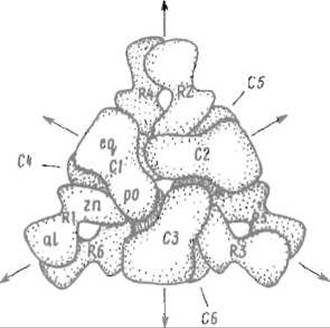
Fig. 7.4. Quaternary structure of E. coli aspartate transcarbamylase.
C1–C6 are catalytic subunits forming two trimers, C1–C3 and C4–C6; R1–R2, R3–R4, and R5–R6 are regulatory subunit dimers; eq, po, zn, and al are the domains that make up these subunits; arrows indicate axes of Symmetry.
Last update: 13/08/2026
Editorial and Educational Adaptation: This material has been compiled based on the primary/original source text. The project team performed an editorial review, corrected technical inaccuracies, structured sections, and adapted the content for an educational format.
What was processed:
- elimination of formatting defects (OCR errors, structural breaks, corrupted characters);
- editorial organization of content;
- standardization of terminology in accordance with academic sources;
- verification of factual statements against the original source text.
All mentions of the author, publication year, and origin of the primary text have been preserved in accordance with the source.