Molecular Biology: Protein Structure and Functions - Stepanov V.M. 2005
Globins
Globins are a family of evolutionarily related Proteins capable of reversibly binding oxygen and facilitating its storage and transport in biological systems.
Globins are widespread throughout the animal kingdom. Leghemoglobin, a protein found in the ROOT nodules of legumes, also belongs to the globin family. Globins are classified as Conjugated Proteins containing a characteristic non-protein component (a prosthetic group) known as heme, which is a complex of ferrous iron and porphyrin:
Heme plays a pivotal role in globin function, as it is the site—specifically, the ferrous iron ion incorporated into its Structure—where the oxygen molecule binds.
A key feature of globins is that, under normal conditions, oxygen binding does not oxidize the iron to the ferric state. The Functional Significance of this mechanism is clear: oxidation would consume the oxygen, rendering its TRANSPORT AND STORAGE impossible.
Class="center">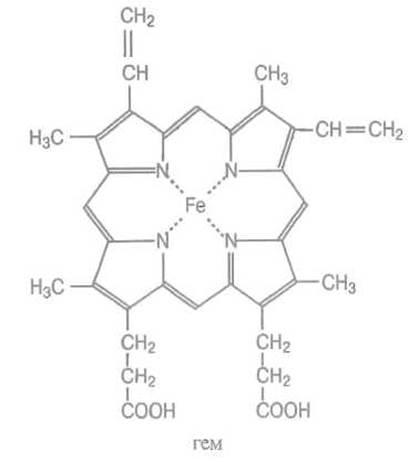
Therefore, when analyzing The structure of these proteins, primary attention should be paid to the mode of oxygen binding and the molecular mechanisms that regulate its association and dissociation.
There are two MAIN TYPES OF globins: Myoglobin, found in Muscle tissue where it provides oxygen storage, and Hemoglobin, a protein concentrated in red Blood Cells responsible for transporting oxygen from the Lungs to the Tissues via the bloodstream. The Study of the structure and Functional Characteristics of globins—with a particularly crucial contribution from the X-ray crystallographic studies conducted by M. Perutz, J. Kendrew, and their coworkers—has profoundly shaped our current understanding of Cell/13.html">Protein Structure, function, and evolution.
Last update: 13/08/2026
Editorial and Educational Adaptation: This material has been compiled based on the primary/original source text. The project team performed an editorial review, corrected technical inaccuracies, structured sections, and adapted the content for an educational format.
What was processed:
- elimination of formatting defects (OCR errors, structural breaks, corrupted characters);
- editorial organization of content;
- standardization of terminology in accordance with academic sources;
- verification of factual statements against the original source text.
All mentions of the author, publication year, and origin of the primary text have been preserved in accordance with the source.