Biochemistry of Amino Acids - A. Majster 1961
General Biochemistry and Physiology of Amino Acid Metabolism
Functions of Vitamin B6 in Amino Acid Metabolism
There are important metabolic relationships between individual Amino Acids and Vitamins. The Role of riboflavin in the form of riboflavin phosphate and flavin adenine dinucleotide was noted above (p. 183). Ascorbic acid is involved in The oxidation of $n$-hydroxyphenylpyruvic acid to homogentisic acid, but The Mechanism of its action remains unclear (p. 419). The relationship between Tryptophan and nicotinic acid will be discussed in detail in a subsequent section (p. 399). Biotin apparently takes part in the incorporation of CO2 (via oxaloacetic acid) into the aspartic acid molecule (p. 312). The presence of $\varepsilon$-biotinyllysine in biological samples indicates a link between biotin and Lysine METABOLISM. The Significance of coenzyme A in various metabolic reactions has also been established. (Several amino acids participate in The formation of the coenzyme A molecule itself (p. 365).) Coenzyme A takes part in the dissimilation of the carbon chains of leucine, isoleucine, and valine, in the synthesis of certain acyl Amino Acid Derivatives (e.g., hippuric acid), and presumably in other amino acid transformations as well. The role of Folic acid in one-carbon unit metabolism will be examined in Chapter IV.
Vitamin B6, in the form of Pyridoxal phosphate or pyridoxamine phosphate, participates in numerous amino acid metabolic reactions (Table 24) and plays an exceptionally important and versatile role in them.
Class="center">Table 24 Reactions Involving Vitamin B6
|
Decarboxylation Racemization Serine → Pyruvic acid + NH3 Threonine → $\alpha$-Ketobutyric acid + NH3 Cysteine → Pyruvic acid + H2S + NH3 Homocysteine → $\alpha$-Ketobutyric acid + H2S + NH3 Homoserine → $\alpha$-Ketobutyric acid + NH3 Tryptophan → Indole + Pyruvic acid + NH3 Indole + Serine → Tryptophan Kynurenine → Anthranilic acid + Alanine 3-Hydroxykynurenine → 3-Hydroxyanthranilic acid + Alanine Cystathionine → Cysteine + $\alpha$-Ketobutyric acid + NH3 Homocysteine + Serine → Cystathionine Threonine ⇄ Glycine + Acetaldehyde Serine ⇄ Glycine + Formaldehyde Alliin → Allicin + Pyruvic acid + NH3 Methionine → CH3SH + NH3 + $\alpha$-Ketobutyric acid |
Information regarding the existence of vitamin B6 was first obtained in 1934 [385], when it was demonstrated to be an essential dietary factor for rats; however, its metabolic Functions have only recently been elucidated. Despite the vast amount of accumulated data on vitamin B6, the full spectrum of symptoms observed in its deficiency is still not completely understood. The Chemical synthesis of vitamin B6 and the discovery of its three naturally occurring forms paved the way for further breakthroughs; first and foremost, its involvement in the enzymatic transamination and Decarboxylation of amino Acids was established.
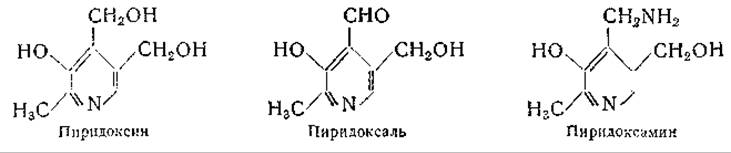
It is now generally accepted that the Mechanism of Enzymatic transamination involves the reversible formation of Schiff bases from an amino (or keto) acid and a pyridoxal (or pyridoxamine) phosphate ester. Several years prior to Braunstein and Kritzmann's discovery [251] of enzymatic transamination, Herbst [249, 250] proposed a similar mechanism to explain non-enzymatic transamination between ethyl esters of $\alpha$-aminophenylacetic acid and pyruvic acid:

A comparable scheme was proposed by Braunstein [257] to account for enzymatic transamination:

The Discovery of the aldehyde and amine forms of vitamin B6 in natural sources led Snell [386] to suggest that the interconversion of these vitamin B6 forms occurs via transamination, and that vitamin B6 can function as a coenzyme in enzymatic transamination. Later, Snell [387] demonstrated the reversible interconversion of pyridoxal and pyridoxamine resulting from non-enzymatic transamination reactions with amino and keto acids. Experimental evidence confirming the participation of vitamin B6 in enzymatic transamination was obtained from studies on rats and microorganisms under conditions of vitamin B6 deficiency. Vitamin B6 deficiency was accompanied by a decrease in transaminase activity, whereas The addition of pyridoxal phosphate to tissue or Cell preparations restored enzyme activity [388–390].
Similar results were obtained in studies on AMINO ACID DECARBOXYLATION processes. It was found that Tyrosine decarboxylase activity in Streptococcus faecalis Cells depends on the presence of pyridoxine in the medium [383, 391]. It was later established that the addition of pyridoxal along with adenosine triphosphate, or of pyridoxal phosphate, to S. faecalis cells grown on a vitamin B6-deficient medium enhances The activity of this decarboxylase. A decarboxylase coenzyme preparation isolated from Yeast [392] was found to be similar to synthetic pyridoxal phosphate in its stability characteristics and ability to activate the decarboxylase [393–396]. A heat-stable transaminase cofactor was also discovered, which likewise proved to be similar to pyridoxal phosphate and could replace it [208, 257, 397]. There is compelling evidence showing that pyridoxal phosphate participates in amino acid decarboxylation, and that both pyridoxal phosphate and pyridoxamine phosphate can take part in transamination. These findings have been gathered from studies on various vitamin B6-deficient organisms as well as from experiments concerning the effects of added synthetic Coenzymes on enzyme systems in vitro.
An interesting experiment was conducted by Snell and his coworkers [398]. They cultured various microorganisms on a medium deficient in vitamin B6 but containing Essential Amino Acids. It turned out that Streptococcus faecalis can grow on a vitamin B6-deficient medium if essential Amino acids are present, but ceases growth when these amino acids are replaced by the corresponding $\alpha$-keto acids. Growth on media containing $\alpha$-keto acids is observed only when a sufficient amount of vitamin B6 is added to the medium. Consequently, under these conditions, the role of vitamin B6 is reduced to supplying the transaminases with coenzyme. Similar studies were carried out regarding D-alanine: conditions were found under which the vitamin B6 added to the medium is required solely to supply alanine racemase with its coenzyme (see p. 241).
The affinity for vitamin B6 varies among different enzyme preparations. This is evidenced by research data examining the activation of isolated apoenzymes and by experiments determining The Effect of vitamin B6 deficiency on tissue enzyme activity. For instance, in vitamin B6-deficient rats, the activity of glutamate-aspartate transaminase [388, 390, 399, 400] and glutamate-alanine transaminase [401, 403] decreases in tissue, whereas the activity of glutamine-$\alpha$-keto acid transaminase remains unchanged [402]. The dependence of the latter on vitamin B6 was confirmed by obtaining a partially coenzyme-depleted apoenzyme extract from rat Liver following the administration of isonicotinic acid hydrazide [404]. A number of studies indicate that isonicotinic acid hydrazide acts as a vitamin B6 antagonist [404–408]. Thus, patients receiving isonicotinic acid hydrazide excrete large amounts of vitamin B6 in their urine, apparently in the form of the corresponding hydrazone. These findings suggest that the action of the hydrazide is due to its ability to combine with the aldehyde group of pyridoxal. At a certain level of vitamin B6 deficiency in rats, liver cysteine sulfinate-Pyruvate transaminase activity decreases compared to controls, whereas cysteine sulfinate-$\alpha$-ketoglutarate and glutamate-pyruvate transaminase activities do not diminish [409]. Upon dialysis of rat liver preparations, liver cysteine desulfhydrase readily dissociates into apoenzyme and coenzyme; the activity of this enzyme system declines even under moderate vitamin B6 deficiency [400, 402].
Although pyridoxal phosphate was already regarded as a coenzyme for transaminases and Decarboxylases in 1944, this compound, along with pyridoxamine phosphate, was not isolated in pure form until 1952. THE POSITION OF the phosphate group in the coenzyme was also precisely established in 1952, although correct inferences regarding its molecular Structure had been made from earlier research data.
1 According to Olenicheva [294], profound suppression of glutamine transaminase and asparagine transaminase activity is readily observable in rats with dietary B6 avitaminosis. — Ed. note.

Pyridoxal-3-phosphate, whose unambiguous synthesis was accomplished by Karrer and Viscontini [410], proved to be non-identical to the biologically active product [411]. Other studies suggested that the phosphate group is attached at position 5 [412, 413]; finally, the unambiguous synthesis of pyridoxal-5-phosphate by Baddiley and Mathias [414] definitively resolved this issue. Undoubtedly, earlier syntheses also yielded pyridoxal-5-phosphate and pyridoxamine-5-phosphate, but only subsequent work by Karrer and coworkers [415, 416] and Peterson and Sober [417, 418] made it possible to obtain pure preparations of these compounds. Peterson and Sober additionally prepared pyridoxine-5-phosphate by treating pyridoxamine-5-phosphate with nitrous acid. Furthermore, 4-deoxypyridoxine-5-phosphate, $\omega$-methylpyridoxamine-5-phosphate, and $\omega$-methylpyridoxal-5-phosphate have been obtained [417, 419, 420].
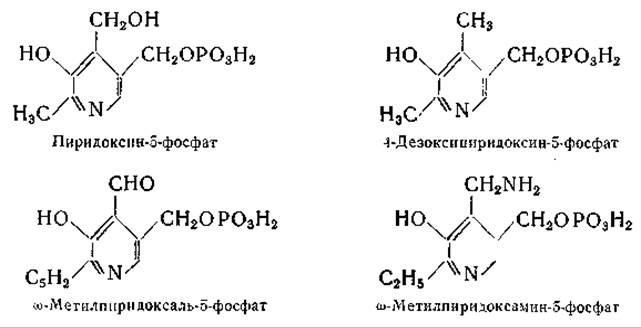
Unlike other vitamin B6-containing Enzymes, transaminases are characterized by the fact that either pyridoxamine phosphate or pyridoxal phosphate can fulfill the coenzyme role, whereas in decarboxylation, racemization, and other Reactions Catalyzed by B6 enzymes, vitamin B6 exhibits catalytic activity exclusively in the form of pyridoxal phosphate. Early research gave some reason to believe that pig Heart glutamate-aspartate transaminase is activated solely by pyridoxal phosphate (and not by pyridoxamine phosphate) [263, 421]. However, it was later shown that both coenzymes are active in this system [422]; subsequent work revealed that both coenzymes can activate other transamination systems as well. It is highly interesting that maximal activity requires preincubation of the enzyme with the coenzyme prior to substrate addition (apparently, some time is required for the coenzyme to bind to the enzyme). Maximal activation of the enzyme by pyridoxamine phosphate requires a longer preincubation period than does pyridoxal phosphate, indicating that the amine form binds to the enzyme protein more slowly. Available data rule out the possibility of a preliminary conversion of pyridoxamine phosphate into pyridoxal phosphate under the given experimental conditions. The coenzyme evidently forms a tight bond with the enzyme. Even after multi-day Dialysis of the transaminase reconstituted with pyridoxal phosphate or pyridoxamine phosphate, enzyme activity did not diminish [422].
The mechanism of enzymatic transamination can be expressed by the following equations (PLP and PMP denote pyridoxal phosphate and pyridoxamine phosphate, respectively)

Attempts to directly demonstrate the interconversion of pyridoxamine phosphate-enzyme and pyridoxal phosphate-enzyme have thus far been unsuccessful1, apparently due to a number of experimental difficulties. These stem from the fact that only a very small amount of coenzyme binds to the enzyme, and There is a lack of a sufficiently reliable method for quantitatively cleaving and assaying the enzyme-bound coenzyme. The task is further complicated by the fact that added synthetic coenzyme can attach to the enzyme protein molecule not only at the site required for enzymatic activity, but at other loci as well. Studies utilizing radiophosphorus-labeled coenzyme revealed non-specific binding of a significant amount of coenzyme, caused (at least in part) by the formation of Schiff bases between the coenzyme and free protein amino groups.
1 This interconversion has been convincingly demonstrated in experiments with a highly purified glutamate-aspartate transaminase preparation [W. T. Jenkins, J. W. Sizer, J. Am. Chem. Soc., 79, 2655 (1957); J. Biol. Chem., 235, 620 (1960)]. — Ed. note.
The formation of pyridoxal phosphate from pyridoxal and adenosine triphosphate was first investigated by Gunsalus and coworkers [393, 396] using the tyrosine decarboxylase system of Streptococcus faecalis. Pyridoxal kinase has recently been isolated from yeast [423] and found to catalyze the following reaction:

This enzyme, which requires Metal Ions for its activity (such as Co++, Mg++, Fe++), is widely distributed; In addition to yeast, it has also been found in Escherichia coli [423], Brain tissue [424], and liver [425]. The system phosphorylates pyridoxal, pyridoxamine, pyridoxine, 4-deoxypyridoxine, and a number of other vitamin B6 analogues. It has been found that 4-deoxypyridoxine inhibits the tyrosine decarboxylase of Streptococcus faecalis; this inhibition is apparently due to the competition of the specified vitamin B6 analogue with phosphopyridoxal for the apodecarboxylase [426–428]. Incubating pig heart glutamate-aspartate transaminase with 4-deoxypyridoxine phosphate prevents enzyme activation upon subsequent incubation with pyridoxamine phosphate or pyridoxal phosphate [422]. However, after complete reactivation of the apotransaminase by incubation with either of the two coenzymes, 4-deoxypyridoxine no longer exerts an inhibitory effect. Similar results were obtained with pyridoxine phosphate, which does not exhibit coenzyme activity for transaminases but exerts an inhibitory effect of approximately the same nature and degree as 4-deoxypyridoxine phosphate. The inhibitory effect of pyridoxine phosphate indicates the possibility of transaminase inhibition in Tissues resulting from the reduction of the formyl group of pyridoxal phosphate incorporated into the enzyme molecule; inactivation may also result from the oxidation of the bound coenzyme to the phosphoric ester of pyridoxic acid.
ω-Methylpyridoxal and ω-methylpyridoxamine can support the growth of S. faecalis in place of Vitamin B6 under conditions where amino acids are synthesized from the corresponding α-keto acids; this provided grounds for suggesting that phosphorylated ω-methyl derivatives of vitamin B6 can exhibit activity as transaminase coenzymes. It was later shown that ω-methylpyridoxal phosphate activates the transaminases of S. faecalis, although the affinity of the apoenzymes for the analogue is lower than for the natural coenzyme [429]. It is highly interesting that the replacement of the methyl group of pyridoxal by an ethyl group is not accompanied by a complete loss of activity. In the alanine racemase system, the activity of ω-methylpyridoxal phosphate is significantly lower than that of pyridoxal phosphate, and in the cysteine desulfhydrase system it appears to be entirely devoid of activity.
Unlike many other vitamin B6 analogues [430–433], ω-methyl derivatives of vitamin B6 exert a certain stimulating effect on growth in the absence of vitamin B6. Thus, ω-methylpyridoxal, ω-methylpyridoxine, and ω-methylpyridoxamine not only act as growth factors for Bacteria [429], but also promote the growth of rats maintained on a vitamin B6-deficient diet. However, after several weeks, the growth rate declines to values close to those of control (avitaminotic) animals or even lower. The results of these studies can be explained by the fact that ω-methylpyridoxal phosphate is capable of acting as an antagonist in some enzyme systems and as an activator in others [434].
The concept that the mechanism of enzymatic transamination involves the reversible formation of Schiff bases with the participation of the aldehyde and amine forms of vitamin B6 was developed on The basis of studies on non-enzymatic Transamination reactions between amino and keto acids [249, 250] and the subsequent expansion of these studies in experiments with pyridoxal and pyridoxamine. It was found that many amino acids enter into non-enzymatic transamination reactions with pyridoxal in the presence of copper, iron, or aluminum ions at 100°, and this reaction proved to be reversible [387, 435–437]:

The reaction between pyridoxal and alanine has been studied in considerable detail, and spectrophotometric measurements have established the formation of two Schiff bases as intermediate products [438]. Paper Chromatography was used to separate these intermediates [439]. Attempts to detect the effect of metal ions in the following reaction were less successful [436]:

According to some data, this reaction is activated to a certain extent by aluminum and iron salts. A requirement for a metal ion in non-enzymatic transamination has been established for several systems; however, for the reaction between glyoxylic acid and amino acids, which proceeds readily at 25°, metal ions appear to be unnecessary [291]. The involvement of metals in enzymatic transamination has not been established.
THE CONCEPT OF Schiff base formation during transamination reactions is consistent with Deuterium Exchange data from these reactions [257, 260, 440–443]. The glutamic acid molecule formed during enzymatic transamination between α-ketoglutaric and aspartic acids in the presence of D2O contains approximately one deuterium atom [440, 444]. The hydrogen of aspartic acid is also replaced by deuterium during enzymatic transamination. The exchange of the α-hydrogen atom of amino acids during transamination is evidently linked to the action of the enzyme; if α-ketoglutaric acid is excluded from the system, less than 6% of the α-hydrogen of aspartic acid is exchanged. It has been established through various approaches that the β-hydrogen atom of amino acids does not participate in transamination reactions. In leucine isolated from rat tissues after feeding them leucine labeled with deuterium at the a-, β-, and γ-positions, the isotope dilution of hydrogen atoms at the β and γ positions was nearly identical, indicating the absence of appreciable reversible α,β-dehydrogenation [445]. Another observation consistent with this Conclusion is that reversible enzymatic transamination between L-isoleucine and α-ketoglutaric acid yields pure L-α-keto-β-methylvaleric acid; under the same conditions, L-allo-isoleucine yields D-α-keto-β-methylvaleric acid [129, 130]. If reversible α- and β-dehydrogenation occurred during transamination, a racemic α-keto acid would be formed. Furthermore, it was found that enzymatic transamination between β-deutero-α-ketoglutaric acid and alanine is not accompanied by any appreciable loss of deuterium, i.e., The amount of deuterium in the resulting glutamic acid is almost equal to that in the initial α-ketoglutaric acid [446].
Isotopic Methods have established the occurrence of transamination between an Amino Acid and its corresponding α-keto acid [444, 447]. In particular, transamination was detected between alanine and C14-pyruvic acid, and between C13-glutamic acid and α-ketoglutaric acid. It follows from these data that in a system comprising two α-keto acids and their analogous amino acids, transamination reactions take place between molecules with identical carbon chains; this should result in a decrease in the net amounts of newly formed amino or keto acids. Such an effect, showing a reduced rate of transamination, has been demonstrated experimentally [448].
Studies utilizing N15-labeled substrates showed that ammonia is not an intermediate product in enzymatic transamination [318], thereby definitively confirming the original hypothesis regarding The Nature of this reaction [251]. It was found that in a medium containing unlabeled ammonium ions, N15-labeled amino acids transfer their amino group directly to α-ketoglutaric acid [318].
The close similarity between enzymatic and non-enzymatic transamination reactions and the discovery of the role of Pyridoxal phosphate as a coenzyme in many other enzyme systems led to The Development of the concept that the mechanisms of reactions catalyzed by vitamin B6 are general in nature. Metzler and coworkers [435] and Braunstein and Shemyakin [449] independently advanced essentially the same theory. According to these authors, a Schiff base is formed from pyridoxal, an amino acid (and a metal ion); vitamin B6-catalyzed reactions are interpreted as the result of various sequential electron shifts within the intermediate molecules. For example, Metzler and coworkers [435] formulated the following mechanism for transamination reactions:
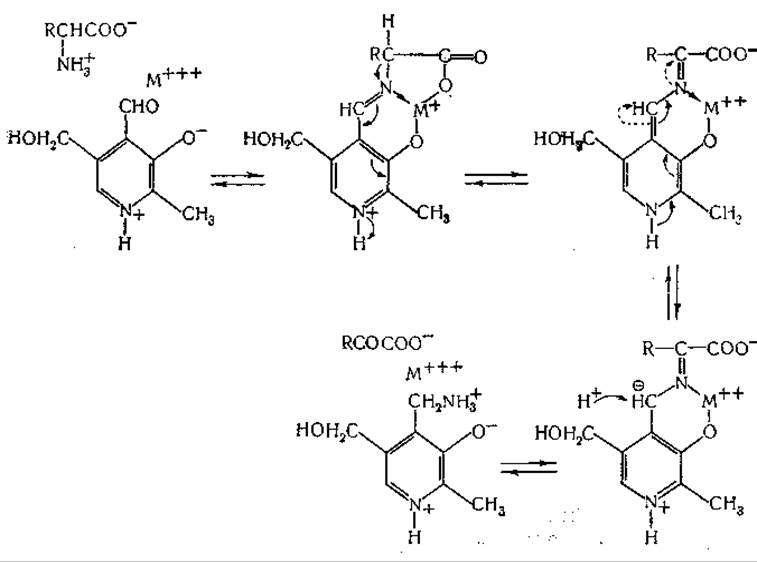
Furthermore, the following reaction scheme for Amino Acid Racemization has been proposed:

Mechanistic schemes have also been developed for decarboxylation, elimination of β-substituents (Serine and threonine dehydratases, tryptophanase, alliinase, cystathionase), addition of β-substituents (tryptophan synthesis, cystathionine formation), Cleavage of γ-substituted amino acids (homocysteine desulfhydrase, homoserine dehydratase), synthesis and cleavage of threonine (into glycine and acetaldehyde) and serine (into glycine and formaldehyde) [435, 449]. The formation of a chelate complex involving the metal, pyridoxal, and amino acid as a common intermediate has been postulated for a number of reactions [435]. These mechanisms are discussed in the relevant sections of Chapter IV. Mandeles and coworkers [246] showed that during the enzymatic decarboxylation of amino acids, one hydrogen atom remains bound to the α-carbon atom. They found that in the amines produced by the enzymatic decarboxylation of lysine, glutamic acid, and tyrosine in a medium containing 99.8% D2O, each molecule contains only one deuterium atom, which is located exclusively at the carbon atom that served as the α-carbon of the starting amino acid. The Reversal of the decarboxylation reaction is also accompanied by deuterium incorporation [244, 245]. According to these authors, this involves asymmetric incorporation of deuterium, leading to the formation of a single optical isomer of the deuterated amine. Hanke and coworkers [450, 451] prepared α-deutero-DL-glutamic acid by the action of glutamate racemase on glutamic acid. This product was enzymatically decarboxylated in an H2O medium to yield one of the isomers
of deutero-γ-aminobutyric acid:

This isomer does not lose its deuterium upon Treatment with glutamate decarboxylase in aqueous solution. Another isomer of deutero-γ-aminobutyric acid was obtained by the decarboxylation of L-glutamic acid in a D2O medium; in the presence of decarboxylase, this isomer exchanges its deuterium for the hydrogen of Water. The data obtained by Hanke and his coworkers are consistent with a decarboxylation mechanism that includes the following intermediate phases:

Vitamin B6 apparently participates in all transamination reactions. The fact that certain transaminases do not require the addition of this coenzyme for maximum activity is explained by its tight binding to the enzyme in these cases. The possibility cannot be excluded that transamination reactions involving aldehydes (such as glyoxylic acid) may proceed without vitamin B6; such reactions have been carried out in non-enzymatic systems, but to date no definitive evidence has been obtained confirming the existence of transaminases that do not contain vitamin B6. All amino acid decarboxylases that have been thoroughly investigated also function with the participation of pyridoxal phosphate. It was initially assumed that Histidine decarboxylase did not require vitamin B6 [452], but it was subsequently established that pyridoxal phosphate is indeed the coenzyme for this enzyme as well [453]. Clostridium welchii aspartate-β-decarboxylase can be activated by pyridoxal phosphate or α-keto acids. The activating effect of α-keto acids was attributed to a transamination reaction between these acids and the pyridoxamine phosphate contained in the enzyme preparation, yielding pyridoxal phosphate (p. 208).
The Diversity of reactions requiring vitamin B6 highlights the paramount importance of this vitamin in Amino acid metabolism and suggests that vitamin B6 deficiency should lead to various Metabolic Disorders. An extensive series of studies on vitamin B6-deficient rats has been published [454–459]. In addition to the expected alterations in tissue transaminase activity, vitamin B6 deficiency was marked by an elevated Blood urea level and a decreased glutamine level in Blood Plasma. Administration of L-glutamic acid and L-lysine leads to a sustained increase in blood urea.
The interpretation of these facts is difficult not only because of the multiplicity of functions of vitamin B6, but also due to the varying affinities of different pyridoxal Enzymes for the coenzyme. It is interesting to note that under certain conditions, bacterial growth is possible in the absence of added vitamin B6; however, the synthesis of small amounts of the vitamin by the microorganisms cannot be ruled out.
Vitamin B6 probably participates in the action of other enzyme systems besides those described above. For instance, it has recently been found that pyridoxal phosphate takes part in heme synthesis [460, 706]; this discovery sheds light on the development of anemia in animals suffering from vitamin B6 deficiency. The question of the possible involvement of vitamin B6 in Amino Acid Transport processes is examined in the first section of this chapter.
Last update: 06/08/2026
Editorial and Educational Adaptation: This material has been compiled based on the primary/original source text. The project team performed an editorial review, corrected technical inaccuracies, structured sections, and adapted the content for an educational format.
What was processed:
- elimination of formatting defects (OCR errors, structural breaks, corrupted characters);
- editorial organization of content;
- standardization of terminology in accordance with academic sources;
- verification of factual statements against the original source text.
All mentions of the author, publication year, and origin of the primary text have been preserved in accordance with the source.