Biochemical Foundations of Human Vital Activity - Volkov N.I., Nesen E.N. 2000
Biochemical Foundations of Human Vital Activity
Biochemistry of Lipids
Intracellular Fat Metabolism
Intermediary Lipid METABOLISM takes place intensively in The Liver and adipose tissue, where the continuous Synthesis and Breakdown of reserve and other Lipids occur. The synthesis of reserve fats, which are triglycerides, leads to their accumulation (deposition) in Tissues. The breakdown of reserve fats into glycerol and Fatty acids, which are subsequently utilized by tissues (fat mobilization), also occurs continuously. The process of neutral fat breakdown in tissues is mediated by tissue lipases and is called lipolysis.
Lipolysis
In 1948–1958, A. Lehninger, F. Lynen, and other scientists discovered the complex process of neutral fat Breakdown and Oxidation. They demonstrated that an increased energy demand of the Organism (e.g., during prolonged muscular activity or starvation) activates lipolysis in adipose tissue Cells (adipocytes). Intracellular lipases break down neutral fats into glycerol and fatty acids, which are released from adipose tissue into the bloodstream and delivered to tissues to be used as an energy or structural material. Because the Chemical Nature of Fatty Acids and glycerol differs, their intracellular metabolic pathways differ as well (Fig. 72).
Glycerol can participate in Gluconeogenesis or enter The Glycolytic Pathway via the preliminary formation of 3-phosphoglyceraldehyde.
Fatty acids are degraded predominantly in the liver, where they serve as primary Energy Sources or participate in the synthesis of Cholesterol and Ketone Bodies.
Let us examine the intracellular processes of glycerol and fatty acid breakdown and oxidation in greater detail.
Class="center">
Fig. 72 Diagram of the intracellular metabolism of glycerol and fatty acids
Glycerol Oxidation
Glycerol is utilized by all Organs and tissues as an efficient energy substrate. Its oxidation begins with The formation of a-glycerophosphate (or phosphoglycerol) utilizing ATP, after which it is progressively converted into 3-phosphoglyceric acid and further oxidized via the carbohydrate oxidation pathway:
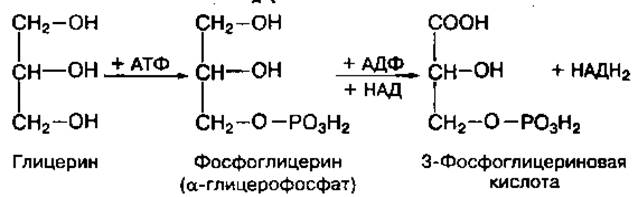
As an intermediate product of the carbohydrate Glycolysis phase, 3-phosphoglyceric acid is oxidized to lactic acid under anaerobic conditions, whereas under aerobic conditions it is converted into acetyl-CoA. The latter enters The Citric Acid Cycle and is oxidized to final metabolic products—CO2 and H2O. The oxidation of one glycerol molecule yields one ATP molecule under anaerobic conditions and 19 ATP molecules under aerobic conditions. Glycerol can also be used for de novo glucose synthesis and the restoration of Glycogen reserves.
Fatty acid oxidation can proceed via several metabolic pathways, of which the principal one for The Human Body is the so-called ß-Oxidation. The Essence of fatty acid ß-oxidation is that a single cycle of chemical transformations involves the oxidation of the carbon atom adjacent to the — COOH group (located in the ß-position) and the Cleavage of an acetyl-CoA molecule. Subsequently, acetyl-CoA enters The Citric Acid cycle, is oxidized by the respiratory enzyme system to final metabolic products—CO2 and H2O—with the release of a large amount of energy (Fig. 73).

Fig. 73 Scheme of palmitic acid oxidation in tissues
The complete degradation of, for example, palmitic acid yields 8 molecules of acetyl-CoA, which are oxidized in the citric acid cycle or transported to the liver, where they are converted into ketone bodies. The Complete oxidation of a palmitic acid molecule can be represented by the equation
С16Н32О2 + 23 О2 → 16СО2 + 146 Н2О + 130 АТФ ∆Q0 = -9788 кДж ∙ моль-1
The process of fatty acid ß-oxidation takes place in the Cell/35.html">Mitochondria. However, the preparatory stage for oxidation is the preliminary activation of the fatty acid molecule, which occurs in the Cytoplasm. Fatty acid activation involves its interaction with coenzyme A and ATP, resulting in the Formation of the active fatty acid form—acyl-CoA. This reaction is catalyzed by the enzyme thiokinase.
Acyl-CoA molecules cannot cross the mitochondrial membrane; therefore, their transport into the mitochondria is carried out in a complex with carnitine. Inside the mitochondria, the acyl-carnitine complex dissociates, and free acyl-CoA enters the ß-oxidation pathway, which proceeds in four stages (Fig. 74).
The first oxidation, or dehydrogenation (1), consists in the removal of hydrogen from the a- and ß-carbon atoms of acyl-CoA with the participation of acyl-CoA dehydrogenase containing the FAD coenzyme. This yields an unsaturated compound: dehydroacyl-CoA and 2 ATP molecules.

Fig. 74 Sequence of reactions in fatty acid ß-oxidation
Hydration (2) is a Water addition reaction across the double bond under the Influence of the enzyme enoyl-CoA hydratase, resulting in the formation of hydroxyacyl-CoA.
The second oxidation (3) is accompanied by the removal of two hydrogen atoms from the carbon atom in the ß-position (hence the name of the process—ß-oxidation) involving an NAD-dependent dehydrogenase. This produces ketoacyl-CoA and 3 ATP molecules.
The thiolase reaction (4) leads to the cleavage of acetyl-CoA from ketoacyl-CoA upon its interaction with another molecule of coenzyme A. This reaction yields acyl-CoA and acetyl-CoA, a process catalyzed by the enzyme thiolase.
Thus, during a single cycle of oxidation, a fatty acid molecule is shortened by two carbon atoms. The cycle steps are repeated until the entire fatty acid molecule is progressively broken down into individual acetyl-CoA molecules, which can either be oxidized to CO2 and H2O in the citric acid cycle or utilized in biosynthetic processes.
Let us examine the energy yield of β-oxidation using the oxidation of palmitic acid (C16H32O2) as an example. The degradation of palmitic acid involves a sevenfold repetition of the reactions discussed above. A single transformation cycle yields 5 ATP molecules. Over the course of seven repetitions, 5 x 7 = 35 ATP are produced.
Palmitic acid breaks down into 8 acetyl-CoA molecules, which yield 8 x 12 = 96 ATP in the citric acid cycle. One ATP molecule is consumed during the activation of the fatty acid. Consequently, the net energy yield is: 35 ATP + 96 ATP - 1 ATP = 130 ATP.
Thus, the energy yield from the oxidation of a fatty acid is three times greater than that from glucose oxidation (38 ATP). The liver plays the primary role in fatty acid oxidation.
Synthesis of Ketone Bodies in the Liver
Acetyl-CoA molecules formed during the Oxidation of Fatty acids, CARBOHYDRATES, and Amino Acids undergo further oxidation in the citric acid cycle or, when in excess, are used to produce ketone (acetone) bodies in the liver. Ketone bodies include acetoacetic acid (CH3COCH2COOH), β-hydroxybutyric acid (CH3CHOHCH2COOH), and acetone (CH3COCH3). Ketone bodies are subsequently utilized by tissues as an energy source (see Fig. 73).
Formation of Ketone bodies. Two acetyl-CoA molecules interact with each other to form acetoacetyl-CoA (Fig. 75). Next, acetoacetyl-CoA can react with a third acetyl-CoA molecule to yield the intermediate compound 3-hydroxy-3-methylglutaryl-CoA (HMG). The latter can also be formed during the breakdown of amino acids, such as leucine, and in the process of Cholesterol Biosynthesis. HMG-CoA synthase is localized primarily in liver cells, which is why ketone bodies are synthesized exclusively in this organ. Subsequently, under The Influence of the enzyme HMG-CoA lyase, HMG-CoA breaks down to yield the first ketone body—acetoacetic acid—which can be converted into 3-hydroxybutyric acid or undergo spontaneous decarboxylation to become acetone.

Fig. 75 Reactions of Ketone Body Synthesis
Ketone bodies serve as an indicator of the intensity of fat oxidation. In the Blood of a healthy individual, the concentration of ketone bodies is low. Their concentration increases when The rate of ketone body formation exceeds the rate of their utilization by peripheral tissues. The blood ketone body level can reach up to 20 mmol∙L-1 under such conditions. This state is known as ketonemia and is accompanied by acidosis—an increase in the acidity of the body's internal environment. When their production rate increases 20- to 30-fold compared to normal, ketone bodies may be excreted in the urine, a condition known as ketonuria. The appearance of ketone bodies in the urine can serve as a diagnostic test for various disorders, most notably Diabetes Mellitus.
Utilization of ketone bodies. The hepatic production of ketone bodies is one of many pathways for redistributing energy substrates among peripheral tissues. From the liver, they enter the bloodstream and are delivered to skeletal Muscles, The Heart, and other tissues, where they are oxidized in the citric acid cycle and used as an energy source. The liver itself does not utilize ketone bodies as an energy substrate, whereas in the heart, for instance, they provide up to 30% of Energy Requirements.
During physical exertion, the level of ketone bodies in the body's internal environment fluctuates depending on the duration of muscular work; however, THE CONTRIBUTION OF ketone bodies to the overall oxidative metabolism of skeletal muscles is minimal, accounting for less than 2%.
The accumulation of ketone bodies in the blood (Ketosis) inhibits triglyceride breakdown in adipose tissues, which can lead to a more intensive utilization of carbohydrates.
By monitoring changes in blood and urine ketone body levels in an athlete following physical exertion, one can determine the intensity of lipid utilization in Energy Metabolism, while their compositional profile reflects the level of liver glycogen.
Biosynthesis of Fatty Acids
The biosynthesis of various fatty acids, which differ in carbon chain length, Structure, and degree of saturation, possesses distinct characteristics. This is manifested in the Chemical transformations of substrates, the set of Enzymes catalyzing these reactions, and the Intracellular Localization of the synthesis process. Unlike fatty acid oxidation, this process occurs not in the mitochondria, but predominantly in the Cell Cytoplasm.
The primary metabolite on The pathway of fatty acid synthesis is the active form of malonic acid—malonyl-CoA—which is formed from acetyl-CoA with the participation of the enzyme acetyl-CoA carboxylase:

An indispensable participant in FATTY ACID BIOSYNTHESIS is the low-molecular-weight acyl carrier protein (ACP), with which fatty acid synthesis is associated.
Initially, ACP interacts with acetyl-CoA and malonyl-CoA to form acetyl-S-ACP and malonyl-S-ACP. They then react with one another:

The resulting D-β-hydroxybutyryl-S-ACP is converted into crotonyl-S-ACP + H2O, which, with the participation of NADPH2, is transformed into butyryl-S-ACP.
Butyryl-S-ACP, which now contains a four-carbon chain, continues to elongate until it forms one of the end products, such as palmityl-S-ACP. The final reaction is the cleavage of ACP with the release of palmitic acid, which can be converted into other saturated fatty acids through chain elongation. However, this process has a different intracellular localization: it occurs not in the cytoplasm, but in the mitochondria and Endoplasmic reticulum, and is catalyzed by different enzyme systems.
Monounsaturated fatty acids, such as oleic acid, can also be synthesized in the body from palmitic and stearic acids. Polyunsaturated acids such as linoleic and linolenic acids are not synthesized in the human body. Consequently, their only source is diet, making them essential nutritional factors. Fatty acid synthesis is an energy-consuming process that requires a supply of energy in the form of ATP and reduced NADP.
Biosynthesis of Triglycerides and Cholesterol
Biosynthesis of triglycerides. The primary specific precursors for triglyceride biosynthesis are glycerophosphate and activated fatty acids (acyl-CoA). The reactions involved in triglyceride biosynthesis are illustrated in Fig. 76. The interaction between glycerophosphate and acyl-CoA yields an intermediate product, lysophosphatidic acid. In the presence of the enzyme acyltransferase, this acid reacts with a second molecule of acyl-CoA to form phosphatidic acid, which serves as an intermediate in the biosynthesis of fats and phosphatides. Subsequently, through the action of the enzyme phosphatase, Phosphatidic acid is converted into a diglyceride. This diglyceride then reacts with a third molecule of acyl-CoA, mediated by acyltransferase, to produce a triglyceride molecule.
The organism-specific fat synthesized in this manner is stored in fat depots or other tissues, such as Skeletal Muscle, where it exists as minor energy reserves.
Biosynthesis of Cholesterol. In the human body, cholesterol is synthesized in virtually all organs and tissues. The Starting Material for its synthesis is the active form of acetic acid, acetyl-CoA. Cholesterol biosynthesis takes place in the cytoplasm and The endoplasmic reticulum, requiring energy in the form of ATP and NADPH molecules. Blood cholesterol levels depend on the rate of its Synthesis and degradation within tissues. The rate of synthesis is determined by The activity of several enzymes and is regulated by Hormones such as Insulin and Glucagon.
Last update: 06/08/2026
Editorial and Educational Adaptation: This material has been compiled based on the primary/original source text. The project team performed an editorial review, corrected technical inaccuracies, structured sections, and adapted the content for an educational format.
What was processed:
- elimination of formatting defects (OCR errors, structural breaks, corrupted characters);
- editorial organization of content;
- standardization of terminology in accordance with academic sources;
- verification of factual statements against the original source text.
All mentions of the author, publication year, and origin of the primary text have been preserved in accordance with the source.