PLANT MORPHOLOGY - T. A. Sautkina - 2012
CHAPTER 6. PLANT REPRODUCTION
6.1. The Concept of Reproduction. Principles of Plant Reproduction Classification
Regardless of their structural Organization level, plant organisms are complex, multi-functional systems capable of sustaining not only the life of each individual specimen, but also the survival of the species as a whole.
One of the most vital Functions of any living Organism is the generation of offspring similar to itself (the self-reproduction function). Self-reproduction can take place at various LEVELS OF STRUCTURAL organization. The increase in The amount of Nucleic Acids in Cell nuclei prior to mitotic or meiotic division represents self-reproduction at THE MOLECULAR LEVEL. The formation of new Cells through mitosis is self-reproduction at THE CELLULAR LEVEL. Finally, reproduction can occur at the organismal level. This is precisely what constitutes reproduction.
Reproduction, i.e., The ability to leave behind progeny, is a fundamental property of All living organisms. It maintains the continuity and succession of species and of life on Earth in general.
For plants, the majority of which lead a sessile lifestyle, reproduction has another crucial significance: it facilitates plant dissemination, leading to the expansion of their geographic range—the area occupied by a species.
While ensuring the overall survival of a species, reproduction does not sustain the life of the reproducing individual itself, and sometimes even leads to its death. Single-celled Algae, annual and biennial flowering (angiosperm) plants, as well as perennial monocarpic species—those that flower and fruit only once in a lifetime (such as aloes, agaves, bamboos, and pineapples)—die after leaving behind offspring.
Plant reproduction is a highly complex biological process, primarily genetic in nature, associated with the transmission of hereditary information from parent organisms to progeny. It is also a PHYSIOLOGICAL AND BIOCHEMICAL process, as it is accompanied by a series of intricate biochemical reactions linked to the accumulation and redistribution of vital compounds such as nucleic acids (DNA and RNA), Proteins, carotenoids, and phytohormones, among others. Finally, reproduction is an embryological process, since in most plants the germ of a new organism develops within the Tissues of the maternal parent.
Regrettably, one must acknowledge that to this day, various textbooks, study guides, reference works, and dictionaries define METABOLISM/2.html">THE CONCEPT OF "plant reproduction" inconsistently. While most authors view reproduction as the generation of offspring like the parents, some contrast The concepts of "reproduction" and "self-Replication" (or propagation), arguing that the term reproduction should be applied exclusively to processes resulting in an increase in the number of individuals within a species.
At the same time, when defining "plant reproduction," the quantitative aspect of the process is less critical than its qualitative dimension—The Emergence of new individuals of the species, which ensures the continuity and Maintenance of the species as a whole. Based on this, plant reproduction can be defined as follows: Plant reproduction is a complex biological process of generation at the organismal level that culminates in the formation of individuals of the species similar to the parents, thereby ensuring the survival of the species and its dissemination.
This definition highlights The Essence of reproduction—the generation of like organisms, i.e., the formation of those morphophysiological structures (individuals of a species) that botanists recognize as a biological species. An individual is the smallest unit of a biological species subject to the forces of evolution.
The efficiency of any mode of reproduction can be theoretically characterized by the reproduction coefficient (K—1) and the dissemination coefficient (K—2).
K - 1 = (a : b) • 100 %,
where a is the number of individuals produced through reproduction; b is the number of individuals that could theoretically have been produced.
K - 2 = (c : d) • 100 %,
where c is the sum of distances by which the daughter individuals moved away from the parent; d is the sum of theoretically possible distances the daughter individuals could have traveled during reproduction.
In natural conditions, these indicators are virtually impossible to calculate precisely; consequently, the efficiency of a given reproductive method can only be estimated hypothetically (approximately).
Ambiguity in understanding the essence of reproduction and in the interchangeable use of the terms "reproduction" and "propagation" has given rise to a similar lack of clarity in the Classification of plant reproduction types—which comes as no surprise. Historically, many botanical discoveries (especially regarding cell biology) followed those made by zoologists, leading to the automatic transfer of zoological terms to botanical objects. This presumably happened with the Concept of Plant reproduction as well. Many botanists oversimplify plant reproduction by drawing parallels with animals and classifying plant reproduction types in much the same way as zoological ones. Textbooks most commonly distinguish Three types of plant reproduction: vegetative, asexual, and sexual. In doing so, they fail to take into account that individual development (ontogeny) and life cycle features in plants are specific, highly complex, and unfold differently than in animals. Whereas in animals ontogeny and The life cycle generally coincide, spore-bearing and perennial seed plants may undergo several life cycles over the course of their ontogeny.
Clearly, the difficulty in establishing a unified classification and delineating types of plant reproduction stems from the extreme diversity of plant structural organization (ranging from unicellular algae to the victors in the Struggle for Existence—angiosperms) and, consequently, highly complex and varied developmental cycles.
Based on the life cycle characteristics of algae and higher plants (bryophytes, lycophytes, horsetails, ferns, gymnosperms, and angiosperms), we consider it feasible to distinguish five types of plant reproduction: asexual, sexual, gametosporous, sporogamous, and seed reproduction. This classification accounts for The Nature of the reproductive processes occurring within plant life cycles, The ultimate outcome of which is the formation of like organisms—that is, The production of progeny and individuals of the species.
6.1.1. Asexual Reproduction
Asexual reproduction is carried out either by PARTS OF THE plant body or by specialized haploid cells known as spores, which are formed within sporangia As a result of mitotic division. Such spores are called mitospores. Taking into account the features of these reproductive elements, asexual reproduction can be subdivided into Vegetative Reproduction and strictly asexual (agamous, or spore formation) reproduction.
Vegetative reproduction. During vegetative reproduction, daughter organisms develop from portions of the thallus, fragments of typical or modified vegetative Organs, as well as specialized structures such as brood buds, which form in certain lycophytes and ferns.
Vegetative reproduction is a universal mode of propagation. It is inherent to both algae and higher plants. Vegetative reproduction occurs spontaneously in nature and is also widely utilized in human practical activities; therefore, it is subdivided into natural and artificial.
Vegetative reproduction is based on the property of regeneration, i.e., the ability to restore missing Water/115.html">Vegetative organs of a plant and form new daughter organisms. Because vegetative reproduction involves the Separation of some parts from the parent organism (whether single-celled or multicellular), the resulting daughter individuals are exact copies of the parent. Consequently, vegetative reproduction conservatively preserves both the genotypic and phenotypic traits of the species.
Natural vegetative reproduction is a process that occurs in nature without human intervention.
In algae, natural vegetative reproduction occurs in various ways. The most primitive forms of vegetative reproduction in these organisms include Cell Division into two, which is typical for amoeboid, monad, and coccoid forms, as well as fragmentation, observed in colonial and multicellular, filamentous, and leafy algae. The breakup of a multicellular thallus into fragments is often caused by accidental mechanical factors (wave action, strong currents, damage by animals) or the natural death of a part of the body. Sometimes special structures serve for vegetative reproduction. In some siphonous, brown, and red algae, specialized organs of vegetative reproduction are formed—brood buds, which are effectively miniature daughter individuals. Charophytes form small tubers from which new individuals grow after the winter.
In higher plants, the Methods of natural vegetative reproduction are more diverse and specialized. In spore plants (mosses, clubmosses, horsetails, ferns), daughter organisms can develop from sections of typical stems (clubmosses), rhizomes (horsetails, ferns), or special buds—brood buds and adventitious buds. Brood buds form On the surface of the thallus in special gemma cups (liverwort Marchantia) or at the apex of the stem (some green mosses). Adventitious buds are characteristic of many tropical ferns, as well as plants of the tundra zone (fir clubmoss — Huperzia selago). In ferns, they most commonly arise on leaves (spleenwort — Asplenium, bladderfern — Cystopteris), stipules (Marattia), and more rarely on roots (adder's-Tongue — Ophioglossum).
In gymnosperms, the capacity for vegetative reproduction is poorly developed. Under natural conditions, dwarf stone pine (Pinus pumila), mountain pine (Pinus montana), and savin juniper (Juniperus sabina) can reproduce vegetatively. In these plants, branches that come into contact with the soil can ROOT and form so-called layers. In some cycad species (Cycas, Ceratozamia), the formation of special buds at the Base of the trunk, from which daughter plants can develop, is occasionally observed.
Angiosperms are characterized by the most diverse and specialized forms of vegetative reproduction. In natural conditions, vegetative reproduction in angiosperms is carried out by various parts. Root suckers are common (raspberry, cherry, willows, lilac, etc.), which arise due to the initiation and development of adventitious buds on the roots. Propagation by stem layers is relatively widespread (currant, viburnum, linden, etc.). Propagation by means of cuttings (crack willow) is also sometimes encountered. A cutting is a part (segment) of any vegetative organ. Cuttings can be stem, leaf, and root (Fig. 131). In response to mechanical damage, wound Meristems form on the cuttings, through the action of which buds and adventitious roots are laid down, and new individuals of the species begin to form. Sometimes buds can form on vegetative organs that have not been detached from the mother plant.
Class="center">Fig. 131. Vegetative plant propagation: A—rooted cutting of English ivy (Hedera helix); B—rooted leaf of royal begonia (Begonia rex); C—rooted leaf section of snake plant (Sansevieria trifasciata): 1—resulting young plants; 2—section of sansevieria leaf

Vegetative reproduction is also carried out by specialized organs: stolons—underground (chickweed) and aboveground (strawberry), rhizomes (couch grass, ground elder), tubers (Jerusalem artichoke, woundwort, potato), bulbs (tulips, hyacinths, daffodils), and root tubers (lesser celandine, dahlia).
A special type of natural vegetative reproduction is viviparity, or live-bearing. A distinction is made between false and true viviparity. In false viviparity, adventitious buds form on leaves (Bryophyllum, cuckoo flower — Cardamine pratensis), shoots (fir clubmoss — Huperzia selago), or in inflorescences (viviparous meadow-grass — Poa vivipara, field garlic — Allium oleraceum), from which miniature daughter individuals possessing all vegetative organs develop while still on the plant (Fig. 132). Upon separation from the parent plant, such "plantlets" easily root and rapidly develop into adult individuals.
Fig. 132. False viviparity: A—cathedral bells (Kalanchoe pinnatum); B—tree onion (Allium cepa var. vivipara); 1—main SHOOT; 2—lateral shoot; 3—"plantlets" developed from adventitious buds; 4—formation of bulblets in the inflorescence; 5—sprouting of bulblets in the inflorescence
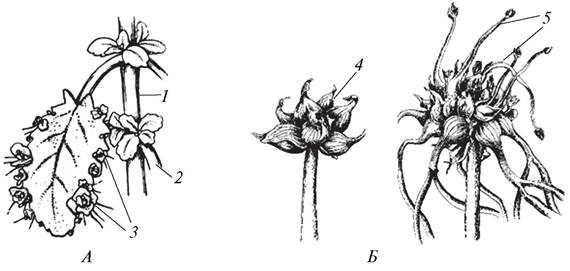
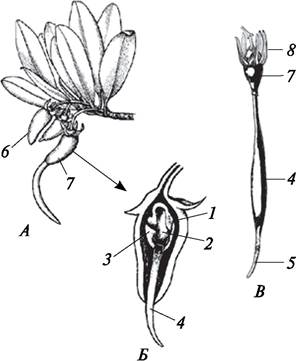
In true viviparity, seeds form that germinate and produce young daughter individuals while still attached to the mother plant. True viviparity is characteristic of mangrove trees (species of the genus Rhizophora—Rhizophora mucronata, R. mangle, etc.) inhabiting coastal ocean shoals (Fig. 133).
Fig. 133. True viviparity: A—branch of red mangrove (Rhizophora mangle) with mature fruits and a germinating seed; B—Cytology/practical/54.html">Longitudinal section of a germinating seed inside the fruit; C—red mangrove seedling: 1—seed coat; 2—cotyledon; 3—endosperm; 4—hypocotyl; 5—embryonic root; 6—mature fruit; 7—germinating seed inside the fruit; 8—perianth remnants
Because daughter organisms in vegetative reproduction are exact copies of the parent organism, this feature has found widespread application in artificial vegetative propagation.
Artificial vegetative reproduction is propagation utilized by humans in practical activities. This type of vegetative reproduction is widely used when a plant does not form seeds (many potato varieties), produces low-quality seeds (peppermint — Mentha piperita), or when a plant is of hybrid origin and produces segregating offspring when propagated by seeds (varieties of garden carnation — Dianthus caryophyllus). Artificial vegetative reproduction is often the only method of propagation that preserves the genetic purity of a variety (potato — Solanum tuberosum, garden strawberry — Fragaria magna).
The methods of artificial vegetative reproduction are the same as natural ones. In cultivation, many plants are propagated by rhizomes (iris — Iris, peppermint — Mentha piperita), bulbs (tulips — Tulipa, daffodils — Narcissus), tubers (potato, Jerusalem artichoke — Helianthus tuberosus), and corms (gladioli — Gladiolus, crocuses — Crocus). Propagation using cuttings of various origins (stem—green and woody; leaf; root) is widely used (see Fig. 131).
The collection of new individuals derived vegetatively from a single parent plant is called a clone. With the industrial development of biotechnology, the method of plant micropropagation in in vitro culture ("in Glass"), i.e., outside a living organism, has become widespread. Various nutrient media containing phytohormones are used for this purpose. There are two methods of micropropagation: new organisms can be obtained from apical meristem cells and from explants—cells of permanent tissues isolated from various plant organs. Micropropagation from apices makes it possible to obtain a very large quantity of ideally uniform planting material (regenerants) free from fungal, bacterial, and, above all, viral infection. This method is used for the propagation and health improvement of many ornamental plants (carnations — Dianthus, chrysanthemums — Chrysanthemum) as well as agricultural plants (garden strawberry, potato). When obtaining regenerants from explants, a wide range of Variability in traits is observed (somaclonal variation); therefore, this micropropagation method is used in breeding as an additional source of organismal variability.
A special type of artificial vegetative reproduction is grafting, the spontaneous formation of which in nature is extremely rare. During grafting, a human surgically separates a part of one plant (a cutting or bud)—the scion—and grafts it onto another plant—the rootstock. Bud grafting ("shield budding") is most often performed in summer, and scion grafting in spring. The method of plant propagation via grafting is widespread in both industrial and ornamental horticulture. Various varieties of apple, pear, cherry, rose, lilac, and others are propagated this way.
Vegetative reproduction is the most ancient method of reproduction. According to M. M. Lodkina (1965), it originated at the pre-cellular level of Life as a response of organisms to disruptions in The ratio of growth and Nutrition processes.
The vegetative reproduction coefficient varies among different plants, but it is relatively low, although in some plants (grape hyacinths — Muscari, star-of-Bethlehem — Ornithogalum) up to 30 bulblets can form during a single growing season. The dispersal coefficient in vegetatively reproducing species is low. Daughter organisms concentrate around parent individuals or locate near them. Due to this, many plants are capable of rapidly forming large groupings (carpet bugleweed — Ajuga reptans, silverweed — Potentilla anserina, couch grass — Elytrigia repens).
Strictly asexual reproduction (agamogony). Strictly asexual reproduction occurs when individuals reproducing the morphophysiological traits of the parent develop from specialized cells (spores) that generally leave the mother organism. This type of reproduction is characteristic of primitive thalloid organisms: unicellular and filamentous green algae (Chlamydomonas, Chlorella, Ulothrix, Oedogonium), as well as euglenoids,raphidophytes, cryptophytes, chrysophytes, many yellow-green algae (Tribonema), and some brown algae. Spores ensuring the reproduction of parental traits are formed as a result of mitotic division and are called mitospores. In the vast majority of cases, mitospores form in the cells of haploid thalli and are haploid just like them.
Mitospores are less commonly formed on a diploid thallus; in this case, they will be diploid, and a diploid plant similar to the parent organism will also develop from them (for example, Cladophora among green algae, Ectocarpus among brown algae).
Most algae form motile flagellated spores known as zoospores. Zoospores can differ in Structure, as well as in the Number and Length of flagella. Motile zoospores typically lack a true rigid Cell wall and are surrounded by a delicate periplast.
In some algae, spores are non-motile (aplanospores). They develop a cell wall while still inside the parent cell (Chlorococcales among green algae, many yellow-green, brown, and red algae), and in some cases, they already resemble the parent organism (e.g., autospores in Chlorella). Zoospores (spores) are formed either in cells that do not differ in shape from vegetative cells or in specialized unicellular reproductive organs known as zoosporangia (sporangia). A single cell or sporangium may contain anywhere from one (Edogonium from the division Chlorophyta) to several hundred zoospores (Cladophora from the same division). Most commonly, spores are microscopically small and produced in large numbers. Typically, they emerge into the surrounding water through an opening in the sporangial wall as a whole group enclosed in a common mucilaginous sheath. Soon the sheath dissolves, and the zoospores rapidly swim off in different directions. Upon settling on a substrate, they form a tough cell wall and germinate, giving rise to a new alga of the same species.
Thus, mitospores execute The process of asexual reproduction proper and facilitate the dispersal of the species.
Strictly speaking, asexual reproduction achieves higher rates of reproduction and dispersal compared to vegetative propagation. According to M. M. Lodkina, sporogenesis as a mode of plant reproduction emerged at the cellular level of organization as a response mechanism to environmental conditions that significantly impair fundamental life processes, most notably growth.
The process of spore formation is characteristic of the vast majority of algae (with the exception of diatoms—Bacillariophyta, charophytes—Charophyta, and brown algae of the class Cydosporophyceae) and all higher plants without exception.
In addition to mitospores, plants also produce meiospores. These are likewise formed within sporangia, but they differ from mitospores in their FORMATION AND STRUCTURE. Because meiospores develop exclusively on sporophytes, their formation is invariably preceded by Meiosis (reduction division). The production of meiospores is typical of many algae and all higher plants without exception. Like typical mitospores, meiospores are specialized haploid cells, but their STRUCTURE AND FUNCTIONS, particularly in higher plants, possess distinctive features. In algae, meiospores may be represented by zoospores (Ulva) or, less commonly, aplanospores (Ulothrix upon zygote germination). In higher spore-bearing plants—such as clubmosses (Fig. 134), horsetails (Fig. 135), and ferns (Fig. 136)—meiospores are invariably non-motile, unlike those of algae, and are enveloped in a two-layered wall consisting of an exospore and an endospore. The exospore is composed of Cellulose and impregnated with sporopollenin, which enhances wall durability. The exospore features a "lesura" (dehiscence slit) through which spore germination takes place. When meiospores of higher spore-bearing plants land on a suitable substrate, they germinate to form a gametophyte (prothallium) (see Figs. 134, 135, 136), which differs morphologically, cytologically, and functionally from the sporophyte within whose sporangia the spores were produced.
Thus, the widespread and common assertion that higher spore-bearing plants (clubmosses, horsetails, ferns) "reproduce by means of spores" is fundamentally incorrect.
Fig. 134. Sporophyte, sporangium, spores, and gametophyte of staghorn clubmoss (Lycopodium clavatum) (A–D) and flat-branched tree clubmoss (Diphasiastrum complanatum) (E): A—general view of the sporophyte with strobilus spikes; B—sporangium on a sporophyll; C—spores viewed from the proximal and distal poles; D, E—STRUCTURE OF THE gametophytes: 1—antheridia; 2—archegonia; 3—fungal hyphae; 4—rhizoids

Fig. 135. Sporophyte, sporangiophore, spore, and gametophytes of field horsetail (Equisetum arvense): A—general view of the vernal and aestival sporophyte shoots; B—sporangiophore with sporangia; C—spore with elaters; D—bisexual gametophyte; E—female gametophyte

Fig. 136. Sporophyte, sporangium, spores, and gametophyte of male fern (Dryopteris filix-mas): A—general view of the sporophyte; B—sporangium with spores; C—spores (proximal and equatorial views); D—bisexual gametophyte

In higher spore-bearing plants, the spore does not perform reproduction in the sense of producing exact replicas of the parent organism. While serving as an integral component of the reproductive process, it fulfills two primary functions: it facilitates species dispersal (the gametophyte developing from the spore subsequently produces the embryo of a new organism), and, owing to its tough outer wall, it helps the species survive conditions unfavorable for development.
Among higher plants, there are homosporous (isospory) and heterosporous (heterospory) species. In homosporous plants, all spores are uniform in their morphological, physiological, and biochemical properties. Such spores give rise to bisexual prothallia. These exist entirely independently of the sporophytes and can be either autotrophic (photosynthetic—in true ferns and horsetails) or mycotrophic (in adder's-tongue ferns and clubmosses) in their mode of nutrition.
Heterosporous plants emerged evolutionarily alongside homosporous ones. Initially, physiological heterospory arose, whereby morphologically indistinguishable spores formed dioecious prothallia when landing on substrates of varying nutrient availability. It has been experimentally proven that horsetails develop male prothallia on nutrient-poor soils and female prothallia on nutrient-rich soils. Subsequently, heterospory became morphological. Heterosporous plants evolved Two Types of sporangia: microsporangia and macrosporangia (megasporangia). Microsporangia produce numerous small spores termed "microspores," whereas macrosporangia produce fewer, relatively larger spores known as "macrospores" (megaspores). Upon further development, microspores give rise to male gametophytes, while macrospores develop into female gametophytes.
Heterospory represents the initial step toward sexual differentiation of individuals. In heterosporous lycophytes (Salvinia) and pteridophytes (Salvinia), the function of species dispersal is carried out exclusively by the macrospore. It is precisely from the macrospore that the female gametophyte develops, bearing archegonia with an egg cell inside, where Fertilization occurs and ultimately leads to the emergence of a new sporophyte embryo. The male gametophyte, which develops from the microspore, disintegrates after sperm cells are formed within its antheridia.
In gymnosperms and angiosperms, which are characterized by morphological heterospory, neither macrospores nor microspores ever leave the parent plant. In representatives of these higher plant divisions, the macrospore has lost its dispersal function, yet spore formation remains an obligate process of great biological significance. It invariably precedes the sexual process.
In all Higher Plants and highly evolved algae without exception, reproduction occurs solely through the combination of two processes: sporogenesis and the sexual process.
Last update: 07/08/2026
Editorial and Educational Adaptation: This material has been compiled based on the primary/original source text. The project team performed an editorial review, corrected technical inaccuracies, structured sections, and adapted the content for an educational format.
What was processed:
- elimination of formatting defects (OCR errors, structural breaks, corrupted characters);
- editorial organization of content;
- standardization of terminology in accordance with academic sources;
- verification of factual statements against the original source text.
All mentions of the author, publication year, and origin of the primary text have been preserved in accordance with the source.