PLANT MORPHOLOGY - T. A. Sautkina - 2012
CHAPTER 5. VEGETATIVE ORGANS OF PLANTS
5.5. General Structural Regularities of Vegetative Organs
Despite the immense diversity in Structure, all vegetative Organs share A number of general regularities. These include the presence of a specific type of Symmetry, polarity, the capacity for metamorphosis, reduction, abortion, and regeneration.
Symmetry (from Greek symmetria — proportionality) is a widespread natural phenomenon characteristic of both individual organs and entire organisms. In plant Morphology, symmetry refers to the possibility of dividing an organ into two mirror-image halves. The plane that divides an organ into symmetrical parts is called the plane or axis of symmetry. Vegetative organs can be monosymmetrical, bisymmetrical, polysymmetrical (radially symmetrical), and asymmetrical.
A monosymmetrical organ allows for only a single plane of symmetry; consequently, the organ can be divided into only two mirror-image halves. Monosymmetrical leaves are found in a number of plants (common lilac — Syringa vulgaris, silver birch — Betula pendula, European wild ginger — Asarum europaeum). Monosymmetrical stems (the winged stem of the narrow-leaved everlasting pea — Lathyrus sylvestris) and roots (plank roots of certain figs) occur only occasionally.
Bisymmetrical organs are flattened stems that allow for two planes of symmetry (Canada bluegrass — Poa compressa, prickly pear — Opuntia polyacantha).
If an organ can be divided by more than two planes of symmetry, it is polysymmetrical. Polysymmetrical structures include round stems (common sunflower — Helianthus annuus), roots (pumpkin — Cucurbita pepo), ROOT crops (radish — Raphanus sativus, garden beet — Beta vulgaris), tuberous roots of certain plants (lesser celandine — Ficaria verna, Sprenger's asparagus — Asparagus densiflorus «Schprengeri»), unifacial leaves (bitter stonecrop — Sedum acre, bulb onion — Allium cepa), and stolons (potato — Solanum tuberosum).
A special type of plant organ structure is Asymmetry. Asymmetrical organs do not possess a single plane of symmetry. Examples include the leaves of elms (smooth elm — Ulmus laevis, wych elm — Ulmus scabra) and certain begonias (royal begonia — Begonia rex).
Polarity (from Latin polus, Greek polos — pole) is one of the general regularities inherent not only in the plant Organism as a whole, but also in its individual organs and Cells. Polarity is characterized by the presence of morphological and physiological differences at opposite ends of a plant body or its elements.
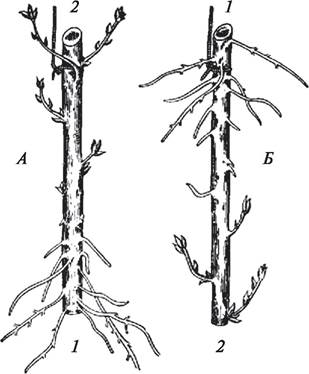
Initial concepts of polarity originated from the works of the German plant physiologist G. Vöchting (1847–1918), who between 1878 and 1882 conducted a series of experiments and discovered that roots always form exclusively at the basal end of a cutting. Subsequent experiments with willow cuttings confirmed his findings. Regardless of how the cuttings were oriented, roots invariably formed only at the morphologically lower end of the SHOOT, while lateral shoots always developed at the morphologically upper end (Fig. 130).
Class="center">Fig. 130. Manifestation of polarity in willow cuttings (Salix sp.): A—normally oriented cutting; B—inverted cutting: 1—basal pole (Base of the cutting); 2—apical pole (upper part of the cutting). Roots are formed exclusively at the basal pole
The property of polarity in plants manifests itself at very early Selection/3.html">Stages of development, essentially from the moment of zygote division. The First Division of the zygote produces two cells—basal and apical—which subsequently give rise to different PARTS OF THE embryo of the future new organism. During embryo differentiation, shoot and root apical Meristems (growing points) form at diametrically opposite poles. Polarity is also inherent in roots and leaves, which exhibit distinct differences between their tips and bases. Due to polarity, plant organs are oriented in space in a specific manner. The polarization process is highly complex and not yet fully understood. Undoubtedly, polarity is driven by physiological processes occurring within the plant and is primarily associated with the action of
phytohormones. In higher plants, polarity is strictly determined and remains unaltered even under changing environmental conditions.
However, in more primitive organisms (Algae), experimental studies have shown that changes in environmental factors (light, Temperature, humidity) or mechanical influences (centrifugation) can alter hormonal and trophic processes, thereby leading to a shift in polarization.
All vegetative organs are capable of metamorphosis, as discussed in the respective sections. The greatest diversity of metamorphosed structures is characteristic of shoots as a whole and their components—leaves. Roots, which exist in relatively stable environmental conditions, undergo metamorphosis less frequently; in autotrophic terrestrial plants, Root Metamorphoses are mainly associated with the performance of storage Functions.
In the course of morphological evolution, not only did the morphophysiological complexity of various organs increase, but under the Influence of Environmental conditions, certain species also experienced the reduction or even the
Reduction (from Latin reductio — return, pushing back) refers to a decrease in the size or number of organs, a simplification of their structure, and the frequently associated alteration of their functions. In rhizomes, leaves have been reduced and transformed into dry scales (couch grass — Elytrigia repens, hairy sedge — Carex hirta). In the bulb onion, the fleshy scales represent the leaf bases. Leaves are reduced in a number of saprophytic plants (yellow bird's-nest — Hypopitis monotropa, common bird's-nest orchid — Neottia nidus-avis, scaly toothwort — Lathaea squamaria), as well as in certain xerophytic plants (flat-topped clubmoss — Diphasiastrum complanatum, northern white-cedar — Thuja occidentalis, Mediterranean cypress — Cupressus sempervirens).
Many aquatic plants feature reduced roots lacking root hairs and root caps. Roots are also reduced in parasitic plants (European dodder — Cuscuta europaea) and hemiparasites (European mistletoe — Viscum album). In Rafflesia arnoldii, which is widespread in the humid tropical forests of Indonesia and the Philippines and parasitizes the roots of Tetrastigma and Cissus—genera of the grapevine family (Vitaceae)—the root is reduced, while the stem and leaves are aborted.
During abortion (from Latin abortus — Miscarriage), an organ disappears entirely. For example, in the floating fern Water spangles (Salvinia natans), the root is aborted. In dodders (Cuscuta), the leaves are aborted. Like metamorphoses, the reduction and abortion of organs are adaptive processes representing the plant's response to environmental conditions. In botanical literature, the terms "reduction" and "abortion" are frequently used as synonyms.
A common property of plant vegetative organs is also the capacity for regeneration (from Late Latin regeneratio — rebirth, renewal), i.e., the restoration of lost parts of the organism. Regeneration forms The basis of vegetative plant propagation. It can occur under natural conditions or be induced experimentally. The capacity for regeneration varies among different taxa. The higher the degree of morphological and anatomical differentiation of a plant and its organs, the weaker their regenerative capacity. Regeneration occurs through the restoration of meristematic activity in parenchyma cells and their subsequent differentiation into vegetative organ Tissues.
The capacity for regeneration is of great practical importance and is widely utilized in horticulture, floriculture, and biotechnology.
Similar general structural regularities are, to some extent, also characteristic of reproductive structures.
Last update: 07/08/2026
Editorial and Educational Adaptation: This material has been compiled based on the primary/original source text. The project team performed an editorial review, corrected technical inaccuracies, structured sections, and adapted the content for an educational format.
What was processed:
- elimination of formatting defects (OCR errors, structural breaks, corrupted characters);
- editorial organization of content;
- standardization of terminology in accordance with academic sources;
- verification of factual statements against the original source text.
All mentions of the author, publication year, and origin of the primary text have been preserved in accordance with the source.