LEHNINGER PRINCIPLES OF BIOCHEMISTRY - VOLUME 1. THE BASIS OF BIOCHEMISTRY, STRUCTURE AND CATALYSIS - 2011
PART I. STRUCTURE AND CATALYSIS
6. ENZYMES
Questions and Problems
1. Preserving the Sweet Taste of Corn.
The sweet taste of kernels in freshly picked ears of corn is due to a high sugar content. Within a day of picking, corn loses much of its sweetness because about 50% of the free sugar in the kernels is converted to starch during storage. To preserve the sweet taste of fresh corn, the husked ears can be immersed in boiling Water for a few minutes ("blanched") and then cooled in cold water. Corn treated in this way and stored frozen retains its sweet taste. What is the biochemical rationale for this Procedure?
2. Intracellular Concentration of Enzymes.
To estimate the concentration of enzymes in a bacterial Cell, assume that the Cytosol contains equal concentrations of 1,000 different enzymes and that the molecular mass of each protein averages 100,000. In addition, assume that a bacterial cell is a cylinder with a diameter of 1 µm and a height of 2 µm, that the cytosol (density 1.20) contains 20% soluble protein by mass, and that all of this protein consists entirely of enzymes. Calculate the average molar concentration of each enzyme in this hypothetical cell.
3. Rate Acceleration by Urease.
The enzyme urease at pH 8.0 and 20 °C accelerates the Hydrolysis of urea by a factor of 1014. If a given amount of urea can be completely hydrolyzed by a given amount of urease at pH 8.0 and 20 °C in 5 min, how long would it take for the same amount of urea to be hydrolyzed under the same conditions, but in the absence of the enzyme? Assume that both reactions take place under sterile conditions without bacterial contamination.
4. Protection of an Enzyme against Thermal Denaturation.
Heating an enzyme solution results in a gradual loss of catalytic activity due to enzyme denaturation. When a hexokinase solution is incubated for 12 min at 45 °C, the enzyme loses 50% of its activity; however, if the incubation is carried out in the presence of a very high concentration of one of its substrates, the loss of activity in 12 min is only 3%. Explain why the thermal denaturation of hexokinase is slowed down in the presence of its substrate.
5. Requirements for Enzyme Active Sites.
Carboxypeptidase, which sequentially removes C-terminal amino acid residues from its peptide substrates, is a polypeptide consisting of 307 residues. The two primary catalytic groups in the Active Site of the enzyme are Arg145 and Glu270.
a) If the carboxypeptidase chain were folded into an ideal α-Helix, what would be the distance (in Å) between the Arg145 and Glu270 residues? Hint: see Fig. 4-4a.
b) Explain how these two amino acid residues can catalyze a reaction spanning a distance of several angstroms.
6. Quantitative determination of Lactate dehydrogenase.
The Muscle enzyme lactate dehydrogenase catalyzes the reaction
Class="center">
NADH and NAD+ are the reduced and oxidized forms of the coenzyme NAD, respectively. Solutions of NADH, but not NAD+, absorb light at a wavelength of 340 nm. This property is used to determine the concentration of NADH in solution by spectrophotometric measurement of Light absorption at 340 nm. Explain how this property of NADH can be used for the Quantitative Assay of lactate dehydrogenase.
7. Role of an Enzyme in a Chemical Reaction.
Which of the following changes during the course of a simple chemical reaction can be brought about by the presence of a catalyst?

a) Decrease in K'eq; b) increase in r1; c) increase in K'eq; d) increase in ∆G‡; e) decrease in ∆G‡; f) a more negative value of ∆G'°; g) increase in r2.
8. Relationship between Reaction Rate and Substrate Concentration: The Michaelis-Menten Equation.
a) At what substrate concentration will an enzyme with rcat = 30 s-1 and Kм = 0.005 M catalyze
the reaction at a rate equal to 1/4 of its maximum velocity?
b) Determine what fraction of Vmах will be reached at substrate concentrations of [S] = 1/2 Kм, 2Kм, and 10 Kм.
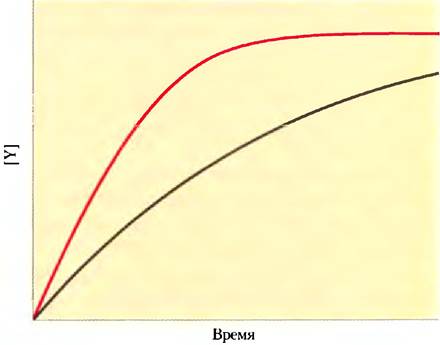
c) An enzyme catalyzing the reaction X ⇄ Y was isolated from two bacterial species. The enzymes have identical Vmах values but different Kм values for substrate X. The Michaelis constant for enzyme A is 2.0 µM, and for enzyme B, it is 0.5 µM. The graph below illustrates the course of the reaction under the action of the enzymes, taken at equal concentrations, at [X] = 1 µM. Which curve corresponds to which enzyme?
9. Application of the Michaelis-Menten Equation (I).
A new version of the enzyme veselase, designated as veselase*, has been discovered in the laboratory; the enzyme catalyzes the following reaction:
sadness ⇄ joy
The Study of the enzyme's properties has begun.
a) In the first experiment, at [Et] = 4 nM, the maximum velocity was found to be Vmах = 1.6 µM s-1. Knowing this, determine the rat constant for veselase* (in appropriate Units of Measurement).
b) In the second experiment, at [Et] = 1 nM and [joy] = 30 µM, the initial reaction velocity was found to be v0 = 300 nM s-1. What is the measured value of Kм for veselase* with respect to the substrate joy (in appropriate units of measurement)?
c) Further studies showed that the purified veselase* used in the first two experiments actually contained a trace of a reversible inhibitor called anger. The anger contaminant was thoroughly removed from the enzyme sample, and the two experiments were repeated; the Vmах value measured under the conditions of experiment (a) was 4.8 µM s-1, and the Kм value measured under the conditions of experiment (b) turned out to be 15 µM. Calculate the parameters α and α' for the inhibitor ANGER.
d) Based on the information provided above, determine the type of inhibitor to which anger belongs.
10. Application of the Michaelis-Menten Equation (II).
An enzyme catalyzing the reaction has been found
A ⇄ B
For this enzyme, the Michaelis constant Kм for substrate A was 4 µM, and rcat was 20 min-1.
a) In one experiment, at a concentration of [A] = 6 mM, the initial reaction velocity v0 was 480 nM min-1. What was the Enzyme Concentration [Et] in this experiment?
b) In the subsequent experiment, at a concentration of [Et] = 0.5 M, the initial velocity was 5 µM min-1. What was the substrate concentration [A] in this experiment?
c) It was found that substance Z is a very potent competitive inhibitor of this enzyme with α = 10. In an experiment with the same enzyme concentration [Et] as in question (a), but at a different concentration of [A], inhibitor Z was added, which led to a decrease in velocity v0 to 240 nM min-1. What is the concentration of [A] in this experiment?
d) Based on the kinetic parameters given above, state whether this enzyme achieves "catalytic perfection". Briefly explain your answer using the kinetic parameter(s) used to define "catalytic perfection".
11. Estimation of Vmах and Kм from Experimental Data.
Although Methods exist for the precise determination of Vmах and Kм (Box 6-1), these parameters can sometimes be estimated quickly by simply observing The values of initial reaction velocities at various substrate concentrations. Estimate Vmах and Kм of the enzymatic reaction based on the data given in the table.
[S] (M) |
v0 (µM/min) |
2.5 • 10-6 |
28 |
4.0 • 10-6 |
40 |
1 • 10-5 |
70 |
2 • 10-5 |
95 |
4 • 10-3 |
112 |
1 • 10-4 |
128 |
2 • 10-3 |
139 |
1 • 10-2 |
140 |
12. Properties of the Enzyme Involved in Prostaglandin Synthesis.
Prostaglandins are a class of Eicosanoids—fatty acid derivatives that exert exceptionally potent effects on vertebrate Tissues. They are intimately involved in The Development of fever and inflammation, as well as the associated pain. Prostaglandins are synthesized from a 20-carbon fatty acid known as arachidonic acid, via a reaction catalyzed by the enzyme prostaglandin endoperoxide synthase. Belonging to the cyclooxygenase family, this enzyme utilizes oxygen to convert arachidonic acid into $\text{PGH}_2$, the direct precursor of many diverse prostaglandins (prostaglandin synthesis is discussed in Chapter 21).
a) The kinetic data for the reaction catalyzed by prostaglandin endoperoxide synthase are presented below. Focusing on the first two columns, determine Vmax and Km for this enzyme.
Arachidonic acid concentration (mM) |
Rate of $\text{PG G}_2$ formation (mM/min) |
Rate of $\text{PG G}_2$ formation in the presence of 10 mg/mL ibuprofen (mM/min) |
0,5 |
23,5 |
16,67 |
1,0 |
32,2 |
25,25 |
1,5 |
36,9 |
30,49 |
2,5 |
41,8 |
37,04 |
3,5 |
44,0 |
38,91 |
b) Ibuprofen acts as an inhibitor of prostaglandin endoperoxide synthase. By inhibiting prostaglandin synthesis, ibuprofen alleviates inflammation and pain. Using the data from the first and third columns, determine the type of inhibition exerted by ibuprofen on the reaction catalyzed by prostaglandin endoperoxide synthase.
13. Graphical analysis of Vmax and Km.
The experimental data presented below were obtained from a Study of the enzymatic activity of intestinal peptidase using glycylglycine as a substrate.
Glycylglycine + Н2O —> 2 Glycine
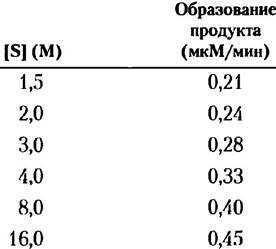
Using graphical analysis (Box 6–1 and interactive graphs), determine Vmax and Km for this enzyme and substrate.
14. Eadie-Hofstee plot.
One of the possible transformations of the Michaelis-Menten equation is the Lineweaver-Burk equation. Multiplying both sides of the Lineweaver-Burk equation by Vmax and rearranging the terms yields the Eadie-Hofstee equation:

Below is a graph showing the dependence of v0 on v0 / [S] for an enzymatic reaction. The blue curve was obtained in the absence of an inhibitor. Which curve (A, B, or C) was obtained in the presence of a competitive inhibitor? Hint: see Equation 6-30.

15. Turnover Number of Carbonic anhydrase.
Erythrocyte carbonic anhydrase (Mr = 30,000) is one of the most active enzymes known to date. It catalyzes the reversible Hydration of СO2.
Н2O + СO2 ⇄ Н2СO3
This reaction plays a crucial role in The transport of СO2 from tissues to the Lungs. What is the turnover number of carbonic anhydrase (in units/min) if 10 µg of the pure enzyme catalyzes the hydration of 0.3 g of СO2 in 1 min at 37 °С?
16. Rate Equation for Competitive Inhibition.
The rate equation for competitive inhibition is given as follows:

Derive this equation using the expression for the total enzyme concentration [Е]tot = [Е] + [ЕI] + [ЕS], along with the Structure/97.html">Definitions of α and K1 given in the text. Proceed by analogy with the derivation of the Michaelis-Menten equation.
17. Irreversible Enzyme Inhibition.
Many enzymes undergo irreversible inhibition by heavy Metal Ions such as Hg2+, Сu2+, or Ag+, which react with essential sulfhydryl groups to form mercaptides:
Е-SН + Ag+ —> Е-S-Ag + Н+
The affinity of Ag+ ions for the sulfhydryl group is so high that these ions can be used for the quantitative titration of SH groups. Exactly enough AgNO3 was added to 10 ml of a solution containing 1 mg/ml of pure enzyme to achieve complete inactivation of the enzyme, which required 0.432 μmol of AgNO3. Calculate the minimum Molecular Weight of the enzyme. Why is the molecular weight value obtained in this way considered a minimum?
18. Clinical Applications of Selective Enzyme Inhibition.
Human Blood serum contains enzymes known as acid Phosphatases, which catalyze the hydrolysis of phosphoric acid esters in a mildly acidic environment (pH 5.0):

Acid phosphatases are synthesized in the erythrocytes, Liver, Spleen, and Prostate Gland. The prostate-specific enzyme is of major clinical significance because elevated levels of its activity in the blood can indicate the development of prostate Cancer. Prostatic acid phosphatase is strongly inhibited by tartrate ions, whereas acid phosphatases from other tissues are not. How can these findings be utilized to develop a specific assay for measuring prostatic acid phosphatase activity in human blood serum?
19. Inhibition of Carbonic Anhydrase by Acetazolamide.
Carbonic anhydrase is strongly inhibited by the drug acetazolamide, which is used as a diuretic and in the Treatment of glaucoma to lower intraocular pressure (elevated pressure resulting from the excessive accumulation of intraocular fluid). Carbonic anhydrase plays a crucial role in these and other secretory processes by participating in The regulation of pH and bicarbonate levels in various bodily fluids. The upper curve in the figure shows the dependence of the initial reaction rate (as a percentage of Vmax) catalyzed by carbonic anhydrase on the substrate concentration. The lower curve was obtained from an experiment performed in the presence of acetazolamide. Based on an analysis of these curves and your understanding of the kinetic properties of competitive and mixed inhibitors, determine the type of inhibition caused by acetazolamide. Explain your reasoning.

20. Effects of Reversible Inhibitors.
Derive the equation describing The Effect of a reversible inhibitor on the apparent value of Km (Km,app = αKm/α′). Start from Equation 6-30 and the fact that Km,app equals the substrate concentration at which v0 = Vmax/2α′.
21. pH Optimum for Lysozyme Activity.
The active site of lysozyme contains two amino acid residues that play a fundamental catalytic role: Glu35 and Asp52. The pKa values of the carboxyl side chains of these residues are 5.9 and 4.5, respectively. In what ionization state (protonated or deprotonated) is each of these residues at the pH optimum of lysozyme (5.2)? How can the ionization states of these residues account for the pH dependence of lysozyme activity shown in the figure?

22. Practice Solving Kinetics Problems (refer to the dynamic graphs for Chapter 6).
a) Using the dynamic graph for Equation 6-9, plot the reaction rate as a function of [S]. Use the values Vmax = 100 μM·s-1 and Km = 10 μM. How much does v0 increase when [S] is doubled from 0.2 to 0.4 μM? What is the value of v0 when [S] = 10 μM? How much will v0 increase if [S] is raised from 100 to 200 μM? Note how the shape of the graph changes when Vmax or Km values are doubled or halved.
b) Using the dynamic graph for Equation 6-9 and the kinetic parameters from part (a), plot the curve for the case where α = α′ = 1. Observe how the graph changes when α = 2; α′ = 3; and α = 2 and α′ = 3.
c) Using the dynamic graph for Equation 6-9 and the Lineweaver-Burk equation from Box 6-1, construct Lineweaver-Burk plots for all the cases listed in parts (a) and (b). Does the x-intercept shift to the left or to the right when α = 2? Does the x-intercept shift to the left or to the right when α = 2 and α′ = 3?
Analysis of Experimental Data
23. Exploring and Modifying The properties of Lactate Dehydrogenase.
Investigations into Protein Structure led to the hypothesis that a correlation exists between the Amino Acid Composition of enzymes and their biological function. One way to test this hypothesis is to use Recombinant DNA technology to generate mutant versions of an enzyme and study the Structure and function of these altered forms. The methodology used for this approach is discussed in Chapter 9.
A classic example of such research is the work by Clarke and colleagues on lactate dehydrogenase, published in 1989. Lactate dehydrogenase (LDH) catalyzes the reduction of Pyruvate to lactate, utilizing NADH as a cofactor (see Section 14.3). The figure schematically illustrates the active site of the enzyme with a pyruvate molecule positioned in the center:

The reaction mechanism is analogous to those of many NADH-dependent reactions (Figure 13-24); it essentially proceeds in the reverse direction of steps 2 and 3 shown in Figure 14-7. In the Transition State, the carbonyl group of the pyruvate molecule is heavily polarized:

a) A mutant form of LDH in which the Arg109 residue is replaced by Gln exhibits only 5% of the wild-type enzyme's pyruvate-binding capacity and 0.07% of its catalytic activity. How would you explain this observation?
b) A mutant form of LDH in which the Arg171 residue is replaced by Lys retains only 0.05% of the wild-type enzyme's substrate-binding capacity. Why was this change unexpected?
c) In the crystal structure of LDH, the guanidino group of Arg171 and the carboxyl group of pyruvate are arranged in a coplanar configuration
resembling a fork-like motif. Given this, explain the drastic alteration in the enzyme's properties that occurs when Arg171 is replaced by Lys.
d) A mutant form of LDH in which the Ile250 residue is replaced by Gln exhibits a reduced affinity for NADH. Explain this result.
Clark and colleagues also attempted to engineer a mutant version of the enzyme designed to bind and reduce oxaloacetate instead of pyruvate. By making a single amino acid substitution—replacing Gln102 with Arg—the resulting enzyme was expected to reduce oxaloacetate to malate while losing The ability to reduce pyruvate to lactate. In this way, they successfully converted LDH into a malate dehydrogenase.
e) Draw a schematic representation of the active site of the mutant LDH with bound oxaloacetate.
f) Explain why the mutant enzyme exhibits a 'preference' for oxaloacetate over pyruvate.
g) Thus, replacing a smaller amino acid in the active site with a larger one allowed the enzyme to bind a larger substrate. Explain this result.
Last update: 06/08/2026
Editorial and Educational Adaptation: This material has been compiled based on the primary/original source text. The project team performed an editorial review, corrected technical inaccuracies, structured sections, and adapted the content for an educational format.
What was processed:
- elimination of formatting defects (OCR errors, structural breaks, corrupted characters);
- editorial organization of content;
- standardization of terminology in accordance with academic sources;
- verification of factual statements against the original source text.
All mentions of the author, publication year, and origin of the primary text have been preserved in accordance with the source.