Human Anatomy (with the fundamentals of dynamic and sports morphology) - Ivanitsky M. F. 2008
Constitutional Morphology and Sexual Dimorphism
Constitutional Morphology
Constitutional Morphology studies human body build characteristics based on body dimensions, proportions, and body mass composition.
The term constitutional morphology is derived from the word constitution. Constitution (from Lat. constitutio — establishment, Organization) is the integrity of morphological and functional traits of an Organism, both inherited and acquired under the Influence of the environment, which determine The rate of ontogenesis and the body's reactivity to external influences. Constitution is a relatively stable characteristic of an organism.
The somatotype serves as the morphological reflection of the constitution.
Body dimensions are subdivided into total (from Fr. total — whole) and partial (from Lat. pars — part).
Total body dimensions are the primary indicators of human physical development. They include body length and weight (mass), as well as chest circumference (girth).
Partial body dimensions are components of total dimensions that characterize the size of individual body parts. They can be longitudinal, transverse, anteroposterior, i.e., linear (e.g., length and width of body segments), thickness-related (Skin-fold thickness), and girth-related (thigh, calf, arm, and forearm circumferences). THE POSITION OF one body part relative to another is assessed using angular characteristics. For instance, describing the shape of the spinal Column requires measuring its curvatures, while the shape of the lower jaw is determined by the angle of inclination of its ramus to the horizontal plane.
The Doctrine of physical development is closely associated with constitutional morphology.
Physical development reflects the conformity of a person's bodily traits to the average level characteristic of individuals of the same sex, age, ethnicity, region, and somatotype. It is usually assessed by total body dimensions, sometimes taking into account certain physiometric parameters such as vital capacity (VC) and grip strength.
Body proportions refer to the ratios of its dimensions—longitudinal, transverse, anteroposterior, and girth—which characterize the geometric shape of the body, specifically its slenderness or stockiness.
Body mass composition is The ratio of its components: fat, Muscle, and bone mass, or fat and fat-free components.
The constitutional-morphological approach takes into account individual variations in human body dimensions, proportions, mass composition, and somatotypes.
Body Dimensions
Body dimensions are determined through anthropometric examinations of various population groups: children, conscripts, athletes, etc. Measurement techniques and instruments—such as the anthropometer (stadiometer), tape measure, and scales (see Appendix 1)—must be standardized. According to the D. N. Anuchin Institute of Anthropology of Moscow State University, the body length of an average adult resident of the USSR is:
Table 6.
|
Sex |
Arithmetic mean M, cm |
Standard deviation, cm |
Coefficient of variation - V, % |
|
Men |
165 |
5.6 |
3.4 |
|
Women |
153.5 |
5.4 |
3.5 |
The cited data do not differ from the global average standard. According to measurements from the 1960s–1970s, the tallest are the indigenous inhabitants of the Baltic republics (men's height 170.9–172.6 cm), while the shortest are the indigenous inhabitants of the Far East and northeastern Siberia (men's height 158.5–164.9 cm). Men are taller than women.
The average citizen of the USSR has the following characteristics regarding the other two total body dimensions—body mass and chest girth (data from the Research Institute of Anthropology of Moscow State University) (Table 7).
Ethnoterritorial differences in body mass and chest girth correspond to those observed for body length. These traits increase from the southeast to the northwest of our country, although deviations from this rule exist. For instance, the greatest body mass and chest girth in women are typical of female residents of Ukraine, whereas greater body length is characteristic of the female population of the Baltic states.
Table 7.
|
Sex |
Body mass, kg |
Chest girth, cm |
||
|
M |
min. — max.* |
M |
min. — max. |
|
|
Men |
66 |
56.4—74.4 |
91 |
86.7—99.0 |
|
Women |
59 |
47.3—68.6 |
88 |
81.1—100.5 |
* Min. — minimum, max. — maximum value of the trait for various ethnic groups of the USSR aged 20–59 years.
Within each ethnoterritorial group, there are individuals with high, medium, and low values (by the standards of that group) of total body dimensions. Within the group, the frequency distribution of individual values follows the normal distribution law. Graphically, this appears as a unimodal symmetrical curve with a rise and fall. The highest frequency corresponds to the mean value of the trait (the "peak" of the distribution curve). The smooth descent of the curve on either side of the peak indicates a gradual decrease in the number of people as the trait value diminishes (left side of the curve) or increases (right side of the curve).
When evaluating a person's body dimensions relative to their group, a conventional division of the entire range of trait Variability into three categories is used: high, medium, and low values. A medium value differs from the arithmetic mean by no more than one standard deviation. A high value exceeds the arithmetic mean by more than 1s, while a low value is less than the arithmetic mean by 1s or more.
Body Proportions
Body proportions characterize the harmony of body build.
The Study of body proportions originated and evolved under METABOLISM/18.html">The Influence of artistic demands. Sculptors and painters, dating back to antiquity, established specific ratios (modules) for human body dimensions and applied these parameters in their creative work. For instance, Polykleitos believed that the height of an adult's body is 8 times the length of the HEAD and 10 times the height of the face; a human body with outstretched arms and spread legs fits into a circle centered at the navel.
Class="center">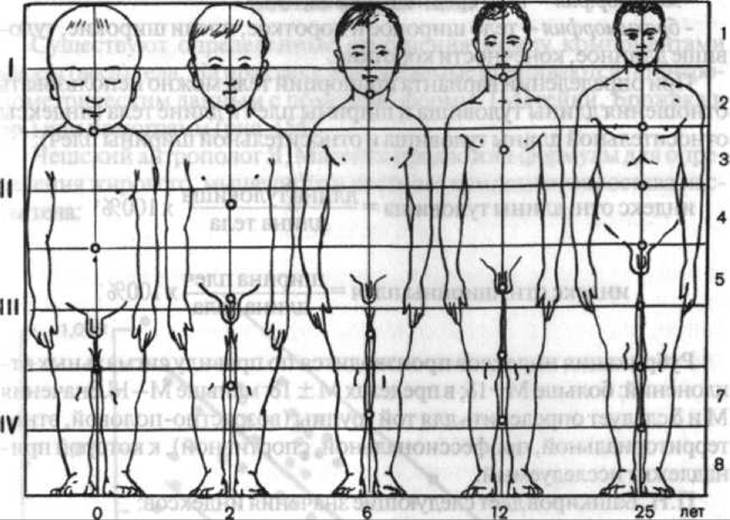
Fig. 153. Changes in body proportions from birth to maturity (after Stratz)
However, harmonious body proportions are also closely related to a person's health status. Disproportionality in body Structure can indicate disorders in growth processes and their underlying causes, such as endocrine disruptions, Chromosomal aberrations, and others.
According to V.V. Bunak, there are 9 variants of body proportions:
- arrostoid — narrow shoulders, short legs;
- hypoharmonoid — narrow shoulders, medium-length legs;
- teinoid — narrow shoulders, long legs;
- hypostyphroid — medium shoulder width, short legs;
- harmonoid — medium shoulder width and medium-length legs;
- parateinoid — medium shoulder width, long legs;
- styphroid — wide shoulders, short legs;
- paraharmonoid — wide shoulders, medium-length legs;
- gigantoid — wide shoulders, long legs.
In practice, a more simplified scheme with a three-part division is commonly used:
- dolichomorphy — narrow and elongated body, narrow shoulders, short trunk, long limbs;
- mesomorphy — intermediate body build;
- brachymorphy — wide and short body, wide shoulders, long trunk, short limbs.
When determining a body proportion variant, one can use the ratios of trunk length and shoulder width to total body height (indices of relative trunk length and relative shoulder width):

The Classification of indices is performed using the rule of sigmal deviations: greater than M+18; within the range of M ± 18; less than M—18. The values of M and 8 should be determined for the specific group (age-sex, ethno-territorial, occupational, or athletic) to which the subject belongs.
P.N. Bashkirov provides the following index values:
Body proportions change during GROWTH AND DEVELOPMENT: the relative size of the head decreases, the trunk shortens, and the lower extremities lengthen (Fig. 153). Early Puberty is associated with The Development of brachymorphy, while late puberty tends toward dolichomorphy. In middle and old age, changes in body proportions are associated with a decrease in trunk length (due to the flattening of intervertebral discs and increased thoracic Kyphosis), flattening of the arches of the feet, and a relative elongation of the lower limbs. Thus, the general trend throughout individual development is the dolichomorphization of body proportions.
Table 8.
|
Gender |
Length index, % |
Width index, % |
|
Dolichomorphy |
29,5 |
21,5 |
|
Mesomorphy |
31,0 |
23,0 |
|
Brachymorphy |
33,5 |
24,5 |
Body Composition
There are specific relationships between the components of body mass (weight). In practice, these constituents are estimated from anthropometric data using formulas (such as those by Matiegka, Brožek, and others) or nomograms (Fig. 154).
Czech anthropology. Matiegka proposed formulas for determining the fat, muscle, and bone components of body mass:
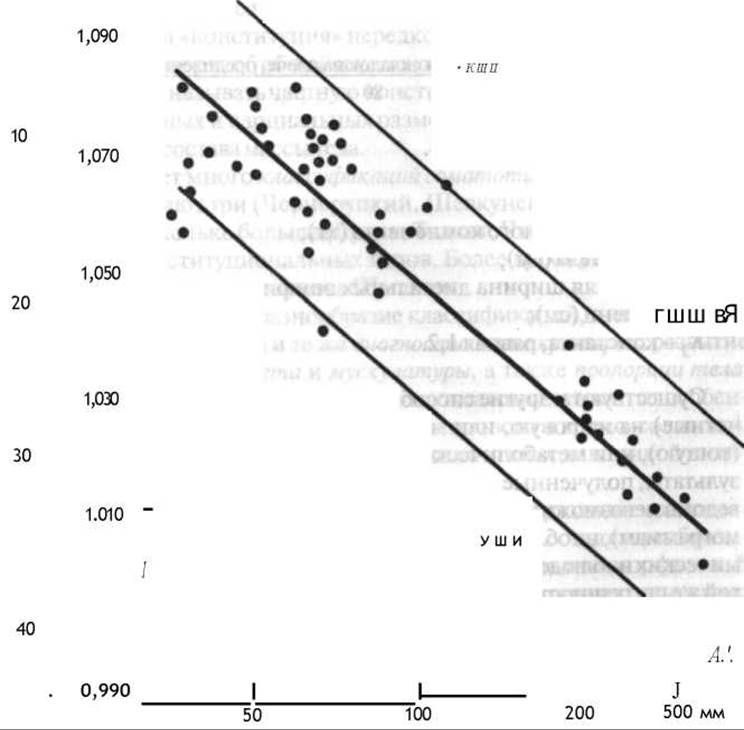
Fig. 154. Relationship between the total thickness (at 10 sites) of skinfolds (x-axis) and the specific gravity of the body, as well as the proportion of the body fat component (y-axis) in boys aged 13—46 years (after Pařízková, from G. Grimm, 1967)
D = dSKF (1)
where D is the weight of the fat mass (kg); d is the average thickness of skinfolds (mm);
S is the body surface area determined using formulas or nomograms (m2);
K is a constant equal to 1.3.

k2 is a constant equal to 6.5.
O = Lc2 (3)
where O is the weight of the bone component (kg);
L is body length (cm);
C is the average width of the distal epiphyses of the humerus, forearm, Femur, and lower leg (cm);
a constant equal to 1.2.
There are also other calculation-based Methods for dividing body mass into fat (metabolically inert) and fat-free or lean (metabolically active) mass. It should be borne in mind that results obtained indirectly via formulas and nomograms—rather than through direct anatomical dissection, which is obviously impossible in living humans—lack absolute precision. Nevertheless, they can be useful in longitudinal observations for identifying trends with a consistent margin of error.
Evaluating the fat component of body mass is of particular importance. Its excess indicates obesity resulting from Lipid Metabolism disorders under conditions of insufficient physical activity and overeating. This process progresses with age.
Physical activity in any form (morning exercises, walking, jogging) helps normalize body mass and reduce the fat component.
Table 9.
|
Gender |
Age, years |
Fat component, % |
|
Men |
18—30 |
11—14 |
|
46—60 |
20 — 22 |
|
|
Women |
18—30 |
23 |
|
46—70 |
32 |
Somatotypes
As the morphological manifestation of constitution, the somatotype is largely based on bodily traits; consequently, the terms "somatotype" and "constitution" are often used interchangeably. Sometimes a distinction is made between general and partial constitution. In this context, the somatotype can be defined as a partial constitution characterized by a set of total and partial body dimensions, proportional features, and body composition.
There are many classifications of somatotypes. Most of them distinguish three (Chernorutsky, Shevkunenko), four (Kretschmer), or slightly more (Bunak, Talant, Chtetsov, Shtefko-Ostrovsky) constitutional types. Sheldon’s system allows for a more detailed assessment of constitution.
Despite such a variety of classifications, they fundamentally rely on the same diagnostic criteria: the development of fat deposition, Skeleton, and musculature, as well as body proportions. The first three criteria demonstrate that the somatotype depends on metabolic characteristics (particularly lipid and Water-Salt Metabolism). The final criterion explains the relationship between the somatotype and the dynamics of an individual's physical development.
There is a correlation between body proportions and the development of adipose tissue. Excessive fat accumulation is frequently associated with brachymorphy, whereas reduced fat accumulation typically accompanies dolichomorphy. In groups with extreme body proportions and levels of adiposity, this combination becomes a rule. The Development of the muscular system, however, follows a different pattern.
Individuals with dolichomorphic body proportions may not exhibit very high values of absolute muscular strength. Nevertheless, despite having a lower body mass, they tend to demonstrate greater relative muscular strength than those with brachymorphy. In dolichomorphs, muscle bellies are less massive and tendons are well-defined. Their Muscles are encased in stronger proper fasciae. Low subcutaneous fat deposition is generally observed alongside well-developed superficial fascia.
Facial morphology is not always taken into account when classifying individuals into specific somatotypes. However, Sigaud's somatotypological classification—which distinguishes four somatotypes: respiratory, digestive, muscular, and cerebral—focuses on the Proportions of the cranial and facial regions, as well as the upper, middle, and lower thirds of the face. In the respiratory somatotype, the face is broadened in the middle segment and narrowed in the upper and lower; in the digestive somatotype, the lower third of the face is widened; in the cerebral, the upper (frontal) third is expanded; and in the muscular somatotype, the face is rectangular in shape.
A person's somatotype is correlated to a certain extent with their health status. However, the probability of developing specific diseases in relation to a given somatotype exists merely as a trend and is not deterministic. A person's health depends not only on biological factors, but also on environmental and social conditions. The latter exert a decisive influence on psychological traits—namely, character and personality features. Kretschmer noted a correlation between the pyknic somatotype (brachymorphy, increased adiposity) and personality traits such as gentleness, good nature, and a practical mindset. Conversely, individuals with an asthenic somatotype (dolichomorphy, reduced adiposity) are more prone to introversion, rationality, and a tendency toward theorizing. These associations are not absolute; they become particularly evident in states of psychiatric disorders and underscore their hereditary nature.
When addressing specific problems in somatotypology, it is often necessary to employ both generalized and highly differentiated somatotyping schemes, i.e., Methods for determining somatotypes.
The simplest scheme for determining the somatotypes of adults is that proposed by M.V. Chernorutsky. According to this classification, adults are divided into three somatotypes: asthenic, normosthenic, and hypersthenic. The asthenic type is characterized by dolichomorphic body proportions, weak musculature, and reduced fat accumulation; the normosthenic type features mesomorphic proportions, moderate muscular development, and average adiposity; while the hypersthenic type exhibits brachymorphy, powerful musculature, and significant fat deposition (Fig. 155).
Representatives of these three types differ in their overall body dimensions and the proportion of body fat mass.
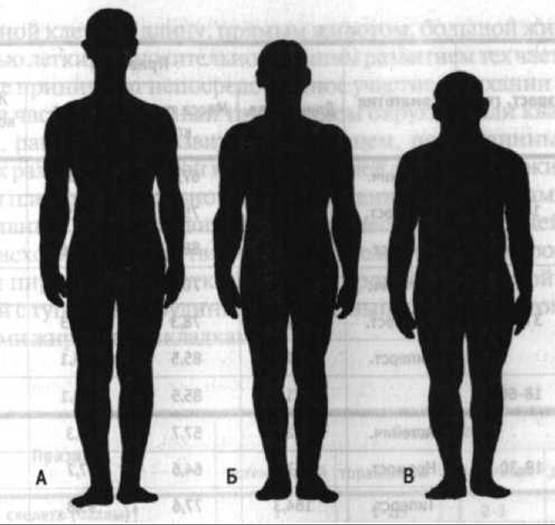
Fig. 155. Scheme of the three main constitutional types according to M.V. Chernorutsky:
A — asthenic; B — normosthenic; C — hypersthenic
The fat component, overall body mass, and chest circumference all increase progressively from the asthenic to the hypersthenic somatotype in both men and women (Table 10).
The diagnostic scheme by Shtefko and Ostrovsky is most frequently used to assess the somatotypes of children. In its modern modification, it provides for pure, transitional, and undefined types.
Pure types include: asthenoid, thoracic, muscular, and digestive; transitional types include: musculo-digestive, digestivo-muscular, etc., depending on the predominance of features from each pure type; the undefined type is a mixed category combining traits of several pure types. In practice, transitional types are usually grouped under the pure type whose features predominate. Children of different somatotypes vary in body dimensions and proportions (Fig. 156), as well as in the development of the skeleton, muscles, adipose tissue, and the shape of the back, legs, and abdomen.
The asthenoid type is characterized by a gracile skeleton, long lower limbs, a narrow chest, an acute infrasternal angle, and a scaphoid abdomen; the thoracic type features pronounced longitudinal development of the chest, a flat abdomen, high vital capacity of the Lungs, and relatively greater development of the facial structures directly involved in Respiration (typically the middle facial third); the muscular type exhibits a round or square face, evenly developed torso, medium infrasternal angle, chest of moderate length, broad and high shoulders, and sharply defined muscle contours; the digestive type is distinguished by a well-developed lower third of the face, diverging mandibular rami, a truncated-pyramid face shape, a short neck, a broad and short chest with an obtuse infrasternal angle, and a prominent abdomen with pronounced fat folds.
Table 10.
|
Sex |
Age, years |
Somatotype |
Variables |
|||
|
Body length, cm |
Body mass, kg |
Chest girth, cml |
Fat component, % |
|||
|
Men |
18-30 |
Asthenic |
175.1 |
67.8 |
75.6 |
13.9 |
|
Normosthenic |
174.8 |
75.7 |
97.5 |
17.4 |
||
|
Hypersthenic |
173.7 |
88.7 |
105.6 |
27.5 |
||
|
31-60 |
Asthenic |
173.5 |
70.0 |
94.2 |
16.3 |
|
|
Normosthenic |
172.2 |
78.3 |
100.3 |
20.1 |
||
|
Hypersthenic |
171.0 |
85.5 |
108.1 |
25.6 |
||
|
18-60 |
171.0 |
85.5 |
108.1 |
25.6 |
||
|
Women |
18-30 |
Asthenic |
162.6 |
57.7 |
83.3 |
30.5 |
|
Normosthenic |
163.4 |
64.6 |
87.7 |
33.5 |
||
|
Hypersthenic |
164.3 |
77.6 |
93.3 |
37.5 |
||
|
31-60 |
Asthenic |
159.0 |
59.0 |
83.3 |
32.4 |
|
|
Normosthenic |
161.0 |
69.5 |
91.7 |
37.5 |
||
|
Hypersthenic |
159.8 |
80.9 |
98.6 |
41.2 |
||
|
18-60 |
161.7 |
68.2 |
яо ц |
35.4 |
||

Fig. 156. Schematic representation of somatotypes according to V.G. Shtefko and A.D. Ostrovsky's classification
Table 11.
|
Somatotype |
||||
|
Variable |
asthenoid |
thoracic |
muscular |
digestive |
|
Skeletal development (points)* |
1 |
1-1.5 |
2-3 |
2.5-3 |
|
Muscular development (points) |
1 |
1.5-2 |
2-3 |
2-3 |
|
Adipose tissue development (points) |
1 |
1-1.5 |
1.5-2.5 |
2-3 |
|
Back shape |
round back |
straight |
straight |
flattened |
|
Chest shape |
flattened |
cylindrical |
cylindrical |
conical |
|
Abdomen shape |
straight |
straight |
straight |
protuberant |
|
Leg shape |
O-shaped (varus) |
normal |
O- or X-shaped |
X-shaped (valgus) |
*Points are determined based on descriptive and measurement criteria.
The distinguishing features of these somatotypes are as follows:
Research in sports morphology frequently utilizes the somatotypological classifications of V.V. Bunak (for men), I.B. Talant (for women), and Sheldon (for men and women). According to Bunak's scheme, 3 main constitutional types are distinguished (thoracic, muscular, and abdominal) along with 4 transitional types (thoraco-muscular, musculo-thoracic, musculo-abdominal, and abdomino-muscular).
The thoracic type is characterized by a Flat chest with an acute infrasternal angle, a hollow abdominal wall, a narrow back, weak musculature, and minimal fat accumulation; the muscular type features a cylindrical chest, a straight and firm abdomen, well-developed musculature, and moderate fat deposition; the abdominal type exhibits a conical chest, a protruding abdomen, substantial fat stores, moderate muscular development, soft elastic skin, and a slightly stooped back. Transitional types are characterized by the predominance of features from one primary type (e.g., the thoraco-muscular type displays more CHARACTERISTICS OF THE thoracic type and fewer of the muscular type).
According to I.B. Talant's classification, leptosomic, mesosomic, and megalosomic constitutions are distinguished (totaling seven somatotypes).
Leptosomatic constitutions include two somatotypes: asthenic and stenoplastic, with an overall tendency toward longitudinal body growth. The asthenic type is slender-built, with a flat and narrow chest, a sunken abdomen, narrow pelvis, long legs (leaving a space between the thighs when brought together), and a poorly developed subcutaneous fat layer. The stenoplastic type is also slender-built, but with better development of all Tissues, good health, and a well-nourished appearance.
Mesosomatic constitutions also include two somatotypes—pyknic and mesoplastic—with an overall tendency toward transversal body growth. The pyknic type is characterized by moderate fat deposition, shortened limbs, broad rounded shoulders, a cylindrical chest, a wide pelvis, rounded abdomen and hips, and smooth, delicate skin. The mesoplastic type features a squat, stocky build with moderately developed muscles and skeleton, alongside a poorly developed fat layer.
Megalosomatic constitutions are divided into three somatotypes: athletic, subathletic, and euryplastic, with a general (more or less equal) tendency toward both longitudinal and transversal growth. The athletic type represents a "masculine woman" somatotype with strongly developed muscles and skeleton, minimal fat, a narrow male-like pelvis, male terminal body Hair, and masculine facial features. The subathletic type is a more feminine variant of the athletic build (tall, slender women of robust constitution with moderate muscle and fat development). The euryplastic type is the "corpulent athletic type," meaning an athletic skeletal and muscular foundation combined with heavy fat accumulation.
Sheldon's classification is based on a point scale (from 1 to 7) evaluating three body components: endomorphy, mesomorphy, and ectomorphy. Endomorphy relates to fat deposition, mesomorphy to the skeletal and muscular system, and ectomorphy to body linearity. The examined individual receives a three-digit score for their somatotype components. For instance, 2-7-2 indicates a mesomorphic somatotype with low endomorphy and ectomorphy—meaning well-developed musculature and bones combined with low body fat and brachymorphic body proportions (Fig. 157).
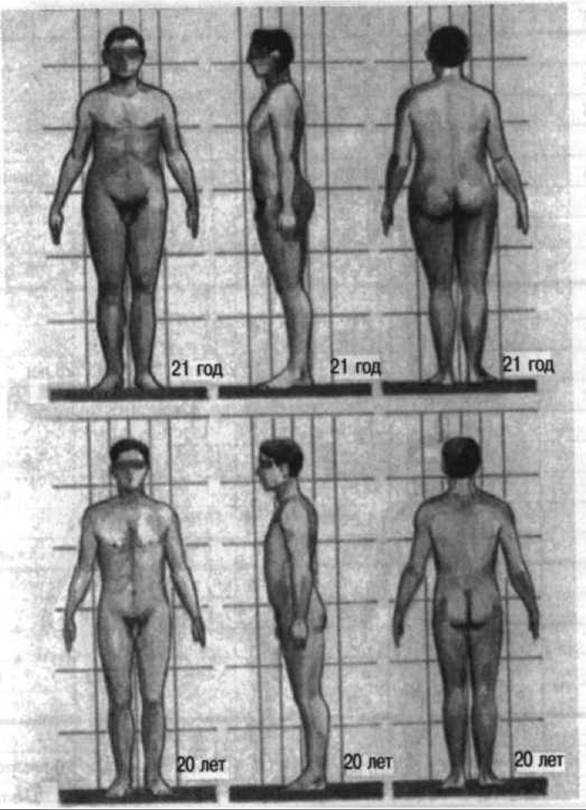
Fig. 157. Extreme Variants of the three components in Sheldon's somatotypes (after Tanker):
A. Extreme endomorphy, 6-3-2; B. Extreme mesomorphy, 1 1/2-7-7.
A novel method for somatotyping adult men and women was proposed by V. P. Chtetsov. It is convenient and objective, as it relies on quantitative body measurements. According to this method, male constitutional types are categorized into chest, muscular, and abdominal types, along with transitional forms. Each type is characterized by specific longitudinal, transversal, and girth dimensions of the body, skinfold thicknesses, body mass components, and dynamometry indices.
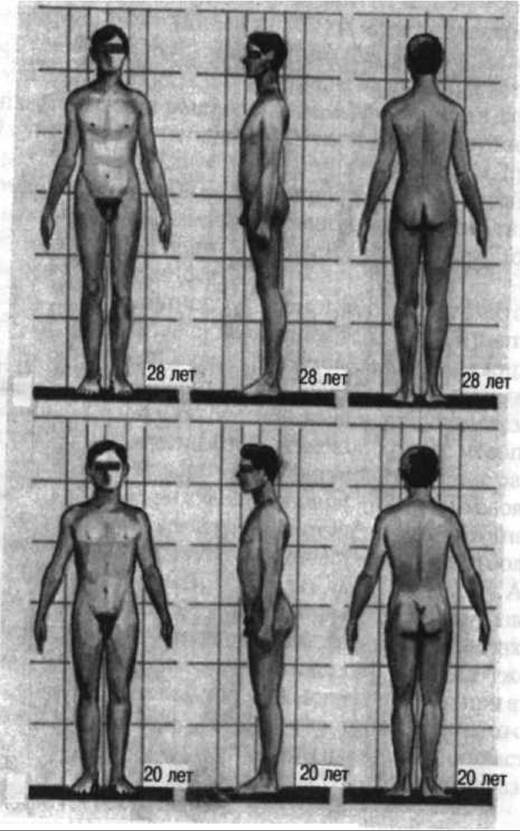
Fig. 157. Extreme variants of the three components in Sheldon's somatotypes (after Tanker):
C. Extreme ectomorphy, 1 1/2-2-6 1/2; D. Average body build type, 3-4-4.
Quantitative body measurements for women aged 17–55 across different somatotypes (mean values) are as follows:
Table 12.
|
Traits |
Chest type |
Muscular type |
Abdominal type |
|
Body length (cm) |
172.9 |
171.5 |
172.1 |
|
Body weight (kg) |
62.5 |
70.1 |
76.5 |
|
Diameters (cm) |
|||
|
shoulders |
38.4 |
40.3 |
39.9 |
|
pelvis |
28.1 |
28.3 |
28.7 |
|
chest: |
|||
|
transverse |
26.1 |
27.7 |
27.6 |
|
anteroposterior |
18.2 |
19.4 |
19.9 |
|
wrist |
5.6 |
5.6 |
|
|
ankles |
7.3 |
7.3 |
|
|
Girths (cm) |
|||
|
chest |
86.3 |
93.4 |
96.2 |
|
waist |
71.8 |
76.4 |
82.5 |
|
gluteal |
91.5 |
94.9 |
100.5 |
|
arm |
26.3 |
29.8 |
31.2 |
|
forearm |
25.7 |
27.8 |
28.2 |
|
wrist |
16.8 |
17.5 |
17.3 |
|
calf |
35.3 |
37.4 |
38.5 |
|
above ankles |
22.6 |
23.4 |
23.7 |
|
Skinfolds (mm) |
|||
|
back |
8.4 |
9.7 |
15.6 |
|
arm |
7.5 |
8.3 |
14.0 |
|
abdomen |
7.6 |
8.8 |
17.3 |
|
thigh |
6.9 |
7.5 |
13.2 |
|
Fat mass |
|||
|
absolute (kg) |
7.4 |
8.8 |
16.2 |
|
relative (% of body weight) |
11.7 |
12.4 |
20.8 |
|
Muscle mass |
|||
|
absolute (kg) |
30.5 |
35.3 |
35.2 |
|
relative (% of body weight) |
48.7 |
50.2 |
46.2 |
|
Grip dynamometry (kg) |
||||
|
right |
43.5 |
49.5 |
49.1 |
|
|
left |
39.4 |
46.2 |
44.3 |
Somatotype, representing the qualitative uniqueness of human morphofunctional organization, and physical development, reflecting the level attained in body size growth and age-related proportion changes, are interrelated concepts. Firstly, because they provide complementary characteristics of the organism. Secondly, because a child's somatotype and their physical development are closely tied to growth processes.
Physical development is assessed using normative charts4. Children should be differentiated not only by sex, age, and ethno-territorial Background, but also by somatotype. Otherwise, the physical development of children with an asthenoid somatotype might be misjudged as reduced or even low, while those with a digestive somatotype might be rated as high (or likewise low, if increased fat deposition is considered a negative factor). At the same time, within the framework of their specific somatotype, these children's physical development may be entirely normal.
Thus, constitutional morphology is closely linked with Age Morphology. Both of these fields are equally tied to sports morphology.
The Model of a Healthy Person
Physical perfection encompasses not only aesthetically pleasing external body contours and shapes, but fundamentally requires health and harmonious personal development.
Models of a healthy person—specifically the body build features associated with good health—remain insufficiently developed. Experience in anthropology and medicine confirms the validity of choosing body mass as an integral somatic characteristic of an individual (sometimes considered in absolute values, sometimes indexed to body length or surface area).
The normal (ideal, optimal) body mass should be defined as the weight of a practically healthy individual that corresponds to their somatotypological traits, accompanied by high working capacity and full performance of social Functions. In its simplest form, the model of a physically perfect person is characterized by a body mass normal for their linear and girth dimensions and somatotype.
Various Methods for Assessing normal body mass have been proposed. The most widespread, despite its obvious imperfections, is the Broca index (height in cm - 100 = body mass in kg)5. R. D. Sinelnikov considered the ideal body weight to be 10–20% below arithmetic mean values. Another standard considered close to ideal is fat-free body mass (total body mass minus adipose tissue mass). This approach takes into account skinfold thicknesses as well as body girth dimensions, specifically chest and waist circumferences.
5 Several modifications of this method exist. For example, for a body length of 155–165 cm, subtracting 100 is suggested; for 166–175 cm, subtracting 105; and for lengths exceeding 175 cm, subtracting 110.
An original approach to this issue was proposed by D. A. Zhdanov—the "body weight rejuvenation" method. It involves determining body weight using a nomogram designed for younger populations, utilizing the individual's current body length and a reduced chest circumference (adjusted to a younger age group level using correction factors). This method grants every individual the freedom to choose the age standard by which they wish to evaluate their body mass. Naturally, the model of a healthy person should not be limited to a single morphological trait (even if its value is indisputable). Body dimensions are interconnected and interdependent, forming a cohesive systemic whole. Body length and mass play the leading role, determining two-thirds of the variance across all other traits. Traditionally, chest girth is added to these key parameters.
The ratio of body length to body weight and chest girth, normalized by body length, proves to be highly variable, particularly among athletes of various sports specializations. For instance, a basketball player is characterized by tall stature with a moderate relative body weight and small chest girth, whereas a weightlifter features short stature with relatively high values for both body weight and chest girth.
Body posture and its anatomical foundations
Posture is defined as the habitual, relaxed stance of a person standing at ease, holding the torso and head upright without active muscular tension.
Posture is determined by the mutual arrangement of the individual parts of The Human Body and depends on the position of the body's general center of gravity, Structural Features of the skeleton (specifically, the curvatures of THE Vertebral Column), the inclination of the pelvis and axes of the lower limbs, the shape of the chest, as well as the state of the muscular system and the joint-ligament apparatus.
As is well known, the vertebral column has four curvatures: two convex forward (cervical and lumbar lordoses) and two convex backward (thoracic and sacral kyphoses). All these physiological curves are formed by the age of 6–7 years and become fixed by 18–20. Depending on the degree of prominence of these curves, several types of posture are distinguished (Fig. 158).
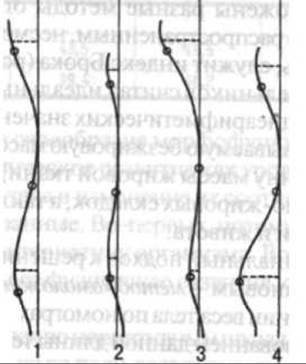
Fig. 158. Posture types:
1 - normal; 2 - straightened; 3 - slouching; 4 - lordotic; 5 - kyphotic
A moderately pronounced curvature of all sections of the vertebral column shapes a normal posture.
A weakly pronounced curvature of the vertebral column characterizes a straightened posture. In this case, the back is sharply flattened and the chest projects somewhat forward.
A sharply pronounced curvature of the vertebral column in the thoracic region creates a slouching posture, characterized by an increased cervical curve and a correspondingly decreased lumbar curve. Concurrently, the chest is flattened, the shoulders are drawn forward, and the head is lowered.
A strongly pronounced curvature in the lumbar region forms a lordotic posture, which is characterized by an enhanced lumbar curve with a simultaneous reduction in the depth of the cervical curve. The abdomen protrudes or sags.
Excessive curvature simultaneously in the cervical and lumbar Regions of the vertebral column leads to a compensatory enhancement of thoracic kyphosis, resulting in a kyphotic posture. This type of posture disorder is accompanied by the shoulders being drawn forward, a protruding abdomen, a lowered head, and the elbow and knee joints typically being semi-flexed.
Lateral curvatures of the vertebral column to the left or right of the vertical line form a scoliotic posture, characterized by an asymmetrical position of the torso, particularly the shoulders and shoulder blades.
Posture disorders may be associated with congenital defects, though environmental factors are of primary importance: habitual working posture, poorly organized work and rest schedules, violation of various hygiene requirements, etc. There is a certain age-related variability in posture types. For example, in childhood, the lordotic posture type is most frequently observed, caused by weak muscle tone. In adulthood, the sagittal curvature of the lumbosacral region of the vertebral column decreases due to a reduction in the angle of pelvic tilt relative to the vertical and an increase in the curvature of the upper spinal column. In women, this is more pronounced than in men. In old age, the flattening of the lumbar lordosis intensifies and thoracic kyphosis increases. Posture types can change during sports training if poorly designed workouts lead to the hyperdevelopment of certain muscle groups at the expense of others. It is especially important to monitor correct posture in sports characterized by asymmetrical movements, such as fencing, tennis, etc. Posture type is not a permanent and immutable characteristic. Systematic Physical Exercise and The Use of corrective exercises aimed at strengthening underdeveloped muscle groups contribute to The formation of proper posture, ensuring the harmonious functioning of the body.
Posture is determined visually (descriptive method) or by means of measurements (using goniometry). In the first case, the degree of prominence of the spinal curves and the relative positioning of body parts are evaluated; In the second case, the angles of inclination of various spinal segments relative to the vertical and the angle of pelvic tilt are measured. In addition, radiography is employed for a more in-depth study of posture.
Symmetry and Asymmetry in body structure
Although the human body exhibits a bilaterally symmetrical structural plan, deviations from it are quite frequent. Certain unpaired Organs are localized predominantly in one half of the body: The Heart, Stomach, and Spleen are shifted to the left of the midline, while the Liver is shifted to the right. Paired organs differ in structure and size (for example, the right lung has three lobes, while the left has two) and occupy different positions (for example, the right Kidney is located lower than the left).
The Musculoskeletal System, nerves, and Blood Vessels of the limbs show significant differences. Most people are more adept with their right hand (right-handedness). Left-handedness and equal proficiency with both hands are considerably less common. Consequently, the right arm is usually larger in size than the left. In such cases, the left leg typically surpasses the right in size, which indicates crossed limb asymmetry. Morphological asymmetry is accompanied by corresponding functional differences in muscle strength, joint mobility metrics, etc.
A leading role in this is played by the morphological and Functional differences between the left and right hemispheres. The speech center is located in the cortex of the left hemisphere, whereas visuospatial Analysis of the external world is performed more effectively by the right hemisphere. However, the differences between the right and left hemispheres are relative; the hemispheres interact closely to ensure the full-fledged functioning of the Brain.
Asymmetry in body structure can be either inherited or acquired. The exacerbation of asymmetry is promoted by unequal physical loads on the right and left halves of the body during occupational and athletic activities.
Last update: 08/08/2026
Editorial and Educational Adaptation: This material has been compiled based on the primary/original source text. The project team performed an editorial review, corrected technical inaccuracies, structured sections, and adapted the content for an educational format.
What was processed:
- elimination of formatting defects (OCR errors, structural breaks, corrupted characters);
- editorial organization of content;
- standardization of terminology in accordance with academic sources;
- verification of factual statements against the original source text.
All mentions of the author, publication year, and origin of the primary text have been preserved in accordance with the source.