BIOCHEMISTRY - L. Stryer - 1984
VOLUME 1
PART I. CONFORMATION AND DYNAMICS
CHAPTER 4. HEMOGLOBIN: AN ALLOSTERIC PROTEIN
The evolutionary transition from monomeric Myoglobin to tetrameric Hemoglobin was accompanied by The Emergence of new functional properties. The hemoglobin molecule is significantly more complex than that of myoglobin. First of all, In addition to O2, hemoglobin transports H+ and CO2. Second, oxygen binding by hemoglobin is regulated by specific Components of the internal environment, namely H+, CO2, and organic phosphates. These regulators exert a profound influence on the oxygen-binding capacity of hemoglobin, even though they bind to sites located far from the heme group. In general, so-called allosteric interactions—that is, interactions between spatially separated sites—occur in many Proteins. Allosteric effects play a crucial role in the regulation and integration of molecular processes in biological systems. Hemoglobin is the most extensively studied allosteric protein, and therefore it is worthwhile to examine its Structure and function in greater detail.
4.1. Functional Differences Between Myoglobin and Hemoglobin
Hemoglobin is an allosteric protein, whereas myoglobin is not. This difference is manifested in three ways:
1. The binding of O2 to hemoglobin enhances the binding of subsequent O2 molecules by the same hemoglobin molecule. In other words, Oxygen binds to hemoglobin cooperatively. In contrast, oxygen binding by myoglobin is noncooperative.
2. The oxygen affinity of hemoglobin depends on pH, whereas myoglobin exhibits no such dependence. CO2 molecules also affect the oxygen-binding capacity of hemoglobin.
3. The oxygen affinity of hemoglobin is regulated by organic phosphates, specifically 2,3-bisphosphoglycerate. As a result, hemoglobin exhibits a lower oxygen affinity than myoglobin.
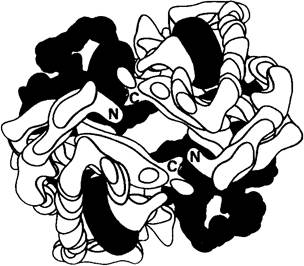
Class="center">Fig. 4.1. Low-resolution model of hemoglobin. The α-chains are shown in yellow, the β-chains in blue, and the heme groups in red.
Last update: 06/08/2026
Editorial and Educational Adaptation: This material has been compiled based on the primary/original source text. The project team performed an editorial review, corrected technical inaccuracies, structured sections, and adapted the content for an educational format.
What was processed:
- elimination of formatting defects (OCR errors, structural breaks, corrupted characters);
- editorial organization of content;
- standardization of terminology in accordance with academic sources;
- verification of factual statements against the original source text.
All mentions of the author, publication year, and origin of the primary text have been preserved in accordance with the source.