Human Anatomy (with Fundamentals of Dynamic and Sports Morphology) - Ivanitsky, M. F. 2008
Age-Related Morphology
Prediction of puberty timing, definitive body dimensions, and motor skill development
Predictive capabilities are based on the genetic programming of GROWTH AND DEVELOPMENT and the correlation of these processes with hereditarily stable traits (genetic markers). The latter can conventionally include a child's somatotype (a specific set of morphological features), although it is less stable than marker traits such as Blood group or the dermatoglyphic patterns of the palms and soles. Taking into account the somatotypological Classification by V. G. Shtefko and A. D. Ostrovsky (see p. 455), it can be considered that Puberty in children of the digestive and muscular somatotypes occurs 2–3 years earlier than in those of the asthenoid and thoracic somatotypes. Differences between the children of the latter two somatotypes are less pronounced. However, a "pure" experiment (observations on dizygotic twins) reveals that belonging to the thoracic somatotype is associated with earlier puberty compared to the asthenoid somatotype (Fig. 151). These data should be taken into account during sports Selection for such "rejuvenating" sports as figure skating, swimming, and artistic gymnastics. By focusing on the somatotype of a 5–6-year-old child and certain other data (for example, the results of a parent survey), the timing of their puberty can be predicted with considerable accuracy.
It is known that physical loads delay puberty. To avoid METABOLISM/18.html">The Influence of physical exertion on the natural course of a child's development, it is preferable to involve children with late maturation in training for the aforementioned sports.
Class="center">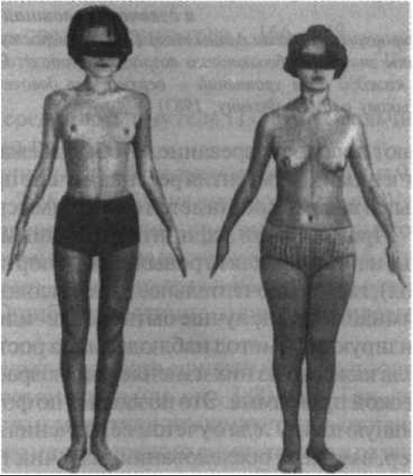
Fig. 151. Dizygotic twin girls, 14 years old:
right — thoracic somatotype, left — asthenoid. Pubertal signs (breast development, body build) are better expressed in the former
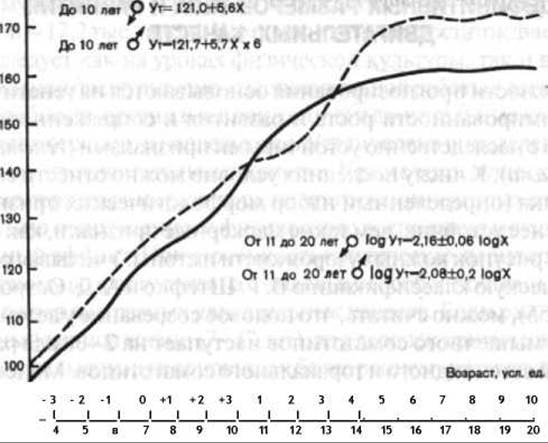
Fig. 152. Body length growth curves in boys (dashed line) and girls (solid line).
Regression equations of body length (Y) by age (X) in conventional units (absolute age values in years are given below the abscissa axis). The ordinate axis represents body length in cm. In each pair of equations, the upper one is for girls and the lower one is for boys (after V. M. Volkov and V. P. Filin, 1983)
Predicting the definitive body length of a young athlete is important, for example, in team sports (basketball, volleyball, handball) where being tall is preferable, or in artistic gymnastics, where being of medium or short stature is advantageous. An individualized method of monitoring children's growth has demonstrated that each child's body length changes with age in accordance with their genetic program. This makes it possible to use formulas to determine definitive body length, taking into account its value at the time of the examination. For example, at the time of the examination, an 11-year-old boy (11 years 2 months) has a body length of 166 cm. It is necessary to predict his body length at the age of 19.
To this end, the average height of his peers is determined using the formula for males aged 11–20 years (Fig. 152): log Y = 2.08 + 0.2 log 1. Since log 1 = 0, then log Y = 2.08. Using the antilogarithm table, we find that Y = 148. We then determine the deviation of the subject's body length from the group average in fractions of the sigma (o) value:
Table 5. Mean square deviation values for body length by AGE AND SEX groups:
|
Age in years |
Boys |
Girls |
Age in years |
Boys |
Girls |
|
4 |
4.6 |
5.7 |
12 |
6.0 |
7.1 |
|
5 |
4.7 |
4.3 |
13 |
7.0 |
6.5 |
|
6 |
4.4 |
3.7 |
14 |
7.4 |
6.1 |
|
7 |
4.4 |
4.5 |
15 |
6.7 |
5.7 |
|
8 |
5.0 |
5.4 |
16 |
5.9 |
5.8 |
|
9 |
5.0 |
5.8 |
17 |
5.2 |
5.7 |
|
10 |
5.3 |
6.5 |
18 |
||
|
11 |
5.5 |
7.1 |
19 |
6.5 |
5.2 |
|
20 |
The subject exceeds the average body length of 11-year-old boys by 3.3 o, meaning he is very tall.
We determine the expected body length of the subject at age 19 (X = 9): log Y = 2.08 + 0.2 log 9; log Y = 2.26. According to the antilogarithm table, Y = 175. Knowing that the subject exceeds his peers in body length by 3.3 o, we determine his expected superiority at age 19: 6.5 cm × 3.3 = 21.45 cm. Consequently, his body length at age 19 will be 175 cm + 21.4 cm = 196.4 cm. The error from the true value does not exceed 0.5%.
The prognosis of motor qualities development is based on The Use of marker traits: somatotype (see p. 388) and others. For instance, adolescent girls of the asthenoid and digestive somatotypes lag behind their peers of the muscular and thoracic somatotypes in The Development of speed-strength qualities and endurance. This leads to an important pedagogical Conclusion: a differentiated approach in physical education must also take into account the children's motor capabilities associated with their somatotype.
Last update: 08/08/2026
Editorial and Educational Adaptation: This material has been compiled based on the primary/original source text. The project team performed an editorial review, corrected technical inaccuracies, structured sections, and adapted the content for an educational format.
What was processed:
- elimination of formatting defects (OCR errors, structural breaks, corrupted characters);
- editorial organization of content;
- standardization of terminology in accordance with academic sources;
- verification of factual statements against the original source text.
All mentions of the author, publication year, and origin of the primary text have been preserved in accordance with the source.