MEDICAL BIOLOGY, HUMAN ANATOMY, PHYSIOLOGY AND PATHOLOGY - Y.I. Fedonyuk 2010
ANATOMY, PHYSIOLOGY, PATHOLOGY
SECTION 2. MUSCULOSKELETAL SYSTEM (THE PROCESS OF MOVEMENT)
SKELETON OF THE HEAD. SKULL
5. AGE AND SEX CHARACTERISTICS OF THE SKULL
The cranial vault of a newborn is 8 times larger than the facial Skeleton, whereas in adults it is only twice as large due to the full Development of the masticatory apparatus.
A characteristic feature of the Skull in newborns and infants is the presence of membranous skull remnants—fontanelles (fonticuli) (Fig. 2.31). Anterior, posterior, and paired lateral fontanelles (sphenoid and mastoid) are distinguished. The anterior fontanelle is the largest; it is located between the frontal and parietal bones and closes in the 2nd year of life. When intracranial pressure rises, the fontanelle bulges, whereas in conditions causing severe dehydration (e.g., dysentery), it sinks. The posterior fontanelle closes by the 2nd month of life. Lateral fontanelles are often absent in full-term newborns, but if present, they close by the 2–3rd month of life.
Class="center">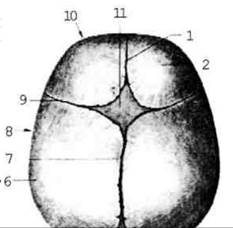
Fig. 2.31. SKULL OF A newborn
A second feature of the newborn skull is the presence of cartilaginous layers between the bone PARTS OF THE cranial base.
The third feature is underdeveloped Paranasal Sinuses, tubercles, and processes; absence of Teeth; poorly developed jaws; wide eye sockets; a Frontal bone consisting of two halves; and the absence of superciliary arches. Cranial sutures are formed by the 3–5th year of life. Skull growth is completed by the 25–30th year of life. The development, growth, and shape of the skull are closely interrelated with The Development of the Brain and Muscles, which exert a modeling effect on young Bone tissue. Regardless of how variable the shape of the skull may be, these variations do not affect human intellectual abilities.
The male skull is relatively larger than the female skull.
The female skull retains certain Features of the infant skull, whereas the male skull more readily displays traits inherent to our ancestors. Overall, Sexual Dimorphism of the skull in humans is minor.
Senile changes are characterized by the resorption of ridges and spongy bone tissue. The skull becomes light and brittle.
Constitutional characteristics also influence the shape of the skull.
Last update: 08/08/2026
Editorial and Educational Adaptation: This material has been compiled based on the primary/original source text. The project team performed an editorial review, corrected technical inaccuracies, structured sections, and adapted the content for an educational format.
What was processed:
- elimination of formatting defects (OCR errors, structural breaks, corrupted characters);
- editorial organization of content;
- standardization of terminology in accordance with academic sources;
- verification of factual statements against the original source text.
All mentions of the author, publication year, and origin of the primary text have been preserved in accordance with the source.