PLANT HETEROPHYLLY - O.M. NEDUKHA - 2011
CHAPTER ONE. MORPHOLOGICAL AND STRUCTURAL-FUNCTIONAL CHARACTERISTICS OF VEGETATIVE ORGANS IN HETEROPHYLLOUS PLANTS
1.2. ORIGIN OF HETEROPHYLLY
Views on The Emergence of heterophilly in plants remain inconclusive. There are several Perspectives regarding its origin—evolutionary and ecologo-genetic (the so-called phenotypic plasticity hypothesis)—which are not mutually exclusive but rather operate at different Levels of Organization (phylogenetic, ontogenetic, tissue, cellular, etc.). Let us examine each of these existing hypotheses in detail.
The evolutionary origin of heterophilly is grounded in the premise that this phenomenon arose As a result of convergent or parallel evolution in response to an aquatic environment (Bradshaw, 1965). According to other authors (Cook, Johnson, 1968; Smith, Hake, 1992), remarkably little is known about the evolutionary origins of heterophyllous plants, specifically the environmental conditions that trigger the heterophyllous habit (Wells, Pigliucci, 2000). It is generally believed that the majority of aquatic taxa belong to monocots, with only a few representatives among dicotyledonous hydrophytes. A return to an aquatic lifestyle has not been documented in dicots (Wells, Pigliucci, 2000). Based on J. Hutchinson's hypothesis, plastic heterophyllous species evolved from non-plastic heterophyllous monocot terrestrial ancestors (Hutchinson, 1975; Goliber, Feldman, 1990) during evolutionary shifts driven by environmental and climatic changes. As noted by S.L. Wells and M. Pigliucci (2000), this is strongly supported by numerous experimental studies in which hydrophytes were transferred to aquaria engineered to simulate the emergence of shoots from the aquatic medium into the air.
A.D. Bradshaw, in his Study of the Evolutionary Significance of plant plasticity, observed that many relatives of heterophyllous taxa exhibit a reduced capacity ("weaker expression") for plasticity in terms of leaf shape variation. He demonstrated that not all species within the same genus are heterophyllous. For instance, among monocots of the genus Potamogeton, there are three heterophyllous species: Potamogeton nodosus, P. natans, and P. polygonifolius, whereas other species of this genus, notably P. lucens and P. perfoliatus, are non-heterophyllous (Bradshaw, 1965). Similar distinctions are characteristic of species within the genus Juncus. Specifically, J. heterophylla is a heterophyllous species, whereas J. obtusiflorus is non-heterophyllous. Among dicots as well, not all species within a given family display traits of heterophilly:
1) Callitriche intermedia - a heterophyllous species,
C. heterophylla - a heterophyllous species,
C. stagnalis - a non-heterophyllous species,
2) Proserpinaca intermedia - a heterophyllous species,
P. palustris - a heterophyllous species,
P. pectinata - a non-heterophyllous species,
3) Ranunculus aquatilis - a heterophyllous species,
R. flabellaris - a heterophyllous species,
R. flammula - a heterophyllous species,
R. hederaceus - a non-heterophyllous species (Bradshaw, 1965).
The existence of specific phylogenetic links between heterophyllous and homophyllous species [heterophyllous and homophyllous species (Iida et al., 2009)] of the genus Potamogeton was also highlighted by D. Les and D. Sherider (Les, Sherider, 1990). In their study of seventeen North American species of the genus Potamogeton (P. foliosus, P. pectinatus, P. perfoliatus, P. pusillus, P. richardsonii, P. robbinsii, P. crispus, P. vaseyi, P. zosterifolius, P. alpinus, P. amplifolius, P. epihydrus, P. gramineus, P. illinoensis, P. natans, P. nodosus, P. spirillus)—which included both heterophyllous and homophyllous species (the first nine species) (Fig. 1.2.1)—these researchers demonstrated that the aerial and submerged leaves of heterophyllous pondweed species differ significantly in flavonoid synthesis. In contrast, the flavonoid content in the aerial leaves of heterophyllous species was comparable to that found in homophyllous pondweed species.
Class="center">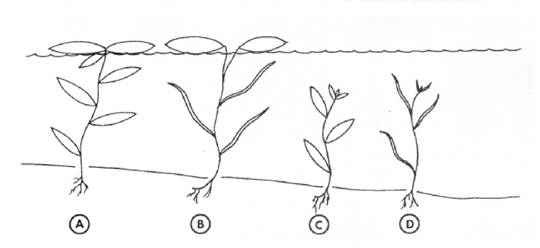
Fig. 1.2.1. Main morphological types of Potamogeton.
A – homophyllous species, in which submerged and floating leaves are similar in shape (lanceolate); B – heterophyllous species, in which submerged linear leaves differ from lanceolate floating leaves; C – homophyllous species with broad, lanceolate, elongated submerged leaves; D – homophyllous species with linear, elongated submerged leaves (Les, Sherider, 1990)
The researchers identified the following Phenolic Compounds in the floating leaves of heterophyllous Potamogeton species: luteolin, 7-OCH3 luteolin, apigenin 6-C-glucoside, apigenin 7-O-glucuronide, luteolin 7-O-glucoside, luteolin 6-C-glucoside, chrysoeriol 6-C-glucoside, luteolin 7-O-glucuronide, apigenin, and chrysoeriol. In submerged leaves, the first six glucosides were absent, whereas the seventh glucoside, luteolin 7-O-glucuronide, was detected in both submerged leaves and in the petioles and blades of aerial leaves. The authors demonstrated that in homophyllous species characterized by broad submerged leaves, the profile of phenolic compounds is closer to that of the aerial leaves of heterophyllous species. Analysis of these substances revealed phylogenetic relationships within this genus independent of morphological and chromosomal data. Glycoflavones found in aerial leaves evidently serve not only as ultraviolet radiation filters (McClure, 1975) but also as metabolites whose synthesis can be regarded as an adaptive mechanism at the functional level during the manifestation of heterophilly. The inhibition of glycoflavone synthesis in the submerged leaves of heterophyllous Potamogeton species, as well as in the linear leaves of homophyllous Potamogeton species, is presumably a consequence of the attenuation of UV radiation within the Water Column, which absorbs these rays. Based on the identification and distribution of the nine aforementioned Flavonoids, the authors concluded that heterophyllous species form a cohesive group of plants, whereas homophyllous species (with broad, ovate-elongate leaves) chemically resemble the floating (ovate-elongate) leaves of heterophyllous species, as illustrated in their schematic diagram (Fig. 1.2.2) (Les, Sherider, 1990).
Furthermore, the authors outlined the evolutionary relationships among various morphological species groups within the genus Potamogeton (Fig. 1.2.3). These findings provide direct support for earlier hypotheses suggesting that flavonoids played a crucial role in the evolutionary transition that allowed plants to conquer the terrestrial habitat (Miller, 1974; McClure, 1975).
According to S. Iida et al. (2004, 2006), the chloroplast rbcL Gene, which encodes the catalytic subunit of Rubisco, has undergone positive Selection in the majority of terrestrial plants. Investigating the adaptive Evolutionary Processes associated with heterophilly and homophilly made it possible to analyze the positive selection of rbcL gene sequences across ecologically diverse aquatic plants in Japan, specifically species of the genus Potamogeton, which exhibit considerable morphological and growth diversity (Wiegleb, 1988). The authors concluded that homophilly in species of this genus is heritable, whereas heritable heterophilly likely arose via parallel evolution (Iida et al., 2004; 2006). Continuing their investigation into genotype-environment interactions in the expression of heterophilly across numerous Potamogeton species—including natural hybrids growing in Japan—these researchers analyzed the Amino Acid Composition of the rbcL gene in heterophyllous and homophyllous pondweed species using phylogenetic and codon analyses (Iida et al., 2009). Three genes (rbcL, atpB, petA) were sequentially sequenced from 18 species of the genus Potamogeton. All nucleotide sequences were obtained from GenBank. Consistent with previous studies, phylogenetic trees based on individual chloroplast genes are congruent (Iida et al., 2004).
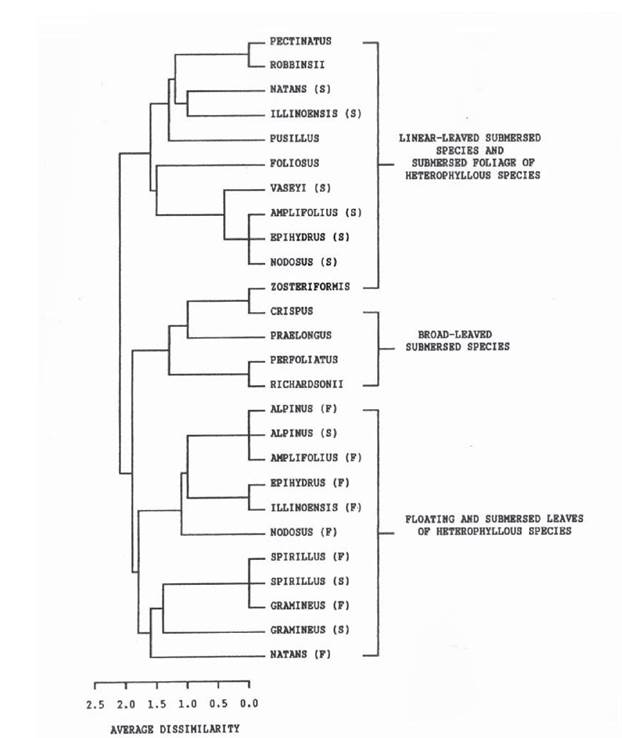
Fig. 1.2.2. UPGMA dendrogram of Euclidean distances corresponding to biochemical data derived from flavonoid traits in 17 species of the genus Potamogeton. Abbreviations: F – data for floating leaves, S – data for submerged leaves (Les, Sherider, 1990).
Fig. 1.2.3. Hypothetical changes in morphological and biochemical traits during the evolution of species within the genus Potamogeton. A — unclear heterophylly and flavonoid differences characterize the ancestors of Potamogeton (e.g., in P. alpines); B — morphological and biochemical specialization has led to distinct heterophylly with a reduction of flavonoids in submersed leaves (e.g., in P. epihydrus); C — homophyllous species with linear leaves and reduced flavonoid content (e.g., in P. foliosus) may derive from heterophyllous ancestors through the loss of floating leaves; D — homophyllous species with lanceolate leaves and varying flavonoid content (e.g., in P. richardsonii) may originate from heterophyllous ancestors that lost their floating leaves; E — homophyllous species with linear leaves apparently arose from homophyllous species (with lanceolate leaves) via morphological specialization and reduced flavonoid synthesis; F — alternating broad-leaved (lanceolate-leaved) homophyllous species ancestralized heterophyllous species through the morphological specialization of floating and submersed leaves. Designation: f — floating leaves (Les, Sherider, 1990)
Researchers (Iida et al., 2009) combined data from four genes (1349 rbcL, 1467 atpB, 918 petA, 660 trnT-trnL) to construct a chloroplast DNA (cpDNA) Phylogenetic Tree of Potamogeton (cpDNA tree; Fig. 1.2.4; see insert I).
The main branching pattern in this DNA phylogenetic tree is consistent with that described in previous work investigating intergenic substitutions (the trnT-trnL spacer) (Iida et al., 2004). Japanese Potamogeton species were segregated into group III, characterized by broad submersed leaves, whereas group II comprised species with linear submersed leaves, which were later subdivided into two subgroups, IIa and IIb (Fig. 1.2.4). Additionally, a new lateral branch comprising several species was identified (Fig. 1.2.4). The hypothesis of positive selection acting on the rbcL gene was tested by examining sequence alignment matches in Potamogeton rbcL based on the cpDNA tree. The authors established the distribution of 12 variable amino acid sites in the RbcL gene across heterophyllous and homophyllous Potamogeton species, as well as ancestral taxa (Table 1.2.1). Amino Acid Substitutions at residues 225 and 281 were identified as potential sites under positive selection. The most prominent substitutions occurred on the terminal Branches of the phylogenetic tree compared to its base (Fig. 1.2.4; see insert I).
The substitution at residue 225 (Ile225 → Leu225, involving the codon change ATT → CTT) occurred twice: first in subgroup Ia, and subsequently in subgroup IIa. In contrast, residue 281 underwent substitution five times: three parallel substitutions of Ser281 → Ala281 (TCT → GCT), and two substitutions of Ala281 → Ser281 (GCT → TCT). Numerous amino acid substitutions in Potamogeton occur between subunits and near active sites. Seven Amino Acids (76, 230, 245, 249, 279, 282, 309) were localized On the surface of the RbcL molecule. Two of these (76 and 230) reside at the RbcL/RbcS interface, whereas five (245, 249, 279, 282, and 309) are located at the RbcL dimer interface. Another four amino acids (101, 225, 281, and 328) are buried within the core of the molecule. Residue 270 is positioned near the molecular exterior, although not entirely buried. Meanwhile, residues 270 and 328 are situated within substrate-binding regions and are shielded by active-site residues (Arg295, His298, and His327) (Knight et al., 1990). Thus, molecular evolutionary analyses indicate that the rbcL gene in species of the genus Potamogeton is subject to positive selection (Table 1.2.1).
TABLE 1.2.1. Amino acid substitution sites in the RbcL gene across 18 Potamogeton species and Stuckenia pectinata (Iida et al., 2009)
Species / trait |
Amino acid site |
|||||||||||
76 |
101 |
225 |
230 |
245 |
249 |
270 |
279 |
281 |
282 |
309 |
328 |
|
P. crispus (-a) |
S |
V |
I |
A |
G |
E |
L |
T |
S |
H |
M |
S |
P. maackianus (-a) |
S |
V |
I |
A |
G |
D |
L |
S |
A |
H |
M |
S |
P. gramineus (++) |
N |
V |
L |
G |
G |
E |
L |
S |
A |
H |
M |
S |
P. dentatus (-) |
N |
V |
L |
G |
G |
E |
L |
S |
S |
H |
M |
S |
P. distinctus (++) |
S |
V |
I |
A |
G |
E |
L |
S |
A |
H |
M |
A |
P. malaianus (++) |
S |
V |
I |
A |
A |
E |
L |
S |
A |
H |
M |
A |
P. perfoliatus (-a) |
S |
V |
I |
A |
G |
E |
I |
S |
A |
H |
M |
S |
P. alpinus (+), P. cristatus (+) |
S |
V |
I |
A |
G |
E |
L |
S |
A |
H |
M |
S |
P. fryeri (++), P. natans (++) |
S |
V |
L |
A |
G |
E |
L |
S |
A |
N |
M |
S |
P. praelongus (-), P. oxyphyllus, P. octandrus (+) |
S |
V |
I |
A |
G |
E |
L |
S |
S |
H |
M |
S |
P. compressus (-), P. obtusifolius (-), P. panormitanus (-a), P. pusillus (-) |
S |
I |
I |
A |
A |
E |
L |
S |
S |
H |
I |
S |
Stuckenia pectinata (-a) |
S |
V |
I |
A |
A |
E |
L |
S |
S |
H |
M |
S |
Structural feature b |
S |
V |
I |
A |
G |
E |
L |
S |
S |
Y |
M |
S |
Confidence, ω ≥ 1c : |
I |
c |
c |
i |
D |
D |
*c |
D |
c |
D |
D |
*c |
Site-specific model (M8) |
.51 |
.38 |
.86 |
.48 |
.85 |
.32 |
.49 |
.48 |
1.0 |
.86 |
.43 |
.38 |
Clade-specific model (ω2: heterophylly) |
.73 |
.02 |
.98 |
.74 |
.29 |
.02 |
.72 |
.03 |
.98 |
.29 |
.02 |
.68 |
Designations: (-a) number of contacts between the RbcL gene of homophyllous pondweed species (with submersed leaves) and spinach RbcL amino acid sites; (+) number of contacts between the RbcL gene of heterophyllous pondweed species (with submersed and floating leaves) and spinach RbcL amino acid sites;
(-) number of contacts between the RbcL gene of heterophyllous pondweed species (with submersed, floating, and terrestrial leaves) and spinach RbcL amino acid sites.
a — species growing in brackish water; b* — residues shielded from active sites.
c — residues buried within the interior of RbcL; d — residues located on The surface of the RbcL dimer; i — residues situated at the interface between the two RbcL and RbcS genes
Out of the twelve amino acid sites, two sites (225 and 281) underwent positive selection, with the substitution at site 281 driving distinct phylogenetic lineages in heterophyllous versus homophyllous species (Fig. 1.2.4; see insert I). Thus, it was established that the evolution of ecological divergence in Japanese Potamogeton species involves the molecular adaptation of the rbcL gene (Iida et al., 2009).
According to research by M.A. Geber et al. (1992), the loss of phenotypic plasticity variations under heterogeneous environmental conditions allows for only minor genetic variation in traits. This phenomenon likely reflects a specific manifestation of phenotypic plasticity in both aquatic and terrestrial plants rather than the outcome of stabilizing selection (Cook, Johnson, 1968; Winn, 1999). The loss of certain morphological plasticity traits in homophyllous species raises several questions for researchers:
— Why does this occur in specific species?
— Is the level of regulation in hydrophyte populations responding to aquatic environment fluctuations—which trigger heterophyllous traits—higher than that in terrestrial populations subjected to flooding?
— What serves as an indicator of the evolution of heterophyllous taxa when their phylogenetic origins are evaluated alongside environmental changes?
These questions demand Answers and, consequently, a concerted effort among florists, botanists, systematists, ecologists, and geneticists to establish a clear conceptual framework for THE ORIGIN OF heterophyllous species.
The ecological theory of the origin of heterophyllous plants posits that populations growing under significant water level fluctuations exhibit greater leaf morphological plasticity compared to populations experiencing stable water levels. Leaf morphological Variability decreases as water levels drop, which directly correlates with The Theory of adaptive plasticity, according to which Structural and functional plasticity is expressed only under specific environmental conditions (Levene, 1953; Schlichting, Pigliucci, 1995; Schlichting, Pigliucci, 1998). Conversely, when plasticity is lost in populations inhabiting more homogeneous natural environments, such populations nevertheless retain the underlying capacity to express heterophylly (Wells, Pigliucci, 2000).
For instance, species of the genus Nuphar (Nymphaeaceae) typically produce early aerial (emergent) leaves that resemble their submersed form; this occurs in plants growing both under drawdown conditions (terrestrial habitats) and submerged in water. Nuphar species initially form immature leaves that remain arrested in this state for several years, morphologically resembling young primordia arrayed along a horizontal stem (Cutter, 1957). Such leaves develop annually on the rhizome, exhibiting non-plastic ontogeny (Aydelotte, Diggle, 1997; Diggle, 1997a, b; Wells, Pigliucci, 2000).
Fundamental differences between labile species belonging to plastic heterophyllous hydrophytes and species independent of environmental shifts (terrestrial ↔ aquatic) are presumably elucidated by METABOLISM/2.html">THE CONCEPT OF reversibility. Dozens of studies investigating heterophylly in aquatic macrophytes have demonstrated that both submersed and aerial leaves develop on the same SHOOT; when submerged, aerial leaves transform to resemble submersed ones (Cook, 1969; Bodkin et al., 1980; Bruni et al., 1996). This has also been substantiated experimentally by altering growth conditions in hydrophytes (Goliber, Feldman, 1990; Bruni et al., 1996).
Leaf shape variability in terrestrial plants can be observed in several scenarios: 1) during an accelerated transition from the juvenile to the mature leaf developmental phase; 2) during the switch from the vegetative to the reproductive phase; 3) in perennial plants where early leaves form during the previous growing season and later leaves during the current one (Eckenwalder, 1980; Webb, 1984; Christodoulakis, 1989; Christodoulakis et al., 1990); and 4) during The production of juvenile leaves along lateral shoot axes (Ashby, 1948a, b). In contrast, leaf shape variation in aquatic plants is governed by both exogenous factors (water ↔ air, gas concentrations, light intensity, Temperature, photoperiod) and endogenous cues.
The diverse leaf morphologies observed in heterophyllous plants represent a manifestation of heteroblastic development, wherein juvenile stems and shoots differ structurally from mature, determinate ones across multiple criteria (Allsopp, 1967). Juvenile leaves are smaller and simpler than adult leaves and may also differ in morphostructural traits. For example, juvenile leaves of maize are significantly shorter and narrower than adult leaves, yet they possess epicuticular Waxes and trichomes that are absent in adult foliage (Poethig, 1997). Although juvenile leaves initially experience delayed growth compared to fully developed leaves, comparative developmental analyses across several species indicate that juvenile leaf primordia are generally smaller and morphologically distinct from adult primordia. The transition from the juvenile to the adult stem phase is likewise marked by the transformation of the shoot apical meristem (Abbe et al., 1941; Stein, Fosket, 1969; Kaplan, 1973; Franck, 1976; Greyson et al., 1982). However, correlations between meristem and leaf size are not always observed and are not universal in heteroblastic development. For instance, in Muehlenbeckia platyclados, the transition from the juvenile to the mature leaf phase is accompanied by an expansion of the meristematic zone, whereas mature leaves possess a small meristematic region (Bruck, Kaplan, 1980).
At the organ and cellular levels, According to the theoretical framework proposed by E. Sinnott (Sinnott, 1940, 1963), leaf blade shape is the cumulative outcome of three components: primordium shape, the rate and spatial distribution of Cell divisions, and the extent and orientation of cell expansion. Each of these components can be modulated by both heredity and environmental physical factors (Ashby, 1948a, b). For instance, the interplay among these three components during leaf development in Gossypium sp. carrying the okra mutation was described as early as 1941 (Hammond, 1941). Mutant leaves were elongated and exhibited deeper sinuses between leaf lobes compared to wild-type Gossypium leaves. Furthermore, mutant leaf primordia were markedly narrower than those of the wild type, and their elongated shape resulted from enhanced Cell Division rates along the longitudinal axis of the leaf. The three components outlined by E. Sinnott do not always interact uniformly during leaf shape modifications. In developing leaves of Cyamopsis tetragonoloba, alterations in cell division and expansion along the blade margin were found to correlate with the enlargement or reduction of leaf lobes in trifoliolate versus entire leaves (Sparks, Postlethwait, 1967a, b). Notably, primordia of entire and compound leaves did not differ during early developmental stages. In trifoliolate leaves, cell division within the basipetal margin "pockets" differed from that in entire leaves—specifically, division lagged behind, leading to The formation of deep leaf lobes—whereas in entire leaves, cell division continued without interruption, preventing lobe formation and resulting in an undivided blade.
In contrast, in another heterophyllous species, Callitriche intermedia (which produces oval leaves above water and elongated ribbon-like leaves submerged), leaf shape showed much less variation in terms of cell division patterns and elongation; researchers observed only the formation of elongated blade segments during The Development of ribbon-like leaves (Deschamp, Cook, 1983).
The regulation of leaf shape may occur at the level of individual Cells, at the whole-organ level, or through complex coordinated processes at both cellular and organ scales. The concept that Organogenesis is governed at THE CELLULAR LEVEL is embodied in the "Cell Theory" of plant development, formulated by analogy with cell theory in animal organisms (Jacobs, 1997). From this perspective, plant organ Morphology is determined by meristematic cells undergoing division followed by expansion to yield the final morphostructure.
In contrast to this theory, there is the “Organism theory” (Kaplan, Hagemann, 1991; Kaplan, 1992), which posits that organ expansion is regulated at the supracellular level, potentially driven by physical tension manifesting across primordia or throughout the entire developing organ (Francis, 1998).
A comparison of the morphogenesis of narrow cotyledons in an Arabidopsis thaliana L. Heynh mutant with the broad cotyledons of the wild type revealed that organ shape is determined exclusively by the Regulation of Cell expansion rather than cell division (Tsukaya et al., 1994). Evidently, both the cellular and organismal theories hold merit, suggesting that cell division and expansion are somewhat uncoupled within the meristem. Notably, the primary role is assigned to epidermal cells originating from the first layer of the shoot apical meristem. Data obtained from mutants akin to the okra mutants in Gossypium species have demonstrated that leaf shape alteration occurs specifically when Gene Expression is confined to the epidermal layer (Hammond, 1941; Dolan, Poethig, 1991; Poethig, 1997). It has been established that at the earliest Stages of development, the primordia of submersed and emersed leaves (in Callitriche heterophylla and Proserpinaca palustris) are indistinguishable until their long-axis length reaches 350–400 μm (Burns, 2005; Deschamp, Cook, 1983). Only thereafter does the morphology of aerial and aquatic leaves correlate with an increased frequency of cell division in the epidermis: in aquatic leaves, cell division was more frequent in the apical lobes compared to the axillary zones, whereas in aerial leaves, no such correlation of cell division across the leaf surface was observed (Schmidt, Millington, 1968; Deschamp, Cook, 1983).
Further investigation into the origins of heterophilly in aquatic and terrestrial plants could focus on identifying the critical factors that trigger heterophilly and the mechanisms governing the adaptation of plant ontogeny in a variable environment. This ranges from environmental signal perception and Transduction to the plant's physiological response across all Levels of biological organization—from MOLECULAR AND CELLULAR to species and population levels—much like the framework proposed by the prominent botanist Elizaveta Kordium in her studies on plant adaptation to external stressors (Kordium, 2003a).
Last update: 07/08/2026
Editorial and Educational Adaptation: This material has been compiled based on the primary/original source text. The project team performed an editorial review, corrected technical inaccuracies, structured sections, and adapted the content for an educational format.
What was processed:
- elimination of formatting defects (OCR errors, structural breaks, corrupted characters);
- editorial organization of content;
- standardization of terminology in accordance with academic sources;
- verification of factual statements against the original source text.
All mentions of the author, publication year, and origin of the primary text have been preserved in accordance with the source.