PLANT HETEROPHYLLY - O.M. NEDUKHA - 2011
1.3. LEAF SHAPE IN HETEROPHYLLOUS PLANTS
In higher aquatic heterophyllous plants, submerged and emergent leaves exhibit different shapes. Leaf Morphology was described following the Classification by A.L. Fedorov et al. (1956). We conditionally divided submerged leaves into three types: dissected, linear (elongated), and rounded. The dissected (odd-pinnatifid) leaf blade type occurs in Sium latifolium, Proserpinaca palustris (Schmidt, Millington, 1968), Myriophyllum sp., Trapa natans, and Potamogeton sp. (Frost-Christensen, Sand-Jensen, 1995; Arber, 2008). Submerged linear leaves are characteristic of all arrowhead species (Sagittaria sp.) (Arber, 2008), whereas oval or rounded basal leaves with very short petioles are typical of the Nymphaeaceae family: yellow Water-lily (Nuphar lutea), white water-lily (Nymphaea candida), N. odorata Aiton, etc. (Kane, 1984; Villani, Etnier, 2008). The dissected and strongly elongated shape of submerged leaves helps withstand water resistance and pressure in both standing waters and flowing rivers subjected to currents and wave action (Tsukaya, 2006).
A prime example of submerged dissected leaves is found in the perennial Sium latifolium (Apiaceae), in which spring leaves (in May) vary greatly in shape and arrangement along the stem (Fig. 1.3.1, see Plate II). Submerged leaves are completely immersed in water and are twice- or thrice-pinnately dissected with thread-like segments (Fig. 1.3.1, a). The blades of submerged leaves consist of 6–8 pairs of lateral segments and one terminal segment; the average dimensions of the blade are 10–12 cm along the long axis and 7–9 cm along the short axis, with segment widths ranging from 0.8 to 3 mm. The petiole length depended on the growth depth and ranged from 8 to 13 cm.
Second-order leaves of S. latifolium resemble submerged ones in shape; their petioles are submerged in water, while the blades remain above the water surface. These leaves consist of 7–8 pairs of lateral segments and one terminal segment, which are twice as wide as the segments of first-order leaves (Fig. 1.3.1, b). The petiole length of second-order leaves ranged from 10 to 20 cm.
Third- and fourth-order leaves of S. latifolium are emergent, with average blade dimensions larger than those of submerged leaves. The long axis of the leaf ranged from 16 to 18 cm, the short axis from 10 to 14 cm, and petiole lengths ranged from 15 to 19 cm. Emergent leaves are pinnately dissected with 4–6 pairs of oval (asymmetric at the base), finely serrate segments (Nedukha, 2010a). The long axis of the leaf segments varied from 5 to 7 cm, and the short axis from 2 to 2.6 cm. Sium latifolium is a perennial with creeping underground shoots. Calyx Teeth are inconspicuous. Petals are white.
Class="center">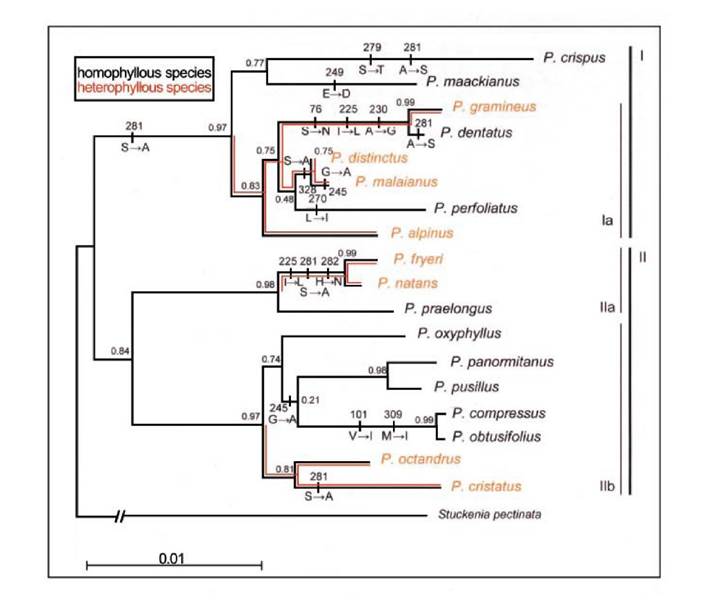
Fig. 1.2.4. Phylogenetic cpDNA tree of the genus Potamogeton, reconstructed based on combined 4394-bp chloroplast DNA sequence data. Numbers indicate branch support (Anisimova, Gascuel, 2006). Amino Acid Substitutions in the RbcL Gene were reconstructed using a codon substitution model (M8). Branches highlighted in orange represent three heterophyllous lineages; branches in black represent homophyllous lineages of Potamogeton species (Iida et al., 2009).

Fig. 1.3.1. General view of leaves in the amphibious heterophyllous plant Sium latifolium (a–c). Submerged leaves are thrice-pinnately dissected (b). Second-order leaves, with petioles submerged in water and blades positioned above water, also exhibit a twice-pinnately dissected shape (c); their segments are larger than those of submerged leaves. Emergent leaves (a–b) are odd-pinnately dissected with oval segments. Material collected in May 2007 (Koncha-Zaspa near Kyiv).
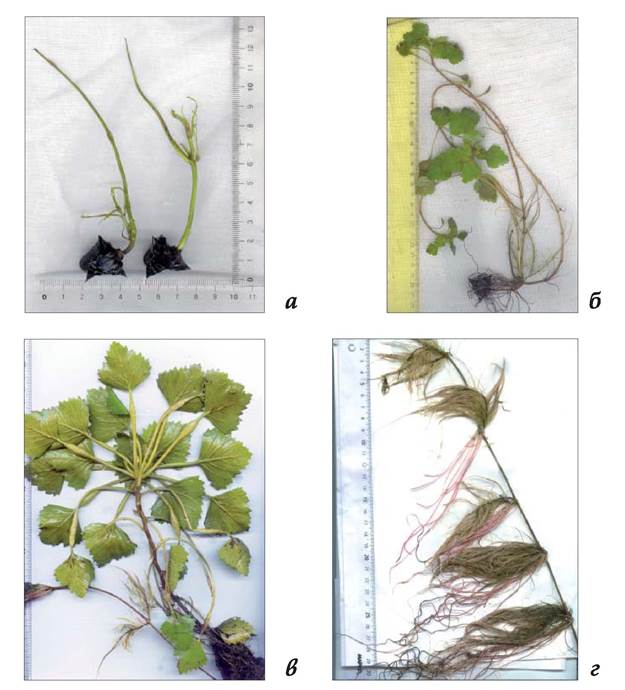
Fig. 1.3.2. Trapa natans is characterized by two forms of submerged leaves [linear (a) and dissected (b–d)] and uniformly triangular floating leaves (b and c). Upon fruit germination, 4–5 linear leaves initially form on the submerged SHOOT (a). When the shoot with its rosette of emergent leaves reaches the water surface, dissected submerged leaves develop on the submerged axis (b, c), which significantly increase in size over time (d). Petioles of floating leaves feature swollen aerated expansions containing air cavities. Submerged linear and dissected (a–d) leaves are green, while adjacent roots are pink (d). Material collected in the Rusanivka Canal, left bank of the Dnipro River (Kyiv area) in May–June 2007–2011.

Fig. 1.3.3. General view of Sagittaria sagittifolia (a, b) and S. filiformis (d). Submerged leaves are linear in shape (b–d); emergent leaves are sagittate (a, b, c), oblong (b, c), and lanceolate (d). Broadleaf arrowhead (Figs. b, c) was collected along the banks of the Psel River near the urban-type settlement of Velyka Bahachka, Poltava Region, in June 2010; (Fig. d — thread-leaf arrowhead, http://ru.wikipedia.org/wiki/).

Fig. 1.3.4. General view of Nuphar lutea. Floating leaves (a–c) are cordate-oval, whereas submerged leaves are rounded (a, b). Material collected in June 2008 on the Psel River near Velyka Bahachka, Poltava Region (Figs. a and b) and in the Rusanivka Canal of the Dnipro River, Kyiv (Fig. c).

Fig. 1.3.5. ABA-induced heterophilly in Marsilea quadrifolia triggered by ABA Treatment (1 mM): a — general view of the plant, b — submerged leaf, c — emergent leaf (Bai-Ling Lin, 2002).

Fig. 1.3.6. General view of leaves in the terrestrial ecoform of Sium latifolium at the vegetative growth stage. The first three leaves have entire blades (a, b), while subsequent ones are pinnately dissected (c). Material collected in May 2007 (Koncha-Zaspa near Kyiv).

Fig. 1.3.8. Sequential series of basal rosette leaves in Pastinaca sativa: 1 — with the first true leaf; 2 — senescing trilobed leaf; 3 — trifoliate leaf with senescing leaflets; 4–6 — trifoliate leaves from different nodes; 7–8 — odd-pinnately compound leaves (Naumov, 2009).
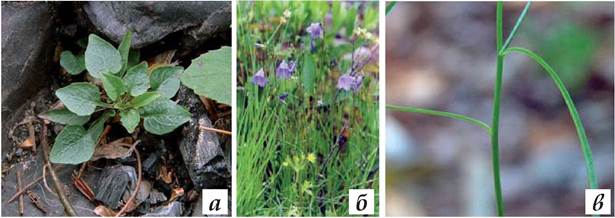
Fig. 1.3.9. General view of Campanula rotundifolia: a — basal leaves acute-ovate; b, c — cauline leaves linear. (Photo source: USDA, US Dept. of Agriculture Natural Resources Conservation Service, www.rook.org/.../campanularot.html)
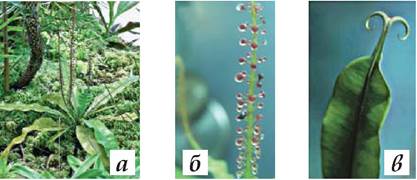
Fig. 1.3.10. General view of the three leaf types in Triphyophyllum peltatum: a — basal lanceolate leaves; b — stem linear, insectivorous leaves with glands; c — stem spatulate leaves with two hook-like appendages at the tip of the blade. (Photo source: http://en.wikipedia. org/wiki/triphyophyllumi http://www.righthealth.com/topic/triphyophyllum)
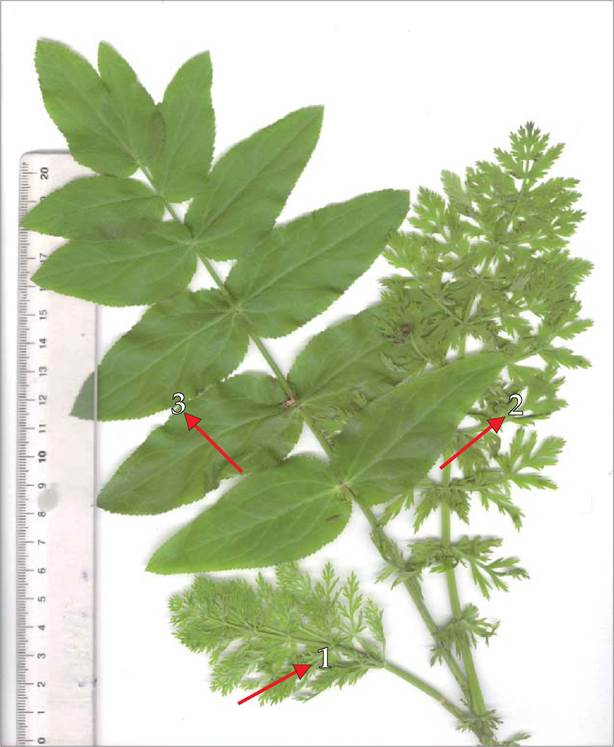
Fig. 1.6.1.1. General view of Sium latifolium leaves: 1 — submerged leaf, 2 — "transitional" leaf, 3 — emerged leaf. Plants collected in May (Koncha-Zaspa near Kyiv)

Fig. 1.6.2.1. Cross-sections of Sagittaria sagittifolia Leaf blades: a–d — emerged sagittate leaf, d, e — emerged oblong leaf; e, f – submerged linear leaf. METABOLISM/14.html">Chloroplasts are indicated by arrows. Material collected on the bank of the Psel River (Velyka Bahachka urban-type settlement, Poltava Region). Abbreviations: Ae — aerenchyma, G — spongy parenchyma, E — epidermis, P — palisade parenchyma, Xl — chloroplast. Scale bar = 100 µm

Fig. 1.6.3.1. Cross-sections of floating (a, d, e) and submerged (b, c) Leaves of Nuphar lutea, budding stage. Figures d and e show enlarged fragments of the floating leaf enclosed in squares in Figure a. Figure c shows an enlarged fragment of the submerged leaf enclosed in a square in Figure b. Water-lily leaves collected on the Psel River (Velyka Bahachka urban-type settlement, Poltava Region). Abbreviations: Ae — aerenchyma, G — spongy parenchyma, E — epidermis, P — palisade parenchyma, FP — photosynthetic parenchyma of submerged leaves. Scale bar = 100 µm

Fig. 1.7.5.3.1. Structure OF THE upper (a, b) and lower (c–f) surfaces of Nuphar lutea floating leaves. Hydropotes are visible in the epidermis (indicated by arrows in figs. d, e) along with unicellular Algae attached to the epidermal cuticle. Scale bar: a, b, c = 10 µm, d, e, f = 50 µm
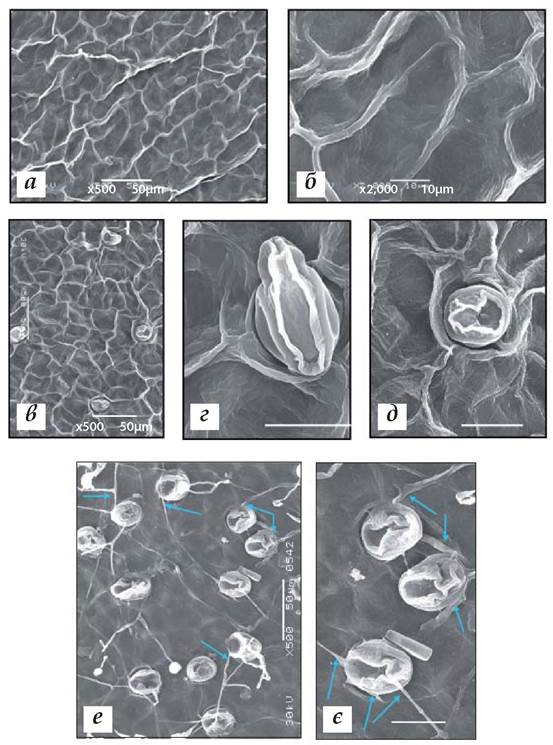
Fig. 1.7.5.3.2. Structure of the upper (a, b) and lower (c–f) surfaces of submerged (benthic) Nuphar lutea leaves. Cup-shaped hydropotes are visible on the lower surface (figs. c–f), interconnected with each other and the main epidermal Cells by tentacle-like cuticular strands (figs. f, g, arrows). Submerged leaves grew at a depth of about 2 meters from the water surface (in the Psel River). June 2008, Psel River near Velyka Bahachka urban-type settlement, Poltava Region. Scale bar: a, c, f = 50 µm; b = 10 µm; d, e, g = 20 µm

Fig. 2.2.2.1. General view of leaves from amphibious (a) and terrestrial (b) Sium latifolium plants. Different blade shapes in amphibious plants: tripinnatisect in submerged and transitional leaves; pinnatisect in emerged leaves (fig. a). Terrestrial plant leaves have two blade shapes (b): the first three leaves have an entire acute-ovate blade, while leaves of subsequent tiers are pinnatisect

Fig. 2.2.2.2. Epidermal (a, b, d, e, g–h) and mesophyll (c, f) cells of leaves from amphibious (a–d, g, h) and terrestrial (e, f) Sium latifolium plants after incubation in Calcofluor white (cf.) solution. The Cellulose+cf. complex fluoresces green, chlorophyll autofluorescence is red; g', h' are fluorescence intensity plots of the cellulose + cf. complex (green curve) and chlorophyll autofluorescence (red curve). The horizontal axis represents the scanned distance (µm) indicated by the white arrow (g, h); the vertical axis represents fluorescence intensity in arbitrary units.
Scale bar = 50 µm

Fig. 2.2.3.1. Mesophyll (a–f) and epidermal (g–i) cells of Sium latifolium leaves after incubation in Fluo-4 solution (Ca2+ + Fluo-4 complex fluoresces green) and DAPI solution (nuclear DNA fluoresces blue); chlorophyll autofluorescence is red. Leaves of amphibious plants: a, b, c, f, g, h — submerged; d, i — emerged. Leaves of terrestrial S. latifolium plants: e — with an entire blade; f, i, j — with a dissected blade; a, b — palisade parenchyma cells, c–f — spongy parenchyma cells; f', j' — fluorescence intensity plots of the Ca2+ + Fluo-4 complex (green line), chlorophyll autofluorescence (red line), and DNA fluorescence (blue line) in mesophyll cells (f') of the submerged amphibious plant leaf and the adaxial epidermal surface (j) of the terrestrial plant leaf. Horizontal axis: scanned distance (µm) indicated by the white arrow in figures f and j; vertical axis: fluorescence intensity of the Ca2+ + Fluo-4 complex in arbitrary units. Scale bar = 50 µm

Fig. 2.2.4.1. Schematic diagram of the expression of genes involved in stem Cell Division and elongation during plant submergence (black indicates the stimulating effect of genes, red indicates the inhibitory effect) (Bailey-Serres, Voesenek, 2008)
Abbreviations of genes inducing the Synthesis of the following Proteins:
CyC2Os — cyclin; CDC2Os — cyclin-dependent kinase; OsACO and RpACO — ACC oxidase; OsACS and RpACO — ACC synthase; OsDD — differentiation protein (Kende et al., 1998); OsAMY — amylase (Fukao et al., 2006); OsEXP, RdEXP, and RpEXP — expansins; OsGRF — growth-regulating factor (Choi et al., 2004); OsRPA — Replication protein A1; OsSBF — sodium-Bile acid symporter family protein (Rzewuski, Sauter, 2002); OsSUB1 — submergence-1 protein; OsTMK — transmembrane protein kinase (Van der Knaap et al., 1999); OsUSP — universal stress protein (Sauter et al., 2002); RpERS1 — Ethylene receptor (Vriezen et al., 1997); RpNCED — 9-cis-epoxycarotenoid dioxygenase; RpGA3ox — gibberellin 3-oxidase (Benschop et al., 2006); OsXTR — xyloglucan endotransglucosylase-related (Darley et al., 2001); OsABA8ox — ABA 8'-hydroxylase (Saika et al., 2007). Designation: Os — Oryza sativa; Rd — Regnellidium diphyllum; and Rp — Rumex palustris or Ranunculus palustris. OsACS1 — synthase, OsACO1 — oxidase in Oryza sativa, RpERS1 — ethylene receptor-synthase (Vriezen et al., 1997) in Ranunculus palustris
Fruit ovoid or oblong, laterally compressed, with thread-like Ribs; fruit ribs narrow. Style free.
Submerged leaves of Trapa natans L. vary in shape: linear and dissected; floating leaves are equilateral triangular (Fig. 1.3.2, see insert III). The first to appear on the sprouting submerged shoot (in April–May) are 4–5 sessile linear leaves (each 20–30 mm long and about 2–2.5 mm wide) with an acute apex and entire margins. When the shoot reaches the water surface (late May–June), the rosette of floating leaves begins to unfold, with their number varying from 9 to 18 per rosette. By this time, the first type of submerged linear leaves begins to wither, and a second type of submerged leaves starts to form on the lower part of the shoot (10–20 mm away from the fruit) — three to five dissected leaves with short petioles; leaf length is 4–6.5 cm, width 2–4.5 cm; the leaf contains 15–47 segments. Floating leaves are equilateral triangular in shape, with a rounded-cuneate base (Fig. 1.3.2, see insert III), acute apex, and dentate margins; the petiole is cylindrical (2–4 cm long, 2–2.5 mm in diameter), featuring a "Swelling" in the middle whose size is 1.5–1.9 times the diameter of the petiole base. The swollen part of the petiole contains well-developed aerenchyma, which allows the leaf to float on the water surface. T. natans is an annual aquatic plant with bundles of filamentous roots that are pale pink (April–May) or light brown (May–September), and a slender branching stem ranging in length (depending on water body depth) from 40 cm to 200 cm or more (Fig. 1.3.2, b). Roots branch out from the stem (Fig. 1.3.2, b, d). In mid-June, the fruit (nut) detaches from the plant.
Floating leaves of Trapa natans have linear or narrowly lanceolate stipules at the base. Flowers are small, bisexual, actinomorphic, with a double perianth, solitary in leaf axils. There are four white petals. The fruit is a drupe with a thin pericarp and a woody shell bearing 2–4 horn-like outgrowths. The starchy seeds of The Water Chestnut contain about 15% protein, 7.5% fat, 52% starch, and 3% sugar; the seeds are edible raw or cooked, and can be ground into groats or flour.
Linear, elongated, or sabre-shaped submerged leaves are typical of most species in the family Alismataceae. For instance, in Sagittaria sagittifolia, the submerged leaves are linear in shape, whereas the blade of the aerial leaves is sagittate and oblong (Fig. 1.3.3, see insert IV). S. sagittifolia is a perennial plant with white flowers and an elongated rhizome that gives rise to numerous roots. S. sagittifolia grows at various depths—ranging from a few dozen centimeters to 1.5 m in muddy substrate.
The submerged leaves of the common arrowhead are sessile, 50–80 cm long, and considerably shorter in shallow water. The width of the submerged leaf blade ranges from 2 to 4 cm or more, and its length also varies depending on the depth at which the plant grows; the venation of the submerged leaves is camptodromous-arcuate. The submerged leaves are light green and emerge after seed germination or develop from buds on the underground shoot. In spring, they grow rapidly but do not reach the water's surface. The dark green emersed leaves, along with their petioles, reach 50 cm or more in length. The blade itself is sagittate, featuring an acute apex and diverging acute basal lobes.
In specimens of the common arrowhead collected along the banks of the Psel River in Poltava Oblast, we identified two forms of leaf blades in the emersed leaves: sagittate and oblong (Fig. 1.3.3, a–c, see insert IV). Plants of this species bore 2–7 emersed leaves with a sagittate blade and one to two leaves with an oblong blade (Fig. 1.3.3, b, c), as well as 5–12 submerged elongated linear leaves. The flowers develop above the water's surface and feature a white perianth, which is dark purple or pink at the base; they are trimerous and arranged in whorls of two or three. Pistillate flowers with short pedicels are located in the lower part of the inflorescence, while staminate flowers with long pedicels are situated above. There are six stamens. The emersed Leaves of Sagittaria filiformis (Fig. 1.3.3, d, see insert IV) are lanceolate, whereas its submerged leaves are linear, similarly to the submerged leaves of S. sagittifolia. In the arrowhead, the aggregate fruit consists of six to eight non-flattened, star-arranged follicles. The receptacle is elongated in fruit. The fruitlets are 6–10 mm long.
A third type of submerged leaf morphology that we distinguished in heterophyllous plants is basal rounded leaves, which occur in species of the family Nymphaeaceae. For example, in Nuphar lutea, the submerged leaves are rounded, plicate along the margins, very thin, and nearly translucent. The floating leaves are cordate-oval (Fig. 1.3.5, see insert V) or ovate-oval, thick, exstipulate, and possess three-sided petioles whose length depends on the plant's growth depth; for submerged leaves, the petiole length is 7–15 cm. The calyx is pentamerous, and the petals are numerous, smaller than the sepals, and yellow. The flowers are 4–5 cm in diameter. In Ukraine, it blooms from June to September. The surface of the fruit is smooth (Key to the Plants of the UkrSSR, 1950).
In addition to the three aforementioned types of submerged leaf morphology, other forms also occur in nature (Fig. 1.3.5, see insert VI). The emersed leaf blades in Marsilea quadrifolia are orbicular, about 10 mm in diameter, and dissected (halfway to the radius) crosswise at an angle of 90o into four lobes with rounded margins (Fig. 1.3.5, a, c). The submerged leaf blades in M. quadrifolia are likewise quadripartite, consisting of four segments (Fig. 1.3.5, a, b) measuring a few millimeters, which extend from a short petiole (0.7–1.5 cm); the margins of the segments are rounded (Bai-Ling Lin, 2002).
Heterophylly in terrestrial plants is species-specific and manifests during ontogeny: during the growth of the vegetative shoot, especially at its early developmental stages, as well as during The formation of the flowering shoot, or when perennial plants produce leaves in different seasons (Satsyperova, 1984; Naumov, 2009; Givnish et al., 1994; Eckenwalder, 1980; Webb, 1984; Christodoulakis, 1989; Christodoulakis et al., 1990). According to early accounts by K. Goebel (Goebel, 1891; 1900), who proposed the term heteroblastic development to describe plant growth, the different leaf shapes in the terrestrial plant Hedera helix appeared in spring: the first juvenile leaves had a pinnate blade, whereas subsequent leaves possessed an entire leaf blade (Goebel, 1990; cited in: Schmidt, Millington, 1968).
We conditionally divided terrestrial heterophyllous plant species into two types based on leaf blade morphology: the first type comprises species in which leaf shape becomes more complex (progressing from an entire blade to a dissected one, etc.) during vegetative shoot formation, or conversely, simplifies during flowering shoot formation; the second type includes species whose basal rosette leaves differ in shape from cauline leaves, i.e., leaves of the subsequent tier. Examples of the first leaf type include the leaf blades of water dropworts: Sium latifolium, S. sisaroideum (Petrova, Barykina, 2005), etc.; examples of the second type include the leaves of Campanula rotundifolia and Triphyophyllum peltatum, which are described below.
In the terrestrial ecotype of Sium latifolium, growing 5–20 m away from the shoreline, leaf blade morphology varies. Plants of this species exhibited heterophylly. The leaves were of two types (Fig. 1.3.6, a–c, see insert VI): entire-bladed (Fig. 1.3.6, a, b) and dissected (Fig. 1.3.6, a, c). The first three leaves with an entire leaf blade were orbicular-ovate and acute-ovate with a cordate base and a crenate margin; the mean dimensions of the long axis of the blade were 2.5 ± 0.3 cm, and of the short axis, 2.0 ± 0.2 cm. Each S. latifolium specimen in May bore three entire leaves and two pinnately dissected ones, the latter consisting of entire oblong-oval leaflets. The pinnately dissected leaves possessed 4–5 pairs of lateral lobes and one terminal lobe with crenate margins; the mean dimensions of the long axis of a lobe were 10 ± 1.2 cm, and of the short axis, 2.9 ± 0.5 cm. The paired leaf lobes are arranged oppositely.
A typical example of leaf blade complexification is found in the leaves of Senecio lautus (Asteraceae), an herbaceous plant growing in rock crevices in New Zealand (Burns, 2005). The first leaves of this species had an entire elongated leaf blade with a short petiole (Fig. 1.3.7; the 8th and 9th leaves from the left); as the plant matured, the shape of the subsequently formed leaves changed dramatically compared to the juvenile leaves, gradually developing an even number of teeth (4 to 10 mm long), while the blade size nearly doubled (Fig. 1.3.7).

Fig. 1.3.7. Leaves of varying shapes collected from a single Senecio lautus plant on the southern coast of Wellington, New Zealand. From left to right: a developmental series progressing from mature dissected leaves to the first acute-ovate juvenile ones (right) (Burns, 2005)
In cultivated or wild-growing plants of Pastinaca sativa, the initiation and Development of the basal rosette proceed similarly to those in Apium graveolens (Naumov, 2009). The lower pairs of leaflets in the basal rosette undergo modifications manifested by these pairs becoming dissected (Fig. 1.3.8; see insert VII). This process is particularly pronounced In the second to fourth pairs of lateral leaflets at the Base of the leaf.
In Campanula rotundifolia, the basal leaves are acute-ovate with a dentate margin (Fig. 1.3.9, a; see insert VII) and long petioles. Rosette leaves are formed in early spring and grow in the shade of surrounding vegetation, whereas in June, linear leaves develop on the stem (Fig. 1.3.9, b, c).
If a plant grows under low light conditions, rounded or cordate leaves will form on the stem instead of elongated ones (Barabanov, 2006).
The tropical African plant Triphyophyllum peltatum is characterized by seasonal heterophylly (Green et al., 1979), which manifests in three leaf types. The first type comprises lanceolate elongated basal rosette leaves measuring 35.5 × 5 cm; such leaves are typical of the juvenile phase of the plant, where the shoot does not exceed 50 cm in height (Fig. 1.3.10, a; see insert VI). When the plant begins to flower, the shoot elongates up to several meters, producing linear glandular insectivorous leaves (the second leaf type) (Fig. 1.3.10, b); these leaves are small, tendril-like (up to 5–8 mm in diameter), often lacking a leaf blade, and utilize glands to digest insects and absorb nutrients after dissolving the prey. The second leaf type may occasionally bear a basal leaf blade. Following flowering, a third leaf type—spatulate cauline leaves with two hooked outgrowths at the tip of the blade (Fig. 1.3.10, c)—is produced on the shoot, enabling the plant to climb tree trunks; the mean dimensions of this third leaf type are 17.8 × 3.7 cm (Green et al., 1979; Albert et al., 1992; Bringmann et al., 2002).
Endemic plants of the genus Cyanea (Campanulaceae: Lobelioideae) growing in deeply shaded habitats on oceanic islands of the Hawaiian archipelago also exhibit heterophylly: the lower leaves are dissected, S-shaped, and spine-like, whereas the upper leaves possess an entire blade (Givnish, 1987; Givnish et al., 1994; Lee et al., 1990). These researchers suggest that the shape of the lower leaves enables them to capture faint sunflecks in the deeply shaded conditions of their habitat. Examining heterophylly across 55 species of the genus Cyanea, the authors established that this phenomenon is characteristic of 18 species that undergo a juvenile hook-leaf stage only on certain islands of the archipelago. According to these authors, heterophylly in oceanic island endemics evolved as a defense mechanism (the formation of spine-like leaves) against mechanical damage by herbivores (Givnish, 1987; Givnish et al., 1994).
Last update: 07/08/2026
Editorial and Educational Adaptation: This material has been compiled based on the primary/original source text. The project team performed an editorial review, corrected technical inaccuracies, structured sections, and adapted the content for an educational format.
What was processed:
- elimination of formatting defects (OCR errors, structural breaks, corrupted characters);
- editorial organization of content;
- standardization of terminology in accordance with academic sources;
- verification of factual statements against the original source text.
All mentions of the author, publication year, and origin of the primary text have been preserved in accordance with the source.