Human Anatomy Part 1 - K. A. Dyubenko, A. K. Kolomiytsev, Yu. B. Chaykovsky 2002
Special Part
Thoracic Skeleton, sceleton thoracis
Ribs
The Skeleton of the Thorax includes the ribs, Sternum, and thoracic vertebrae.
The ribs, costae [I—XII] (Fig. 32), are narrow bone plates of varying length, symmetrically located on both sides of the thoracic Vertebral Column. Each rib consists of a longer bony part, os costae, and a shorter cartilaginous part—the costal Cartilage, cartilago costalis—as well as two ends: an anterior (sternal) and a posterior (vertebral).
The bony part of the rib features a HEAD, caput costae, a neck, collum costae, and a body, corpus costae. The head is thickened and presents the articular surface of the head of the rib, facies articularis capitis costae. On ribs II—X, this surface is divided into two parts by a horizontally oriented crest of the head, crista capitis costae.
The neck of the rib, collum costae, is its narrowest part, featuring the crest of the neck of the rib, crista colli costae, along its upper margin. At the junction with the body, the ten upper ribs have a small tubercle of the rib, tuberculum costae, bearing the articular surface of the tubercle, facies articularis tuberculi costae, for articulation with the transverse costal facet of the corresponding vertebra.
The body of the rib, corpus costae, lying between the costal tubercle and the sternal end, is the longest section of the bony part. At a certain distance from the tubercle, the body bends to form the angle of the rib, angulus costae, which coincides with the tubercle only on the 1st rib. The 12th rib does not form an angle. Each rib has internal and external surfaces, as well as two borders—upper and lower. Along the lower border on the internal surface runs the costal groove, sulcus costae, which houses Vessels and nerves.
Costal cartilages are direct continuations of the bony PARTS OF THE ribs. The first seven ribs, known as true ribs, costae verae [I—VII], attach directly to the sternum via their costal cartilages. The eighth, ninth, and tenth ribs are called false ribs, costae spuriae [VIII—X], while the eleventh and twelfth are termed floating ribs, costae fluctuantes. The cartilaginous ends of ribs VIII—X do not reach the sternum directly; instead, each attaches to the cartilage of the rib immediately above it. The cartilages of the 11th and 12th ribs end freely in the abdominal wall musculature.
Class="center">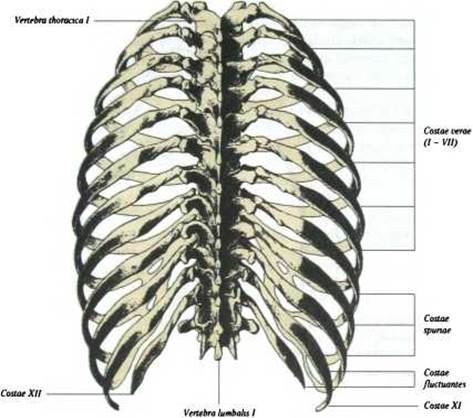
Fig. 32. Ribs, costae
Last update: 08/08/2026
Editorial and Educational Adaptation: This material has been compiled based on the primary/original source text. The project team performed an editorial review, corrected technical inaccuracies, structured sections, and adapted the content for an educational format.
What was processed:
- elimination of formatting defects (OCR errors, structural breaks, corrupted characters);
- editorial organization of content;
- standardization of terminology in accordance with academic sources;
- verification of factual statements against the original source text.
All mentions of the author, publication year, and origin of the primary text have been preserved in accordance with the source.