BOTANY WITH BASICS OF HYDROBOTANY (AQUATIC PLANTS OF UKRAINE) - B.Ye. Yakubenko - 2011
X. SEED PLANTS
Water-chestnut Family (Trapaceae)
Annual aquatic herbaceous plants with flexible stems floating in the Water and anchored to the bottom by brownish, thread-like roots. Heterophylly is characteristic: thread-like leaves appear first and fall off early; subsequently, long, Hair-like divided photosynthetic Organs develop on both sides of the leaf cushions. Due to varying petiole lengths, the leaves form a leaf mosaic. Flowers are small, solitary, axillary, tetramerous, with a double perianth. The calyx is cup-shaped, deeply four-cleft, its lobes arranged in pairs in two whorls; after flowering, they transform into prickles that persist near the fruits. Petals are free, white, occasionally pinkish, translucent, longer than the sepals, and up to 8-10 mm in diameter. The Ovary is bilocular. The fruit is a single-seeded, drupe-like nut with a stony endocarp that forms a hard shell bearing two or four horns—outgrowths of the endocarp. The embryo has unequal cotyledons: one is large and fleshy, while the other is scale-like.
This is a monotypic family comprising a single genus, the water chestnut, which includes 25 species growing in waters almost worldwide. There are 9 known species of water chestnut in Ukraine.
Water chestnut (Trapa natans L.). An annual plant rooted to the bottom; an aquatic therophyte, aerohydatophyte, heliophyte, entomophil, autogamy, barochore, hydrochore, zoochore (Fig. 139). Roots are of two types: thread-like, brownish to dark violet, serving an anchoring function, and adventitious, aquatic, hair-like, pinnately branched, pale green, emerging from the axils of two decayed primary leaves. The stem is slender, flexible, sometimes extremely long—60-120 cm (occasionally 400-800 cm) depending on depth—and branched. Leaves, 20-30 in number, are gathered at the SHOOT apex into a floating rosette 15-50 cm in diameter. Submerged leaves are linear or thread-like, opposite, and drop off quickly. Floating leaves have petioles of varying lengths ranging from 3 to 10 (20) cm, with a cylindrical or longitudinally elliptical Swelling near the leaf blade.
Class="center">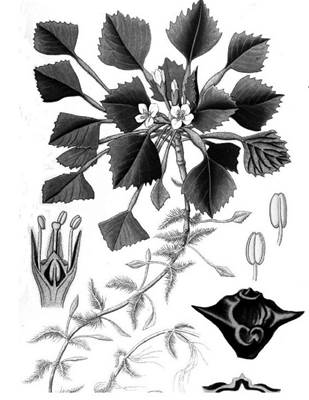
Fig. 139 Water chestnut (Trapa natans)
The petioles in their middle section are filled with an aerenchyma tissue, serving as floats for the rosette apparatus. In addition to keeping the plant on the water surface, they also regulate its position in the upper water layer. At night, before rain, or in autumn, the rosettes submerge their central part by 2-3 cm into the water, whereas during the day under optimal Temperature conditions they float back to the surface. The leaf blades of the floating leaves resemble birch leaves in size and shape; they are broadly rhombic, coarsely dentate, 3-4 cm long, 4-4.5 cm wide, sharply toothed at the apex, pubescent along the Veins underneath, and arranged in a mosaic. Flowers are small, solitary, axillary, bisexual, and tetramerous. Pedicels are short and slender, covered with upward-directed, semi-appressed hairs. The perianth is double. Sepals persist near the fruits and grow into horn-like structures. Petals are white-pink, 5-10 mm long.
There are four stamens and a single pistil with a bilocular semi-inferior ovary, a slender cylindrical style, and a capitate stigma. Floral formula: *K4C4A4G(2). It blooms on the water surface in May-June. Self-pollination predominates—sometimes flowers do not open at all—while insect pollination occurs less frequently. Following pollination, the flowers submerge, and fruit maturation takes place underwater. The fruit is nut-like, single-seeded, large, about 2.5 cm long and 3-4 cm wide, with a well-defined crown 6-10 mm in diameter, nearly black in color, indistinctly ribbed or entirely smooth without ridges or prominent sculptural projections. It reproduces by seeds. Under Ukrainian climatic conditions, a single rosette produces 10-12 (20) fruits per growing season, of which only 5-8 mature fully, while the rest fail to do so due to early frosts. The plant remains anchored to the substrate by the previous year's nut. When the water level rises, the water chestnut may detach from the bottom and drift considerable distances, rooting once it reaches a suitable water depth. Seed germination requires a dormancy period of 4-6 months, followed by a sufficiently high water temperature (not below 10-12°C). The first rosettes appear in early June. The most active leaf development, formation of lateral rosettes, and bud production begin when the water temperature reaches 20°C, with mass flowering occurring at 20-23°C. Most of the fruits that drop to the bottom of the water body germinate the following spring, while others do so after one to two years. Fruits maintain viability for up to three years provided a permanent water layer is present. Optimal germination requires light. In the event of desiccation and exposure to low temperatures (8-10°C and below), the fruits lose their germination capacity.
The species exhibits considerable Variability. This is primarily facilitated by the isolation of formerly widespread habitats, rapidly accelerating environmental changes, and alterations in The chemical composition of the water. Consequently, depending on overall plant variations, leaf shapes, and particularly the shape and Structure OF THE fruits, several taxa at the species rank are distinguished, along with A large number of subspecies, varieties, and forms.
It grows in freshwater, eutrophic, closed or sluggishly flowing water bodies with temporary or permanent connections to river channels, in areas where water levels fluctuate between 5-10 and 300-400 cm during the growing season; in lakes, bays, river channels, shallow reservoir areas, streams, and marshy water bodies. It does not grow in fast-flowing waters. Optimal conditions include: a water depth of 0.5 to 1.5 m, and a neutral to slightly acidic water reaction. At pH 3.0-4.0 or above 9.8, the species disappears. It reacts negatively to water salinity; at a 0.1% salt content, particularly NaCl, populations thin out and vanish. It vegetates under conditions of reduced dissolved oxygen and elevated concentrations of carbon dioxide and hydrogen sulfide. Mild anthropogenic eutrophication of water bodies stimulates its development. It is distributed in Transcarpathia, Roztochchia-Opillia, and Western Polissia. It is a rare species, protected, and listed in the Red Data Book of Ukraine.
An indicator of eutrophic, closed, or sluggishly flowing water bodies with fluctuating water levels and a muddy-sandy bottom covered by a significant layer of sapropel.
The plant has fodder, fishery, food (groats and flour are produced from dried and crushed seeds), medicinal, dyeing, ornamental, and water-conservation significance. It serves as food for freshwater shrimp, leaf beetles, dipteran insects (including mosquitoes), wax moth caterpillars, cyprinid Fishes, geese, ducks, beavers, and nutrias.
It is promising for Introduction into cultivation and acts as a pioneer plant in the overgrowth of oxbow lakes. It forms a dense cover of rosettes that isolates the underlying water layer and facilitates The transfer of iron and phosphate compounds from bottom sediments into the water. During the summer period, its communities create functional heterogeneity in aquatic ecosystems. Excessive proliferation in streams exerts a negative impact on fish populations. Effective Methods for managing water chestnut populations include mowing or the introduction of herbivorous fish.
Last update: 07/08/2026
Editorial and Educational Adaptation: This material has been compiled based on the primary/original source text. The project team performed an editorial review, corrected technical inaccuracies, structured sections, and adapted the content for an educational format.
What was processed:
- elimination of formatting defects (OCR errors, structural breaks, corrupted characters);
- editorial organization of content;
- standardization of terminology in accordance with academic sources;
- verification of factual statements against the original source text.
All mentions of the author, publication year, and origin of the primary text have been preserved in accordance with the source.