Biochemistry - Chemical Reactions in Living Cells, Volume 1 - D. Metzler 1980
The Site of Action
Multicellular Organisms
Diversity of Animal Forms
In this section, we do not intend to describe the full diversity of Multicellular animals (Metazoa) and plants (Metaphyta), but rather to focus on certain aspects of particular interest to biochemistry.
Until recently, the attention of biochemists was focused primarily on higher vertebrates. However, a growing interest is now directed toward A wide variety of lower forms. The simplest of these are tiny symbiotic1 worm-like animals belonging to the phylum Mesozoa, which inhabit the Kidneys of deep-Water cephalopods [41]. They consist of just 25 Cells arranged in a single layer surrounding one or more axial cells (Fig. 1-10). It would be of great interest to investigate The Nature of chemical communication among this small number of cells.
Sponges (Porifera) are the most primitive multicellular animals. They lack tissue differentiation, yet possess several specialized Cell types. The sponge body is formed by stationary cells that draw in water through pores and extract necessary nutrients. Within the sponge body, amoebocytes function cooperatively to form spicules composed of calcium carbonate, silicon dioxide, or the protein spongin (Fig. 1-10). Nervous system elements appear to be absent in sponges.
The Cnidarians (Cnidaria, formerly known as Coelenterata) constitute another highly diverse and important animal phylum. These organisms exhibit radial Symmetry and consist of two distinct cell layers—the ectoderm and the endoderm. Many species exist simultaneously in both polyp or hydra forms (Fig. 1-10) and medusa forms. As far as is known, medusae lack a cerebral ganglion, but the way in which Neurons connect to form a primitive radial net is of undeniable interest.
1 Members of the phylum Mesozoa are generally considered parasites, but they appear to facilitate the elimination of NH3 from the host Organism by increasing urine acidity [40a]. Some biologists view Mesozoa as a subkingdom rather than a phylum.
Class="center">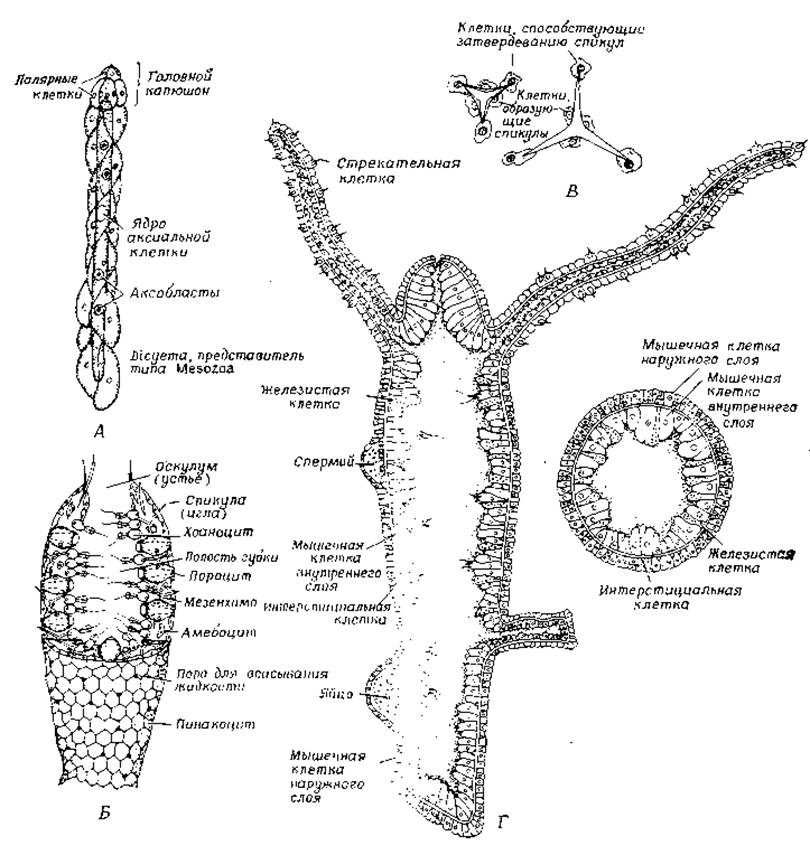
FIG. 1-10. Some lower forms of multicellular animals. A. Phylum Mesozoa (25 cells). (Hickman C. P., Biology of Invertebrates, Mosby, St. Louis, Missouri, 1973.) B. Small sac-like sponge. (Villee C. A., Walker W. E., Barnes R. D., General Zoology, Saunders, Philadelphia, Pennsylvania, 1973.) C. Amoeboid cells of a spicule-forming sponge. (Hickman, 1967.) D. Hydra. (Loomis M. F., Sci. Am., 200, 150. Apr. 1959.)
Cnidarians are exceptionally simple in Structure and possess a remarkable capacity for regeneration. One of the primary subjects of biological research is the freshwater hydra, an organism about a centimeter in length (Fig. 1-10). An entire hydra, consisting of approximately 105 cells, can regenerate from a tiny piece of tissue as long as it retains cells from both the outer and inner layers [42].
The body of Flatworms (phylum Platyhelminthes) consists of two outer layers (endoderm and ectoderm) and a third layer situated between them. Flatworms have a distinct excretory system. In addition to a nerve net resembling that of cnidarians, they possess a cerebral ganglion and visual Organs. Planarians—a large group of flatworms typically about 15 mm long—inhabit streams. They appear to be among the simplest creatures suitable for behavioral studies.

FIG. 1-10. E. Medusa stage of the hydroid coelenterate Obelia. F. Planarian, 15 mm long. (Hickman, 1973.) a — diagram of the digestive and nervous systems; part of the right side of the body is removed to reveal the Mouth located on the ventral side; b — Pharynx protruding from the mouth. G. Rotifer Philodina (~103 cells). (Villee C. A. et al., General Zoology, 1973.) H. Roundworm Rhabditis. Ascaris has a similar appearance (Hickman, 1973).
Among flatworms, There are many parasitic forms (trematodes and tapeworms) that affect higher organisms. For instance, tiny worms of the genus Schistosoma are transmitted to humans via snails and damage Blood Vessels. The resulting Schistosomiasis is currently one of the most widespread diseases, afflicting over 200 million people.
Roundworms (Nematoda) and rotifers (Rotifera) are sometimes classified into separate phyla or occasionally grouped into a single phylum, Aschelminthes. These organisms are distinguished by the presence of a body cavity in addition to the digestive tract. Roundworms include both free-living aquatic and soil-dwelling species, as well as parasites. The latter cause immense damage to plants, while certain species—such as trichina worms, tapeworms, and guinea worms—infect humans.
Rotifers, with their beating crown of cilia on the HEAD and transparent bodies, are a true delight for microscopists.
For cell biologists, rotifers are especially interesting due to their cellular constancy: it has been demonstrated that in these organisms both the total number of cells and the number of cells in each body part are strictly constant.
Annelids (segmented worms) are considered the evolutionary ancestors of Arthropods. Extant species of this phylum include earthworms, leeches, and approximately 106 species of marine polychaetes (bristle worms). Annelids possess a body cavity separated from the digestive tract and lined with a specialized layer of epithelial cells. They also feature a well-developed Circulatory system, with blood typically containing Hemoglobin or a related compound, erythrocrruorin.
Arthropods (Arthropoda) comprise ~106 species, accounting for about 80% of all currently known animals. These creatures, possessing a segmented exoskeleton made of Chitin or other substances, include horseshoe crabs, arachnids (scorpions, spiders, mites), crustaceans, myriapods (centipedes and millipedes), and insects. A number of significant biochemical problems in this field arose with the invention and application of insecticides. The Study of metamorphosis during The Development of many arthropods is also of great interest [43].
Among Mollusks (phylum Mollusca), cephalopods—squids and octopuses—are of the greatest interest to biochemists. Squids possess Nerve Cells (neurons) with a giant axon, the study of which has made a major contribution to our understanding of The Mechanism of Nerve Impulse Conduction. Octopuses exhibit rudimentary intelligent behavior, which is absent in other invertebrates whose neural responses are entirely "hardwired". The Brain of certain gastropods consists of only 104 neurons, some of which are exceptionally large. Mollusk brains are the subject of intensive research aimed at understanding their Organization and functional mechanisms.
Echinodermata, which include starfish, sea urchins, and sea cucumbers, are regarded as a phylum of animals that have reached a high level of evolutionary development1. Their Embryogenesis has been studied with particular thoroughness.
The phylum Chordata, to which you and I belong, includes not only vertebrates but also more primitive marine animals. These primitive forms, which appear to be related to the extinct common ancestor of Chordates, include tunicates (Tunicata), specifically sea squirts. These organisms are remarkable for the high vanadium content in their blood.
1 Adult Echinoderms are characterized by five-fold radial symmetry, which might suggest a relationship to primitive cnidarians. However, echinoderm larvae exhibit bilateral symmetry, and therefore the radial body ORGANIZATION OF THE adult forms should not be considered of fundamental phylogenetic significance.
Last update: 06/08/2026
Editorial and Educational Adaptation: This material has been compiled based on the primary/original source text. The project team performed an editorial review, corrected technical inaccuracies, structured sections, and adapted the content for an educational format.
What was processed:
- elimination of formatting defects (OCR errors, structural breaks, corrupted characters);
- editorial organization of content;
- standardization of terminology in accordance with academic sources;
- verification of factual statements against the original source text.
All mentions of the author, publication year, and origin of the primary text have been preserved in accordance with the source.