LEHNINGER PRINCIPLES OF BIOCHEMISTRY - VOL 2. BIOENERGETICS AND METABOLISM - 2014
PART II. BIOENERGETICS AND METABOLISM
18. AMINO ACID OXIDATION AND THE PRODUCTION OF UREA
Questions and Problems
1. Products of AMINO ACID Transamination.
Name and draw The Structure of the α-keto acid formed by the transamination of α-ketoglutarate with each of the following Amino Acids: (a) aspartate, (b) glutamate, (c) Alanine, (d) phenylalanine.
2. Measurement of alanine aminotransferase activity.
To measure The activity of alanine aminotransferase (the reaction rate), an excess of Lactate dehydrogenase and NADH is typically added to the reaction mixture. The rate of alanine depletion is equal to the rate of NADH consumption, which is determined spectrophotometrically. Explain the principle underlying this assay method.
3. Alanine and glutamine in the Blood.
Under normal conditions, human Blood Plasma contains all the amino acids required for Protein Synthesis, but at varying concentrations. The concentrations of alanine and glutamine are significantly higher than those of all Other Amino Acids. Why do you think this is?
4. Distribution of amino group nitrogen.
If your diet contains a large excess of alanine but is deficient in aspartate, will you exhibit symptoms of aspartate deficiency? Explain.
5. Lactate versus alanine as metabolic fuel: the cost of nitrogen disposal.
The three carbons of lactate and alanine share the same oxidation state, and animals can utilize their carbon skeletons as metabolic fuel. Compare the ATP yield (moles of ATP per mole of substrate) resulting from the complete oxidation (to CO2 and H2O) of lactate and alanine, taking into account the "cost" of nitrogen disposal.
Class="center">
6. Ammonium toxicity caused by dietary Arginine deficiency.
In a study conducted several years ago, cats were fasted overnight and then fed a meal containing all Essential Amino Acids except arginine. Within two hours, the blood ammonium level in the cats rose from a normal value of 18 µg/dL to 140 µg/dL, accompanied by severe symptoms of ammonia intoxication. In a control group fed a complete amino acid mixture or an amino acid mixture lacking arginine but supplemented with Ornithine, no abnormal symptoms were observed.
a) What was the purpose of the fasting period in the experiment?
b) What caused the increase in ammonium levels in the experimental group? Why does the absence of arginine lead to ammonia toxicity? Is arginine an essential amino acid for cats? Why?
c) Why can ornithine substitute for arginine?
7. Oxidation of glutamate.
Write out the sequential reactions (with stoichiometric coefficients) and the overall balanced equation for The oxidation of 2 mol of glutamate to 2 mol of α-ketoglutarate and 1 mol of urea.
8. Transamination and The Urea Cycle.
The activity of aspartate aminotransferase is higher than that of any other aminotransferase in mammalian Liver. Why?
9. Argument against the liquid protein diet.
A weight-loss diet intensely promoted several years ago consisted of daily consumption of a "liquid protein" (a "brew" of hydrolyzed gelatin), Water, and a multivitamin Supplement. All other foods and beverages were excluded. On this diet, a person typically lost 4.5–6 kg During the first week.
a) Opponents argued that its effectiveness was largely due to water loss, and the weight would rapidly return upon resuming a normal diet. What is the biochemical basis for this argument?
b) Several individuals following this diet died. What are the hazards of such a diet, and how can it lead to death?
10. Ketogenic Amino Acids.
Which Amino acids are strictly ketogenic?
11. Genetic Defects in Amino acid METABOLISM: A Historical Example.
A two-year-old child was brought to the hospital. His mother reported that the child suffered from frequent vomiting, especially after feeding. The child's weight and physical development were below normal. His Hair showed white patches, although it was predominantly dark. A urine sample treated with iron(III) chloride (FeCl3) turned green in the presence of phenylpyruvate. The results of the urine analyses are presented in the table.
Substance |
Concentration (mM) |
|
Patient's urine |
Normal urine |
|
Phenylalanine |
7.0 |
0.01 |
Phenylpyruvate |
4.8 |
0 |
Phenyllactate |
10.3 |
0 |
a) Deduce which enzyme is likely defective in this child. Propose a Treatment.
b) Why does phenylalanine appear in the urine in such large amounts?
c) What are the sources of phenylpyruvate and phenyllactate? Why is this pathway (normally inactive) stimulated when phenylalanine concentrations rise?
d) Why are there white patches in the child's hair?
12. The Role of Cobalamin in Amino Acid Catabolism.
Pernicious anemia is caused by impaired absorption of vitamin B12. What effect does this have on amino acid catabolism? Is the effect the same for all amino acids? (Hint: See Box 17-2.)
13. Vegetarianism.
A vegetarian diet provides a high intake of antioxidants as well as a lipid profile that helps prevent cardiovascular disease. However, it also presents certain challenges. Blood samples were collected from a large cohort of volunteers consisting of vegans (who follow a strict vegetarian diet completely devoid of animal products), lactovegetarians (vegetarians who consume dairy products), and control subjects whose regular diet includes various foods, including meat. Individuals in each group had maintained their respective diets for several years. Elevated levels of homocysteine and methylmalonate were found in the blood of vegans, slightly lower levels in lactovegetarians, and significantly lower levels in omnivores. Explain this observation.
14. Pernicious Anemia.
Vitamin B12 deficiency can occur in several rare Genetic Disorders where the vitamin level is depleted despite a normal dietary intake containing meat and dairy products. This condition cannot be cured by vitamin B12 supplementation. Explain why.
15. Mechanism of Pyridoxal phosphate-Dependent Reactions.
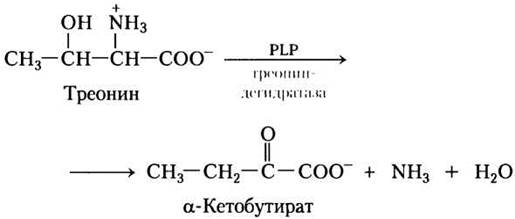
Threonine is cleaved by Threonine dehydratase, which catalyzes The conversion of threonine to α-ketobutyrate and ammonia. This enzyme uses Pyridoxal phosphate as a cofactor. Based on the mechanism shown in Figure 18-6, propose a mechanism for this reaction. Note that this reaction involves the removal of a β-carbon atom from the threonine molecule.
16. Fate of Carbon and Nitrogen in Glutamine Metabolism.
When [2-14C,15N]glutamate undergoes oxidative degradation in rat liver, in which metabolites will each of the isotopes be found: (a) urea, (b) succinate, (c) arginine, (d) citrulline, (e) ornithine, (f) aspartate?

17. Chemical Strategy of Isoleucine Catabolism.
Isoleucine is degraded in six steps to propionyl-CoA and acetyl-CoA:
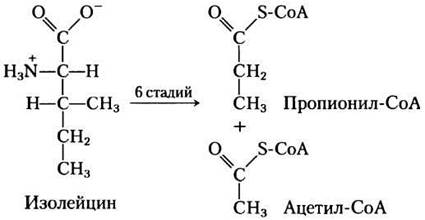
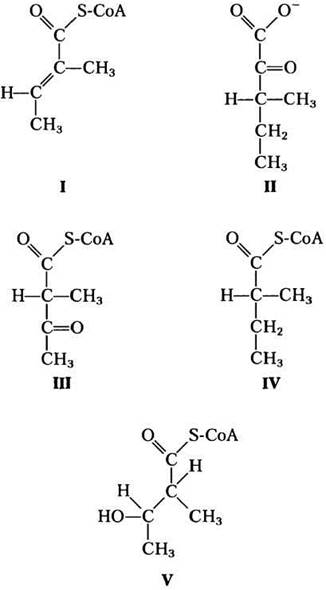
a) The chemistry of isoleucine degradation involves strategies similar to those used in The Citric Acid Cycle and fatty acid β-oxidation. The degradation intermediates of isoleucine (from I to V) are shown below out of order. Drawing on your knowledge and understanding of The Citric Acid cycle and the β-oxidation pathway, arrange these intermediates in the metabolic sequence corresponding to isoleucine degradation.
b) For each proposed step, describe the chemical process, provide an analogous reaction from the citric acid cycle or fatty acid β-oxidation (where applicable), and indicate the required Cofactors.
18. The role of pyridoxal phosphate in Glycine metabolism.
The enzyme Serine hydroxymethyltransferase uses pyridoxal phosphate as a cofactor. Propose a mechanism for the reaction catalyzed by this enzyme in the direction of serine degradation (glycine formation). (Hint: See Figs. 18-19 and 18-20, b.)
19. Parallel PATHWAYS OF AMINO acid and fatty acid degradation.
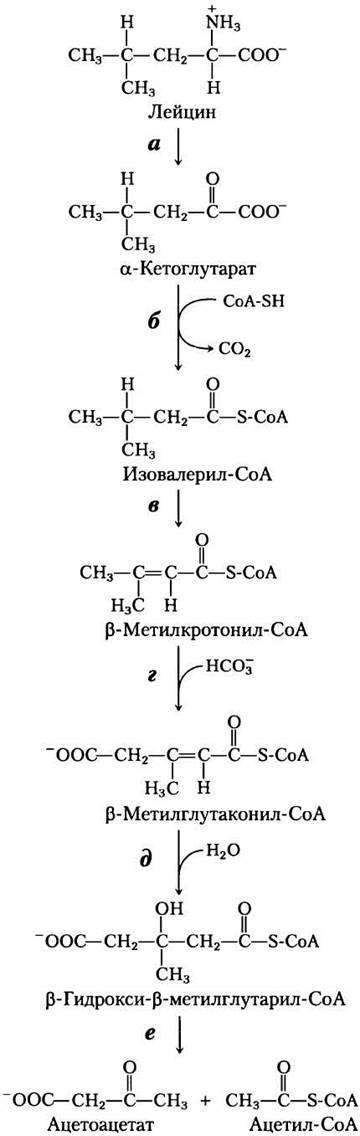
The carbon Skeleton of leucine is degraded via a series of reactions analogous to certain steps in the citric acid cycle and β-oxidation. For each reaction from (a) to (f), specify the reaction type, provide a similar reaction from the citric acid cycle or the β-oxidation pathway (where applicable), and indicate the required cofactors.
Analysis of Experimental Data
20. Maple syrup urine disease.
Figure 18-28 illustrates the degradation pathway of branched-chain amino acids, highlighting the site of the biochemical defect that leads to maple syrup urine disease. The initial observations that ultimately led to elucidating The Nature of this disorder were published in three papers in the late 1950s and early 1960s. This problem is based on The history of discovering the biochemical mechanism of the disease, starting from the earliest investigations.
Menkes, Hurst, and Craig (1954) reported cases of death in the same family of four newborns, all of whom exhibited identical symptoms of a then-unknown disease. In all cases, Pregnancy and Childbirth were normal. No problems were detected during the first 3 to 5 days of life either. Soon afterward, however, the infants developed convulsions and died between 11 days and 3 months of age. Autopsy revealed severe Brain edema. Starting from the third day of life, the urine of these infants had a strong and unusual "maple syrup" odor.
Menkes (1959) reported on another six children who showed the same symptoms as those described in the first paper. All children died between 15 days and 20 months of age. Menkes managed to obtain a urine sample from one of the children during the last month of life. Treatment of the urine with 2,4-dinitrophenylhydrazine, which forms colored precipitates with carbonyl compounds, revealed that three α-keto acids were present in very high amounts:
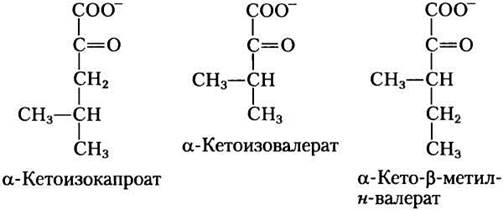
a) These α-keto acids are formed As a result of AMINO ACID DEAMINATION. Indicate from which amino acid each of the α-keto acids shown above is derived.
Urine (mg/24 h) |
Blood plasma |
(mg/mL) |
|||
Amino acids |
Normal |
Patient |
Normal |
Patient |
|
March 1956 |
January 1957 |
January 1957 |
|||
Alanine |
5-15 |
0.2 |
0.4 |
3.0-4.8 |
0.6 |
Arginine |
1.5-3 |
0.3 |
0.7 |
0.8-1.4 |
0.8 |
Asparagine and glutamine |
5-15 |
0.4 |
0 |
3.0-5.0 |
2.0 |
Aspartic acid |
1-2 |
0.2 |
1.5 |
0.1-0.2 |
0.04 |
Valine |
2-4 |
1.6 |
15.4 |
2.0-3.0 |
3.1 |
8-15 |
0.3 |
4.7 |
1.0-1.7 |
0.7 |
|
Glycine |
20-40 |
4.6 |
20.7 |
1.0-2.0 |
1.5 |
Glutamic acid |
1.5-3 |
0.7 |
1.6 |
1.0-1.5 |
0.9 |
Isoleucine |
2-5 |
2.0 |
13.5 |
0.8-1.5 |
2.2 |
Leucine |
3-8 |
2.7 |
39.4 |
1.7-2.4 |
14.5 |
2-12 |
1.6 |
4.3 |
1.5-2.7 |
1.1 |
|
2-5 |
1.4 |
1.4 |
0.3-0.6 |
2.7 |
|
Ornithine |
1-2 |
0 |
1.3 |
0.6-0.8 |
0.5 |
2-4 |
0.5 |
0.3 |
1.5-3.0 |
0.9 |
|
Serine |
5-15 |
1.2 |
0 |
1.3-2.2 |
0.9 |
Taurine |
1-10 |
0.2 |
18.7 |
0.9-1.8 |
0.4 |
4-8 |
0.3 |
3.7 |
1.5-2.3 |
0.7 |
|
Threonine |
5-10 |
0.6 |
0 |
1.2-1.6 |
0.3 |
3-8 |
0.9 |
2.3 |
not measured |
0 |
|
Phenylalanine |
2-4 |
0.4 |
2.6 |
1.0-1.7 |
0.8 |
2-4 |
0.5 |
0.3 |
1.0-1.5 |
0 |
|
Dancis, Levitz, and Westall (1960), reviewing additional data, proposed a biochemical mechanism for this disorder (see Fig. 18-28). They monitored the progression of the disease in an infant whose urine first developed the maple syrup odor at 4 months of age. At 10 months of age (March 1956), the child was hospitalized with a high fever and exhibited severe motor retardation. At 20 months of age (January 1957), the child was hospitalized again with neurological symptoms previously observed in patients with maple syrup urine disease, and died shortly thereafter. The results of urine and blood analyses are presented in the table.
b) The table lists taurine, an amino acid that is not typically found in Proteins. Taurine is often a byproduct of Cell damage. Its formula is shown below:
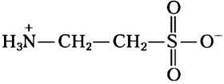
Based on the molecular structure of taurine and the information presented in this chapter, suggest which amino acid is most likely its precursor. Explain your reasoning.
c) Which amino acids were present at particularly high concentrations in the patient's blood in January 1957 (compared to normal values)? Which amino acids were present in the urine at particularly high concentrations?
Based on their findings and knowledge of the metabolic pathway shown in Fig. 18-28, Dancis and co-workers concluded: "The authors consider it most likely that the primary metabolic block occurs in the degradation pathway of branched-chain amino acids, although this cannot yet be considered conclusively proven."
d) How do the data presented here support this Conclusion?
d) Which of the results presented here are inconsistent with the proposed model for maple syrup urine disease? How can this apparent contradiction be explained?
e) What additional data could further substantiate the conclusion drawn?
Last update: 06/08/2026
Editorial and Educational Adaptation: This material has been compiled based on the primary/original source text. The project team performed an editorial review, corrected technical inaccuracies, structured sections, and adapted the content for an educational format.
What was processed:
- elimination of formatting defects (OCR errors, structural breaks, corrupted characters);
- editorial organization of content;
- standardization of terminology in accordance with academic sources;
- verification of factual statements against the original source text.
All mentions of the author, publication year, and origin of the primary text have been preserved in accordance with the source.