Biological Chemistry - Berezov T. T., Korovkin B. F. 1998
Protein Chemistry
Natural Peptides
In recent years, there has been a significant surge of interest in the Structure AND Functions of low-molecular-weight Peptides found in a free state within the Organism, which perform a range of specific biological functions. Short peptides containing up to 10 Amino Acids are generally referred to as oligopeptides; meanwhile, Polypeptides and Proteins are often considered interchangeable terms, although "polypeptides" is more frequently used to designate products with a Molecular Weight of less than 10,000. Some bioactive peptides contain unusual amino acids not found in natural proteins, or derivatives of standard amino acids (such as Hormones and Antibiotics). The hypothesis that peptides might act as intermediates in METABOLISM/35.html">Protein Biosynthesis was disproven; as shown in Chapter 14, this process occurs de novo via a template mechanism in all Cells across All living organisms.
Natural peptides endowed with biological activity are conventionally divided into 4 groups based on their mode of action and origin: 1) peptides exhibiting hormonal activity (vasopressin, oxytocin, corticotropin, Glucagon, Calcitonin, melanocyte-stimulating hormone, hypothalamic releasing factors, etc.; see Chapter 8); 2) peptides involved in Digestion (specifically, gastrin and secretin; see Chapter 12); 3) peptides derived from the a2-globulin fraction of Blood serum (such as angiotensin, bradykinin, and kallidin); and 4) Neuropeptides.
Recently, certain regulatory patterns governing the synthesis of physiologically active peptides from biologically inert protein precursors have been elucidated through a process known as post-translational modification (post-synthetic transformations of the protein molecule). It is known, for instance, that angiotensins (which are octapeptides) exert a pronounced vasoconstrictor effect and are generated from the inactive blood serum protein angiotensinogen via the sequential action of several Proteolytic Enzymes (renin and a specific enzyme involved in converting inactive angiotensin I into active angiotensin II).
Class="center">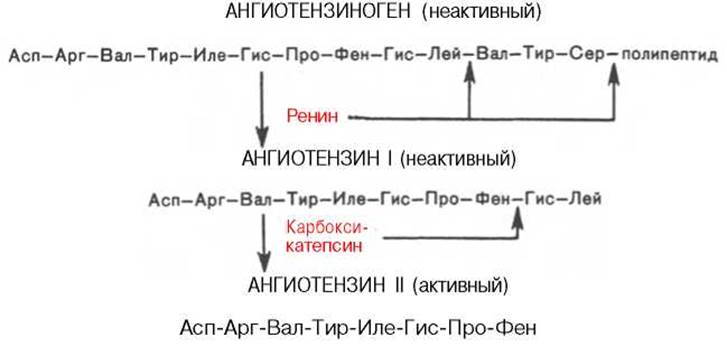
Furthermore, the group of vasoactive peptides (those affecting vascular tone) includes bradykinin and kallidin, which are widely utilized in medical practice.
Bradykinin is a nonapeptide:
H-Arg-Pro-Pro-Gly-Phe-Ser-Pro-Phe-Arg-OH.
Kallidin is a decapeptide generated from the inactive plasma protein kininogen, differing from bradykinin by the presence of an additional amino acid residue (Lys) at the N-terminus:
H-Lys-Arg-Pro-Pro-Gly-Phe-Ser-Pro-Phe-Arg-OH.
Quite recently, biologically active peptides that regulate vascular tone and electrolyte metabolism have been isolated from atrial tissue extracts (but not from Heart ventricles) of humans and animals. Their physiological effect was found to be the opposite of the renin-angiotensin-aldosterone system. It manifests as a vasodilatory effect, enhanced Glomerular Filtration, and stimulation of sodium and chloride excretion through the inhibition of their tubular reabsorption. These peptides were named atriopeptins (from the Latin atrium). They are composed of varying numbers of amino acids (from 23 to 100), but an essential requirement for their biological activity is the presence of a 17-membered ring structure within the molecule, formed by a disulfide bond between Cysteine residues.
Cyclic guanosine monophosphate (cGMP) has been identified as the intracellular mediator of atriopeptin action. Its synthesis is driven by the activation of the membrane-bound enzyme guanylyl cyclase, whereas The activity of adenylyl cyclase is inhibited by atriopeptins.
The low-molecular-weight tripeptide Glutathione is widely distributed in all animal Tissues and in certain plants. Although discovered relatively long ago, its functions are not yet fully understood. Glutathione is an atypical tripeptide (in which one of the peptide bonds is formed by the y-carboxyl group of glutamate rather than the a-carboxyl group) with the following structure: y-glutamyl-cysteinyl-Glycine:

Cysteine is an integral component of glutathione; consequently, the latter can exist in reduced (SH) and oxidized (S-S) forms (abbreviated as G-SH and G-S-S-G), which appears to be relevant to the Biological Role of glutathione in the organism.
Interest in natural peptides is largely driven by their unusually high biological activity. They exert potent pharmacological effects on numerous physiological Functions of the body. At the same/time, however, researchers have noted their low stability and rapid degradation within the organism at physiological pH levels. All of this has spurred research both in the preparative isolation of natural peptides from Organs and tissues (including The production of bioactive peptides from precursors via Limited proteolysis of well-known hormones) and in chemical synthesis. The derivation of biologically active neuropeptides from Pituitary Hormones—specifically endorphins and enkephalins, which possess potent analgesic properties (through binding to specific Brain Cell receptors) hundreds or thousands of times exceeding the analgesic effect of morphine—is described in Chapter 8.
Additionally, a Sleep-inducing hexapeptide has been isolated from brain tissue, and various other neuropeptides participate in the Biochemical Mechanisms of memory, fear, learning, etc. To enhance the stability of peptides upon administration into the organism, attempts have been made to chemically synthesize peptides in which one or more L-amino acid residues are replaced by D-amino acid residues. Such a substitution, without reducing bioactivity, protects the peptide from the action of tissue proteinases, thereby prolonging the therapeutic effect of the compound.
Among naturally occurring small peptides, mention should be made of the antibiotic gramicidin S, isolated from Bacillus brevis, which is a cyclic decapeptide:

As can be seen, The structure of gramicidin S contains 2 Ornithine (Orn) residues, derivatives of The amino acid Arginine, and 2 residues of unnatural D-isomers of phenylalanine. The arrows indicate the direction of synthesis from the NH2 groups to the COOH groups of each residue, and due to its cyclic nature, gramicidin S has no free terminus.
An artificial (genetically engineered) dipeptide composed of L-isomers of aspartic acid and phenylalanine methyl ester, named aspartame, has found widespread application, particularly in the food industry, as a sugar substitute:

Aspartame is hundreds of times sweeter than sugar and readily breaks down in the body into two free amino acids that are completely harmless to the organism; therefore, it is recommended as a sugar substitute for diabetic patients. This is a prime example of a peptide endowed with a profound biological effect.
Last update: 06/08/2026
Editorial and Educational Adaptation: This material has been compiled based on the primary/original source text. The project team performed an editorial review, corrected technical inaccuracies, structured sections, and adapted the content for an educational format.
What was processed:
- elimination of formatting defects (OCR errors, structural breaks, corrupted characters);
- editorial organization of content;
- standardization of terminology in accordance with academic sources;
- verification of factual statements against the original source text.
All mentions of the author, publication year, and origin of the primary text have been preserved in accordance with the source.