ECOLOGICAL BIOCHEMISTRY - Textbook - V. M. Isaenko 2005
Chapter 4. ECOLOGICAL AND BIOCHEMICAL INTERACTIONS BETWEEN PLANTS AND ANIMALS
4.5. Biochemical Mechanisms of Plant Pollination
Insects, birds, and bats generally pollinate flowers as they fly from blossom to blossom in search of nectar and pollen for food. This process benefits both the pollinating animals and the plants.
In temperate regions, flower pollination occurs mainly during the day by bees, bumblebees, butterflies, and other insects. In the tropics, due to a greater diversity of pollinators (hummingbirds, moths, wasps, beetles, etc.), pollination can take place at any time of day. Certain flowers are pollinated exclusively at night by bats or moths. There are also documented cases of pollination by rodents: mice and shrews pollinate some Protea species in South Africa, while bush rats pollinate Banksia flowers in Australia. Smaller animals, such as flies and certain ants, can also act as flower pollinators.
Certain plants, such as grasses, are wind-pollinated, but their number is limited. For the majority of plants, animal pollination is obligatory.
Through the evolution of their main floral structures, some plants have become restricted to specific animal pollinators. Flowers with a short corolla are pollinated primarily by bees and bumblebees, those with a narrow, medium-length corolla by butterflies, and those with a narrow, long corolla by hummingbirds.
Interactions between animal pollinators and plants are established through such biochemical factors as flower coloration and scent, as well as the Nutritional Value of nectar and pollen.
Flower color and its role in pollination. Bees prefer white, yellow, and blue flowers. They are also sensitive to flavones and flavonols, which strongly absorb in the ultraviolet spectrum and are present in nearly all flowers. Although indifferent to red, bees may visit red flowers precisely due to the presence of flavones within them. Beetles mostly pollinate gray, cream, or green flowers, although their color discrimination is poor. Birds (such as hummingbirds) are sensitive to red and thus predominantly visit bright red or red-yellow flowers. Butterflies (Lepidoptera) prefer vibrant colors, including red and purple. Flies mostly pollinate gray, brown, purple, or green flowers, while wasps prefer brown. Mice generally pollinate flowers with a white interior.
Plants exhibit considerable metabolic plasticity, allowing them to rapidly halt, modify, or resume the synthesis of flower-color pigments depending on the pollinators available in their local habitat.
Flower color is determined primarily by pigments located in METABOLISM/14.html">Chloroplasts and vacuoles. As noted, Flavonoids are the main pigments, providing hues ranging from orange and red to blue, as well as yellow and white. Yellow shades, along with orange and red undertones, are imparted by carotenoids. Other pigments have a lesser impact on flower color, including chlorophylls (green), Quinones (occasionally yellow and red), and Alkaloids (yellow, red, and purple). The main chemical compounds determining flower color are listed in Table 4.7.
Colored nectar compounds, particularly flavones and flavonols—known as nectar guides—are designed primarily to direct insect pollinators toward the floral reproductive Organs and nectar. They can form A wide variety of patterns, such as spots, dots, or lines. Some of these are invisible to the human eye but are readily distinguished by insects due to their strong Absorption in the ultraviolet region of the spectrum.
Class="center">Table 4.7
COLORED CHEMICAL COMPOUNDS IN PLANT FLOWERS
(according to Harborne, 1985, with additions)
Color |
Pigments |
Plants |
White, cream, ivory |
Flavones (e.g., luteolin), flavonols (e.g., quercetin) |
The vast majority of white-flowered species |
Yellow |
Carotenoids Yellow flavonol anthochlor Yellow flavonol with carotenoid Alkaloids (e.g., berberine, betaxanthin) |
Most yellow-flowered plants, Primula, Gossypium, Linaria, Oxalis, Dahlia Coreopsis, Rudbeckia, Berberis |
Orange |
Carotenoid Pelargonidin with aurone |
Calendula, Lilium, Antirrhinum |
Bright red |
Cyanidin with carotenoid |
Tulipa |
Crimson, dark red |
Cyanidin |
Most red-flowered plants, including Rosa |
Pink |
Peonidin |
Peony (Paeonia) |
Pinkish-mauve, purple |
Delphinidin |
Most pinkish-mauve and purple-flowered plants, including Verbena |
Blue |
Cyanidin with copigment-methanol Delphinidin with copigment-methanol |
Centaurea Most species |
Green |
Chlorophyll |
Helleborus |
Visible colored nectar compounds are most commonly formed As a result of pigment concentration on the corolla surface or at the Base of the petal. Ultraviolet-absorbing nectar compounds are located primarily on the lower lip (labellum).
Floral scents and pollination. Floral fragrance plays a decisive role in attracting pollinators. This is particularly crucial for night-pollinated plants, where visual cues are virtually absent. Insects are sensitive to odorants at extremely low concentrations. The scents of certain flowers are imperceptible to humans yet easily detected by pollinators. In many plants, peak production of volatile compounds coincides with pollen maturation and floral receptivity.
Fragrance is emitted not only by flowers but also by other plant Tissues; for instance, the leaves of certain plants release volatile Essential Oils.
Floral scents are divided into two groups: pleasant (fragrant, fruity) and unpleasant (aminoid). The structures of several odorous compounds are shown in Figs. 4.16 and 4.17. The specific scent of a flower is determined not by a single substance, but typically by a complex mixture of several compounds.
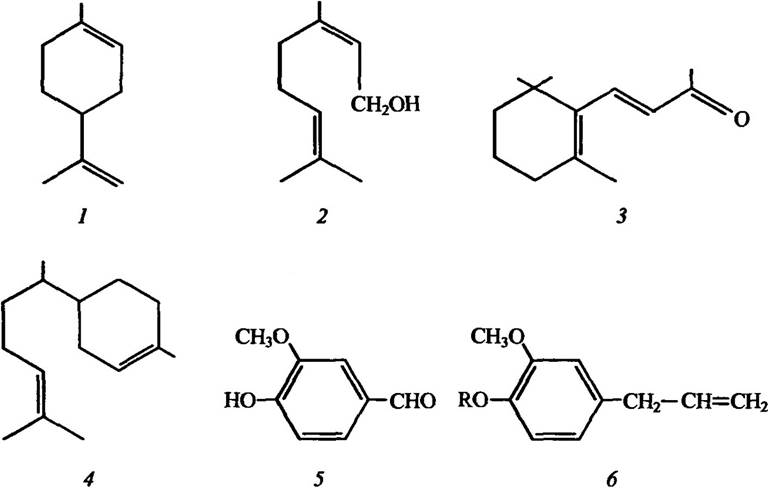
Fig. 4.16. Structure of some major floral scent compounds:
1 — limonene (the main component of citrus aromas);
2 — geraniol (in geranium and rose); 3 — β-ionone (in violet); 4 — α-bisabolol (in orange blossoms);
5 — vanillin (in orchids); 6 — eugenol in Eugenia (R = H) and methyleugenol in Cassia (R = CH3)
An unpleasant odor is a specific chemical signal that makes a plant smell like decaying meat or feces, thereby deceiving insects that feed on dead animal remains and excrement by luring them to the flowers. It should be noted that human olfactory perception may be entirely irrelevant to insect pollinators.
The main component of this unpleasant odor is a fishy smell produced by monoamines, ranging from methylamine to hexylamine (Fig. 4.17). Free ammonium may also contribute. Putrescine and cadaverine, which are products of protein decomposition, likewise have an unpleasant odor. The smell of feces is characteristic of skatole and indole.
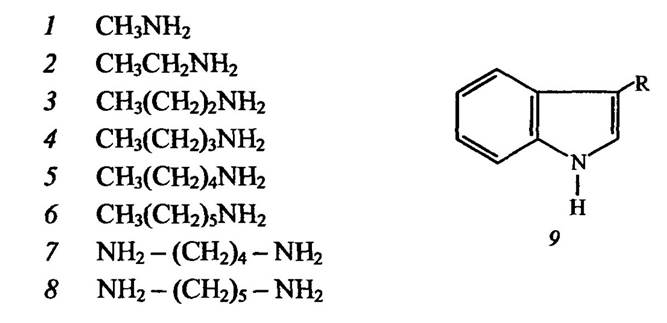
Fig. 4.17. Structure of certain compounds found in flowers with an odor unpleasant to humans:
1 — methylamine; 2 — ethylamine; 3 — propylamine; 4 — butylamine; 5 — pentylamine; 6 — hexylamine;
7 — putrescine; 8 — cadaverine; 9 — indole (R = H) and skatole (R = CH3)
At night, the spathe of Arum nigrum and Arum maculatum opens, revealing the spadix. Within the Cell/35.html">Mitochondria of its Cells, the uncoupling of Oxidative Phosphorylation occurs, causing the Temperature inside the spadix to rise up to 30°C. This temperature increase enhances the volatility of compounds that emit the stench of decaying matter. This odor attracts carrion flies and beetles. Landing on the spadix, they fall into a chamber formed by the base of the inflorescence. The trapped insects cannot escape due to the slippery surface of the spathe and remain there for a day, during which time they pollinate the flower. By the end of the day, wrinkles form On the surface of the spathe, allowing the insects to escape and fly away.
Some plants feed on insects; in such cases, insects captured by carnivorous plants are unable to escape. To capture prey, these plants use odor to attract insects. For instance, Sarracenia flava produces the alkaloid coniine, which has a mouselike odor inside its pitcher. This compound not only attracts insects but also paralyzes them, facilitating the plant's digestive process.
Insect behavior is regulated by chemical substances: some insects release volatile compounds to attract others. These compounds are known, as previously mentioned, as pheromones, and will be described in more detail in Chapter 6. They are involved in almost all vital activities of insects—feeding, reproduction, egg-laying, defense, aggression, and so on. Most pheromones are simple aliphatic alcohols, acids, or esters. Some terpenoid pheromones are identical to fragrant substances. Consequently, a flower's scent may resemble an olfactory signal emitted by an insect to attract a mate. For example, the flowers of Cassia fastulosa secrete the fragrant methyleugenol ether—phenylpropanol, which acts as a pheromone for the fruit fly Dacus dorsalis, regulating its feeding and mating behavior. Another example of plants utilizing pheromones is the pollination of orchidaceous plants of the genus Ophrys by bees of the genus Andrena. In shape and coloration, the flowers of this plant mimic female Andrena bees. A male bee lands on the plant and pollinates the flower during pseudocopulation. In addition to visual attraction, olfactory attraction also takes place, as the flowers secrete γ-cadinene, which mimics the scent of female bees.
Nectar and pollen and their role in pollination. The primary reason that pollinating animals visit plants is to obtain nectar and pollen as food products.
Most nectars are a sweet-tasting aqueous solution of sugars (17–75% by mass) and Amino Acids. Lipids of nutritional value and certain toxic substances have also been detected in nectar. Among the sugars in nectar, sucrose, glucose, and fructose are the most common (Fig. 4.18). Disaccharides (maltose, trehalose, melibiose) and trisaccharides (raffinose) also occur.
Plant nectars can be divided into three main groups based on the relative content of glucose, fructose, and sucrose: those containing predominantly sucrose, those with roughly equal amounts of all three sugars, and those dominated by glucose and fructose.
The amount of amino acids in nectar is relatively small, yet sufficient to supply insects with nitrogen—particularly butterflies, for whom nectar is the primary nutrient. A correlation has been found between The amino acid content in nectar and the type of pollinator. For instance, bees, which can obtain nitrogen not only from nectar but also from other sources (such as pollen), are capable of pollinating flowers with a low amino acid content in their nectar; whereas butterflies pollinate plants whose floral nectar contains elevated levels of amino acids.
All major protein Amino acids have been found in plant nectar, and the nectars of different plants vary significantly in their Amino Acid Composition. The most frequently occurring amino acids in nectar are Arginine, Histidine, Lysine, Tryptophan, phenylalanine, Methionine, Threonine, leucine, isoleucine, valine, glutamic acid, and aspartic acid.

Fig. 4.18. Structure of nectar sugars:
1 — glucose; 2 — fructose; 3 — sucrose
Oils containing significant amounts of lipids have been observed in plants (families Scrophulariaceae, Iridaceae, Krameriaceae, Malpighiaceae, Orchidaceae) that are pollinated primarily by bees. These oils become part of the food supply for larvae and adult males. The oils are mixed with pollen, and the female lays an egg in this mixture, providing the future larva with a diet rich in fats. In the oils of Calceolaria pavonii, the main lipid components are diglycerols of acetic and β-acetoxystearic acids. Saturated free Fatty acids with chain lengths from C16 to C22 containing an acetate group in the β-position have been detected in Krameria oils.
Sometimes floral nectars contain plant toxins derived from other PARTS OF THE plant. For example, the nectar of Sophora microphylla may contain alkaloids in quantities sufficient to poison bees. The toxicity of these alkaloids poses a hazard to humans who consume the honey. However, as a rule, such honey has a bitter taste and an unusual color.
Nectar may also contain substances that are toxic to pollinating insects yet harmless to humans. For instance, the nectar of Tilia contains mannose, which insects cannot metabolize due to a lack of the enzyme mannose-phosphate isomerase. This results in the accumulation of mannose-6-phosphate, which induces paralysis in insects.
Pollen is a valuable source of nutrients. It contains 16–30% protein, 1–7% starch, up to 15% sugars, and 3–10% lipids. In addition, it contains carotenoids (α- and β-carotene, lutein, zeaxanthin, and their epoxides), flavonoids (such as isorhamnetin), as well as minor amounts of Vitamins and inorganic salts.
It should be noted that pollen is more readily accessible to pollinators than nectar, which accounts for its widespread use by many pollinators. The primary consumers of pollen are beetles and bees.
Last update: 06/08/2026
Editorial and Educational Adaptation: This material has been compiled based on the primary/original source text. The project team performed an editorial review, corrected technical inaccuracies, structured sections, and adapted the content for an educational format.
What was processed:
- elimination of formatting defects (OCR errors, structural breaks, corrupted characters);
- editorial organization of content;
- standardization of terminology in accordance with academic sources;
- verification of factual statements against the original source text.
All mentions of the author, publication year, and origin of the primary text have been preserved in accordance with the source.