ZOOLOGY OF CHORDATES: STUDY GUIDE - Zakharenko M.O. - 2015
CHAPTER 5. HIGHER VERTEBRATES
5.5. Characteristics of Selected Mammalian Representatives
Subclass Prototheria - Order Monotremata
More than 6,000 species have been described, of which 4,629 species belonging to 26 orders are presented in accordance with the current status of the world's mammals in the latest Synthesis of the 1990s (Wilson, Reeder, 1992).
Subclass Prototheria. These are the most primitive among extant mammals, distributed in Australia, New Guinea, and Tasmania. They lay eggs, which they either incubate (platypus) or carry in a specialized abdominal pouch (echidna); the young are fed with milk. The Pectoral Girdle retains a coracoid and an episternum (features characteristic of reptiles). A cloaca is present. As in reptiles, the Brain lacks a corpus callosum—the commissure between the hemispheres. The Mammary Glands are tubular in Structure. Nipples are absent, and the ducts of the mammary glands open onto "glandular fields" of the Skin. Females have only a left Ovary functioning. After Fertilization, the egg remains in the reproductive tract for a prolonged period (16–27 days) and is laid with an already developed embryo. Consequently, the incubation or gestation period is short (up to 10 days). Body Temperature is lower than in other mammals, averaging about 32°C, and ranges between 25–36°C depending on environmental conditions. The subclass is represented by a single order, Monotremata, which comprises two families. Family Tachyglossidae (echidnas).
The body is covered with spines up to 6 cm long; the snout is elongated, pointed, and forms a beak covered with a horny sheath. Body length is up to 40 cm. The limbs are equipped with strong claws. They feed on small animals. The female lays 1–2 eggs, which she incubates in a leathery pouch that forms on her abdomen prior to egg-laying. The newborn young, 1.5–2 cm long, leave the pouch after 42–56 days. There are 2 species: the western long-beaked echidna Zaglossus bruijni (New Guinea) and the short-beaked echidna Tachyglossus aculeatus (Australia, New Guinea, Tasmania) (Fig. 318).
Class="center">
Fig. 318. Family Tachyglossidae
A - western long-beaked echidna; B - short-beaked echidna: 1 - lateral view; 2 - ventral view; 3 — embryo
Family Ornithorhynchidae includes a single species, the platypus Ornithorhynchus anatinus, which inhabits Australia and Tasmania (Fig. 319).
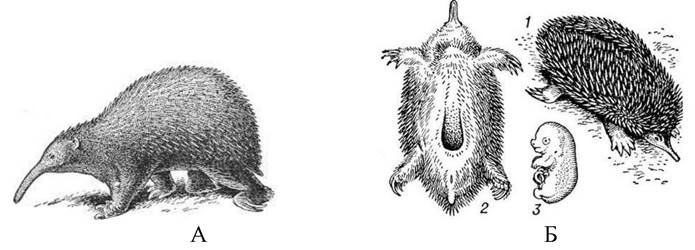
Fig. 319. Platypus
The platypus is a semi-aquatic animal. Its snout terminates in a broad "duck-like" bill covered with a horny sheath, which the animal uses to sift Water and mud in search of worms, insects and their larvae, crustaceans, and Mollusks. The feet have swimming webs between the digits. One to three eggs are laid in a specially excavated burrow, where the young are hatched. During the incubation period (up to 10 days), the female seals the entrance to the nesting chamber with a soil plug.
Subclass Theria - Infraclass METATHERIA
This group comprises over 250 species across 9 families within a single order, Marsupialia. They vary greatly in body size, ranging from 4 cm (marsupial mouse) to 1.6 m (gray kangaroo). Body temperature is generally higher and less variable than in monotremes (around 36°C). They give birth to underdeveloped embryos, completing their development in a pouch (for an adult gray kangaroo weighing 60–70 kg, the newborn weighs a mere 80 g). The young independently crawl into the pouch, locate a nipple, and latch onto it. The most distinctive feature of marsupials is the presence of marsupial (epipubic) bones attached to the pelvic bones. The coracoid is fused with the scapula. The Vagina and Uterus are double; correspondingly, the Penis is bifurcated in many species.
Family Didelphidae (opossums) is represented by animals with a body length of 7–50 cm, comprising 84 species. They are omnivorous, with a predominantly insectivorous diet. Active mainly at night and during twilight; they lead a terrestrial or arboreal lifestyle. Females give birth to 4 to 20 young (Fig. 320).

Fig. 321. Opossum
Family Dasyuridae includes very small animals (marsupial mice - Antechinus, with a body length of 4–10 cm) as well as relatively large ones (the thylacine or Tasmanian tiger - Thylacinus, with a body length of 100–110 cm). These are carnivorous or insectivorous species. The giant anteater (Myrmecophaga tridactyla) feeds on ants and termites and, unlike carnivorous mammals, leads a diurnal lifestyle. The marsupial mole (Notoryctes caurinus) resembles our common mole in appearance, lifestyle, and diet (Fig. 321).
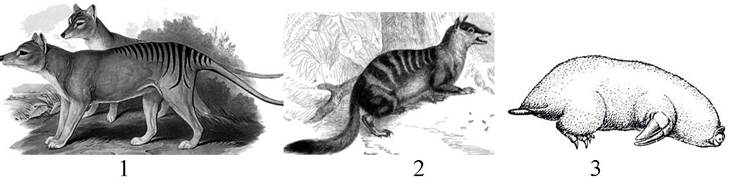
Fig. 321. Carnivorous marsupials
1 - thylacine; 2 - giant anteater; 3 - marsupial mole
Family Phascolarctidae includes a unique marsupial bear, the koala - Phascolarctos cinereus (Fig. 322).

Fig. 322. Koala
The family Macropodidae (kangaroos) includes 54 species (Fig. 323).
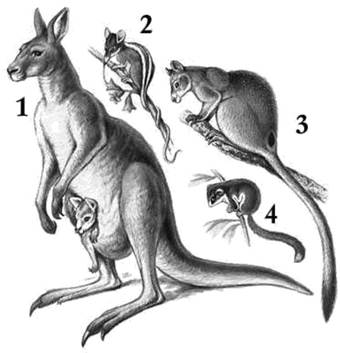
Fig. 323. Macropods (kangaroos)
1 - eastern grey kangaroo; 2 - honey possum; 3 - tree-kangaroo; 4 - pygmy feathertail glider
The body length of macropods ranges from 25 to 160 cm, tail length from 15 to 105 cm, and mass from 1.4 to 90 kg. They are predominantly terrestrial animals, with 9 species united in the genus of tree-kangaroos, Dendrolagus. They move by bounding on their hind limbs at speeds up to 50 km/h. Kangaroos are herbivores, and only a few consume small animals. Symbionts play a crucial role in Cellulose Digestion.
The female gives birth to 1-2 young. Larger species have economic significance (valuable fur, meat). Some species are bred on specialized farms. Representatives include the giant kangaroo (Macropus gigantea), the red kangaroo (Macropus rufus), and the swamp wallaby (Wallabia bicolor).
Infraclass Eutheria, or Placentalia (placental mammals)
The most highly organized mammals, adapted to various environmental conditions. The cerebrum features a well-developed secondary Cerebral Cortex (neopallium), with the left and right hemispheres connected by the corpus callosum. A Placenta is always present; brood pouches and marsupial bones are absent. Newborn young are capable of suckling milk. Body temperature in adult placentals is high and constant. Most species have two generations of Teeth (milk and permanent).
Order Edentata (edentates)
Few in number and specialized in various directions, these mammals inhabit South, Central, and the southern part of North America; they are known from the early Tertiary period. During the Tertiary period, they represented a numerous and diverse group (giant megatheriums, ox-sized megalonyxes, large glyptodonts with a powerful carapace, etc.). Relatively small animals have survived (body length 12-120 cm). Teeth are absent or lack enamel, are capable of continuous growth, and are almost undifferentiated. The family Myrmecophagidae (anteaters) is characterized by an elongated HEAD and facial region; the oral fissure is narrow, and a long, sticky Tongue is adapted for catching termites and ants; teeth are absent. There are 4 species, living in forests and savannas. The long and sharp claws of the forelimbs are used to break open termite mounds (Fig. 324).

Fig. 324. Giant anteater
In the family Bradypodidae (three-toed sloths), the Skull is shortened in the facial region with closely set eyes; teeth are limited to premolars and molars and grow throughout life. The Stomach is complex. Body temperature is variable (fluctuating between 24-340С). They inhabit forests and are herbivores (young leaves, shoots, and tree buds). Sluggish, they spend most of their time suspended from branches. There are 3 species, with the pale-throated three-toed sloth (Bradypus tridactylus) as the typical representative (Fig. 325).

Fig. 325. Sloth and armadillo
The family Dasypodidae (armadillos) features an external carapace made of bony plates covered with a horny layer, movably connected and covering the body and tail from above and on the sides. When in danger, they hide in burrows, dig into the ground, or roll into a ball. The belly and limbs are covered with sparse Hair. The forelimbs are armed with powerful claws. They inhabit open areas, less commonly forests; they are prolific diggers and feed on small animals, carrion, and plants. There are 20 species.
Order Insectivora (insectivores)
Small to medium-sized animals (body length 3.5-44 cm) of primitive structure (Fig. 326).

Fig. 326. Insectivores
1 - European hedgehog; 2 - long-eared hedgehog; 3 - Eurasian common shrew; 4 - greater white-toothed shrew; 5 - Russian desman; 6 - European mole
The hair coat is short and soft, or the body is covered with spines (hedgehogs). The skull is elongated; the tympanic bullae are underdeveloped. In the brain, the olfactory lobes are strongly developed, and the cerebral hemispheres are almost unvoluted. Activity is predominantly nocturnal,
and round-the-clock in some species. They give birth to 6-14 young; they are polygamous. The mole and, historically, the desman are fur-bearing animals of commercial value; shrews and hedgehogs destroy many harmful pests. Widely distributed except in Australia, Antarctica, and most of South America. The order comprises 7 families (428 species), known from Late Cretaceous deposits.
The family Erinaceidae (hedgehogs) includes 21 species (body length 10-44 cm). The snout is elongated and pointed; the DORSAL SIDE OF the body is covered with spines. The northern white-breasted hedgehog or European hedgehog (Erinaceus europaeus) and the southern white-breasted hedgehog (Erinaceus concolor) are widely distributed in the fauna of Ukraine, while the long-eared hedgehog (Hemiechinus auritus) is found in the steppes of eastern Ukraine.
The family Talpidae (moles) comprises 42 species with a body length of 5-21 cm. Their digits bear long claws; the snout is elongated, the eyes are small (subcutaneous in some), and external auricles are small or absent. Both moles and desmans possess valuable fur. In Ukraine, the European mole (Talpa europaea) is widespread, whereas the Russian desman (Desmana moschata) is currently extremely rare.
The family Soricidae (shrews) consists of small animals (body length 3.5-18 cm) encompassing 312 species. This family includes the smallest of living mammals, such as the least shrew (Sorex minutissimus), weighing 2-3 g. A total of 312 species are known globally, 8 of which inhabit the fauna of Ukraine. Representative species include the common shrew (Sorex araneus), the Eurasian water shrew (Neomys fodiens), and the bicolored white-toothed shrew (Crocidura leucodon).
Order Chiroptera - Bats
This order comprises 925 species of small to medium-sized mammals adapted for flight (body length 3-40 cm). A leather-like flight membrane (patagium) extends between the second to fifth digits of the forelimbs, the forearm, upper arm, flanks, hind limbs, and tail. The first digit of the forelimbs is short and clawed (Fig. 327).

Fig. 327. Bats (Chiroptera)
1 - noctule bat; 2 - whiskered bat; 3 - greater noctule bat; 4 - greater horseshoe bat
Flying foxes and primitive bats possess slightly inferior flight capabilities; their wings are broad with nearly rounded tips, and the shoulder joint is single. In other species, a second articular surface has evolved, supported by a specialized process of the humerus. Molossid bats, which exhibit the superior flight performance, have long, sickle-shaped wings. Heat loss from the relatively large wing surface is mitigated because its temperature is approximately 7-90 C lower than the body temperature. The head features a wide Mouth gap, small eyes, and occasionally complex auricles with a skin flap (tragus) at the Base of the auditory meatus. The pelage is dense and single-layered, and the flight membrane is sparsely covered with hairs. The ulna and often the Fibula are rudimentary; the radius is elongated, curved, and longer than the humerus; the clavicle is well-developed; and the pectoral girdle is more robust than the Pelvic Girdle. The Sternum bears a small keel. In adaptation to animal or soft fruit diets, the digestive tract is 1.5-4 times the body length, the stomach is simple, and the cecum is frequently absent.
The order is divided into 2 suborders: Pteropodimorpha (megabats) and Microchiroptera (microbats). The order includes 17 families.
Family Pteropodidae (flying foxes and fruit bats) comprises 166 species. These animals reach a body length of up to 40 cm and a wingspan of up to 170 cm. The skull has an elongated facial region, and the teeth are adapted for frugivory; the intestine is 4 times the body length. At daytime resting sites, they form aggregations of up to 10,000 individuals. They undertake foraging Migrations, flying 90-100 km per night. Females give birth to 1-2 young. They are distributed from Africa to Australia and are the only native mammals on the islands of Oceania (excluding human introductions).
The other 16 families comprise small animals (body length 3-14 cm) with a shortened facial skull region that feed primarily on insects, while some feed on fish, and others suck the Blood of large animals or drink flower nectar.
Family Megadermatidae (false vampire bats) inhabit Australia, Africa, and Southeast Asia. Small species feed on insects, whereas larger ones prey upon other bats, birds, small rodents, and frogs.
Family Rhinolophidae (horseshoe bats) are distinguished by their nasal structure. The snout features hairless, leaf-like skin outgrowths forming a "horseshoe" that borders the nostrils laterally and anteriorly. Ultrasound is emitted through the nostrils by these bats; the reflected ultrasonic echo is perceived, as in all bats, by large and complexly structured ears. They are distributed in temperate and tropical Regions of the Eastern Hemisphere. In Ukraine, they are represented by 3 species: Rhinolophus hipposideros (lesser horseshoe bat), R. ferrumequinum (greater horseshoe bat), and R. euryale (Mediterranean horseshoe bat). They feed on insects.
Family Vespertilionidae (vesper bats) encompasses 318 species of small animals with a body length of 3-10 cm. Most species are insectivorous, though some feed on fish. They catch prey on the wing, but can also glean it from tree trunks and the ground. Some species migrate southward, while others hibernate. Mating typically occurs in September-October, but the eggs are fertilized only in the spring using sperm that remains viable within the female reproductive tract. They are distributed across all continents except Antarctica; they do not penetrate the tundra. Ukraine hosts 23 species. Representative species include: Myotis myotis (greater mouse-eared bat), Plecotus auritus (brown long-eared bat),
Nyctalus noctula (common noctule), Pipistrellus pipistrellus (common pipistrelle), and Eptesicus serotinus (serotine bat).
Order Primates - Primates.
This order numbers 233 species. It is characterized by a diversity of body Sizes and Shapes while retaining many primitive structural features. Owing to the arboreal lifestyle of most species, the limbs of primates are five-toed and plantigrade. The first digit is opposable, which provides a grasping function for the limb. Body length ranges from 10 cm (small prosimians) to 180 cm in the gorilla. The pelage consists of various categories of hair and is dense and soft (particularly in prosimians). The skull features a large braincase; the eyes are directed forward (stereoscopic Vision). Teeth of all categories are present; their shape correlates with diet (predominantly plant-based). The stomach is simple, and a cecum is present. Primates are distinguished by large brains and complex behavior. Primates represent one of the ancient orders of placental mammals, originating from Upper Cretaceous insectivores. Currently, they inhabit the subtropical and tropical regions of Asia, Africa, and the Americas, as well as the Sunda Islands and the Philippines.
Suborder Strepsirhini - Strepsirrhines
This suborder comprises 78 species of small to medium-sized animals (Fig. 328).

Fig. 328. Lower primates
1 - aye-aye; 2 - ruffed lemur; 3 - Philippine tarsier; 4 - slender loris
The digits in the vast majority of species bear claws. Family Lemuridae (lemurs) includes small to medium-sized animals (body length 12-48 cm). The head features a shortened facial region and a large braincase.
They lead an arboreal lifestyle, feeding on plants and small animals. Some smaller species hibernate during the dry season. They inhabit Madagascar and the Comoro Islands. An even more ancient group is the tarsiers, possessing limbs exceptionally well-adapted for arboreal life.
Suborder Haplorrhini - Haplorhines
It comprises 155 species (Fig. 329).

Fig. 329. Higher primates
1 - guenon; 2 - orangutan; 3 - chimpanzee; 4 — gorilla
All of its representatives have relatively large cerebral hemispheres, often with numerous sulci and gyri. They are typically active during the day. The family Cebidae, or New World monkeys, includes the so-called "platyrrhine monkeys" inhabiting South America (body length 24–90 cm). They have a long tail, which is prehensile in some species. Arboreal in habit, they are capable of leaping long distances and moving swiftly through trees by running. They feed on fruits, leaves, small animals, and bird eggs. They form groups, sometimes numbering several dozen individuals, characterized by highly organized social behavior.
The family Cercopithecidae, or Old World monkeys, comprises species inhabiting Africa and South Asia. These are medium to large-sized animals (body length 32–110 cm) that occupy various landscapes, including jungles, mangrove swamps, and rocky slopes (extending up to 4,000 m above sea level in mountains). They exhibit terrestrial (baboons) or arboreal-terrestrial lifestyles, and are herbivorous or omnivorous.
The higher catarrhines (anthropoid apes) are a small group of humans' closest relatives. Their forelimbs are longer than their hindlimbs, and the head is rounded. They feature a highly complex cerebral cortex. The facial region is sparsely haired, and the palms and soles are hairless; they are inhabitants of tropical forests. Gorillas and chimpanzees (Africa) lead a terrestrial-arboreal lifestyle, while gibbons (Southeast Asia, Indonesia) and orangutans (Sumatra and Borneo) are almost exclusively arboreal.
Order Carnivora — Carnivores
Predominantly carnivorous animals, although many species Supplement their diet with plant matter. Felids are the most strictly carnivorous; mustelids and, especially, bears make extensive use of plant food. Body size and shape vary greatly (body length ranges from 14 cm to 3 m; mass from 100 g to 1 t). Incisors are small, canines are always well-developed, and cheek teeth are tuberculate, often with cutting edges. The last upper premolar and the first lower molar are notably large and possess a cutting edge; these are the so-called carnassial teeth, which reach their highest development in the most strictly carnivorous species. The pelage is well-developed, being thick and fluffy in northern forms. These characteristics define about 240 widely distributed species.
The family Canidae, or dogs, comprises medium-sized animals with digitigrade limbs adapted for running (Fig. 330).

Fig. 330. Family Canidae
1 - wolf; 2 - jackal; 3 - coyote; 4 - arctic fox; 5 - raccoon dog; 6 - red fox
They typically hunt by pursuit, which is reflected in The Development of their olfactory Organs (long, elongated muzzle). They feature a complex population structure, frequently forming large family groups and packs. Their sophisticated nervous activity facilitated the domestication of the wolf; high Variability and artificial Selection have enabled the derivation of most dog breeds. Among wild canids, the red fox and arctic fox are important fur-bearing animals. Their domesticated forms with particularly valuable pelts (silver foxes, blue foxes) are farmed. The raccoon dog, native to the Ussuri region, has widely dispersed in the European part of its range where it was acclimatized. Ukraine is home to 5 species: the gray wolf (Canis lupus), the golden jackal (C. aureus), the red fox (Vulpes vulpes), the corsac fox (V. corsac), and the raccoon dog (Nyctereutes procyonoides). The jackal is a recent addition to our theriofauna, having appeared in southern Ukraine only in recent years. Historically, the corsac fox occurred in Crimea, but today it is found in very small numbers in the
Luhansk region. The raccoon dog inhabits river valleys and other wetland habitats and is an acclimatized species in Ukraine.
The family Felidae (cats) includes 36 species of medium to large size (mass 1.5–275 kg), representing the most carnivorous members of the order (Fig. 331).
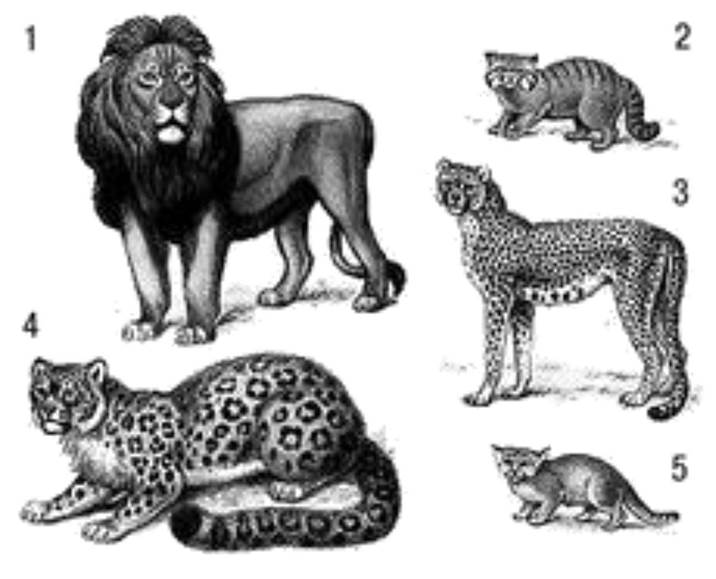
Fig. 331. Family Felidae
1 - lion; 2 - Pallas's cat; 3 - cheetah; 4 - snow leopard; 5 - sand cat
They hunt by stalking prey and launching a sudden rush, rarely engaging in prolonged chase. This mode of hunting is facilitated by a rounded head with a short muzzle and large eyes, and digitigrade limbs armed with sharp, retractable claws. They are primarily terrestrial animals, though many climb trees proficiently. They are distributed on all continents except Australia. Small felids inhabit the mixed lowland and mountain forests of Europe (wildcat, Felis silvestris), as well as the steppes and deserts of Asia and Africa (African wildcat, F. lybica; sand cat, F. margarita). The jungle cat (F. chaus) lives in the reed beds and thickets of Asia. Large cats include the tiger (Panthera tigris), leopard (P. pardus), snow leopard (Uncia uncia), and others. The lion (Panthera leo) historically inhabited Asia Minor, Transcaucasia, and Southern Europe; today, small populations survive in Gir National Park in India and in Central Africa. The Eurasian lynx (Lynx lynx) is the only felid inhabiting the taiga zone; thanks to its broad paws, it can move easily even through deep snow. The cheetah (Acinonyx jubatus), which inhabits the lowland deserts and savannas of Africa and Asia, differs markedly from other cats, bearing a superficial resemblance to canids. It is long-legged with non-retractable claws, and hunts by pursuing and running down its prey. Ukraine has 2 species: the wildcat and the Eurasian lynx. Today, these are rare animals of the Carpathians and Polissya, and in the case of the wildcat, also the Danube Delta; their numbers and distribution have declined sharply over the 20th century.
The family Hyaenidae (hyenas) is distributed in Africa and South Asia; these animals feed almost exclusively on carrion, occasionally attacking fairly large animals (sick or wounded ones). It comprises 4 species.
The family Mustelidae (mustelids) includes 65 species of predominantly small, less frequently medium size (mass 100 g – 40 kg) (Fig. 332).
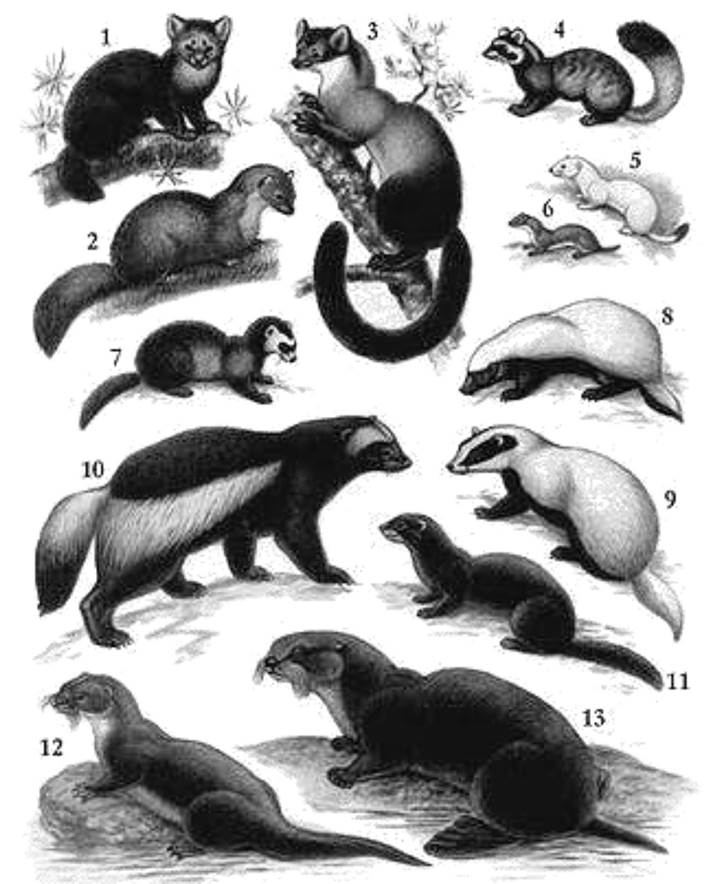
Fig. 332. Mustelids
1 - sable; 2 - pine marten; 3 - yellow-throated marten; 4 - marbled polecat; 5 - ermine; 6 - least weasel; 7 - European polecat; 8 - honey badger; 9 - Eurasian badger;
10 - wolverine; 11 - European mink; 12 - otter; 13 - sea otter
Distributed across all continents (one species is marine — the sea otter, *Enhydra lutris*); introduced and acclimatized in Australia. The family includes valuable fur-bearing animals: the sable (*Martes zibellina*), pine marten (*M. martes*), stoat (*Mustela erminea*), Eurasian otter (*Lutra lutra*), sea otter, and others. Among mustelids, there are exterminators of harmful rodents (weasels, polecats, marbled polecats, etc.). Larger mustelids include the wolverine (*Gulo gulo*), which inhabits the taiga and forest-tundra of Eurasia and North America, and badgers (*Meles*). The latter feed on a variety of animal and plant foods, dig complex burrows, and are widespread in Eurasia. Skunks (*Mephitis*, *Spilogale*) are characteristic of North and Central America. Ukraine has 11 species: the pine marten (*M. martes*), beech marten (*M. foina*), stoat (*Mustela erminea*), least weasel (*M. nivalis*), European mink (*M. lutreola*), American mink (*M. vison*), European polecat (*M. putorius*), steppe polecat (*M. eversmanni*), marbled polecat (*Vormela peregusna*), Eurasian badger (*Meles meles*), and Eurasian otter (*L. lutra*). The preferred habitats of otters and minks are rivers with numerous floodplains and shrub-overgrown oxbow lakes. The steppe polecat and marbled polecat gravitate toward the steppe and forest-steppe zones. Due to the plowing up of virgin steppes and anthropogenic pressure on their habitats, the latter species has become endangered. The steppe polecat, a species until recently widely distributed in Ukraine, has disappeared from many areas of its former range over the last third of the 20th century. The American mink displaces the European mink in areas where their ranges overlap; the distribution of the species in Ukraine remains unclear. It was never specially introduced here, having spread As a result of escapes from fur farms. The beech marten and European polecat can cause some damage by preying on small domestic animals (chickens, pigeons, rabbits) if they settle near human settlements. Thanks to its tiny size, the least weasel easily penetrates rodent burrows; this small predator destroys up to 2–3 thousand voles and mice per year.
Closely related to terrestrial carnivores are the pinnipeds, formerly classified in a separate order, Pinnipedia. They spend most of their Life in water, coming ashore or onto ice to rest, mate, give birth, and molt. They are larger than terrestrial carnivores (body mass 40–3,000 kg), an adaptation to living in cold water. The pelage consists of coarse hairs (with an underfur in young individuals). A thick layer of fat lies beneath the skin, being especially thick in inhabitants of cold seas. The body is elongated and streamlined. The limbs are modified into paddle-like flippers that extend beyond the trunk from the midpoint of the forearm (forelimbs) and the distal third of the lower leg (hind limbs). Thick webbed skin stretches between the digits. Locomotion is performed primarily by the hind flippers, while the forelimbs act as stabilizers and rudders. On land, eared seals move more easily, using both pairs of flippers; true seals are much more helpless on hard substrates. They swim and maneuver well in the water Column because their body density, increased by the thick subcutaneous fat layer, is close to that of water. The distinctions between different categories of teeth are less pronounced; the teeth are mostly conical. The SENSE OF SMELL is well developed. Currently, 34 species from 3 families of these animals are included within the order Carnivora (Fig. 333).

Fig. 333. Pinnipeds
1 - bearded seal; 2 - grey seal; 3 - harbor seal; 4 - ringed seal; 5 - Mediterranean monk seal; 6 - ribbon seal;
7 - hooded seal (male); 8 - hooded seal (female); 9 - Weddell seal; 10 - crabeater seal; 11 - leopard seal; 12 - South American sea lion;
13 - sea lion; 14 - walrus; 15 - southern elephant seal
The family of eared seals (Otariidae) comprises 14 species. They possess rudimentary External ear flaps; their hind flippers can be rotated forward at the heel joint and, together with the forelimbs, serve as support when moving on land. They are distributed mainly in the temperate zones of both hemispheres: in the Northern Hemisphere, only in the Pacific Ocean; in the Southern Hemisphere, more widely. The northern fur seal (*Callorhinus ursinus*) is an important commercial species yielding valuable fur. During the summer breeding season, they form large, complexly organized rookeries on land. After the breeding and molting period, they migrate south. Steller sea lions (*Eumetopias jubatus*) and sea lions (*Zalophus* and *Otaria*) are less numerous.
The family of true seals (Phocidae) lacks external ear flaps; their hind flippers cannot be rotated forward, and their pelage lacks underfur. They inhabit the seas of both hemispheres. For molting, mating, and giving birth, they haul out onto ice, forming numerous rookeries. Important commercial species include the harp seal (*Pagophilus groenlandica*) and the bearded seal (*Erignathus barbatus*). The ringed seal (*Phoca hispida*) is distributed in the northern PARTS OF THE Atlantic, Pacific, and Arctic Oceans; it also occurs in Lake Ladoga, Lake Baikal, and the Caspian Sea. In Ukraine, the Mediterranean monk seal (*Monachus monachus*) was historically known, having once occurred in the northwestern Black Sea region. Until the 1950s, it was occasionally caught in fishing nets at the Kilia mouth of the Danube. In recent years, there have been no reliable records of sightings within Ukraine, nor any documented physical finds (dead animals).
The walrus family (Odobenidae) has only a single representative, *Odobenus rosmarus*, which is circumpolar in distribution along the coasts and islands of the Arctic Ocean.
The population numbers of many pinniped species have declined markedly as a result of excessive slaughter.
The raccoon family (Procyonidae) is characterized by medium size, plantigrade limbs, and a long, sometimes prehensile tail (Fig. 334).

Fig. 334. Procyonids
1 - ringtail; 2 - white-nosed coati; 3 - kinkajou; 4 - raccoon
Carnassial teeth are weakly developed. There are 18 species. The greater part of their range is in the Americas, with a smaller portion in Southeast Asia. The North American raccoon (*Procyon lotor*), acclimatized in the European part of the continent, may soon be discovered in Ukraine due to the spontaneous expansion of its range from Belarus, Poland, Slovakia, Hungary, and Romania.
The bear family (Ursidae) comprises large, plantigrade beasts (Fig. 335).
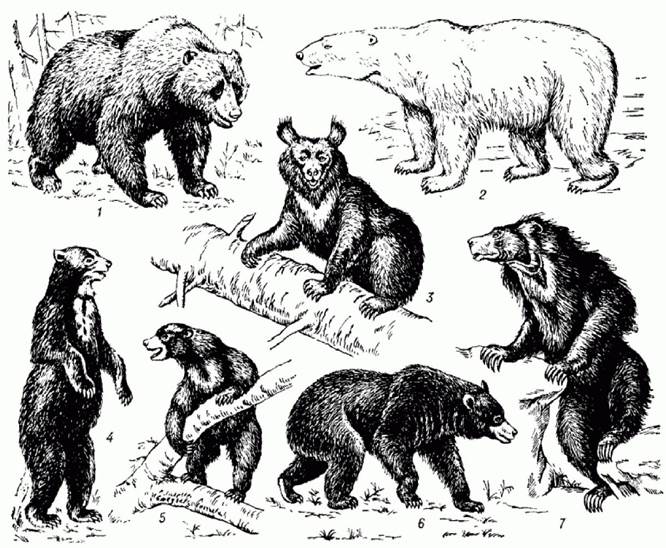
Fig. 335. Bears
1 - brown bear; 2 - polar bear; 3 - Asian black bear; 4 - spectacled bear; 5 - sun bear; 6 - American black bear; 7 — sloth bear
They are distributed primarily in the Northern Hemisphere. The polar bear (*Ursus maritimus*), which feeds on seals, is active year-round; only pregnant females retire to dens on Arctic Ocean islands to give birth. The brown bear (*U. arctos*) inhabits the forest belt of the European part of the country, the Caucasus mountains, and Central Asia; it feeds on a mixed diet, with a predominance of plant matter. For the winter, they den, where the female gives birth to 2–3 tiny cubs (weighing about 500 g). Until recently, this powerful predator was a common animal of continuous forest tracts across a significant part of Ukraine. Today, the bear survives in small numbers only in the western part of the country—in the mountainous terrain of the Carpathian forests.
The civet family (Viverridae)—the most primitive representatives of carnivorous mammals—is distributed in Southern Europe, South Asia, and Africa; it includes 34 species of diverse small- to medium-sized animals (*Genetta*, *Viverra*, *Eupleres*, etc.). The family formerly included the genus of mongooses (*Herpestes*), the representatives of which are now grouped into a separate family, Herpestidae, comprising 37 species (Wilson, Reeder, 1992).
Order Cetaceans - Cetacea
Includes about 80 species (Fig. 336).
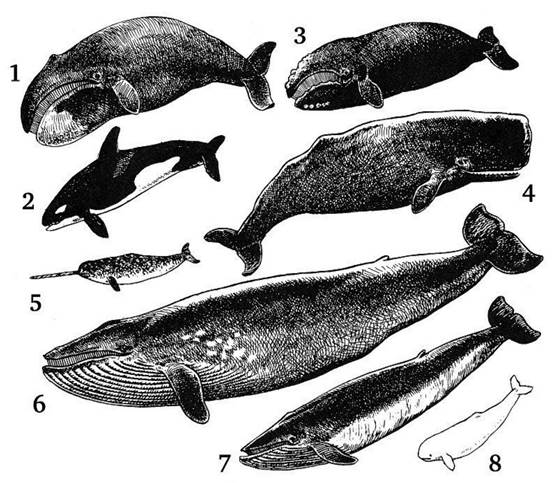
Fig. 336. Whales
1 - bowhead whale; 2 - killer whale; 3 - southern right whale; 4 - sperm whale; 5 - narwhal; 6 - blue whale; 7 - rorqual; 8 — beluga whale
They are fully adapted to an aquatic lifestyle: they never come ashore and, if stranded on shallow water, are unable to refloat themselves. Their body shape is torpedo-like, sometimes with a disproportionately large head and no distinct neck constriction. The forelimbs have evolved into flippers, while the hindlimbs are vestigial. The skin is naked, hairless, highly elastic, and underlaid with a thick layer of blubber. The muscular tail region is exceptionally mobile and features a horizontal, two-lobed skin fluke. Some species also possess a dorsal fin. The pectoral fins (flippers) are positioned horizontally, acting as stabilizers as well as depth and steering rudders; they also function as thermoregulators by shedding excess body heat generated during rapid swimming. The Skeleton has acquired features reminiscent of fish anatomy. THE Vertebral Column is weakly differentiated: a very short neck region consists of 7 flat vertebrae; the thoracic region bears 10–17 pairs of Ribs (with only 2–8 pairs articulating with the sternum); and the lumbosacral and caudal regions are barely differentiated. Of the hindlimbs, only vestiges of the pelvic girdle remain—two small bones unconnected to the Axial Skeleton. The skull features elongated jaws. The nostrils have shifted to the upper surface of the head, and the respiratory tracts form specialized air sacs.
The suborder Mysticeti (baleen whales) includes the largest animals on Earth. They feed on planktonic organisms by engulfing them in their massive mouths and filtering them through a straining apparatus consisting of vertically suspended triangular plates of baleen. The external nasal openings are paired. Right whales (family Balaenidae; body length 5–22 m) are very scarce, and their commercial hunting is strictly prohibited. The bowhead whale (*Balaena mysticetus*) inhabits northern seas, whereas the southern right whale (*Eubalaena glacilis*) is native to the Southern Hemisphere. Gray whales (family Eschrichtiidae) inhabit coastal waters. The California-Chukchi population of gray whales is small, while the Okhotsk-Korean population is nearly extinct; they winter off the coast of California and spend the summer feeding in the Chukchi and East Siberian seas. Rorquals (family Balaenopteridae) breed in warm seas during the winter and migrate to cold seas to feed in the summer. A blue whale (*Balaenoptera musculus*) female caught in 1926 measured 33 m in length and weighed over 150 tons. Humpback whales (*Megaptera novaeangliae*) range from the Arctic to the Antarctic.
The suborder Odontoceti (toothed whales) have jaws armed with conical, uniform teeth. They capture prey using their teeth while simultaneously suctioning it into the mouth. Their echolocation system is highly developed, which accounts for the characteristic Asymmetry of their skulls. There is a single blowhole. The sperm whale family (Physeteridae) is distinguished by a large spermaceti-filled fat organ (the spermaceti organ or case) in the head. The lower jaw is narrow, causing the mouth slit to be positioned on the underside of the head. The largest toothed whale, the sperm whale (*Physeter catodon*), reaches lengths of up to 20 m.
The dolphin family (Delphinidae) comprises over 30 species of small toothed whales (1–10 m in length). The largest dolphins, killer whales (*Orcinus orca*), inhabit all oceans; they prey on relatively large whales, pinnipeds, and other animals, though their primary diet consists of fish and cephalopods. Many dolphin species are of commercial importance. The polar seas are home to the beluga whale (*Delphinapterus leucas*), a large-sized dolphin, and the rarer narwhal (*Monodon monocerus*), the males of which are equipped with a long tusk.
These are the largest terrestrial animals, standing 3–4 m tall and weighing 4–5 tons; they were numerous and widely distributed during the Tertiary period (Fig. 337).

Fig. 337. Elephants
1 - African elephant; 2 — Indian elephant
The trunk is a heavily elongated muscular Nose fused with the upper lip and supported at the base by Cartilage; it serves as a prehensile organ that simultaneously Functions for Touch and smell. The limbs are five-toed, featuring small hooves and a flat sole; a resilient, jelly-like cushion beneath the skin on the soles ensures silent movement over the ground. The skin is thick and, in extant species, hairless. Tusks are enlarged, continuously growing upper incisors that project far beyond the Oral Cavity. Each side of the jaw contains only a single functional molar at a time; as it wears down, it is replaced by the next molar developing behind it. In the Indian elephant (*Elephas maximus*), tusks are present only in males. The African elephant (*Loxodonta africana*) is larger in size, and tusks are present in both sexes; they are notoriously difficult to domesticate.
During the Quaternary period, extensive regions stretching from the tundra to the steppes were inhabited by the woolly mammoth (*Elephas primigenius*), characterized by long reddish-brown fur and large curved tusks. They were abundant in Ukraine, particularly in the Dnieper river basin, as evidenced by fossil remains discovered there. Well-preserved mammoth remains are occasionally recovered from the permafrost of Siberia.
Order Perissodactyla (Odd-toed ungulates)
Moderately large to large animals characterized by the dominant Development of the third digit (with some species retaining only this digit) (Fig. 338).
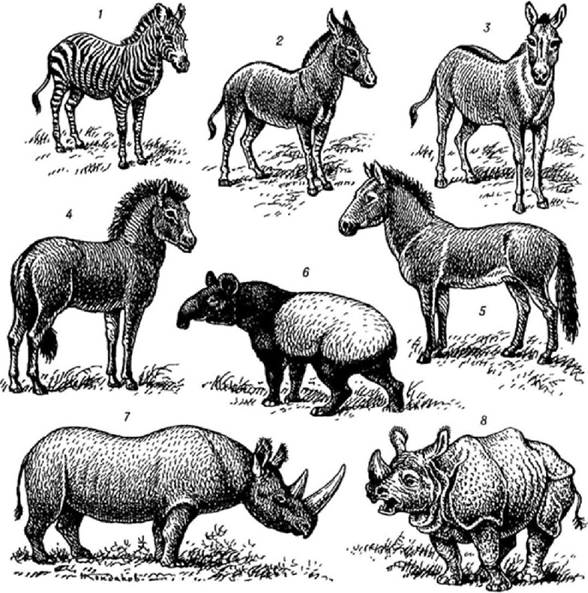
Fig. 338. Perissodactyls
1 - zebra; 2 - wild ass; 3 - kulan; 4 - tarpan; 5 - Przewalski's horse; 6 - tapir; 7 - black rhinoceros; 8 - Indian rhinoceros
The degree of reduction in the remaining digits correlates with running speed (reaching a maximum in single-toed forms). The terminal Phalanges of the digits bear horny hooves. The pectoral girdle lacks clavicles. The stomach is simple. The ancestors of perissodactyls were primitive ungulates known as Condylarthra. By the Eocene epoch, perissodactyls had diversified significantly (around 500 species have been described), but their numbers declined sharply in the Miocene. Today, only three families comprising 18 species survive.
The tapir family (Tapiridae) represents the most primitive perissodactyls. The forelimbs are four-toed, while the hindlimbs are three-toed. One species—the Malayan tapir (*Tapirus indicus*)—inhabits Southeast Asia, and three species are found in South America.
The rhinoceros family (Rhinocerotidae) comprises large, heavily built beasts (body length 2–4 m, mass 1–3.5 t). Their limbs are three-toed, and their thick skin is nearly hairless. One or two horns, composed of keratinized epidermal fibers, sit atop the nasal and frontal bones. Canines are reduced.
The horse family (Equidae) possess a single digit on both fore- and hindlimbs, with vestiges of the second and fourth digits persisting as "splint bones." They are exceptionally well-adapted for running at high speeds. Zebras (*Hippotigris*) roam the African savannas, wild asses still inhabit the deserts of North Africa, and Przewalski's wild horses (*Equus przewalskii*) currently survive in small numbers in Mongolia.
Order Artiodactyla (Even-toed ungulates)
Large to medium-sized animals with elongated limbs (except for the suborder of non-ruminants), well-adapted for swift running (Fig. 339).

Fig. 339. Artiodactyls
1 - moose; 2 - European bison; 3 - wild boar; 4 - red deer; 5 - argali; 6 — roe deer
Limbs are four-toed, with the third and fourth digits being large (long) and serving as support. The second and fifth digits are considerably smaller. Clavicles are absent. The terminal phalanges of the digits bear horny hooves. The stomach in most species consists of several chambers. Herbivorous. Primarily gregarious animals that sometimes form large herds numbering thousands of individuals. They lead a nomadic lifestyle; many species undertake regular seasonal migrations. Generally polygamous. The order comprises about 170 species inhabiting all continents (introduced by humans to Australia).
The suborder Nonruminantia or Suiformes is small (12 species) and includes animals with a massive body and short legs. The limbs are four-toed; the second and fifth digits are relatively long and touch the ground during
locomotion. The stomach is relatively simple, consisting of 1–3 chambers. It unites the families Suidae (pigs), Tayassuidae (peccaries), and Hippopotamidae (hippopotamuses). All species are herbivorous, although pigs frequently consume small animals as well. Pigs are found in Eurasia and Africa; peccaries inhabit South and Central America, and hippopotamuses inhabit tropical Africa. The wild boar (*Sus scrofa*) is the ancestor of numerous breeds of domestic pigs.
The suborder Ruminantia includes about 160 species of ungulates of various sizes. They are longer-legged; digits number 2 or 4 (the second and fifth digits are small and do not touch the ground). The upper jaw lacks both incisors and canines (canines persist in mouse-deer and musk deer); the stomach is complex, usually with 4 chambers. Swallowed food is regurgitated (cud) and re-chewed. Most species possess horns—outgrowths of the Frontal bone, sometimes covered with a horny sheath. Molars have a characteristic selenodont structure, capable of grinding coarse, fiber-rich forage. The suborder includes 6 families. It is a thriving group.
The family Tragulidae (chevrotains or mouse-deer) comprises ancient and most primitive ruminants known from the Late Eocene. The second and fifth digits are relatively long, and males have prominent canines projecting from the mouth. These animals are the size of a hare. They are distributed in Africa and Southeast Asia. Closely related to chevrotains is the family Moschidae (musk deer), represented by a single species, *Moschus moschiferus*, inhabiting the mountain systems of the Altai, Sayan, Eastern Siberia, the Far East, Korea, Mongolia, and China. Body length is up to 90 cm, height 65 cm, and mass 10–17 kg. The hind legs are one-third longer than the front legs. Horns are absent, but males possess quite large, outwardly projecting upper canines.
The family Cervidae ( deer) comprises slender animals with branched bony antlers (lacking a horny sheath) that develop on frontal bone outgrowths and are shed annually. Typically, only males bear antlers; in reindeer, females also possess them (water deer, *Hydropotes*, lack antlers). Preorbital scent glands are present, used by males to mark their individual territories. About 43 species. Widely distributed; several species have been acclimatized in Australia; absent in Africa. The reindeer (*Rangifer tarandus*) inhabits the tundra and taiga zones of Eurasia and North America. Long domesticated; the development of reindeer husbandry has reduced wild reindeer populations. The red deer (*Cervus elaphus*) lives in many regions of Eurasia and is a valuable game species. It is bred under semi-natural conditions to obtain antlers—ossified velvet antlers containing a valuable medicinal substance (the preparation pantocrine). Far Eastern sika deer (*C. nippon*) are used for the same purpose. The roe deer (*Capreolus capreolus*), a smaller deer, is also widely distributed. Moose (*Alces alces*) inhabit the forest zone of Eurasia and North America; during population peaks, they venture into the forest-steppe and formerly ranged into the Caucasus. They are powerful animals adapted to moving through deep snow and bogs. The fauna of Ukraine includes 5 species: the European elk, red deer, roe deer, fallow deer, and sika deer. The latter two species have been acclimatized.
The family Giraffidae is represented by only two African species: the giraffe (*Giraffa camelopardalis*), inhabiting the savannas of Central and Eastern Africa, and the okapi (*Okapia johnstoni*), which has relatively short neck and limbs.
They feed on the leaves and shoots of woody plants. The giraffe is the tallest animal, capable of raising its head up to 7 m above the ground. A system of Valves in the large jugular vein prevents sharp blood pressure fluctuations during rapid Head movements.
The family Bovidae (bovids) is particularly diverse (numbering 137 species). It includes animals with horns formed by bony outgrowths of the frontal bones covered with epidermal horny sheaths. In many species, both males and females are horned. They are absent in Australia and South America (excluding domestic or acclimatized species). Almost all species have or have had significant economic importance. The antelope group is widely represented in Africa. Goitered gazelles (*Gazella subgutturosa*) live in the steppes and deserts of the Eastern Transcaucasia, Kazakhstan, and Central Asia. Saigas (*Saiga tatarica*) inhabit the steppes of Kazakhstan and the Northern Caspian region. Wild goats and sheep (Caprinae) inhabit mountains. Goats (the Caucasian tur, *Capra caucasica*, and Siberian ibex, *C. sibirica*) predominantly occupy rocky landscapes; sheep (mufflons, *Ovis orientalis* and *O. musimon*, and argali, *O. ammon*) are also found on more sloping terrain.
Bovines (Bovinae) are distributed in Eurasia, Africa, and North America. These include the water buffalo (*Bubalus bubalis*) and African buffalo (*Syncerus cafer*), the banteng (*Bos javanicus* / *Bos banteng*), and others. The yak (*Bos grunniens*) lives in Central Asia. The American bison (*B. bison*) has been preserved in reserves and North American prairies, and the European bison (*B. bonasus*) in Europe.
The family Antilocapridae includes a single representative, the pronghorn (*Antilocapra americana*), which inhabits the steppe and semi-desert regions of North America. These are long-legged animals with a medium-length neck; horns are present in both males and smaller in females, though females are sometimes hornless. The horns are up to 25 cm long, laterally compressed with a short forward-pointing branch, and their tips curved backward; they possess a thin, unbranched bony core and a horny sheath that is shed annually and regrows (the regrowth process takes 4 months).
The family Camelidae (camels) was until recently classified within the suborder Tylopoda of the order Artiodactyla, or alternatively treated as a separate Order Tylopoda. The two-toed limbs bear blunt, curved claws. The lower surface of the FOOT is an elastic calloused pad upon which the digits rest. They originated in North America in the Eocene and subsequently dispersed to South America, Eurasia, and North Africa. The wild Bactrian camel (*Camelus bactrianus*) has survived in very small numbers only in Mongolia. The dromedary is known exclusively as a domesticated animal.
Order Rodentia (Muriformes)
The most numerous group of modern mammals, numbering 2015 species combined into 29 families (Fig. 340).

Fig. 340. Rodents
1 - Siberian chipmunk; 2 - forest dormouse; 3 - slender-pawed ground squirrel; 4 - squirrel; 5 - brown rat; 6 - black rat; 7 - common hamster; 8 - house mouse;
9 - lesser jerboa; 10 - little ground squirrel; 11 - muskrat; 12 - beaver; 13 - porcupine; 14 - northern birch mouse; 15 - Peruvian guinea pig;
16 - gerbil; 17 - nutria; 18 - steppe lemming; 19 - Altai zokor; 20 - tarbagan marmot
Found worldwide and inhabiting diverse landscapes. Mostly small to medium-sized. Herbivorous. They possess a pair of robust, continuously growing upper and lower incisors whose outer surface is formed of hard enamel while the remainder consists of softer dentin (the difference in the wear rate of these tooth parts ensures the constant sharpness of their cutting edge); canines are absent, replaced by a toothless gap—the diastema. The surface of premolars and molars (usually 3–5 in the upper jaw and 3–4 in the lower) features slightly protruding enamel ridges or is tuberculate, adapted for grinding coarse plant food. The digestive tract is long, typically featuring a large caecum. Small rodent species are distinguished by rapid sexual maturity (maturing at one to two months of age) and high fecundity (litters at intervals of 1.5–2 months).
The great importance of rodents to humans. Beavers, marmots, squirrels, muskrats, chinchillas, and others are valuable fur-bearing animals. Among mice, voles, gerbils, and ground squirrels are many agricultural pests, and many serve as reservoirs or vectors of pathogens for dangerous epidemic diseases affecting humans, domestic animals, and game (plague, tularemia, encephalitis, leishmaniasis, leptospirosis, etc.). Rodents constitute one of the most vital Components of the Biomes of the Arctic (lemmings), taiga (squirrels, voles), broadleaf forests (voles, mice, dormice, etc.), steppes, savannas, and deserts (marmots, gerbils, hamsters, ground squirrels, jerboas, etc.). Their activity plays a crucial role in soil formation and the development of vegetation cover.
Based on The structure of their masticatory apparatus (jaw structure and chewing musculature), rodents are divided into 3 groups, which, however, do not hold taxonomic rank. The first group comprises the anatomically most primitive "squirrel-like" rodents (Sciuromorpha); the second, "mouse-like" rodents (Myomorpha); and the third, "porcupine-like" rodents (Hystricomorpha).
The beaver family, Castoridae, comprises only 2 species: the Eurasian beaver, Castor fiber, and the North American beaver, C. canadensis. They inhabit river floodplains in forest zones, building dams on shallow rivers, digging burrows in riverbanks, or constructing sturdy lodges from branches. On the waterbed, they store tree branches, feeding on their bark during winter. By the beginning of the 20th century, as a result of ruthless overhunting, isolated colonies of these mammals survived only in certain areas of Polissya and the Middle Dnipro region. Today, they are widespread in Polissya and the forest-steppe zone, and the species population is recovering.
The squirrel family, Sciuridae, is distributed across all continents except Australia and Antarctica, numbering over 270 species. Sciurids are divided into 2 ecological groups: terrestrial (marmots, ground squirrels) and arboreal (tree squirrels), with chipmunks occupying an intermediate position. Marmots, Marmota, inhabit meadow and steppe biotas in both hemispheres, including alpine species. They live in burrows and feed on the vegetative parts of herbaceous plants. They hibernate and live in large colonies where neighbors maintain constant acoustic communication to warn of danger. Marmots are a fur-bearing game species and serve as reservoirs for diseases dangerous to humans, such as plague. Ground squirrels (Citellus, Cynomys, Callospermophillus, and others) have a wider distribution, also inhabiting deserts. They form dense colonies, damage crops, and act as vectors for A number of dangerous diseases.
Chipmunks (Tamias, Eutamias) are associated with brushwood and forest vegetation, leading a semi-arboreal lifestyle. Finally, tree squirrels are specialized arboreal mammals with a predominantly solitary (or family-based) lifestyle; they are particularly diverse in the forests of South Asia (palm squirrels such as Funandulus, Callosciurus, and others), with some reaching a body length of 50 cm and a mass of 3 kg (Ratufa). The Eurasian red squirrel, Sciurus vulgaris, inhabits the taiga, mixed forests, and broad-leaved forests of Eurasia. It is one of the most important fur-bearing animals and has been acclimatized to the forests of Crimea and the Caucasus, where it was previously absent. African ground squirrels, Xerus, behaviorally resemble ground squirrels (living in burrows), and are closely related to the thin-toed ground squirrel, Spermophilopsis leptodactylus, which inhabits the sandy deserts of Kazakhstan, Central Asia, and northern Iran.
The fauna of Ukraine includes 6 species of the squirrel family: the bobak marmot, Marmota bobak, the European ground squirrel, Spermophilus citellus, the spotted ground squirrel, S. suslicus, the speckled ground squirrel, S. odessanus, the little ground squirrel, S. pygmaeus, and the Eurasian red squirrel, Sciurus vulgaris.
Among mouse-like rodents, the dormouse family, Myoxidae (Gliridae), is represented by small, predominantly nocturnal, arboreal rodents. They inhabit forests and orchards in North Africa, Southern Europe, and Central Asia (reaching as far as the Altai). Ukraine is home to 4 species: the forest dormouse, Dryomys nitedula, the hazel dormouse, Muscardinus avellanarius, the edible dormouse, Glis glis, and the rare garden dormouse, Eliomus quercinus. This family now also includes the desert dormouse of eastern Kazakhstan, Selevinia betpakdalensis, as its sole representative.
The jerboa family, Dipodidae, is distributed across the steppes and deserts primarily of Africa and Asia. They are characterized by highly developed hind limbs, reduced forelimbs, and a long balancing tail. These small to medium-sized hibernating mammals (with a body length of 5–30 cm) feed on seeds and plant shoots, and consume large quantities of small invertebrates. In Ukraine, they are represented by two Rare species of generally southern distribution: the greater jerboa, Allactaga major, and the five-toed pygmy jerboa, Stilodipus telum.
The murid family, Muridae, varies greatly in size and appearance. It is a large family, some members of which (such as house mice and rats) have spread globally alongside humans. Species richness is particularly high in Southeast Asia and Africa. The largest representatives are the Philippine giant rats (Phloemys), which exceed 1 kg in mass. Their behavioral and physiological plasticity has enabled wide dispersal; this group holds a significant place in biocenoses and is numerous in human settlements. Murids form one of the core mammal groups in the theriofauna of Ukraine, recorded across all types of surveys, and comprise 10 species: the striped field mouse, Apodemus agrarius, the brown rat, Rattus norvegicus, the house mouse, Mus musculus, the yellow-necked mouse, Sylvaemus tauricus, and others.
The hamster family, Cricetidae, is numerous and widely distributed. South American fish-eating hamsters (Ichtyomys, Laptomys, Anotomys) feed on fish and other aquatic animals. Two species of this family found in the fauna of Ukraine do not reach high population numbers: the common hamster, Cricetulus cricetus, and the migratory hamster, Cricetulus migratorius.
The vole family, Arvicolidae, is widespread in the Northern Hemisphere and represented by a number of abundant species: lemmings in the tundra, bank voles (Myodes) in forests, social voles (Microtus) and steppe lemmings (Lagurus) in forest-steppes and steppes, and the water vole (Arvicola) and muskrat (Ondatra) in river oxbows and marshes. Voles constitute the most numerous group of mammals in our fauna, acting as dominants in most habitat types, both natural (forests, shrublands, marshes, meadows) and semi-natural (orchards, crop fields, road verges). Ukraine hosts 15 species: the muskrat, Ondatra zibethicus, the bank vole, Myodes glareolus, the snow vole, Chionomys nivalis, the European water vole, Arvicola amphibius, the common vole, Microtus arvalis, and others.
The mole-rat family, Spalacidae, consists of fossorial rodents that rarely come to the surface and feed on underground plant parts. These animals feature underdeveloped pinnae and tails, short limbs, and eyes hidden beneath the skin, where a thick skin fold densely covered with stiff bristle-like hairs has formed. Ukraine is home to 5 relatively rare species: the lesser blind mole-rat, Nannospalax leucodon, the sandy blind mole-rat, Spalax arenarius, the Bukovinian blind mole-rat, S. graecus, the Podolian blind mole-rat, S. zemni, and the giant blind mole-rat, S. microphthalmus.
Within the porcupinomorph group, the central place is occupied by the Old World porcupine family, Hystricidae, which comprises large terrestrial or semi-arboreal rodents. Their body sides, back, and tail are covered in long quills, while other parts bear stiff bristles. They feed on shoots, shrub leaves, grasses, and underground plant parts, and live in burrows or caves. They inhabit the Mediterranean region, Asia, and Africa. A characteristic representative is the Indian crested porcupine, Hystrix hirsutirostris. In North America and northern South America, they are replaced by New World porcupines, Erethizontidae, whose bodies are covered in short quills and which lead a predominantly arboreal lifestyle.
The cavy family, Caviidae, inhabits South America; most species are small, burrow-dwelling animals. The nutria family, Myocastoridae, inhabits wetlands in Cuba, Jamaica, Haiti, and South America. Nutrias were first introduced to Ukraine in 1931; acclimatization trials demonstrated that the nutria cannot adapt to freezing water bodies.
Lagomorphs were formerly grouped with rodents; later, the convergent nature of this similarity was clarified, and close affinities with other orders have not been established. Lagomorphs differ from rodents in the STRUCTURE OF THE bony palate, which forms a narrow transverse bridge between the upper tooth rows, and the presence of double upper incisors (duplicidentates). Their pelage varies from thick and fluffy to relatively sparse and bristle-like. They are herbivores, feeding primarily on fiber-rich vegetative plant parts. The order includes 2 families and 80 species.
The hare family, Leporidae, unites animals with long hind legs and long ears. They do not store food and are characterized by sharp, periodic population fluctuations. Hares (genus Lepus) do not build permanent shelters, whereas rabbits (Oryctolagus) live in burrows. Hares give birth to sighted, fur-covered young after a gestation period of about 50 days, whereas rabbit young are born after a 30-day gestation. Ukraine has 3 species: the European hare, Lepus europaeus, the mountain hare, Lepus timidus, and the European rabbit, Oryctolagus cuniculus. The latter species was introduced to Ukraine approximately 150 years ago from Southern Europe.
Last update: 19/08/2026
Editorial and Educational Adaptation: This material has been compiled based on the primary/original source text. The project team performed an editorial review, corrected technical inaccuracies, structured sections, and adapted the content for an educational format.
What was processed:
- elimination of formatting defects (OCR errors, structural breaks, corrupted characters);
- editorial organization of content;
- standardization of terminology in accordance with academic sources;
- verification of factual statements against the original source text.
All mentions of the author, publication year, and origin of the primary text have been preserved in accordance with the source.