ZOOLOGY OF CHORDATES: STUDY GUIDE - Zakharenko M.O. - 2015
CHAPTER 5. HIGHER VERTEBRATES
5.6. Identification of Mammal Taxa
Methods for taking morphometric parameters of mammals. When using identification keys for mammals, one should carefully study the figures, as textual descriptions of features can sometimes be fully and accurately understood only with their help.
One of the important taxonomic features of many mammal species is the size of their body and its individual parts. Therefore, it is necessary to provide the rules for taking body measurements of these animals (Fig. 341).
Class="center">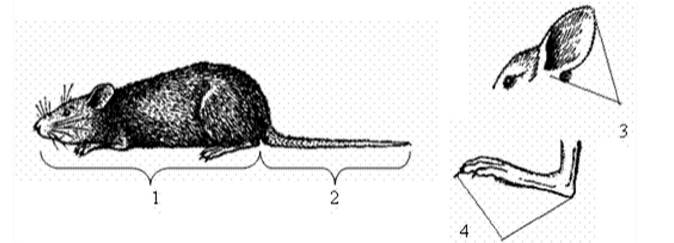
Fig. 341. Schemes of measurements in small mammals
The length of the hind FOOT is measured (using a vernier caliper, measuring ruler, or tape, depending on the size of the animal) in a straight line from the rear edge of the heel to the tip of the longest toe excluding the claw. Ear length is determined by measuring the distance from the lower edge of the ear notch to its apex excluding terminal hairs. If the ear notch is located above its base, the ear length is measured from the base to the apex of the auricle along its dorsal side. When measuring ungulates, it is recommended to take additional measurements (Fig. 342).

Fig. 342. Scheme of measurements in ungulates
1 - body length; 2 - tail length; 3 - foot length; 4 - ear length; 5 - height at the withers; 6 - trunk girth; 7 - oblique body length; 8 - foreleg length; 9 - hind leg length; 10 - hand length
Height at the withers is determined by the distance on the foreleg extended perpendicular to the animal's body axis, from the highest point of the nape to the tip of the hoof. Trunk girth is measured with a tape behind the Base of the forelimbs. Oblique body length is established by measuring with a tape the distance from the anterior edge of the shoulder-blade joint to the posterior PROJECTION OF THE ischial tuberosity. Foreleg length is measured with the limb extended, using a tape from the tip of the elbow joint to the tip of the hoof. Hind leg length is measured from the hip joint to the tip of the hoof of the longest toe across the knee and hock joints.
Many taxonomic groups of mammals and their species differ in the size of the Skull or its individual parts. Therefore, when identifying these animals, one often has to perform certain craniological measurements, the most common of which are the following (Fig. 343):

Fig. 343. Measurement of mammalian skulls
1 - total skull length; 2 - condylobasal length; 3 - zygomatic width; 4 - interorbital width;
5 - braincase width; 6 - nasal region width
Total skull length is the distance from the most anteriorly projecting point to the most posteriorly projecting point of the skull. Condylobasal skull length is the distance from the most anterior part of the premaxillary bones to the posterior surface of the occipital condyles. Zygomatic skull width is the distance between the most laterally protruding points of the outer surfaces of the zygomatic arches. Interorbital skull width is the width of the interorbital space at its narrowest point. Braincase width is the distance between the most prominent points on the lateral sides of this skull region. Nasal region width is the distance between the outer sides of the skull rostrum near the base of the canines. In addition, additional parameters are taken from the skull.
Skull height is the distance from the lowest point of the base of the braincase to the highest point of its vault. Alveolar length of the upper (or lower) molar row is the distance from the anterior edge of the alveolus of the first molar to the posterior edge of the alveolus of the last molar. Length of the nasal bones is the straight-line distance between the most anteriorly and posteriorly projecting ends of these bones. Height of the lower jaw is the distance from the indentation of its lower margin near the base of the angular process to the tip of the coronoid process (Fig. 344).
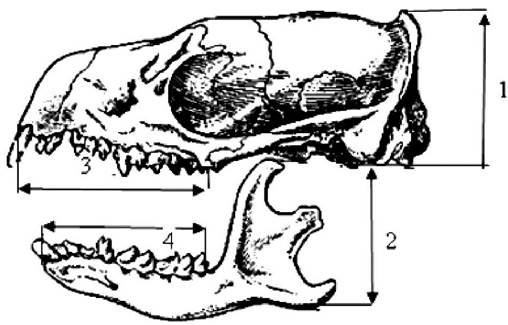
Fig. 344. Additional skull parameters of mammals
1 - skull height; 2 - lower jaw height; 3 - alveolar length of the upper tooth row;
4 - alveolar length of the lower tooth row;
An important characteristic of mammals is The Structure of the orbits (Fig. 345).
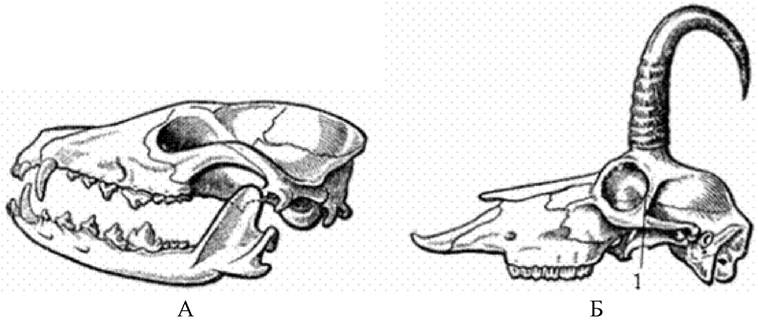
Fig. 345. STRUCTURE OF THE eye sockets in skulls of different mammals: wolf (A) and roe deer (B)
In carnivorous mammals, the eye sockets are not separated from the temporal fossa, whereas ungulates feature a bony bridge (Fig. B, 1).
Identification key for orders of the Class Mammalia
1 (12). Digits bear claws at the tips. Skull orbits are not separated from the temporal fossae by bony bridges (Fig. 3.26, a). Length of the nasal bones is less than 100 mm.
2 (9). Lower jaw has 2–3 pairs of incisors. Canines are present. Teeth of the upper and lower jaws form continuous rows or are separated by small gaps whose length is significantly less than the length of the molar tooth row.
3 (4). Snout is elongated into a mobile proboscis. Incisors of the inner pair in both upper and lower jaws are usually significantly larger than the others; if the sizes of all incisors are approximately equal, the outer ones closely adjoin the canines. Insectivores (Insectivora).
4 (3). Snout is not elongated into a mobile proboscis. Incisors of the inner pair in the upper and lower jaws are equal in size to (or smaller than) the other incisors, or are absent. A small gap is present between the outer incisors and the upper canines.
5 (6). Forelimbs are modified into wings. Their digits, except for the first, are greatly elongated and connected by a thin flight membrane. The flight membrane also connects the forelimbs to the hindlimbs and the latter to the tail. Length of the third digit exceeds body length. The hard palate of the skull has a wide and deep notch at the front, resulting in the left and right upper incisors being separated by a large gap; the inner pair of incisors is absent. Bats (Chiroptera).
6 (5). Forelimbs are not modified into wings. All digits are significantly shorter than body length. There is no notch on the anterior margin of the hard palate. Incisors of the left and right sides of the upper jaw meet.
7 (8). Forelimbs are not modified into flippers. Forelimbs and hindlimbs are separated from the trunk above the elbow and knee joints. Digits of the forelimbs are separated from one another. Tooth rows typically feature prominently large carnassial teeth (the last upper premolar and the first lower molar). If these teeth do not stand out in size, the length of the two posterior upper molars is less than their width. Carnivores (Carnivora).
8 (7). Forelimbs are shaped like flippers. Elbow and knee joints are concealed beneath the Skin of the trunk, and the limbs are set off by no more than half of the forearm and shank. Digits of the forelimbs are connected by a common skin web. Carnassial teeth are absent. Length of the two posterior upper molars exceeds their width. Pinnipeds (Pinnipedia).
9 (2). Lower jaw has only a single pair of incisors. Canines are absent. Upper incisors are separated from the molars by a large toothless gap (diastema) whose length exceeds the length of the molar row. 10(11). Upper jaw possesses small columnar second incisors situated behind the large chisel-like first pair of incisors. Each side of the lower jaw bears 5 molars. Lagomorphs (Lagomorpha).
11(10). Upper jaw lacks small columnar second incisors behind the powerfully developed chisel-like first pair of incisors. Each side of the lower jaw bears only 3–4 molars. Rodents (Rodentia).
12 (1). Tips of the digits terminate in hooves. Skull orbits are separated from the temporal fossae by bony bridges. If they are not separated from the temporal fossae (wild boar), the length of the nasal bones exceeds 100 mm.
13(14). Feet bear one hoof each. Upper jaws have 3 chisel-shaped incisors on each side. Orbits are separated from the temporal fossae by a bony bridge. All molars are of approximately equal size. Posterior molars have a flat surface with a complex pattern of enamel folds (lophodont type). Odd-toed ungulates (Perissodactyla).
14(13). Feet bear 4 or 2 hooves; if 4, the front ones are significantly larger than the hind ones. Upper jaw usually lacks incisors; if present, the Orbit is not separated from the temporal fossa. Molars are lophodont or bunodont; the posterior ones are larger than the anterior ones. The most accessible group for study during summer fieldwork comprises small mammals, combined into the micromammal category. METABOLISM/2.html">THE CONCEPT OF "micromammals" is not taxonomic and refers primarily to an ecological or survey group of mammals. Its taxonomic composition is determined by regional faunal features and extends to several families of small terrestrial mammals from the orders Insectivora and Rodentia, primarily shrews (family Soricidae) and mouse-like rodents (superfamily Muroidea). Ground squirrels (family Sciuridae) and small mustelids (family Mustelidae) are occasionally included in this survey group. Small mammals constitute the bulk of the species richness of the Ukrainian theriofauna, and in terms of population density and biomass, they represent the dominant mammalian group in most regions of Ukraine. The majority of their genera are either insectivorous (shrews) or herbivorous—both folivorous (voles) and granivorous (mice). Most species are terrestrial, while some have adapted to arboreal life (dormice), subterranean life (mole rats), and semi-aquatic habitats (Water shrews). Most of them are highly specialized and restricted to specific habitat types. All species are resident, and some undergo hibernation.
1. General characteristics of mammals.
2. Structure of mammalian skin.
3. Skeleton of mammals.
7. Digestive System of mammals.
5. Respiratory system of mammals.
6. Excretory system of mammals.
7. Circulatory system OF mammals.
8. Nervous system of mammals.
9. Mammalian Reproductive System.
10. Reproduction and development of mammals.
13. The Role of mammals in nature and human life.
14. Classification of mammals.
15. Comparative characteristics of mammals and reptiles.
16. Distribution of mammals across the globe.
Last update: 19/08/2026
Editorial and Educational Adaptation: This material has been compiled based on the primary/original source text. The project team performed an editorial review, corrected technical inaccuracies, structured sections, and adapted the content for an educational format.
What was processed:
- elimination of formatting defects (OCR errors, structural breaks, corrupted characters);
- editorial organization of content;
- standardization of terminology in accordance with academic sources;
- verification of factual statements against the original source text.
All mentions of the author, publication year, and origin of the primary text have been preserved in accordance with the source.