Plant Physiology - Musiyenko, M. M. 2001
Physiology of Plant Growth and Development
Germination. Primary and secondary growth
Germination
Plant growth begins with seed germination. The germination period is a crucial stage in a plant's ontogeny, significantly influencing its subsequent growth, development, and productivity. Research has established that final crop yield correlates better with early seedling emergence than with any other parameter. Agronomic practice shows that high-quality seeds germinate rapidly and uniformly. However, in most cases, seeds of various agricultural crops germinate unevenly due to variable seed quality established during maturation. The longer the period from sowing to seedling emergence, the greater the likelihood of the germinating seed being damaged by soil-borne microorganisms and Fungi. Therefore, Methods involving the application of physiologically active substances, microelements, Vitamins, and Other Compounds, as well as physical factors, are widely studied to enhance seed germination speed. This trait is also vital for breeding work.
Currently, it has been established that a reliable criterion for germination is not the visible protrusion of the seed coat, as previously believed, but rather The entry of apical meristem Cells into the DNA Synthesis phase and mitosis. This is because, under certain conditions, the radicle may emerge while the seedling fails to develop. Consequently, the temporal parameters of the first Cell Cycle in the ROOT meristem—specifically its marker processes, such as DNA SYNTHESIS AND mitosis—can be of practical importance in determining seed physiological activity.
The germination process also encompasses those events that occur within the seed before any visible signs of growth appear. In angiosperms, a seed consists of an embryo, endosperm, and seed coat. Depending on the primary reserve substances, seeds are classified as oil-, starch-, or protein-storing. All plant seeds contain phytin. Its main function is to supply the embryo with phosphorus compounds. Simultaneously, phytin contains minor amounts of K+, Mg2+, and Ca2+. Seeds also contain Enzymes and Hormones, albeit in an inactive state. The distribution of substances within the seed is uneven; for instance, embryonic Tissues are enriched with mineral elements, Amino Acids, enzymes, and hormones, with particularly high concentrations found in the embryonic rootlet (radicle).
Certain enzymes exist in a bound, inactive state and become active only under METABOLISM/18.html">The Influence of imbibition. However, A number of enzymes are synthesized de novo, which requires messenger RNAs.
Based on their time of formation, mRNAs in germinating seeds are divided into three types. The first type is the so-called pre-existing, or residual mRNA, which was transcribed from DNA as early as the seed Embryogenesis stage. However, its amount is negligible, and therefore its role is minor. The second type refers to RNA that was also transcribed during embryogenesis, but has not undergone Processing and is consequently inactive. During imbibition, necessary transformations occur within it, ensuring the synthesis of Proteins specific to germination, particularly hydrolase enzymes. Finally, the third type is newly synthesized RNA, which appears 1–2 hours after soaking. This RNA is transcribed during germination from DNA, involving RNA polymerase I, and is responsible for synthesizing specific protein enzymes. It is believed that Protein Synthesis during germination initially relies on Ribosomes formed during embryogenesis; later, roughly 8 hours after seed imbibition, an enhanced formation of ribosomal RNA is observed, and new ribosomes are assembled.
Phytohormones, particularly Gibberellins, play a major role in regulating enzyme production. The embryo serves as the source of gibberellins. In dry seeds, gibberellins are present in a bound state; they are activated and partially synthesized de novo under the influence of imbibition. As Hydrolases, particularly Nucleases, catalyze The breakdown of Nucleic Acids, purine bases emerge, which give rise to the phytohormone cytokinin. Simultaneously, under the action of proteases, proteins break down into amino acids, including Tryptophan, which acts as a precursor to the phytohormone auxin. Cytokinins and Auxins regulate embryo growth.
The enzymes pectinase and cellulase also promote the growth of embryonic Organs. Endomannanases cleave the Polysaccharides (Mannans) that bind Cellulose fibrils, thereby enabling the embryonic axis to overcome the resistance of the endosperm. Abscisic acid inhibits The production of the enzyme mannanase, which is one of the reasons for its inhibitory effect on seed germination. For nuclear division to begin, DNA reduplication is required. DNA synthesis in germinating seeds starts significantly later than the synthesis of RNA and proteins. Characteristically, in dry seeds, the majority of cells reside in the (presynthetic period) state.
The Development of the embryo within the seed requires specific environmental conditions, most notably Water. Air-dry seeds contain between 5% and 15% of water and remain in a state of enforced dormancy. However, quite often, even in the presence of optimal conditions, seeds fail to germinate until specific changes related to maturation physiology take place within them. In other words, seeds always possess mechanisms that synchronize the timing of germination with the onset of a seasonal climate favorable for the growth of that Organism.
In these mechanisms, the outer seed coats play a significant role, as they are often impermeable to water and oxygen, and sometimes contain growth inhibitors. In such seeds, mechanical damage to the coats (scarification) can accelerate germination processes. Under natural conditions, similar effects can be brought about by various Bacteria that degrade the seed coat. Some fruits and seeds contain growth inhibitors, most commonly abscisic acid. It is likely that during prolonged soaking, these inhibitors are washed out, and their suppressive effect disappears. Concurrently, the concentration of growth stimulants, such as gibberellins, may increase.
Finally, Temperature plays a crucial role in germination processes. Optimal germination temperatures typically correspond to those characteristic of the plant species' native habitat. For the seeds of certain plant species to germinate, they must undergo exposure to low temperatures.
Some plants require light for their seeds to germinate. Following imbibition, light often breaks seed dormancy in certain plant species, a process controlled by phytochromes.
Following the dormancy period, embryo development begins. This is driven by water adsorption through the micropyle and seed coats via colloids such as proteins, starch, hemicelluloses, and pectic substances. The Swelling of these substances generates sufficient force to rupture the seed coat. Subsequently, via osmosis, water moves from Cell to Cell, and in The process of transport, it activates a wide range of biochemical processes. Above all, water participates in the Hydrolysis of reserve nutrients.
Normal germination requires specific temperatures that influence the Rate of Enzymatic reactions, as well as an unhindered supply of oxygen. Oxygen is necessary to sustain aerobic Respiration processes. The physiology of germination is linked to the functioning of two active zones: the reserve nutrient stores and the embryonic region. Since the processes of nutrient breakdown are already familiar to us, suffice it to say—leaving aside the details of hydrolysis—that all breakdown products are transported to the embryonic growth zone. The energy required for synthetic processes is supplied through respiration. All of this leads to a sharp decrease in the seed's dry mass, a process that continues until green leaves appear on the seedling and autotrophic Nutrition begins.
Embryo growth occurs through Cell Division and differentiation. The first sign of growth is The Emergence of the embryonic root (radicle). It exhibits positive geotropism, thus growing downwards and anchoring the seed in the soil. Next, the plumule (or SHOOT bud) emerges, exhibiting negative geotropism, meaning it grows upwards. Two Types of germination are distinguished, depending on whether the cotyledons remain underground or are lifted above the soil surface (Fig. 159).
Class="center">
Fig. 159. Etiolated underground seedlings and changes in their shape induced by light during the transition to an above-ground lifestyle: a — cereals; b — dicots with hypogeal germination; c — dicots with epigeal germination: 1 — coleoptile, 2 — mesocotyl, 3 — primary compound leaf, 4 — epicotyl, 5 — hypocotyl
In dicots, through the elongation of the internode located directly beneath the cotyledons (hypocotyl), the cotyledons are lifted to the surface. This type of germination is called epigeal. If, however, the internode located above the cotyledons (epicotyl) elongates, the cotyledons remain underground, and this type of germination is termed hypogeal. In both cases, the curved section of the internode protects the cotyledon from damage, and upon emerging into the light, this region straightens out immediately. This process is controlled by Phytochrome. In cereals, which also belong to monocots, the plumule is protected by a sheath—the coleoptile, which is characterized by positive phototropism and negative geotropism.
The first leaf emerges through the coleoptile and rapidly expands under the influence of light (Fig. 160). Light triggers a series of phytochrome-controlled reactions known as photomorphogenesis. These changes drive the transition from etiolated growth to normal growth. The cotyledons transform into true leaves, chlorophyll synthesis takes place, and the seedling shifts to an autotrophic mode of nutrition.
Thus, normal GROWTH AND DEVELOPMENT of seedlings require light. As soon as the first green leaves appear, Photosynthesis begins. At this point, the seedling phase concludes, and the plant enters the juvenile phase.
In the light, Plastids develop from proplastids within the leaf mesophyll. Furthermore, even before plastid growth and The formation of the granal-lamellar Structure are complete, the synthesis of enzymes catalyzing the dark reactions of photosynthesis begins. The carboxylation enzyme RUBISCO is present in seedlings even before the leaves turn green. At the same time, de novo synthesis of this same enzyme occurs in the light. The initiation of photosynthesis also requires the presence of the primary CO2 acceptor, ribulose-1,5-bisphosphate. It is formed as an intermediate product of the Pentose Phosphate Pathway of respiration. It is known that even before germination, the key enzyme of this respiratory pathway—glucose-6-phosphate dehydrogenase—is present in the embryo. During germination, The activity of this enzyme increases sharply, leading to the accumulation of the CO2 acceptor. Once The Calvin Cycle begins operating, the activity of glucose-6-phosphate dehydrogenase declines.
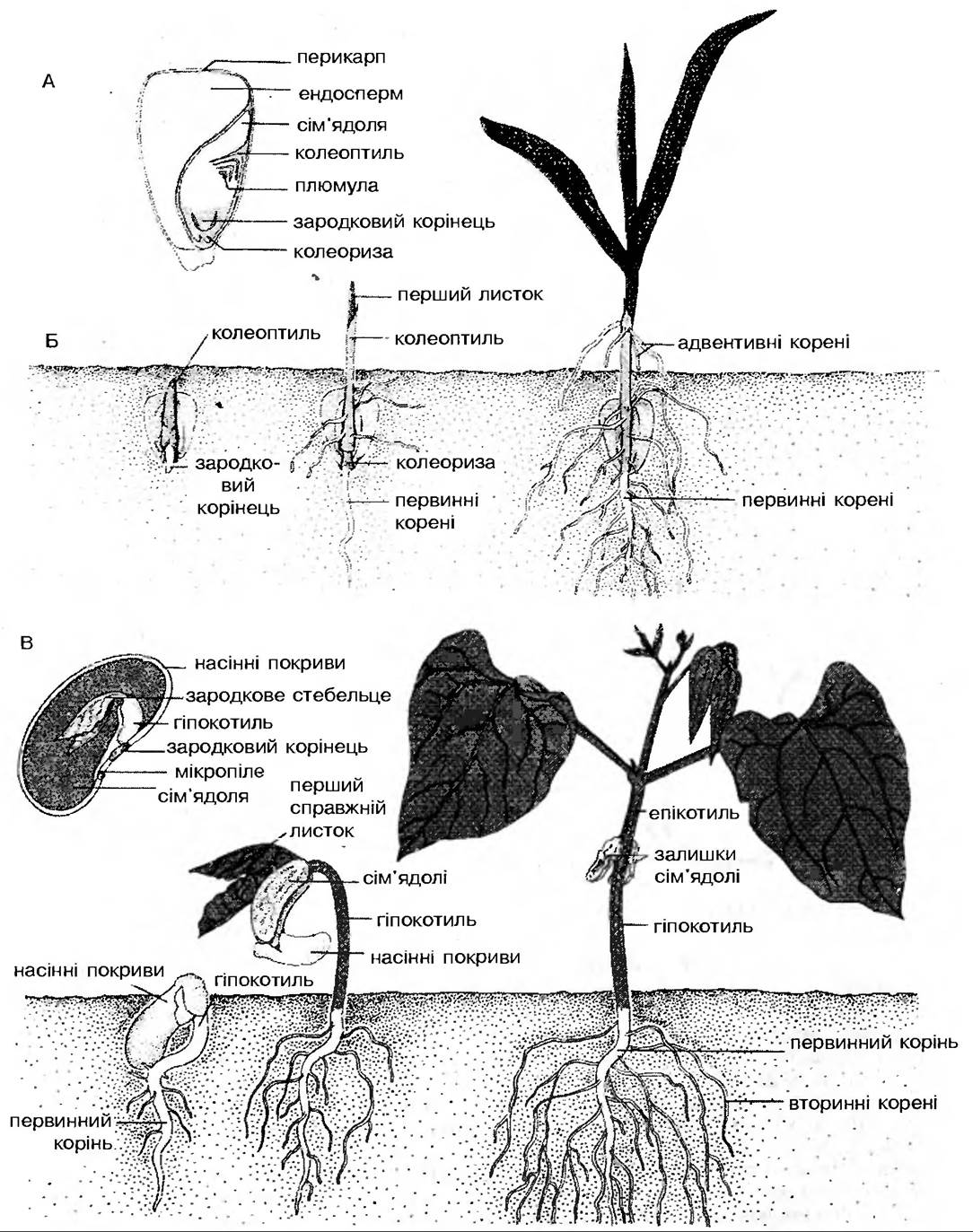
Fig. 160. Seed germination (A) and seedling development (B) in monocot and dicot (C) plants
Thus, germination begins with imbibition. In some species, this alone causes the seed coat to rupture. The subsequent stage of hydrolysis and transport of reserve nutrients is accompanied by intensive respiration. Next, through cell expansion (stretching) and the resumption of water uptake, the embryo enlarges. Finally, upon the emergence of the radicle and the rupture of the seed coat, the seed is considered germinated.
Seed germination depends on numerous conditions. In nature, these are rarely all optimal, and consequently, the germination of seeds even within the same species can span years. This ensures the survival of a viable seed reserve even if unfavorable conditions cause the already germinated seeds to perish. Overall, seed germination represents one of the most critical stages in the life of a plant organism, upon which the survival of a given species largely depends.
Last update: 07/08/2026
Editorial and Educational Adaptation: This material has been compiled based on the primary/original source text. The project team performed an editorial review, corrected technical inaccuracies, structured sections, and adapted the content for an educational format.
What was processed:
- elimination of formatting defects (OCR errors, structural breaks, corrupted characters);
- editorial organization of content;
- standardization of terminology in accordance with academic sources;
- verification of factual statements against the original source text.
All mentions of the author, publication year, and origin of the primary text have been preserved in accordance with the source.