Pharmacognosy with the Basics of Plant Biochemistry - Kovalyov, V. M. 2004
Special Part
Essential Oils
Triterpenes and Triterpene Saponins
Triterpenes contain an isoprene unit C5H8 in their molecules, which repeats six times to form compounds with the overall formula C30H48. The Structure of triterpenes is typically cyclic, with the exception of squalene, which serves as the biogenetic precursor of triterpenes and Steroids.
Triterpenoids occur in plants both in a free state and as Glycosides, which are referred to as triterpene saponins.
Modern biochemical concepts of biosynthesis indicate that the triterpene C30-precursor is synthesized by the "tail-to-tail" Condensation of two farnesyl C15-residues, which then undergoes several intermediate steps to form squalene.
Squalene is converted into squalene-2,3-oxide, in which the C-3 atom is asymmetric. It then undergoes cyclization. This reaction distinguishes photosynthetic plants, which produce cycloartenol, from non-photosynthetic organisms (such as Fungi and animals), whose metabolic product is lanosterol. The pathway from squalene-2,3-oxide to pentacyclic triterpenes, such as α-amyrin, is supported by substantial experimental data.
Depending on the number of rings in the molecule, triterpenoids are divided into tetracyclic and pentacyclic groups, with the latter being more widespread. Over 3,000 triterpene compounds are known, structurally belonging to 20 main types.
Class="center">General biosynthesis pathway of triterpenes and steroids

The MAIN TYPES OF tetracyclic triterpenes are derivatives of parent Hydrocarbons: lanostane, cycloartane, and dammarane.
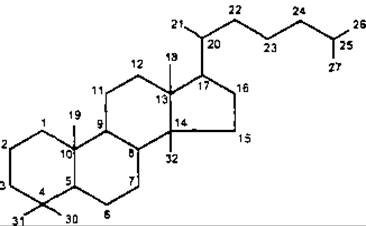
Lanostane

Cycloartane
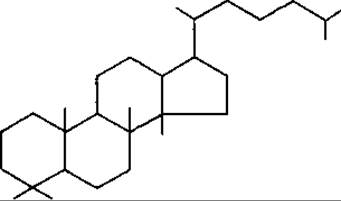
Dammarane
The lanostane formula illustrates the numbering of the carbon core, where the C-28 and C-29 atoms are reserved for additional carbon atoms attached to C-24 in plant sterols.
The dammarane subgroup includes the saponin aglycones of Asian ginseng (*Panax ginseng*, Araliaceae). Cycloartane derivatives have been found in the Fabaceae, Ranunculaceae, and other families.
The most widespread types of pentacyclic saponins include the lupane, hopane, friedelan, ursane (α-amyrin), and oleanane (β-amyrin) types.
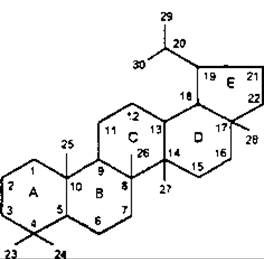
Lupane
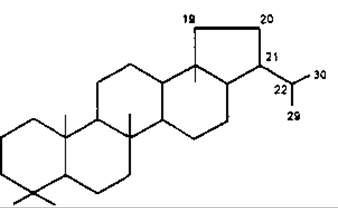
Hopane
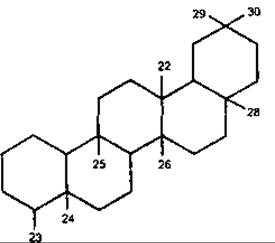
Friedelan
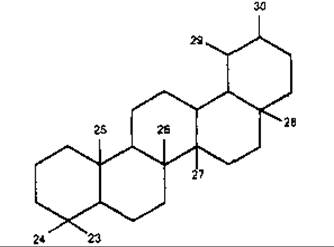
Ursane
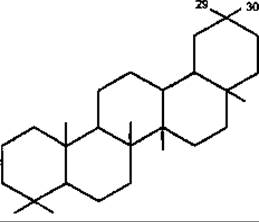
Oleanane
Functional groups at positions C-2, C-3, C-4, C-14, C-16, C-17, and C-19 may include hydroxyl, methyl, methoxyl, aldehyde, keto, lactone, and ester radicals. Triterpenoids containing aldehyde or lactone groups, or ester linkages, are unstable and can undergo changes during plant extraction Procedures. A significant portion of pentacyclic compounds contains an acidic group. Typically, sugar residues substitute the hydroxyl group at C-3, the carboxyl group, or both together, forming Disaccharides. A double bond is most frequently found at the C12-C13 or C20-C21 positions.
Distribution
Triterpenoids have been identified in more than 70 families, frequently serving as chemotaxonomic markers for them. Derivatives of α- and β-amyrin, such as oleanolic, ursolic, and betulinic acids, are the most widespread in nature, whereas saponins exhibit greater physiological activity. Triterpenoids are localized in resins, latex, and integumentary Tissues of numerous plants, such as the Rosaceae family (Potentilla erecta, Rubus caesius, etc.), as well as in fungi (Inonotus, Ganoderma). The Biological Role of triterpenoids in plant life activity has not yet been fully elucidated.
Physicochemical Properties
Free triterpenoids are generally crystalline compounds with definite melting points and are non-volatile. They are lipophilic substances soluble in organic Solvents and insoluble in Water. Conversely, their glycosides (saponins) are soluble in aqueous-alcoholic solutions and water. Triterpenoids containing a carboxyl group are soluble in low-concentration aqueous-alcoholic solutions. Their solutions exhibit a neutral or acidic pH, with acidity caused by the carboxyl groups. Acidic triterpenoids form salts with monovalent metals (which are water-soluble) and with divalent or polyvalent metals (which are water-insoluble).
Triterpenoids share many properties with steroids and give a positive Liebermann-Burchard reaction. They can be distinguished from steroids by the Rosenheim reaction with trichloroacetic acid or the Brieskorn-Briner reaction with chlorosulfonic acid. Alcoholic hydroxyl groups in the molecule can be acetylated; the derivatives are identified using spectral Methods (IR, NMR, PMR).
Triterpenoid molecules possess numerous centers of Asymmetry and double bonds within their cyclic structures, which provides the prerequisites for geometric and optical isomerism. Plant raw material often contains a mixture of conformational isomers.
Among triterpenoids, triterpene glycosides find medical application, though specific pharmacological activities—such as anti-inflammatory, antitumor, and hypoglycemic effects—have also been established for certain free triterpenoids. Triterpenoids typically accompany primary BIOLOGICALLY ACTIVE SUBSTANCES, contributing to the overall therapeutic effect, for instance, in marigold flowers, hawthorn raw material, dandelion and chicory roots, etc.
Key Triterpenoids
Lupeol is a pentacyclic triterpenoid of the lupan type, first isolated from the yellow lupine (Lupinus luteus, Fabaceae). Either alone or along with α- and β-amyrin, it is localized in the latex or bark of plants such as black alder (Alnus glutinosa, Betulaceae), mistletoe shoots (Viscum album, Loranthaceae), and others.
Betulin was the first triterpenoid substance isolated from plants (Lowitz, 1878). It is found in significant quantities in birch bark (up to 2.5%) and the wood of other trees, exhibiting antiseptic properties. Betulinic acid is also present in the bark of various trees and in herbs, such as hedge hyssop (Gratiola officinalis, Scrophulariaceae). Hedge hyssop herb is being intensively studied as a raw material with antiviral activity.

Lupane-type triterpenoids
R = H — Lupeol
R = СН2ОН — Betulin
R = СOOН — Betulinic acid
Friedelin is a pentacyclic triterpenoid of the friedelane type; it is found in the cork integumentary tissues of plants, as well as in the genus Crataegus (Rosaceae). It exhibits anti-inflammatory properties.
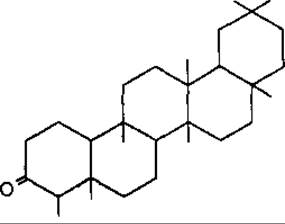
Friedelin
α-Amyrin belongs to the ursane group, possesses a cis-configuration of the D/E rings, and is frequently found in resins. Ursolic acid was first isolated from the leaves of bearberry (Arctostaphylos uva-ursi, Ericaceae), from which it derived its name. It is also found in other representatives of Ericaceae, as well as in mistletoe, sage, hawthorn, lesser periwinkle, and others. It exhibits cytostatic and anti-inflammatory properties and lowers Blood Cholesterol levels.
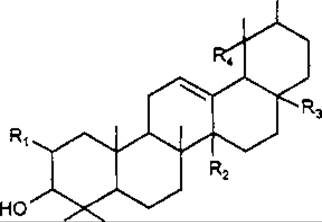
Ursane-type triterpenoids |
R1 |
R2 |
R3 |
R4 |
α-Amyrin |
H |
CH3 |
CH3 |
H |
Ursolic acid |
H |
CH3 |
COOH |
H |
Quinova acid |
H |
COOH |
COOH |
H |
Tormentic acid |
OH |
СН3 |
COOH |
OH |
Crataegolic acid |
H |
СН3 |
OH |
H |
Quinova acid occurs in both free state and as the β-quinovoside glycoside in cinchona bark (Cortex Cinchonae). Tormentic acid, which has a closely related structure and forms various spatial isomers, has been studied in the rhizomes of tormentil (Rhizomata Tormentillae). Experimental studies show that tormentic acid glycosides exhibit hypoglycemic activity. Crataegolic acid from the leaves of hawthorn (Crataegus spp.) lacks a carboxyl group, yet demonstrates acidic properties.
β-Amyrin belongs to the oleanane-type triterpenes and is one of the most widespread triterpenoids in the plant kingdom. The A/B, B/C, and C/D rings in the β-amyrin molecule have a trans-configuration, whereas the D/E rings feature a cis-configuration, similar to ursane-type compounds. It occurs in the free state and as fatty acid esters, and is characteristic of most plants containing milky sap. Glycyrrhetinic acid, which is found in significant quantities in licorice roots (Radices Glycyrrhizae) and possesses anti-inflammatory properties, is a derivative of β-amyrin.

Oleanane-type triterpenoids
R1 = R2 = CH3 — β-Amyrin
R1 = CH3, R2 = COOH — Oleanolic acid
R1 = CHO, R2 = COOH — Gypsogenin
R1 = CH2OH, R2 = COOH — Hederagenin
Oleanolic acid occurs in plants in free form and as a saponin aglycone. It is found in the leaves of the olive tree (Olea europea, Oleaceae), from which it derives its name, as well as in mistletoe, various species of sage, beggar-ticks, goldenrod, and others.
Gypsogenin is the aglycone of acidic saponins from the Caryophyllaceae family and is found in significant amounts in soapwort roots (Radices Saponariae). Hederagenin is the aglycone of saponins from ivy (Hedera helix, Araliaceae) and black cumin seeds (Nigella sativa, Ranunculaceae). The aglycone moiety of aescin, a glycoside from horse chestnut seeds, consists of protoaescinogenin and barringtogenin, which also belong to oleanane-type triterpenoids.
A separate group of compounds comprises the triterpenoids of the Asteraceae family: taraxasterol, arnidiol, and its spatial isomer faradiol.

Compound name |
R |
Source |
Taraxasterol |
Н |
Taraxacum, Cichorium, Tanacetum, Centaurea |
Arnidiol |
ОН |
Calendula, Arnica |
Faradiol |
ОН |
Taraxacum, Arnica |
Cucurbitacins and limonoids are triterpene compounds that form distinct groups. Cucurbitacins are responsible for the bitter taste of plants belonging to the Cucurbitaceae family. When isolated in pure form, they exhibit cytostatic properties, but are highly toxic.

Cucurbitacin A

Limonin
Limonoids are modified triterpenes identified in the Rutaceae family and also possess a bitter taste. Limonin is a representative member of this group. Certain limonoids exhibit antitumor, antimycotic, and antiviral properties, while limonoid derivatives are used as insecticides.
Triterpene saponins
Saponins (from Latin *sapo* — soap) are glycosides of PLANT AND ANIMAL origin, the majority of which exhibit surface-active and hemolytic properties, as well as toxicity toward cold-blooded animals.
Like other glycosides, saponin molecules consist of a sugar moiety and an aglycone, referred to as a sapogenin. Based on the type of aglycone, triterpene saponins are classified into dammarane, cycloartane, lupane, friedelan, ursane, oleanane, and other groups. These glycosides contain one or two carbohydrate chains of linear or branched structure. Most commonly, the carbohydrate chain is located at the C-3 position, although substances containing a carbohydrate residue attached to the carboxyl group of the aglycone also occur. The carbohydrate chain may contain from 1 to 11 Monosaccharides: D-glucose, D-galactose, D-xylose, L-arabinose, L-ribose, D-fucose, L-rhamnose, and D-glucuronic acid. Some glycosides incorporate organic acid residues, such as angelic, tiglic, cinnamic, acetic, and others.
Distribution and biological Functions in plants. Saponins have been detected in 900 plant species belonging to 90 families. Tetracyclic triterpene saponins are found in a limited group of families, such as Araliaceae, Cucurbitaceae, and a few others. The pentacyclic group is much more widespread in nature, occurring in plants across 40 families, notably Fabaceae, Caryophyllaceae, Asteraceae, Araliaceae, Polygalaceae, Lamiaceae, and others. Among HIGHER SPORE PLANTS, some fern species contain triterpene saponins. Saponins occur very rarely in the animal Organism.
Saponins have been detected in all plant parts, but they predominantly accumulate in roots, rhizomes, tubers, and fruits, and to a much lesser extent in the bark and aerial parts. The saponin content in various plant species varies within a wide range — from traces up to 10% (soapbark tree — Quillaja saponaria, Rosaceae). Saponin content fluctuates depending on the vegetation period and climatic conditions.
In plants, saponins occur either in a free state or combined with other substances. Most often, several saponins are present, with one or two predominating quantitatively. Studies on plant saponins have revealed certain patterns in their accumulation. Plants containing high amounts of Essential Oils are generally poor in saponins. A. Rosenthaler and L. Ruzicka explain this by the fact that isoprene can follow two biosynthetic pathways: one leads to the accumulation of mono- and sesquiterpenes, which are the main constituents of essential oils, while the other leads to The formation of di- and triterpenes, and subsequently to the accumulation of triterpene saponins.
Despite the widespread occurrence of triterpene saponins in nature and their long-standing use by humans, they remain insufficiently studied due to The complexity of their chemical and stereochemical structures. They have been investigated by numerous foreign and domestic scientists (L. Ruzicka et al., Z. Chernikova, A. Khorlin, Yu. Ovodov, G. Elyakov, etc.).
There are three main hypotheses regarding The Physiological Role of saponins in plants: saponins may serve as an intermediate link between low-molecular-weight and high-molecular-weight carbon-containing compounds; they may act as reserve substances (due to their high sugar content); or they may play a protective role by deterring insect herbivores.
Triterpene saponins affect plant Cell permeability, a property associated with their surface activity. Low concentrations of saponins accelerate seed germination and Plant GROWTH AND DEVELOPMENT, whereas high concentrations inhibit them.
Physicochemical properties. Sapogenins are crystalline substances with distinct melting points. Most glycosides are amorphous substances lacking a definite melting point (they decompose upon heating). Crystalline saponins have been obtained only for those containing no more than four monosaccharide residues.
The solubility of saponins depends on their structure and, primarily, on the number of monosaccharide units in their molecule. Saponins containing 2-4 sugar residues dissolve poorly in water, but their solubility increases with a larger number of residues. Aqueous solutions and herbal infusions containing saponins produce a persistent foam upon shaking. Some saponins can foam even at dilutions of 1:100,000. This foaming ability is due to the fact that saponins reduce surface tension at the water-air interface. Unlike soap lather, saponin foam exhibits a neutral or acidic reaction. The ability of saponins to form persistent foam is a specific property widely used for their Qualitative and quantitative determination in plants, although certain saponins yield solutions that do not foam upon shaking.
Saponins are less soluble in ethyl and methyl alcohols. Heating increases their solubility in alcohols, but upon cooling, the saponins precipitate out. Saponins are insoluble in ether, chloroform, acetone, and other organic solvents.
All saponins are unstable in the presence of strong acids, which cause their Hydrolysis. Many saponins form complexes with Proteins, Lipids, and other molecules. With cholesterol, they form water-insoluble, stable compounds. The most characteristic feature of saponins is their ability to induce hemolysis—the destruction of red Blood Cells with the release of Hemoglobin, which results from the ability of saponins to bind with cholesterol in Erythrocyte membranes. The hemolytic action of saponins is based on their capacity to dissolve the lipoid component of The erythrocyte membrane, converting it from semipermeable to permeable. As a result, hemoglobin escapes from THE RED BLOOD cells into the Blood Plasma, turning the blood bright red and transparent. Sapogenins do not exhibit hemolytic activity. Hemolysis has traditionally been used for the qualitative and Quantitative Assay of saponins in plant material.
Because of their hemolytic activity, saponins must not be administered intravenously or subcutaneously.
Saponins are absorbed very slowly through intact Skin, which may lead to inflammation or suppuration. Inhalation of saponins causes severe irritation of the Upper Respiratory Tract mucosa and eyes (sneezing, coughing, lacrimation).
Ingestion of small doses is harmless, whereas large doses irritate the gastrointestinal mucosa, causing vomiting and diarrhea. Saponins are particularly toxic to lower vertebrates and fish.
Methods of isolation and investigation. Isolation: Plant material is defatted with petroleum ether, ethyl ether, or carbon tetrachloride to break down complexes of saponins that are insoluble in water and aqueous alcohols. Total saponin extracts are typically obtained by treating the raw material with polar solvents such as methanol, ethanol, or aqueous alcohols. Other methods rely on the ability of saponins to form water- or aqueous-alcohol-insoluble salts with barium hydroxide or lead acetate, or complexes with cholesterol, Tannins, and proteins. These salts are subsequently decomposed with sulfuric acid; cholesterol complexes are broken down by extracting the cholesterol with benzene or ether; tannin complexes, by extraction with an aqueous zinc oxide suspension; and Protein Complexes, by extracting the saponins with polar organic solvents.
Chromatographic purification methods utilizing aluminum oxide, silica gel, and activated charcoal are very widespread.
Saponin fractions are mixtures of glycosides with very similar structures and properties; their Separation has only recently become feasible thanks to chromatographic techniques, though it remains a challenging task.
Identification. Preliminary detection of saponins in plant material involves tests based on their physical properties (foaming tests and DETERMINATION OF CHEMICAL nature); chemical properties (precipitation and color reactions); and biological properties (hemolysis); however, these methods lack sufficient Specificity. The most reliable results are provided by chromatographic Methods for the detection and identification of saponins. Recently, advanced Physicochemical methods (adsorption Chromatography, UV and IR spectroscopy) have been employed in saponin research.
Quantitative determination. Biological, gravimetric, and physicochemical methods are used for the quantitative assay of saponins. For a long time, the primary methods for detecting saponins in plant raw Materials were the Determination of the hemolytic index and the foam number.
The hemolytic index is defined as the lowest concentration of saponins capable of causing complete hemolysis of erythrocytes within 24 hours.
The saponin index, or foam number, refers to the lowest concentration of an infusion (adjusted to a unit mass of the substance) that produces a persistent foam lasting for at least one minute. The foam number is a reliable indicator only when the raw material has a high saponin content, as accompanying substances can also cause foaming. This method is mainly used for the preliminary screening of medicinal plant materials.
Saponin content can also be determined gravimetrically. This method is based on the ability of saponins to be precipitated from aqueous solutions by ether, strong alcohol, and certain salts (such as barium hydroxide). Gravimetric methods have not found widespread application due to the complexity of isolation, purification, and the difficulty of isolating individual compounds.
There are no universal physicochemical Methods for determining saponins in raw materials; procedures that work reliably for certain saponins are often unsuitable for others.
Biological activity and application. Plant materials containing triterpene saponins are used in medicine, as well as in the food and light industries. Saponins possess mucolytic properties and are therefore used to treat dry, lingering coughs (in species of Polygala, Polemonium, and Primula). Their surface activity facilitates expectoration, allowing the mucus altered by saponins to be easily discharged. The irritant effect of saponins on the gastric mucosa reflexively stimulates the secretion of all glands, which also exerts a therapeutic effect on the Bronchi. However, it should be kept in mind that an excess of saponins will irritate the mucous membranes of The Stomach and intestines.
Certain saponins exhibit diuretic effects (e.g., Java tea, field horsetail), while others tone the Central Nervous system or exert hypotensive, anti-inflammatory, and antimicrobial effects. It has also been established that triterpene saponins with a low hemolytic index do not significantly affect the course of atherosclerosis, but they do stimulate the central nervous system (e.g., saponins from Araliaceae). Conversely, saponins with a high hemolytic index demonstrate pronounced therapeutic efficacy against atherosclerosis.
Saponins enhance the solubility, transport, and absorption of other biologically active substances (BAS), meaning that even low concentrations of active ingredients can produce a therapeutic effect in the presence of saponins.
The emulsifying properties of saponins are widely utilized to stabilize various dispersed systems (emulsions and Suspensions).
In biochemical laboratories, saponins are used for the Quantitative determination of sterols. Individual saponins are also utilized in the manufacture of Vaccines.
In crop production, saponins are used as seed germination stimulants and cell growth enhancers.
Information regarding the medicinal properties of plant materials and saponin-containing preparations is provided in Table 14 of the Appendices.
Last update: 06/08/2026
Editorial and Educational Adaptation: This material has been compiled based on the primary/original source text. The project team performed an editorial review, corrected technical inaccuracies, structured sections, and adapted the content for an educational format.
What was processed:
- elimination of formatting defects (OCR errors, structural breaks, corrupted characters);
- editorial organization of content;
- standardization of terminology in accordance with academic sources;
- verification of factual statements against the original source text.
All mentions of the author, publication year, and origin of the primary text have been preserved in accordance with the source.