BIOCHEMISTRY - Laboratory Practical - NAU 2015
MODULE I
BIOCHEMICAL COMPONENTS OF THE CELL
Laboratory Work 4
DETERMINATION OF CHEMICAL PARAMETERS OF FATS
Objective: to investigate the main chemical parameters of fats — saponification value, acid number, ester value, iodine value, peroxide value; to calculate the glycerol content in fat; to compare several fats based on their chemical parameters.
Basic Theoretical Background
Fats, or Lipids, are bioorganic compounds diverse in Structure and function, united by their insolubility in polar Solvents (primarily Water) and solubility in non-polar organic solvents (acetone, chloroform, diethyl ether, etc.). Fats vary in appearance, color, odor, consistency, and chemical parameters, which serve as their specific characteristics.
The saponification value (SV) is defined as The amount of potassium hydroxide in
1 mg required to neutralize all Fatty acids (both free and bound within triacylglycerols) contained in 1 g of fat.
The fat acidity, or acid number (AN), is defined as the amount of KOH in mg required to neutralize the free fatty acids contained in 1 g of fat.
The ester value (EV) is defined as the amount of KOH in mg required to neutralize all fatty acids liberated during the saponification of triacylglycerols contained in 1 g of fat. The EV is determined by the difference between the saponification value and the acid number of the fat.
The iodine value (IV) is defined as the amount of iodine in grams that can react with 100 g of fat. This value corresponds to the number of double bonds of Unsaturated fatty acids in the fat.
The peroxide value is defined as the volume (in mL) of a 0.005 M Na2S2О3 solution consumed in the titration of free iodine released during The oxidation of KI by the peroxide group of one gram of fat. Alternatively, the peroxide value is defined as:
- the number of grams of iodine liberated from potassium iodide under the action of peroxides contained in 100 g of fat;
- the number of grams of iodine that can react with active hydrogen of peroxides contained in 100 g of fat;
- the amount of iodine equivalent to the amount of HI that has reacted under standard conditions with peroxide or hydroperoxide groups of the fat, expressed as a percentage.
Equipment: 50 mL flasks, reflux condenser, water bath, analytical balance, pipettes, burettes, dropping bottles.
4.1. Determination of the Saponification Value
Materials and Reagents: sunflower oil or another vegetable oil, any solid fat (e.g., butter, margarine, lard), 0.1% alcoholic phenolphthalein solution, 0.5 M HCl solution, 0.5 M alcoholic KOH solution (prepared by mixing 10 mL of a 10 M aqueous KOH solution and then diluting with purified ethanol to the required concentration; stored in a tightly closed container).
Place 0.5 g of solid fat or 0.5 mL of oil (test sample) into one flask, and 0.5 mL of water (control sample) into a second flask. Add 15 mL of alcoholic KOH solution to both flasks and boil under a reflux condenser on a water bath for
50 min until complete saponification of glycerides and neutralization of free fatty acids occurs, then cool to 30–40 °C. Add several drops of phenolphthalein solution to both flasks and titrate with warm HCl solution until the pink color disappears (neutral reaction).
The amount of milligrams of KOH consumed for the neutralization of all fatty acids contained in 1 g of fat — the saponification value (SV) — is calculated using the formula
Class="center">SV = (B — A) f Q / a,
where (B — А) is the difference between the titration results of the control and test samples with 0.5 M Hydrochloric acid solution, in mL;
f and f is the titer correction factor for the 0.5 M HCl solution (0.98);
Q is the amount of KOH (28.05 mg) equivalent to 1 mL of 0.5 M KOH solution, and a is the weight of the test fat sample, in grams.
4.2. Determination of the Acid Number of Fat
Materials and Reagents: sunflower oil or other vegetable oil, any solid fat (butter, margarine, lard), alcohol neutralized against phenolphthalein, KOH solution (0.1 M), 0.1% phenolphthalein solution.
Procedure
Add 5 ml of alcohol (neutralized against phenolphthalein) to 1 g of fat, mix thoroughly to completely dissolve free fatty acids, and titrate with the KOH solution until a pink color appears (the color must persist for 0.5–1 min).
The amount of KOH in mg consumed in the titration of free fatty acids contained in 1 g of fat is determined by the formula
AV = A f Q / a,
where A is the volume of the 0.1 M KOH solution used for titrating the test sample, ml; f is the titer correction factor for the 0.1 M KOH solution (0.98); Q is the amount of KOH (5.61 mg) equivalent to 1 ml of the 0.1 M KOH solution, and a is the weight of the fat sample, g.
4.3. Determination of the Iodine Value of Fat
Materials and Reagents: sunflower oil or other vegetable oil, any solid fat (butter, margarine, lard), 0.1 M alcoholic iodine solution, 1% starch solution, 0.05 M Na2S2О3 solution.
Procedure
The determination of the iodine value (IV) is based on the addition reaction of iodine across double bonds, which proceeds According to the equation
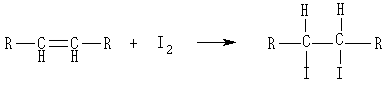

Place a 0.1–0.2 g fat sample into one flask (test sample), and 0.1–0.2 ml of water into the second flask (control sample). Add 10 ml of the alcoholic iodine solution to each, mix, and let stand for 15 min. After 15 min, titrate the Contents of the flasks with the Na2S2О3 solution until a yellowish color appears. Then, add 1 ml of the starch solution and continue the titration until the blue color disappears.
The iodine value is calculated using the formula
IV = (V — A) f Q 100 / a 1000,
where (V — A) is the difference in titration results between the control and test samples using 0.05 M sodium thiosulfate solution, ml; a is the weight of the test fat sample, g; f is the titer correction factor for the 0.05 M Na2S2О3 solution (0.96); Q is the amount of I2 (12.69 mg) equivalent to 1 ml of the 0.05 M Na2S2О3 solution.
4.4. Determination of the Peroxide Value of Fat
Materials and Reagents: sunflower oil or other vegetable oil, any solid fat (butter, margarine, lard), rancid fat, saturated KI solution, chloroform, 0.005 M Na2S2О3 solution, 1% starch solution, glacial acetic acid.
Procedure
The method is based on the ability of the peroxide groups in fat to react with KI in an acidic medium.
Since this reaction is highly sensitive, control samples must be prepared to avoid errors caused by potential iodine formation from the oxidation of KI by atmospheric oxygen.
Place a fat sample (1 g) into one flask (test sample) and 1 ml of water into the second flask (control sample). Add 5 ml of glacial acetic acid, 6 ml of chloroform, and 1 ml of freshly prepared saturated KI solution to each. Shake for 5 min, add ten drops of the starch solution as an indicator, and titrate with the Na2S2О3 solution.

The peroxide value—defined as the volume of 0.005 M Na2S2О3 solution (in ml) consumed in the titration of 1 g of fat—is calculated as
C = (A — B) f,
where (A − B) is the difference between the titration results of the test and control samples using 0.005 M Na2S2O3 solution; f is the correction factor for the titer of 0.005 M Na2S2O3 solution (0.96).
Processing of Experimental Data
Determine the ester value of the fats under study.
Given that the release of one glycerol molecule requires three KOH molecules, calculate the glycerol content in the fat (%) using the formula:
C = 96.02 EV 100 / 56.11 • 3 • 1000,
where 96.02 is the Molecular Weight of glycerol; EV is the ester value of the fat, mg; 56.11 is the molecular weight of KOH; 3 is the conversion factor; 1000 is the number of milligrams in 1 g.
Construct a table indicating the chemical parameters of the fats studied, and compare PLANT AND ANIMAL fats.
Selection/5.html">Control Questions and Tasks
1. Name saturated, monounsaturated, and polyunsaturated Higher Fatty Acids. Write their structural formulas. Which higher fatty acids make up vitamin F?
2. What determines the consistency of fat? Write the formula of a liquid fat and the reaction for its conversion into solid fat.
3. What compounds accumulate in rancid fats? In what reactions are they formed?
4. Which fat — solid or liquid — has a higher iodine value? Justify your answer. Explain why the acid value of fats increases during storage.
5. What are prooxidants and antioxidants? What are the most important natural antioxidants known to you?
6. Which enzyme systems in the body neutralize peroxide compounds?
7. Write the saponification reaction of a triacylglycerol, and name the reactants and reaction products. Write the Esterification reaction between palmitic, oleic, and stearic acids and glycerol. Under what conditions is this reaction reversible? Name the reaction product.
8. Write the structural formulas of phosphatidic acid and the most common phosphoacylglycerols — phosphatidylethanolamine and phosphatidylcholine. What biological role do they perform? What other phosphoacylglycerols do you know?
9. What structure forms The basis of Cholesterol? Write its formula and the general formula of cholesterol esters. Explain the Biological Role of cholesterol.
References: [1; 2; 4 — 7].
Last update: 06/08/2026
Editorial and Educational Adaptation: This material has been compiled based on the primary/original source text. The project team performed an editorial review, corrected technical inaccuracies, structured sections, and adapted the content for an educational format.
What was processed:
- elimination of formatting defects (OCR errors, structural breaks, corrupted characters);
- editorial organization of content;
- standardization of terminology in accordance with academic sources;
- verification of factual statements against the original source text.
All mentions of the author, publication year, and origin of the primary text have been preserved in accordance with the source.