BIOCHEMISTRY - Laboratory Practical - NAU 2015
MODULE I
BIOCHEMICAL COMPONENTS OF THE CELL
Laboratory Work 3
QUALITATIVE REACTIONS FOR MONOSACCHARIDES, REDUCING DISACCHARIDES, AND STARCH
Objective: to master Methods for detecting Monosaccharides (glucose, fructose) and reducing Disaccharides in solutions using redox reactions; to be able to detect starch in solutions using the iodine-starch test.
Basic Theoretical Background
Simple CARBOHYDRATES (monosaccharides,oses, or simple sugars) are polyhydroxy aldehydes or polyhydroxy ketones. They are classified into aldoses and ketoses depending on the presence of an aldehyde or keto group. Another Classification is based on the number of carbon atoms (trioses, tetroses, pentoses, hexoses, heptoses, etc.). These two classifications are conveniently combined. The most common monosaccharides are aldohexoses, aldopentoses, and ketohexoses. Aldoses can be oxidized to their corresponding acids while simultaneously reducing metal salts. This property is utilized in Qualitative and quantitative detection assays.
Complex carbohydrates break down into simple ones during Hydrolysis (simple carbohydrates do not undergo hydrolysis). Disaccharides are the simplest complex sugars. They consist of two monosaccharides linked by a glycosidic bond. Disaccharides are divided into reducing and non-reducing ones. Reducing disaccharides (such as lactose, cellobiose, or maltose) can be oxidized to their corresponding acids, thereby reducing metal salts. Thus, these disaccharides participate in reactions characteristic of aldose monosaccharides. However, non-reducing disaccharides (such as sucrose) do not enter into such reactions. To detect them, Methods based on the hydrolysis of disaccharides into monosaccharides followed by the detection of these hydrolysis products (monosaccharides) are most commonly used.
Polysaccharides differ in chain length, Chemical Nature of the repeating monomer units (if the monomers are identical, they are Homopolysaccharides; if different, Heteropolysaccharides), and the degree of branching (unbranched or linear polysaccharides have identical bonds between oses; in branched polysaccharides, oses are linked by different bonds). Polysaccharides contain no free reducing groups and therefore lack reducing ability. The products of complete polysaccharide hydrolysis in the presence of acids or specific Enzymes are monosaccharides, which exhibit reducing properties.
Starch is the primary storage carbohydrate in plants. It consists of two homopolysaccharides—amylose and amylopectin—whose monomeric units are glucose. Amylose has a linear Structure in which glucose residues are interconnected by α-1,4-glycosidic bonds. The Introduction/11.html">Secondary structure of amylose forms a helix whose inner diameter corresponds to the size of an iodine molecule (0.5 nm). Therefore, in the presence of molecular iodine in solution, iodine molecules are incorporated into the amylose helix to form unstable complexes, resulting in a blue coloration. Amylopectin has a significantly higher molecular weight than amylose; it does not yield a positive iodine-starch test and forms a paste upon heating. The primary type of bond between glucose residues is the α-1,4-glycosidic bond, just as in the amylose molecule. However, every 25–30 oses, the bond between them is an
α-1,6-glycosidic bond, which serves as a chain branching point.
The animal analog of plant starch is Glycogen. It is also a homopolysaccharide. The structure of glycogen resembles that of amylopectin—glucose residues are connected by the same types of bonds, but branching occurs much more frequently, namely every 5–6 oses. The final product of hydrolysis for both starch and glycogen is glucose.
Equipment: Glass stirring rods, test tubes, graduated pipettes, dropping bottles, test tube rack, Water bath, laboratory thermometer, spatula, stopwatch, burner.
3.1. Trommer's Test
Materials and Reagents: solutions of glucose, sodium hydroxide, and copper(II) sulfate (all 0.5%).
Solutions of aldoses (such as glucose) in an alkaline environment reduce copper(II) oxide to copper(I) oxide upon heating, while being oxidized themselves to aldonic acids. The reaction involving glucose is:
Class="center">
Add two drops of copper(II) sulfate solution to 0.5 mL of sodium hydroxide solution in a test tube. A blue precipitate of copper(II) hydroxide forms. Add 1 mL of glucose solution and mix the Contents of the test tube. The precipitate dissolves, and the solution turns blue. Upon gentle heating in a burner flame until boiling, the precipitation of a yellow copper(I) hydroxide precipitate or a red copper(I) oxide precipitate is observed.
3.2. Fehling's Test
Materials and Reagents: glucose solution (5%), Fehling's reagent (see Laboratory Work 2).
Procedure
Add 1 mL of glucose solution and 1 mL of Fehling's reagent to a test tube. In Fehling's reagent, copper(II) ions exist as a complex compound with tartrates. The reaction mechanism of all reducing carbohydrates with Fehling's reagent is identical to that of Trommer's test. The advantage of Fehling's reagent is that copper does not precipitate as copper(II) oxide when the reagent is in excess:
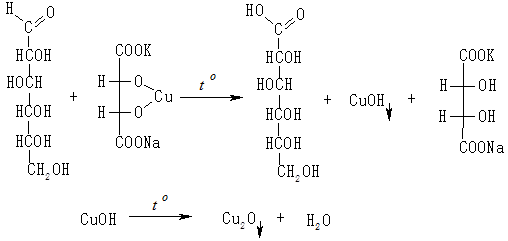 Mix the contents of the test tube and heat in a burner flame until boiling. The formation of a red copper(I) oxide precipitate is observed.
3.3. Seliwanoff's Test for Ketoses
Materials and reagents: crystalline resorcinol, 5% fructose solution, 25% Hydrochloric acid solution.
Procedure
Pour 1 ml of fructose solution and 0.5 ml of hydrochloric acid solution into a test tube, and add a few crystals of resorcinol. Heat the mixture in a water bath for 5–10 min at 80 °C until a cherry-red color appears.
When fructose or other ketoses are heated with hydrochloric acid, hydroxymethylfurfural is formed. The compound resulting from the Condensation of hydroxymethylfurfural with resorcinol is cherry-red in color.
The reaction equation involving fructose is as follows:
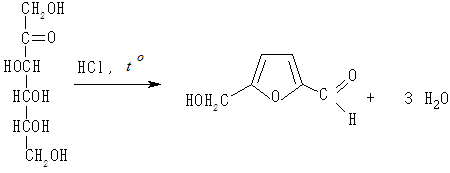
Observe the appearance of the coloration.
3.4. Reducing Power of Lactose and Maltose
Materials and reagents: 0.5% solutions of lactose, maltose, sodium hydroxide, and copper sulfate (all 0.5%).
Procedure
Pour 2 ml of lactose solution into one test tube and 2 ml of maltose solution into another. Then add 1 ml of sodium hydroxide solution and five drops of copper sulfate solution to both test tubes. Carefully heat the test tubes in a burner flame and observe the formation of a red precipitate of copper hemioxide.
Due to the presence of a free aldehyde group in the molecules of lactose, cellobiose, and maltose, these disaccharides exhibit reducing properties and can participate in reduction reactions, notably giving a positive Trommer's test.
3.5. Reaction of Starch with Iodine
Materials and reagents: Lugol's reagent (1 g of iodine and 2 g of potassium iodide are dissolved in 15 ml of water and then diluted with water to a total volume of 300 ml); 0.1% starch solution, 10% sodium or potassium hydroxide solution.
Procedure
Pour 2 ml of starch solution into a test tube and add one to two drops of Lugol's reagent. Mix the contents of the test tube. The interaction of starch with iodine produces a blue complex adsorption compound. Transfer 1 ml of the liquid to another test tube and add 1 ml of sodium or potassium hydroxide solution. Observe the discoloration of the test tube contents, which indicates the interaction of molecular iodine with the alkali.
Heat the remaining mixture in the test tube in a water bath. Observe the disappearance of the blue color (the solution turns yellow due to the iodine content). The blue color reappears upon cooling. The disappearance of the color upon heating is caused by the disruption of the secondary structure of amylose and the release of iodine; upon cooling, the secondary structure is restored, and the unstable starch-iodine complexes are also reformed, turning the color blue again.
Processing of Experimental Data
Construct a table listing the names and formulas of Monosaccharides and Disaccharides, and classify them. Write out the reactions used to identify them. Schematically depict the secondary structure of amylose and the Formation of the iodine-starch complex. Write the formulas of amylose and amylopectin fragments, and name the bonds between the glucose residues.
Selection/5.html">Control Questions and Tasks
1. Why does copper(II) hydroxide precipitate dissolve when mixed with a glucose solution? Write the equation for the corresponding reaction. The presence of which functional groups does it confirm?
2. The presence of which functional group is proven by the positive Tollens, Trommer, and Fehling tests? Write these reactions for glucose.
3. To which class of monosaccharides does fructose belong (based on the number of carbon atoms and the presence of functional groups)?
4. What is Tautomerism and mutarotation? Do they always occur in solutions of monosaccharides and reducing disaccharides?
5. Write the tautomeric forms of monosaccharides (glucose, galactose, mannose, fructose, ribose, deoxyribose) and reducing disaccharides (maltose, lactose, cellobiose). Provide their full names.
6. Write the Tollen's reaction with lactose, Trommer's reaction with cellobiose, and Fehling's reaction with maltose. Name the reaction products.
7. Write the hydrolysis reaction of sucrose and name the reaction products. Will the Tollen's, Trommer's, and Fehling's tests be positive with unhydrolyzed sucrose and with sucrose after hydrolysis? What is meant by the inversion of sucrose and invert sugar?
8. Is tautomerism characteristic of sucrose? Does a freshly prepared solution of sucrose undergo mutarotation? Why?
9. What is the structure of starch? Which polysaccharides does it consist of? Which polysaccharide causes a positive iodine-starch test, and which causes starch paste formation? Construct a Scheme for the formation of the iodine-amylose clathrate complex.
10. What is the structure of glycogen? Write a fragment of the glycogen molecule.
11. What is the structure of dietary fiber (Cellulose)? Which monosaccharide serves as its monomer unit?
12. What compounds are called heteropolysaccharides? What biological Functions do they perform? Give Examples.
References: [1; 2; 4 — 7].
Last update: 06/08/2026
Editorial and Educational Adaptation: This material has been compiled based on the primary/original source text. The project team performed an editorial review, corrected technical inaccuracies, structured sections, and adapted the content for an educational format.
What was processed:
- elimination of formatting defects (OCR errors, structural breaks, corrupted characters);
- editorial organization of content;
- standardization of terminology in accordance with academic sources;
- verification of factual statements against the original source text.
All mentions of the author, publication year, and origin of the primary text have been preserved in accordance with the source.