Biological Chemistry - Berezov, T. T., Korovkin, B. F. 1998
Chemistry of Carbohydrates
Polysaccharides
Homopolysaccharides
According to their functional purpose, homopolysaccharides can be divided into two groups: structural and Reserve Polysaccharides. An important structural homopolysaccharide is Cellulose, while the main reserve ones are Glycogen and starch (in animals and plants, respectively).
A strict Classification based on chemical Structure or biological role is impossible due to a lack of comprehensive data for many polysaccharides. Therefore, polysaccharides are most commonly named after their sources of isolation, even though the exact same polysaccharide may be obtained from completely different sources.
As noted, starch is the primary reserve material in plants. It is found in small quantities in leaves, but primarily accumulates in seeds (cereal grains such as wheat, rice, and corn contain up to 70% starch), as well as in bulbs, tubers, and the core of plant stems, where its content reaches up to 30%.
Starch is a mixture of two homopolysaccharides: linear amylose and branched amylopectin, with the general formula (С6Н10О5)n. Typically, the amylose content in starch ranges from 10% to 30%, and amylopectin from 70% to 90%. Starch polysaccharides are built from D-glucose residues connected in amylose and the linear chains of amylopectin by a-1→4 bonds, and at the branching points of amylopectin by interchain a-1→6 bonds:
Class="center">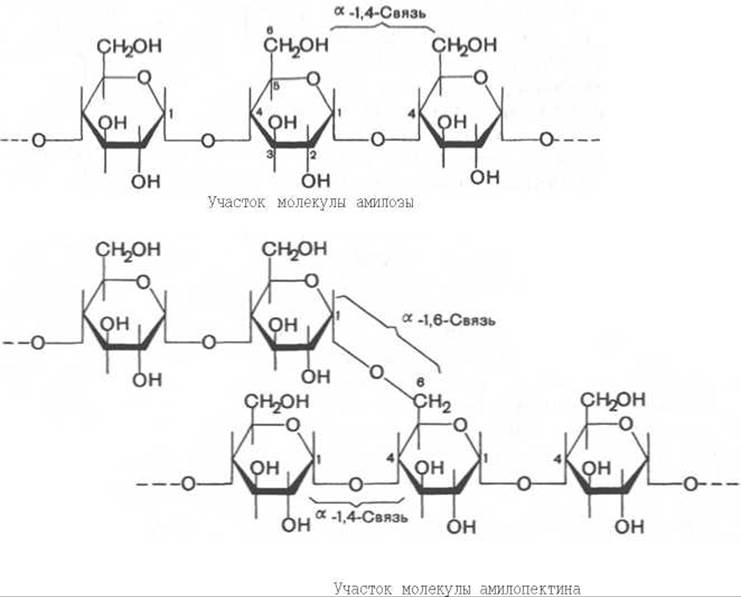
Thus, the sole monosaccharide making up starch is D-glucose. The amylose molecule contains an average of about 1000 linearly linked glucose residues; individual sections of the amylopectin molecule consist of 20—30 such units. Currently, the generally accepted model for amylopectin is a "branched" structure of individual chains with a-1→4 bonds (Fig. 5.3).
It is known that amylose does not form a true solution in Water. Instead, amylose chains in water form hydrated micelles. Upon addition of iodine, amylopectin turns blue in solution. Amylopectin also forms a micellar solution, though the shape of the micelles is somewhat different. The amylopectin polysaccharide is colored red-violet by iodine.
Starch has a Molecular Weight of 105—107 Da. Partial Acid Hydrolysis of starch yields polysaccharides with a lower degree of polymerization — dextrins* — while complete hydrolysis yields glucose. For humans, starch is an important dietary carbohydrate; its content in flour is 75—80%, and in potatoes, 25%.
* Dextrins (С6Н10О5)р are products of the partial breakdown of polysaccharides: starch and glycogen. All dextrins are readily soluble in water. They are found in the intestine as a product of Enzymatic hydrolysis, and have also been detected in the portal vein Blood of animals and humans after the ingestion of carbohydrate-rich meals.
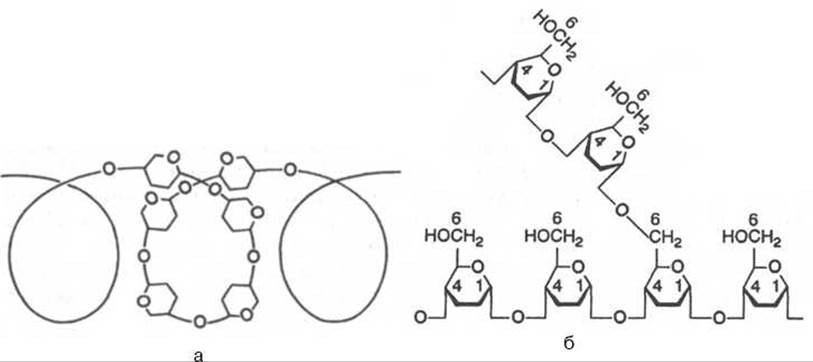
Fig. 5.3. Structure of starch.
a - amylose with its characteristic helical structure; b - amylopectin, forming 1-6 type bonds at the branching points.

Fig. 5.4. Structure of an individual section (a) and the entire molecule (b) of glycogen (after Meyer).
White circles represent glucose residues connected by a-1,4 bonds; black circles represent glucose residues attached by a-1,6 bonds; R is the reducing end group. Inner chains, or branches, are the segments between branching points. Outer chains, or branches, start from a branching point and end with a non-reducing glucose residue.
Glycogen is the main reserve polysaccharide in higher animals and humans, constructed from D-glucose residues. The empirical formula of glycogen, like that of starch, is (С6Н10О5)п. Glycogen is found in virtually all Organs and Tissues of animals and humans; the highest amounts are detected in The Liver and Muscles. The molecular weight of glycogen is 105-108 Da and higher. Its molecule is built from branching polyglucan chains in which glucose residues are linked by a-1→4-glycosidic bonds. At the branching points, there are a-1→6-glycosidic bonds. In its structure, glycogen is similar to amylopectin. In the glycogen molecule, one distinguishes inner branches — the segments from the peripheral branching point to the non-reducing end of the chain (Fig. 5.4).
Glycogen is characterized by a more branched structure than amylopectin; the linear segments in the glycogen molecule comprise 11—18 residues of a-D-glucopyranose.
Upon hydrolysis, glycogen, much like starch, is broken down to form first dextrins, then maltose, and finally glucose.
Inulin is a polysaccharide found in the tubers and roots of dahlias, artichokes, and dandelions. Its hydrolysis yields fructose; consequently, it is a fructan.
Methylation of inulin indicates that the D-fructose residues are linked to each other by 2→1 bonds and exist in the furanose form:
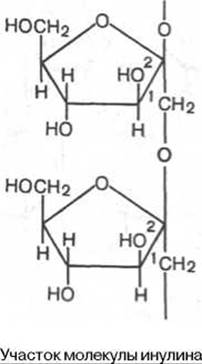
The degree of polymerization of inulin is approximately 35 monosaccharide residues. Unlike potato starch, this polysaccharide is readily soluble in warm water. Inulin is used in physiological studies to determine The rate of Glomerular Filtration in the Kidneys.
Chitin is an important structural polysaccharide of invertebrate animals (primarily Arthropods). In particular, the external Skeleton of crustaceans and insects is built from it.
Chitin also partially or completely replaces cellulose in The Cell walls of saprophytic plants, such as Fungi.
The structure of chitin is composed of N-acetyl-D-glucosamine units connected by ß-(1→4)-glycosidic bonds:

Cellulose is the most abundant structural polysaccharide in the plant kingdom. It consists of D-glucose residues in their ß-pyranose form; that is, in the cellulose molecule, the ß-glucopyranose monomer units are linked linearly by ß-(1→4)-bonds:
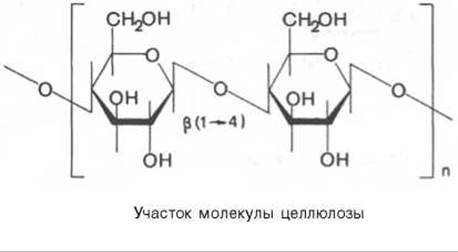
Partial hydrolysis of cellulose yields the disaccharide cellobiose, whereas complete hydrolysis yields D-glucose. The molecular weight of cellulose ranges from 1000 to 2000 kDa. Dietary fiber is not digested by the Enzymes of the human gastrointestinal tract because human digestive enzymes lack Hydrolases capable of cleaving ß-bonds. Consequently, cellulose can be viewed as a substantial yet underutilized dietary reserve. Nevertheless, it is well established that optimal amounts of dietary fiber promote normal bowel function and stool formation. A complete absence of fiber from the diet disrupts normal fecal consistency.
The gut of ruminants and other herbivores contains microorganisms capable of enzymatically cleaving ß-bonds (ß-glucosidic bonds), making cellulose an important source of dietary calories for these animals.
Finally, cellulose and its derivatives are of immense practical significance. The bulk of cellulose is used in the manufacture of cotton textiles and paper. In addition, artificial fibers, plastics, and various other Materials are produced from cellulose. A hallmark feature of cellulose—largely responsible for its mechanical, physicochemical, and chemical properties—is the linear conformation of its molecules, stabilized by intramolecular Hydrogen Bonds.
Last update: 06/08/2026
Editorial and Educational Adaptation: This material has been compiled based on the primary/original source text. The project team performed an editorial review, corrected technical inaccuracies, structured sections, and adapted the content for an educational format.
What was processed:
- elimination of formatting defects (OCR errors, structural breaks, corrupted characters);
- editorial organization of content;
- standardization of terminology in accordance with academic sources;
- verification of factual statements against the original source text.
All mentions of the author, publication year, and origin of the primary text have been preserved in accordance with the source.