Principles of Biochemistry Volume 1 - A. Lehninger 1985
Biomolecules
Carbohydrates: Structure and Biological Functions
Cellulose is the most widespread structural polysaccharide
Many Polysaccharides serve as extracellular structural elements in The Cell walls of unicellular microorganisms and higher plants, as well as on the outer surface of animal Cells. Other polysaccharides are components of vertebrate Connective Tissue and the arthropod exoskeleton. Structural polysaccharides protect cells, Tissues, and Organs, giving them shape and mechanical support.
A wide variety of structural polysaccharides exist in nature. By examining one of them—specifically Cellulose—we can see how the specific Molecular Organization of a substance is adapted to perform a distinct biological function. Cellulose is a tough, fibrous, Water-insoluble substance found in Plant Cell Walls, predominantly in branches, stems, tree trunks, and other woody parts of plants. Wood consists primarily of cellulose and other polymeric substances, while cotton is composed almost entirely of cellulose. If Proteins are the most widespread intracellular Biopolymers (see Section 3.6), cellulose is undeniably not only the most abundant extracellular structural polysaccharide in the plant world, but also the most abundant biopolymer in nature overall.
Class="center">
Fig. 11-16. Structure of cellulose and various Conformations of ß(1→4) linkages in cellulose chains, as well as a(1→4) linkages in starch and Glycogen chains. A. Cellulose chain: D-glucose residues joined together by ß(1→4) linkages. B. Schematic representation of parallel cellulose polymer chains connected by Hydrogen Bonds (highlighted in color). C. To-scale representation of two segments of parallel chains, showing the precise arrangement of D-glucose residues and cross-links formed by hydrogen bonds. D. To-scale representation of a segment of an amylose molecule. Due to the a(1→4) linkages
Cellulose is a linear, unbranched homopolysaccharide consisting of 10,000 or more D-glucose residues linked together by (1→4)-glycosidic bonds; in this regard, it is similar to amylose and the linear segments of glycogen chains. However, there is one crucial difference between these polysaccharides: in cellulose, the (1→4) linkages have the ß configuration, whereas in amylose, amylopectin, and glycogen, they have the a configuration. This seemingly minor difference in structure between cellulose and amylose leads to profound differences in their properties (Fig. 11-16). Due to the geometric constraints of a(1→4) linkages, the linear segments of polymer chains in glycogen and starch tend to adopt a coiled, helical conformation, which facilitates The formation of dense granules typically found in most animal and plant cells.
The a(1→4) linkages of glycogen and starch are readily hydrolyzed by the a-amylase of the vertebrate gastrointestinal tract, and the resulting D-glucose enters the bloodstream to be used in METABOLISM/26.html">Energy Metabolism. In the case of cellulose, however, the ß configuration of the linkages causes its polymer chains to be fully extended and aligned side-by-side to form long, insoluble fibrils (Fig. 11-16). The ß(1→4) linkages in the cellulose molecule are not hydrolyzed by a-amylases. Because vertebrate intestines lack an enzyme capable of hydrolyzing cellulose, it is indigestible, and its D-glucose residues cannot serve as food for most higher organisms. Termites digest cellulose efficiently, but only because their gut harbors parasitic microorganisms, *Trichonympha* (Fig. 11-17), which secrete cellulase—the cellulose-hydrolyzing enzyme that enables termites to digest wood. Cellulase is also synthesized by certain wood-rotting Bacteria and Fungi.
Among vertebrates, only cattle and other ruminants (sheep, goats, camels, giraffes, etc.) are able to use cellulose as food. However, they do so in a rather unusual way. The greater part of the digestive tract—accounting for 15% of a cow's total body weight—consists of four interconnected stomachs. The first two compartments make up the rumen. The microorganisms harbored there secrete cellulase and break down cellulose into D-glucose, which is subsequently fermented into short-chain Fatty acids (see Chapter 12), carbon dioxide, and methane gas (CH4). The resulting Fatty acids are absorbed into the cow's bloodstream, distributed to tissues, and used as metabolic fuel. Methane and CO2, produced at a rate of 2 L/min, are continually expelled via an involuntary process resembling a barely audible burp. In the remaining two Chambers of the ruminant Stomach, the microorganisms that have completed their task are digested by Enzymes secreted by the gastric mucosa; this process yields Amino Acids, sugars, and other nutrients that are absorbed and utilized by the cow's body. Thus, a symbiotic relationship is established between the cow and the rumen microorganisms, wherein the microorganisms enjoy a short but comfortable life in a warm, sheltered environment, while the cellulose from clover and other grass serves as the primary energy source for both the symbionts and the host Organism. Every year, massive amounts of cellulose are synthesized by plants, including not only forest trees but also cultivated crops. Calculations show that plants produce approximately 50 kg of cellulose daily for every human living on Earth. Cellulose has widespread industrial Applications. Wood, cotton, paper, and cardboard consist almost entirely of cellulose. Cellulose is also used to manufacture rayon, as well as insulation, construction, and packaging Materials.
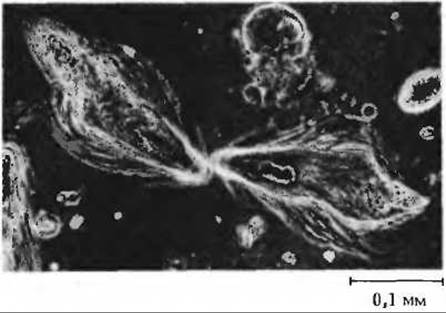
Fig. 11-17. Two *Trichonympha* cells. These Protozoa live in the gut of termites and secrete cellulase. Without these parasites, termites would be unable to digest cellulose.
The tough, insoluble shells, or exoskeletons, of lobsters, crabs, and many insects are constructed primarily of Chitin—a linear polysaccharide composed of N-acetyl-D-glucosamine residues joined by ß linkages (Fig. 11-18). The chitinous framework in lobsters and crabs is reinforced by deposits of calcium carbonate.
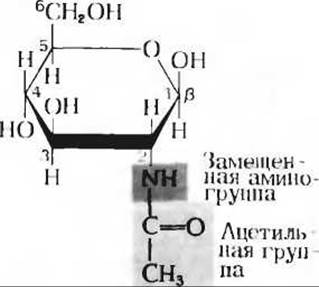
Fig. 11-18. N-acetyl-D-glucosamine, an important building block of chitin and many other structural polysaccharides. In this amino sugar molecule, an amino group (highlighted in red) replaces the hydroxyl group at the C-2 carbon atom of D-glucosamine.
Last update: 06/08/2026
Editorial and Educational Adaptation: This material has been compiled based on the primary/original source text. The project team performed an editorial review, corrected technical inaccuracies, structured sections, and adapted the content for an educational format.
What was processed:
- elimination of formatting defects (OCR errors, structural breaks, corrupted characters);
- editorial organization of content;
- standardization of terminology in accordance with academic sources;
- verification of factual statements against the original source text.
All mentions of the author, publication year, and origin of the primary text have been preserved in accordance with the source.