Protein Chemistry - Part 1 - General Protein Chemistry - Ashmarin I. P. 1968
Isolation and Purification of Proteins
Separation of Protein Mixtures
Methods Based on Differences in Protein Molecular Weight and Size
Ultracentrifugation. In ultracentrifuges, at accelerations on the order of 100,000–500,000 g, the vast majority of Proteins undergo rapid sedimentation. The sedimentation rate depends primarily on the Molecular Weight of the protein. The Theory of protein ultracentrifugation and the Applications of this method for studying the Size and Shape of Protein Molecules will be discussed in Chapter VI. Here, we only note that the method can also be used for preparative purposes. Theoretically, the efficiency of such Separation should be significant. In practice, however, insurmountable obstacles arise. The maximum distance that proteins travel in an ultracentrifuge Cell is small, making it possible to isolate only the extreme fractions. Moreover, it is difficult to prevent the mixing of liquid zones in The Cell when the centrifuge is stopped. To prevent this, researchers resort to techniques such as dividing the ultracentrifuge cell with porous partitions. As a result, a clear separation is achieved only for proteins that differ in sedimentation rate by a factor of several times. The efficiency of preparative centrifugation is significantly inferior to analytical centrifugation. These circumstances, along with the high cost of ultracentrifuges, their limited service life, and the relatively small working volumes of preparative rotors, all prompt researchers to prefer other preparative Methods. Preparative ultracentrifugation has proven much more practical when applied to supramolecular structures such as Viruses, Ribosomes, and the like. However, a Description of the methods for isolating and purifying these objects is beyond The Scope of this manual.
Class="center">

Fig. 1 Crystalline proteins (after Northrop, Kunitz, and Herriott, 1950):
1 — Pepsin (× 90), 2 — Chymotrypsin (× 120), 3 — chymotrypsinogen (× 260), 4 — trypsinogen (× 220), 5 — Trypsin (× 220), 6 — soybean trypsin inhibitor (× 225), 7 — carboxypeptidase (× 85), 8 — Ribonuclease (× 190), 9 — hexokinase (× 116).
Molecular filtration. Over the past decade, methods have been developed for producing polymers that act as three-dimensional molecular sieves with controlled pore sizes. Sephadexes have become widely used; these are polymers in the form of beads constructed from filamentous dextran polysaccharide molecules cross-linked at regular intervals.
The approximate Structure of a Sephadex unit cell is as follows:

The greater the number of cross-links, the smaller the pore sizes of the molecular sieve. Sephadex grades with various pore sizes are commercially available. In particular, Sephadexes designated conventionally as G-200 have pores that allow biopolymer molecules with a molecular weight of about 200,000 or less to penetrate. Sephadexes G-100, G-75, G-50, and G-25 are permeable to molecules with maximum molecular weights of approximately 100,000, 50,000, 10,000, and 4,000, respectively. Naturally, this refers to molecules whose shape does not deviate too drastically from spherical. For any given protein, some deviations from the average molecular sieve exclusion limits specified above are possible.
The protocol for using molecular sieves to separate protein mixtures is generally as follows. A Column is packed with Sephadex beads and equilibrated with a solvent. The protein solution is slowly applied to the column; its volume is typically many times smaller than the column volume. Once the protein solution has entered the gel bed, a flow of solvent is passed through the column. The smallest molecules diffuse into the beads the fastest. Some of them diffuse back out, but as a result of repeated "entries" into the beads, they migrate through the column significantly slower than the liquid flow. Larger molecules, which are still able to penetrate the molecular sieve pores, enter the beads less frequently and therefore lag behind the liquid flow to a lesser extent. Finally, molecules that are too large to penetrate the beads of a given pore size at all will "flow around" the beads and pass through the column without delay. Consequently, by collecting the effluent from the column in small fractions, well-resolved protein fractions can be obtained in order of decreasing molecular weight. Fig. 2 shows an example of an fractionation experiment on Sephadex G-200 using a protein mixture consisting of Ovalbumin, immune gamma-globulin, and their interaction product.
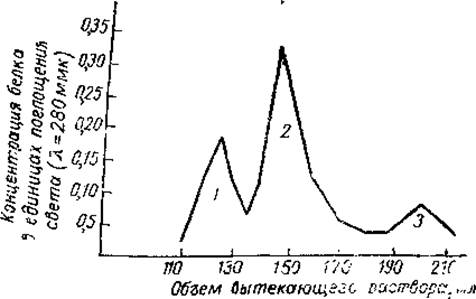
Fig. 2. Fractionation on a Sephadex G-200 column of a mixture of ovalbumin (3), immune gamma-globulin (2)—which in this case acts as an antibody against albumin—and their interaction product, the antigen–antibody complex (1) (after Tarkhanova, 1966).
In this case, gamma-globulin is an antibody against albumin and tends to form an antigen–antibody complex with it. As can be seen, the largest particles—the antigen–antibody complex with a molecular weight exceeding 200,000—elute from the column first. They are followed by gamma-globulin with a molecular weight of 160,000. Ovalbumin, with a molecular weight of 44,000, elutes last.
Andrews established a nearly linear relationship between the migration rate of a series of proteins in Sephadex G-75 or G-100 and the logarithm of their molecular weight, provided that the latter lies within the range of 4,000 to 160,000. Thus, The Use of molecular filtration makes it possible not only to fractionate protein mixtures but also to provide a preliminary estimate of the molecular weight of the mixture components.
It should be noted that any significant adsorption of proteins on Sephadexes of the type described above generally does not occur. This is what allows The Essence of the process to be attributed to molecular filtration. Furthermore, this determines the mild nature of Sephadex separation and, consequently, the suitability of this method for fractionating labile proteins. In some cases, however, it is useful to combine molecular filtration with ion-exchange processes on the beads, thereby uniting two different principles of protein mixture separation. Therefore, ion exchangers based on Sephadexes—such as DEAE-Sephadex, CM-Sephadex, and others—have recently been produced for this purpose.
Obviously, the molecular filtration method is applicable not only to protein fractionation but also to freeing proteins from low-molecular-weight impurities (including salts), as well as to separating Amino Acid and peptide mixtures. In these cases, Sephadex grades with small molecular sieve pore sizes must be used.
In Conclusion, it should be noted that along with dextran-based molecular sieves, acrylamide polymers (polyacrylamide) have found widespread application in recent years. These polymers are commercially known as "Bio-Gels." Their beads, like Sephadex beads, can have pores of various diameters, and the separation of substances of different molecular sizes is based on the same principle described above.
Last update: 06/08/2026
Editorial and Educational Adaptation: This material has been compiled based on the primary/original source text. The project team performed an editorial review, corrected technical inaccuracies, structured sections, and adapted the content for an educational format.
What was processed:
- elimination of formatting defects (OCR errors, structural breaks, corrupted characters);
- editorial organization of content;
- standardization of terminology in accordance with academic sources;
- verification of factual statements against the original source text.
All mentions of the author, publication year, and origin of the primary text have been preserved in accordance with the source.