Protein Chemistry - Part 1 - General Protein Chemistry - Ashmarin I. P. 1968
Isolation and Purification of Proteins
Separation of Protein Mixtures
Ion-Exchange Chromatography of Proteins
Methods based on the differing affinity of Proteins for various adsorbents have long been used for Protein Purification and fractionation. Recently, this approach has been further advanced through adsorption Chromatography of proteins. A typical example is the chromatography of protein mixtures on hydroxylapatite columns (Са5(РО4)3ОН). However, Ion-exchange chromatography of proteins has achieved The most significant development and Structure/182.html">Practical Application, and it will be the focus of Discussion here.
The method relies on The Use of ion-exchange polymers, which consist of an insoluble high-polymer backbone linked to ionizable groups, known as ionogenic groups. The molecular chains making up the backbone are cross-linked via natural or artificial bridges. The degree of cross-linking affects the Swelling capacity of the polymer and the ability of various ions to penetrate deep into the polymer particle. Unlike Sephadex, most ion-exchange polymers used for chromatography (such as Dowex resins) are so densely cross-linked that protein molecules cannot penetrate inside the particles and interact solely with their surface.
Only a few of the known ion exchangers are suitable for Protein chromatography. Sephadex- and Cellulose-based ion exchangers are best suited for this purpose. Typical Examples of the latter are carboxymethylcellulose (CM-cellulose) and diethylaminoethylcellulose (DEAE-cellulose). In the former, a portion of the cellulose hydroxyl groups is replaced by —ОСН2СООН groups, which are converted into a salt form (e.g., —ОСН2СООNa) upon Treatment with alkali. The sodium cation can be exchanged for other cations, including protein cations. Therefore, ion-exchange polymers of this type are termed cation exchangers. In DEAE-cellulose, some of the cellulose hydroxyl groups are substituted with —О—СН2—СН2—N(C2H5)2 groups. These can be converted into the OH- or Cl- form by treating the ion exchanger with alkali or acid ([—О—СН2—СН2— —HN+(C2H5)2]∙OH- or [—O—СН2—СН2—HN+(C2H5)2]∙Cl-). Hydroxyl or chloride anions can be exchanged for other ions, including those of protein origin. This type of polymer is an example of an anion exchanger.
Cation exchangers such as the polycarboxylic ion-exchange resin Amberlite IRC-50 are successfully used for the fractionation of basic proteins with low molecular weights. Resins of this type are copolymers of methacrylic acid and a cross-linking agent:
Class="center">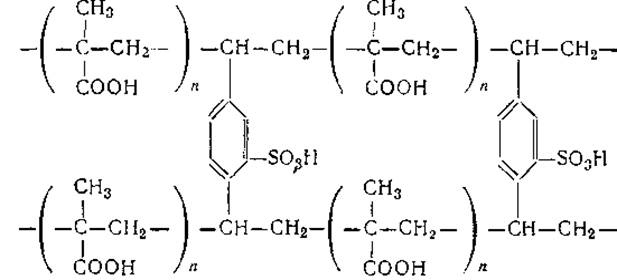
The active ionogenic group of this resin type is the SO-3H+ moiety, which can readily exchange its hydrogen ion for any other cation.
Since proteins are ampholytes and contain both positively and negatively charged side chains, both types of ion exchangers are, in principle, suitable for their fractionation. However, anion exchangers are more efficient for separating acidic and neutral proteins, as the latter are relatively rich in negatively charged groups over a wide pH range. Conversely, cation exchangers are more convenient for the Separation of basic proteins.
It should be borne in mind that while electrostatic interaction between the charged groups of the protein and the ion exchanger is the primary force acting during chromatography, hydrogen bonding and Van der Waals interactions between the protein and the backbone (matrix) of the ion exchanger also play a definite role.
The general Procedure for protein chromatography is as follows. A Column is packed with a granular ion exchanger that has been converted into its salt form and washed free of excess acid or alkali impurities. A buffered protein solution is slowly loaded onto the column, initiating the partial Displacement of the mobile ions of the ion exchanger by protein ions. Proteins with a higher capacity to displace mobile ions (such as Na+, acetate, etc.) and bind to the Functional groups of the polymer are retained first. Proteins with a lesser ability to compete with mobile ions are retained later. Typically, all proteins in the mixture are initially immobilized at the top of the column.
The varying ability of proteins to displace mobile ions may stem from differences in the number and nature of charged groups in various protein molecules, as well as the Influence of the overall size and conformation of the protein molecule On the Stability of the resulting bonds. Thus, partial fractionation of the protein mixture occurs already at this stage. However, the most efficient separation step is the subsequent phase—protein elution. Elution is usually achieved by applying a solution with a high salt concentration (e.g., sodium chloride). Salt ions displace the bound proteins, with those exhibiting a lower affinity for the ion exchanger eluting first. As a result, the initial separation effect is dramatically enhanced. Finally, fractionation can be further improved by performing elution with a gradually (или step-wise) increasing salt concentration (gradient elution). By collecting the eluate in small fractions, the separation of components can be achieved with high resolution. Automatic fraction collectors are widely used for this purpose.
Proteins can be eluted not only using concentrated salt solutions. By altering the pH of the eluting fluid, the ratio between the number of charged groups on the protein and the ion exchanger can be modified, thereby weakening their interaction. This elution method is usually applied in combination with the first one.
As a rule, the efficiency of chromatographic protein fractionation is very high. A prime example is the separation of Pepsin and pepsinogen on DEAE-cellulose, shown in Fig. 3 (according to L. M. Ginodman). Both pepsin and pepsinogen are acidic proteins, which dictates the choice of an anion exchanger. Chromatography was performed at pH 5.6 in an acetate buffer, under which conditions both proteins are negatively charged. Elution was carried out using a solution with an increasing sodium chloride concentration. As can be seen, a very sharp separation was achieved, despite the fact that differences between pepsin and pepsinogen in terms of the number and nature of polar groups, molecular weight, and many other properties are very subtle.

Fig. 3. Chromatography of a mixture of pepsin and pepsinogen (gradient elution) on a DEAE-cellulose column (from Ginodman, 1964).
Despite all its advantages, ion-exchange chromatography of proteins also has serious drawbacks. Many proteins are not completely eluted from the ion exchanger, sometimes leading to significant losses. A number of labile proteins undergo Denaturation upon interaction with the ion exchanger, which is believed to result from the interaction between hydrocarbon radicals and the polymer matrix, leading to the unwinding of the peptide chains that make up the protein molecule. Therefore, chromatographic separation yields the best results with relatively stable, low-molecular-weight proteins.
Last update: 06/08/2026
Editorial and Educational Adaptation: This material has been compiled based on the primary/original source text. The project team performed an editorial review, corrected technical inaccuracies, structured sections, and adapted the content for an educational format.
What was processed:
- elimination of formatting defects (OCR errors, structural breaks, corrupted characters);
- editorial organization of content;
- standardization of terminology in accordance with academic sources;
- verification of factual statements against the original source text.
All mentions of the author, publication year, and origin of the primary text have been preserved in accordance with the source.