BIOCHEMISTRY - Laboratory Course - NAU 2015
MODULE I
BIOCHEMICAL COMPONENTS OF THE CELL
Laboratory Work 2
QUALITATIVE REACTION FOR PEPTIDES AND PROTEINS. PROTEIN FRACTIONATION BY SALTING-OUT. DETERMINATION OF MAJOR CONSTITUENTS OF NUCLEOPROTEINS
Objective: to master Methods for detecting Proteins AND Peptides in solutions, separating proteins of different molecular weights, and identifying components of Conjugated Proteins in hydrolysates.
Basic Theoretical Background
Proteins are Biopolymers whose monomers are Amino Acids. Proteins are formed from amino acids via a polycondensation reaction, with Water as a byproduct. A protein consists of at least fifty amino acid residues linked together by peptide bonds formed via carboxyl and amino groups. Peptide bonds can exist in keto or enol forms, with Tautomerism (dynamic isomerism) occurring between these forms.
Proteins are Polypeptides. A polypeptide contains at least ten amino acid residues. Peptides containing from two to ten amino acid residues are called oligopeptides. The smallest oligopeptides are dipeptides, which are formed by the Condensation of Two amino acids and contain a single peptide bond.
All peptides except dipeptides, as well as proteins, yield a positive biuret test, which is a qualitative test for the peptide bond. In an alkaline medium in the presence of copper(II) sulfate, they form blue-violet copper coordination complexes, the intensity of which depends on the number of peptide bonds in the protein molecule. The reaction for forming such copper coordination complexes was first performed with biuret, hence its name.
Proteins vary in molecular weight depending on the number of amino acid residues in the molecule. Proteins are hydrophilic compounds; they dissolve in water to form colloidal solutions. A Hydration shell forms around the protein molecule due to water dipoles oriented in a specific manner near polar and charged groups, keeping the protein macromolecule in a dissolved state. The charge and hydration shell are the factors responsible for the Stability of the protein molecule in solution (see figure):
Class="center">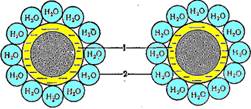
Proteins in aqueous solution. 1 — colloidal protein particles;
2 — hydration shell
Salting-out is the reversible precipitation of proteins under the action of dehydrating agents that strip the protein of its hydration shell (salts of alkali and alkaline-earth metals, ammonium sulfate, alcohol, acetone). Proteins precipitate at varying salt concentrations. Some precipitate at an ammonium sulfate concentration of about 1/10 of saturation, globulins at half-saturation, and albumins at full saturation.
Proteins may consist solely of a polypeptide chain; such proteins are called simple. If a protein includes a non-protein moiety—a prosthetic group—it is called a conjugated (complex) protein. Upon complete Hydrolysis of a conjugated protein, Amino Acids and the constituent Components of the prosthetic group can be detected in the solution. Conjugated Proteins can be classified by The Nature of their prosthetic group, for example: Lipoproteins, Glycoproteins, Nucleoproteins, Chromoproteins, and Metalloproteins. Most known proteins are conjugated. They serve diverse Functions and exhibit varied intracellular localization: nucleoproteins are components of the apparatus for storing and expressing Genetic information, glycoproteins participate in Cell-to-cell signaling, and chromoproteins transport oxygen and carbon dioxide between Tissues, store oxygen in tissues, and so on.
Nucleoproteins are conjugated proteins whose prosthetic group consists of Nucleic Acids. During hydrolysis, nucleoproteins progressively break down into their constituent components; after complete hydrolysis, the hydrolysate contains amino acids, purine and pyrimidine nitrogenous bases, pentoses, and phosphoric acid.
Equipment: test tube rack, graduated pipettes, dropping bottles, Glass stirring rods, funnels, filter paper, water bath.
2.1. Biuret Test for Detecting Peptide Bonds in Peptides and Proteins
Materials and Reagents: 1% egg albumin solution, 10% sodium (or potassium) hydroxide solution, 1% copper sulfate solution.
Add 1 mL of sodium hydroxide solution and one to two drops of copper sulfate solution to 3 mL of egg albumin, and mix.
Biuret can be obtained by heating urea to 180 °C; it is not a peptide, but it contains two peptide bonds. In an alkaline medium, biuret undergoes enolization:

Copper(II) hydroxide for the biuret test is obtained by the reaction of copper(II) sulfate with sodium (or potassium) hydroxide:

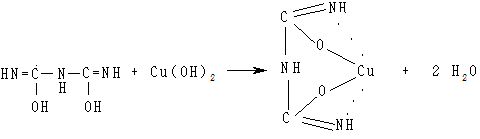
Two biuret molecules in the enolic form react with copper (II) hydroxide to form a complex in which coordination bonds are established through the electron pairs of the imino group nitrogen atoms. The biuret-copper complex is formed According to the following scheme:
Peptides and proteins can form a similar copper complex. First, the peptide bonds undergo enolization in an alkaline medium:

The simplest peptide that yields a positive biuret test is a tripeptide:
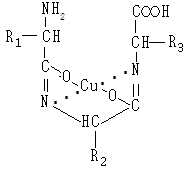
Proteins containing peptide bonds in the enolic form react with copper (II) hydroxide to produce similar complexes.
The Contents of the test tube turn a reddish-violet color.
2.2. Fractional Precipitation of Proteins by Salting Out
Materials and Reagents: Blood serum solution, ammonium sulfate (crystalline and saturated solution).
Procedure
Pour 2–3 ml of blood serum into a test tube, add an equal volume of saturated ammonium sulfate solution, and mix. Globulins precipitate out (at 50% saturation), which have a relatively high molecular weight and a low charge. The precipitate is filtered off. A small amount of water is added to the precipitate on the filter. The resulting solution contains globulins, the presence of which is detected by boiling, observing The formation of a precipitate.
The filtrate containing the albumin solution is divided into two test tubes. Crystalline ammonium sulfate is added to the first test tube to full saturation (100% solution saturation). Albumins precipitate out. The contents of the second test tube are boiled, and the formation of a protein (albumin) precipitate is observed.
2.3. Identification of Major Components in a Nucleoprotein Hydrolysate
Materials and Reagents: Nucleoprotein hydrolysate, concentrated ammonia solution, ammoniacal silver nitrate solution
(add ammonia solution dropwise to up to 5% AgNO3 until the gray precipitate dissolves); concentrated sulfuric acid, 1% alcoholic solution of α-naphthol; Fehling's reagent (consisting of two solutions: the first is prepared by dissolving 40 g of Rochelle salt and 30 g of sodium hydroxide, bringing the volume to 200 ml; the second is prepared by dissolving 8 g of recrystallized copper sulfate (CuSO4∙5H2O) in distilled water, bringing the volume to 200 ml; equal volumes of the First and Second solutions are mixed prior to use), 10% NaOH, litmus; molybdate reagent (7.5 g of ammonium molybdate dissolved in 100 ml of water mixed with 100 ml of concentrated nitric acid).
Procedure
Detection of Purine Bases
Add concentrated ammonia solution dropwise to 2 ml of the nucleoprotein hydrolysate (until alkaline to litmus) along with 0.5 ml of ammoniacal silver nitrate solution. Upon interaction with the ammoniacal silver nitrate solution, purine bases form a light brown precipitate of silver salts of purine bases:
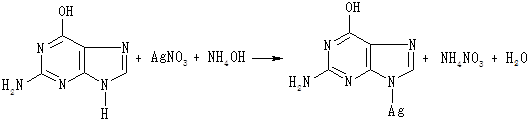
Guanine
The formation of a precipitate is observed.
Detection of Pentoses via the Pobedov—Molisch Test
Place 1 ml of the nucleoprotein hydrolysate into a test tube, add
1 ml of a 1% alcoholic solution of α-naphthol, and mix. Then, carefully and without shaking, add 1 ml of concentrated sulfuric acid down the side of the test tube. When concentrated sulfuric acid reacts with pentoses, they undergo dehydration to form furfural, which condenses with thymol or α-naphthol in the presence of concentrated sulfuric acid to yield red or reddish-violet condensation products:
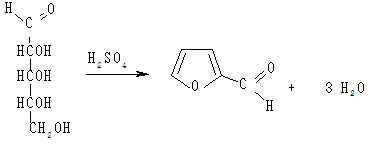
Pentose (D-ribose) Furfural
Color development is observed.
Detection of pentoses using the Fehling test
Place 1 mL of the nucleoprotein hydrolyzate into a test tube, neutralize with a 10% sodium hydroxide solution (using litmus paper), and add an equal volume of Fehling's reagent. Mix the contents of the test tubes and heat. The reaction is based on the ability of pentoses, upon heating in an alkaline medium, to undergo oxidation while reducing blue copper(II) hydroxide to yellow copper(I) hydroxide, subsequently forming a brick-red copper(I) oxide precipitate.
Color development is observed.
Detection of phosphoric acid
Add an equal volume of molybdate reagent to 1 mL of the nucleoprotein hydrolyzate. Heat the mixture for a few minutes in a water bath. Upon heating with the molybdate reagent, phosphoric acid forms triammonium phosphomolybdate, which precipitates as a yellow solid upon cooling:
12(NH4)2MoО4 + Н3РО4 + 21HNО3 →
→ 21NH4NО3 + (NH4)3PО4 · 12MoО3 · 6H2О + 6H2О
Color development is observed.
Detection of α-amino acids via the ninhydrin reaction
(see Laboratory Work 1).
Processing of Experimental Data
Provide a schematic diagram of the Sequential Stages of nucleoprotein hydrolysis; for each stage, specify the component PARTS OF THE hydrolyzate and the corresponding identification reactions. At which stages can proteins be precipitated by salting out? Propose an experimental method to confirm the reversibility of salting out. At which stage does the biuret test become negative?
Selection/5.html">Control Questions and Tasks
1. Which compounds containing peptide bonds do not yield a positive biuret test?
2. Write the tautomeric forms of the peptide bond.
3. Write the reaction for the formation of a tripeptide and provide its abbreviated and full names.
4. Which substances cause reversible protein precipitation (salting out)? Explain The Mechanism of salting out. Name the stabilization factors of a protein molecule in solution.
5. What factors cause Irreversible Protein Precipitation?
6. State the hallmarks of Denaturation. What is renaturation?
7. What LEVELS OF STRUCTURAL Organization does a protein molecule possess? What types of bonds stabilize them?
8. What is the prosthetic group of a protein?
9. How are conjugated proteins classified? Name the Major Classes of conjugated proteins and provide Examples.
10. How can proteins and peptides be distinguished in solution?
11. Will the biuret test be positive for a nucleoprotein hydrolysate after complete hydrolysis? After partial hydrolysis? Write the equation for the biuret reaction with a tripeptide.
References: [1; 2; 4–7].
Last update: 06/08/2026
Editorial and Educational Adaptation: This material has been compiled based on the primary/original source text. The project team performed an editorial review, corrected technical inaccuracies, structured sections, and adapted the content for an educational format.
What was processed:
- elimination of formatting defects (OCR errors, structural breaks, corrupted characters);
- editorial organization of content;
- standardization of terminology in accordance with academic sources;
- verification of factual statements against the original source text.
All mentions of the author, publication year, and origin of the primary text have been preserved in accordance with the source.