Chemistry and Biology of Proteins - F. Haurowitz 1953
Methods for Protein Isolation, Purification, and Characterization
Irreversible Protein Precipitation
Proteins are precipitated by salts of heavy metals (Cu, Pb, Hg, UO2, Fe), certain organic acids (trichloroacetic, sulfosalicylic, picric, etc.), as well as by acids forming colloidal solutions (tungstic, tannic) and bases (iron hydroxide). These precipitating agents generally cannot be used to obtain pure proteins, as many proteins undergo Denaturation upon their action. However, it has recently been found that if a heavy metal salt is added cautiously and an excess is avoided, heavy metal salts of certain Proteins can be obtained in crystalline form [29]. Proteins can be recovered in their Native State from complexes with certain heavy metals, such as zinc [30].
If an excess of precipitating agents is added to protein solutions, the proteins become denatured and are quantitatively precipitated from the solution.
This method is widely used in clinical laboratories to remove proteins from biological fluids, for the Quantitative determination of proteins (e.g., in Blood serum), and for the qualitative detection of proteins in urine and other biological fluids.
formed mainly by tripeptides and tetrapeptides. According to these data, The Structure of the tetrapeptide-copper complex can be represented as follows:
Class="center">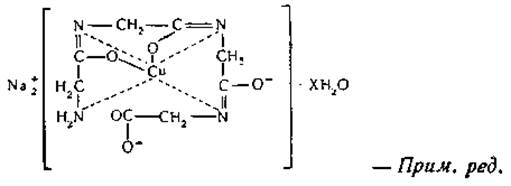
When precipitating proteins by the Methods mentioned above, it is very difficult to separate the precipitated denatured protein from the precipitating agent itself. This difficulty can be avoided by using thermal coagulation or the Sevag method [31] for Protein Denaturation and precipitation. The Sevag method involves denaturing the protein and converting it into an insoluble state by shaking with chloroform. The excess chloroform is then removed by evaporation.
The irreversible precipitation of proteins using phosphotungstic acid is employed in histochemistry to detect proteins in tissue sections. The presence of protein is detected by measuring the X-ray absorption of the heavy tungsten atom in dried tissue sections [32].
Last update: 06/08/2026
Editorial and Educational Adaptation: This material has been compiled based on the primary/original source text. The project team performed an editorial review, corrected technical inaccuracies, structured sections, and adapted the content for an educational format.
What was processed:
- elimination of formatting defects (OCR errors, structural breaks, corrupted characters);
- editorial organization of content;
- standardization of terminology in accordance with academic sources;
- verification of factual statements against the original source text.
All mentions of the author, publication year, and origin of the primary text have been preserved in accordance with the source.