Chemistry and Biology of Proteins - F. Haurowitz 1953
Methods for Protein Isolation, Purification, and Determination
Color Reactions for Proteins
Biochemistry textbooks typically describe various color reactions for Proteins. Most of these reactions are characteristic of specific Amino Acids and will be discussed in Chapter III. The phenolic ring of Tyrosine yields a yellow color with nitric acid (xanthoproteic reaction), a red color with Millon's reagent, a positive diazo reaction, and a blue color with alkaline phosphomolybdate solutions. The color reactions resulting from the interaction of proteins with aldehydes—such as dimethylaminobenzaldehyde (Ehrlich) or glyoxylic acid (Hopkins-Cole)—are due to the presence of Tryptophan in the protein molecule; the red color produced with hypochlorite and a-naphthol is due to Arginine (Sakaguchi); and the dark coloration formed upon heating protein solutions with an alkaline lead acetate solution is characteristic of proteins containing cystine or Cysteine residues. Repeated attempts have been made to utilize these reactions for the quantitative Colorimetric determination of proteins. However, it is evident that the intensity of these reactions varies from one protein to another and depends on the percentage of the corresponding amino acid within the protein molecule.
In this regard, the biuret reaction differs from all the color reactions mentioned above. In this test, The addition of a dilute copper sulfate solution to a strongly alkaline protein solution produces a purple-violet coloration. Since this reaction is given by all Polypeptides, it is obviously due to the presence of peptide bonds —CONH— in the protein molecule. It is suggested that this reaction results in The formation of a complex in which a copper ion is coordinated with the peptide bond, forming a copper-containing ring, most likely of the following Structure1:
Class="center">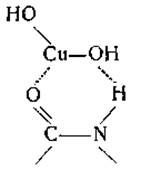
It is possible, however, that this ring possesses a different structure [28]. The biuret reaction is not very sensitive, and its value for research purposes is limited because, on the one hand, a negative biuret test does not entirely rule out the presence of protein in solution, and on the other hand, a positive reaction is also given by The amino acid Histidine.
1 According to data obtained by M. I. Plekhan from spectrophotometry of protein biuret complexes (Journal of Applied Chemistry, 12, 62, 1940; Bulletin of Moscow State University, No. 10, 1948; Abstracts of Papers at the Second Session of the Division of Medical and biological Sciences of the USSR Academy of Medical Sciences, Moscow, 3, 1949)
Aside from the color reactions specific to individual amino acids and the biuret reaction, most proteins give a positive Molisch test—that is, a red coloration upon the addition of a-naphthol and sulfuric acid to a protein solution. This reaction is due to the presence of small amounts of CARBOHYDRATES in many proteins.
Last update: 06/08/2026
Editorial and Educational Adaptation: This material has been compiled based on the primary/original source text. The project team performed an editorial review, corrected technical inaccuracies, structured sections, and adapted the content for an educational format.
What was processed:
- elimination of formatting defects (OCR errors, structural breaks, corrupted characters);
- editorial organization of content;
- standardization of terminology in accordance with academic sources;
- verification of factual statements against the original source text.
All mentions of the author, publication year, and origin of the primary text have been preserved in accordance with the source.