BIOCHEMISTRY - Laboratory Practical - NAU 2015
MODULE I
BIOCHEMICAL COMPONENTS OF THE CELL
Laboratory Work 1
QUALITATIVE REACTIONS FOR AMINO ACIDS
Objective of the work: to master Methods for detecting individual Amino Acids in Proteins and protein hydrolyzates, and to investigate the Amino Acid Composition of the provided protein solutions.
Basic Theoretical Background
Amino acids are heterofunctional compounds containing both amino and carboxyl groups. Amino acids are classified According to the number of these groups (monoaminomonocarboxylic, monoaminodicarboxylic, diaminomonocarboxylic, diaminodicarboxylic), the presence of additional functional groups (e.g., hydroxyl, sulfhydryl) or heteroatoms (e.g., sulfur), and the relative position of the amino and carboxyl groups (e.g., α-, β-, γ-amino acids). Amino acids also differ in The Nature of their radicals (acyclic and cyclic, aromatic and non-aromatic cyclic, carbocyclic and heterocyclic) as well as their polarity—polar (hydrophilic) and non-polar (hydrophobic). All amino acids, with the exception of Glycine which lacks a side chain and a chiral center, are optically active compounds, meaning they rotate the plane of polarized light. They are divided into L- and D-stereochemical series, which differ in the spatial arrangement of substituents, the direction of optical rotation, and biological activity. Proteinogenic Amino Acids, i.e., those that build the proteins of living organisms, are of particular significance. Proteinogenic amino acids are L-α-amino acids. For organisms, Amino acids can be essential and non-essential, as well as partially or conditionally essential. Each species of living Organism has a specific set of Essential Amino Acids. For example, humans require eight essential amino acids, while Two amino acids are conditionally essential—they are mandatory for children and optional for adults.
Amino acid composition is an important characteristic of a protein. The Spatial Structure of a protein and its Functions depend on which specific amino acids make up the protein molecule and in what sequence (its Qualitative and quantitative composition).
Nutritionally complete dietary proteins match The amino acid COMPOSITION OF THE body's own proteins.
Equipment: test tube rack, graduated test tubes, pipettes, dropper bottles, Glass stirring rods, ice bath, Water bath, burner, stopwatch.
1.1. Ninhydrin Reaction for α-Amino Acids
Materials and Reagents: protein hydrolyzate or 1%
α-amino acid solution; 0.1 M ninhydrin solution; protein solutions 1, 2, and 3 provided by the instructor.
The ninhydrin reaction is characteristic of amino groups located in the α-position relative to the carboxyl group. When heated with ninhydrin, α-amino acids are oxidized and broken down into an aldehyde, carbon dioxide, and ammonia, while ninhydrin is reduced to diketohydrindogen:
Class="center">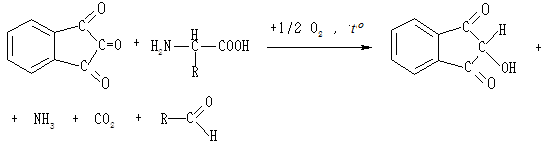
The released ammonia reacts with another molecule of ninhydrin and with diketohydrindogen to form a compound that colors the solution an intense purple-blue.
Add 2—3 drops of the α-amino acid solution (or protein hydrolyzate) to a test tube, add 1—2 drops of 0.1 M ninhydrin solution, heat slightly, and observe the color change of the solution.
1.2. Xanthoproteic Reaction
Materials and Reagents: Tyrosine solution (1%) or protein solution; concentrated nitric acid; ammonia; protein solutions 1, 2, and 3 provided by the instructor.
Procedure
Add 1—2 drops of tyrosine solution (or protein) and 2—3 drops of concentrated nitric acid to a test tube, heat, and observe the color change of the solution. Then, add ammonia drop by drop while mixing until the color changes.
The xanthoproteic reaction is characteristic of the aromatic amino acids phenylalanine, tyrosine, and Tryptophan, whose benzene ring is nitrated upon Treatment with concentrated nitric acid to form nitro compounds that color the solution yellow; the color turns orange upon The addition of ammonia.
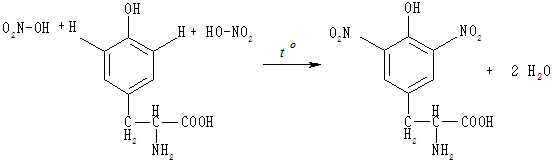
The xanthoproteic reaction is highly sensitive, making it easy to detect not only aromatic amino acids but also the proteins that contain them.
1.3. Föhl's reaction for Sulfur-Containing Amino Acids (free
or as part of Peptides and Proteins)
Materials and reagents: 0.01% aqueous solution of Cysteine; Föhl's reagent (add 10% sodium hydroxide solution to 10% lead acetate solution until the formed precipitate dissolves); concentrated sodium hydroxide solution; protein solutions 1, 2, 3 provided by the instructor.
Procedure
Add 1 mL of cysteine solution, 2 mL of concentrated sodium hydroxide solution, and 1 mL of Föhl's reagent to a test tube. Mix the mixture thoroughly and boil in a water bath for 2 min. During boiling in an alkaline environment, peptides or proteins containing sulfur-containing amino acids readily split off sulfur in the form of hydrogen sulfide, which reacts with the alkaline medium to form sodium sulfide. The reaction equation involving cysteine is as follows:

Sodium sulfide can be detected using heavy Metal Ions, such as lead, which form an insoluble black lead sulfide with sulfur ions. Soluble lead acetate interacts with sodium hydroxide to form sodium plumbite, which reacts with sodium sulfide to produce a black precipitate of lead sulfide:
 After 3–5 min, a black precipitate of lead sulfide appears.
1.4. Millon's reaction for tyrosine
Materials and reagents: 0.01% aqueous solution of tyrosine; Millon's reagent (dissolve 40 g of mercury in 57 mL of concentrated nitric acid and dilute with two volumes of water, let it settle and use the supernatant); protein solutions
1, 2, 3 provided by the instructor.
Procedure
The phenolic hydroxyl group of the aromatic amino acid tyrosine participates in the reaction with Millon's reagent (a mixture of mercury(I) and (II) nitrates and nitrites dissolved in concentrated nitric acid). This results in The formation of a red-colored mercury salt of tyrosine:
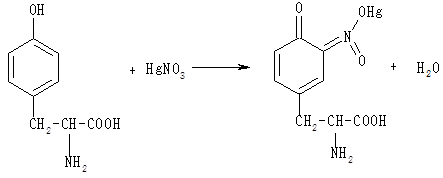
Add 1 mL of Millon's reagent to 3 mL of tyrosine solution and mix thoroughly. After 10 min, the solution turns red. The reaction can be accelerated by warming the solution.
1.5. Adamkiewicz reaction for tryptophan
Materials and reagents: 0.01% aqueous solution of tryptophan, glacial acetic acid (which always contains a small amount of glyoxylic acid), concentrated sulfuric acid, protein solutions 1, 2, 3 provided by the instructor.
Procedure
To 0.5 mL of tryptophan solution, add 0.5 mL of glacial acetic acid containing glyoxylic acid. Heat the resulting mixture first, then cool it, and carefully add 1 mL of concentrated sulfuric acid dropwise down the side of the test tube, ensuring the liquids do not mix. After 10 min, a red-violet ring forms at the interface of the two layers.
In an acidic medium, tryptophan reacts with glyoxylic acid (aldehydes) to form red-violet colored Condensation products:
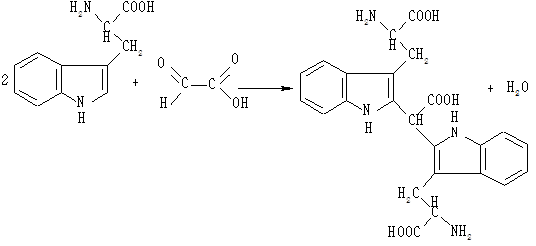
The reaction can be accelerated by heating in a water bath.
1.6. Voisenet's reaction for tryptophan
Materials and reagents: 0.01% aqueous solution of tryptophan, 2.5% aqueous formaldehyde solution, concentrated sulfuric acid, 0.5% sodium nitrate solution, protein solutions 1, 2, 3 provided by the instructor.
Procedure
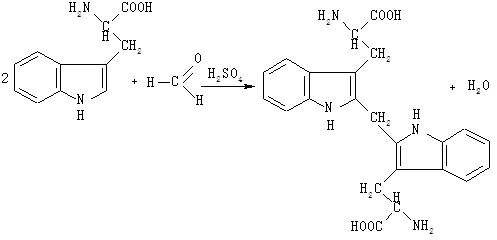
Add one drop of formaldehyde solution to 2 mL of tryptophan solution, mix, and add 6 mL of concentrated sulfuric acid in portions of a few drops while cooling the test tube in an ice bath. Mix the mixture again and let it stand for 10 min. Tryptophan condenses with formaldehyde to form a colored condensation product, bis-2-tryptophanylmethane:
1.7. Pauly's reaction for Histidine and tyrosine
Materials and Reagents: 0.01% aqueous solution of histidine,
1% solution of sulfanilic acid in 5% Hydrochloric acid, 0.5% sodium nitrite solution, 10% sodium carbonate solution, protein solutions 1, 2, and 3 provided by the instructor.
Procedure
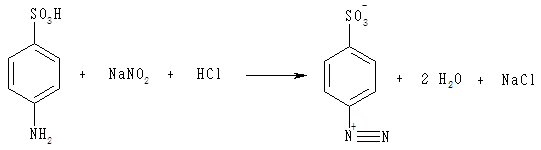
Add 2 ml of sodium nitrite solution to 1 ml of sulfanilic acid solution, mix, immediately add 2 ml of histidine solution, mix thoroughly again, and add 6 ml of sodium carbonate solution. The interaction between sulfanilic acid and sodium (or potassium) nitrite in an acidic medium results in a diazotization reaction. Its product is diazobenzenesulfonic acid, which reacts with histidine (or tyrosine) to form a cherry-red compound:
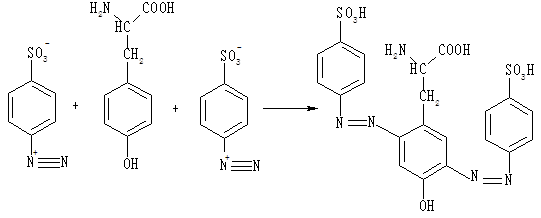
After mixing, the solution turns a cherry-red color.
Processing of Experimental Data
Test protein solutions 1, 2, and 3 for the presence of amino acids (see experiments 1.1 — 1.7). Create a table indicating which amino acids are present in each of the tested protein solutions.
METABOLISM/35.html">Selection/41.html">Review Questions and Tasks
1. List the proteinogenic amino acids, draw their structural formulas, and highlight their side chains (R-groups).
2. Categorize the amino acids into essential, conditionally essential, and non-essential for humans.
3. Classify the amino acids using all known Classification methods.
4. Which amino acids give a positive ninhydrin reaction? Write the general formula for such amino acids.
5. What is THE PRINCIPLE OF the xanthoproteic reaction? Which amino acids can be detected using this reaction? Write the formulas of these amino acids.
6. Which amino acids can be detected by Föhl's test? Explain the principle of this reaction.
7. Define enolic and phenolic hydroxyl groups and give Examples of compounds containing them. Which reaction is used to detect the phenolic hydroxyl group in tyrosine?
8. Explain the principle of qualitative tests for tryptophan.
9. Write the chemical equation for Pauly's reaction for histidine.
10. Are amino acids chiral compounds? Represent amino acid formulas using Fischer projections.
11. Which proteinogenic amino acid lacks a side chain, and which one lacks an amino group?
References: [1; 2; 4 — 7].
Last update: 06/08/2026
Editorial and Educational Adaptation: This material has been compiled based on the primary/original source text. The project team performed an editorial review, corrected technical inaccuracies, structured sections, and adapted the content for an educational format.
What was processed:
- elimination of formatting defects (OCR errors, structural breaks, corrupted characters);
- editorial organization of content;
- standardization of terminology in accordance with academic sources;
- verification of factual statements against the original source text.
All mentions of the author, publication year, and origin of the primary text have been preserved in accordance with the source.